Category Archives: Polling

Rare Ohio Data

By Jim Ellis

March 28, 2018 — Survey USA came into Ohio to test the Buckeye statewide races — campaigns that have not yet received much attention from national political pollsters. The results provided both expected and surprising tallies.

state-of-ohio-mapIn the US Senate race, a campaign that has undergone a great deal of change after original candidate Josh Mandel, Ohio’s treasurer who held Sen. Sherrod Brown (D) to a 51-45 percent win in 2012, was forced to exit the re-match because of his wife’s recently discovered serious medical condition. Upon Mandel’s departure, Rep. Jim Renacci (R-Wadsworth), who had already announced and was actively campaigning for governor, decided to switch gears and entered the Senate race.

Investment banker Mike Gibbons, an ally of Gov. John Kasich (R), was opposing Mandel while the latter man was still in the Senate contest, and continues to battle Rep. Renacci. S-USA tested them all.

According to the polling data (March 16-20; 1,408 likely Ohio voters; 541 GOP likely primary voters; 509 Democratic likely primary voters) Sen. Brown maintains strong, and identical, leads against both Republican contenders. Against Rep. Renacci and Gibbons individually, Sen. Brown’s advantage is 52-38 percent.

Continue reading

Yesterday’s Illinois Primary

By Jim Ellis

March 21, 2018 — Land of Lincoln voters went to the polls yesterday to vote in the nation’s second primary of the 2018 midterm election season.

2018-elections-open-seats-185The headliner of Election Day was the gubernatorial primary, as Gov. Bruce Rauner (R), sporting poor job approval ratings but having virtually unlimited financial resources, squared off against conservative state Rep. Jeanne Ives (R-Wheaton). Ives received early support in the form of a $2.5 million donation from mega-donor Dick Uihlein, but her standing did not greatly improve in the past weeks, meaning her long-shot campaign remained as such entering Election Day.

Because of significant dissatisfaction with Gov. Rauner within the GOP base constituency, Ives was projected to perform better than a typical candidate challenging a sitting governor in a party primary. Yet, her performance was not strong enough to deny Rauner from advancing into the general election. Rauner scored only a 51.5 – 48.5 percent win over Ives in a primary result that indicates the state chief executive’s GOP political base is eroding.

Yesterday’s most competitive race wasn’t the one most had predicted — on the Democratic side of the gubernatorial primary. Venture capitalist J.B. Pritzker had spent over $65 million of his own money in this campaign, and was fortunate to have drawn two equivalently strong intra-party opponents.

A new poll from Victory Research (March 13-16; 1,204 registered Illinois voters) — the last before the vote — found Pritzker with only a 32-26-22 percent lead over Chicago businessman Chris Kennedy, who had advertised heavily and featured footage in his promotional ads of his late father, US attorney general and Sen. Robert F. Kennedy, and state Sen. Daniel Biss (D-Chicago). Biss had shown surprising strength for a legislator without statewide name identification. But Pritzker won the party nomination with 45.4 percent of the vote, a much larger total than the polling had predicted.

Continue reading

Lamb, Barely

By Jim Ellis

Pennsylvania’s current 18th District, in the southwest corner of the state.

Pennsylvania’s current 18th District, in the southwest corner of the state.

March 15, 2018 — Democrat Conor Lamb appears to have captured the 18th District special election held Tuesday in southwestern Pennsylvania, besting Republican state Rep. Rick Saccone (R-Canonsburg); but it will likely be a couple days before the result is finalized. The margin stands at 641 votes in Lamb’s favor of 228,177 ballots cast with all precincts reporting and absentee votes counted, meaning a recount could be ordered.

Democrats will claim that this special election result sets the groundwork for the “blue wave” they have been predicting because their candidate converted a district that President Trump carried by 20 points and where resigned Rep. Tim Murphy (R-Pittsburgh) didn’t even draw an opponent during the past two elections.

Republicans will now counter saying that Lamb didn’t run like a liberal Democrat but was able to bring the large conservative western PA Democratic voter contingent — those who came out in droves to support President Trump, for example — back into his party’s column. During the campaign, Lamb publicly indicated that he would not support Minority Leader Nancy Pelosi (D-CA) as a way to convince the behaviorally conservative regional voter that he is not a national Democrat. Additionally, Lamb’s deep family ties to the Democratic base helped him as well. His grandfather is a former state House majority leader, and his uncle is the Pittsburgh City controller.

President Trump will undoubtedly take some credit for the close outcome. Prior to his visit to the district, pollsters were showing a much larger lead for Lamb than the preliminary final outcome produced. The final Monmouth University poll, for example, predicted a six to seven-point Lamb lead if the Democrats “surged” in turnout as they have done in other special elections around the country.

Continue reading

CATCHING UP WITH THE PA-18 ELECTION

By Jim Ellis

Former Pennsylvania Assistant US Attorney Conor Lamb (L) | Former Pennsylvania Rep. Rick Saccone (R)

Former Pennsylvania Assistant US Attorney Conor Lamb (L) | Former Pennsylvania Rep. Rick Saccone (R)

March 14, 2018 — The Keystone State special congressional election was held yesterday, as southwestern Pennsylvania voters went to the polls to choose a replacement for resigned Rep. Tim Murphy (R-Pittsburgh).

Before PA-18 Election Day, Democrats appeared to have the better candidate in the person of attorney Conor Lamb, whose grandfather was a former state House Democratic leader and uncle is the Pittsburgh City Controller.

Simultaneously, this election carried major national ramifications, yet the winner’s success might be short-lived, when one can be identified, which likely will take a day or two longer. With 100 percent of the vote in, Lamb leads Republican state Rep. Rick Saccone (R-Canonsburg) 113,111 (49.8 percent) to 112,532 (49.6 percent) a difference of only 579 votes as of this writing. Absentee and provisional ballots are still being counted. So there’s a chance that Saccone could overtake Lamb, however, that’s unlikely.

Democrats predicted victory before yesterday’s election, citing polls showing Lamb holding a slight lead over Saccone. The last survey, coming from Monmouth University (March 8-11; 372 likely PA-18 voters), gave Lamb leads of two to seven points, depending upon the overlaid turnout model. Obviously, the more energized and aggressive Democratic participation model gave Lamb the stronger edge. Under a low turnout model, the lead dropped to two points. Pennsylvania is one of 13 states that has no early voting system, so there were no tangible pre-election turnout indicators for this contest.

The Lamb campaign approached $5 million in dollars raised for the race versus Saccone directly commanding resources in the $1 million range. The national Republican Party organizations and conservative groups entered the district to even the spending, so it’s likely we’ll see total combined expenditures approach or exceed the $15 million mark.

Continue reading

“R’s” Up in Dubious Senate Polls

By Jim Ellis

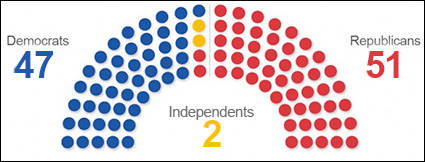
1200px-Seal_of_the_United_States_Senate.svgMarch 12, 2018 — One of the keys to deciding the 2018 Senate election cycle is seeing how the 10 Democrat senators forced to defend states that President Trump carried will fare. A series of new Axios/Survey Monkey polls in these aforementioned places produces good news for Republicans, but the data appears flawed.

According to the methodology, 17,289 registered voters participated in the surveys within the 10 states between Feb. 12 and March 5. Obviously, the sampling period is too long, unless the polls were conducted successively, but there is no indication of such. The voluntary online response system also brings the polling reliability factor into question.

That being said, even suspect studies are valuable to analyze because more opportunities are provided to detect flows and trends within the various sampling sectors.

The results of the 10 polls are as follows (listed in alphabetical order):
Continue reading

New Poll Confirms Toss-Up in PA-18

By Jim Ellis

March 9, 2018 — The PA-18 special election will be decided on March 13, falling between the Texas primary this past Tuesday and the Illinois state primary on March 20. And, as the two candidates, Republican state Rep. Rick Saccone (R-Canonsburg) and Democratic former federal prosecutor Conor Lamb, head for the finish line, late polling suggests this contest is a pure turnout battle.

Pennsylvania’s current 18th District, in the southwest corner of the state.

Pennsylvania’s current 18th District, in the southwest corner of the state.

The current 18th District lies in the southwestern corner of Pennsylvania, encompassing a portion of Pittsburgh. The district contains parts of four different counties: Allegheny, Westmoreland, Washington, and Greene.

Though this Pennsylvania region is culturally Democratic, Republicans have moved the 18th District from marginal status to secure in the past few elections. President Trump easily won here in 2016, and resigned Rep. Tim Murphy (R-Pittsburgh) didn’t even draw an opponent in his past two campaigns. The congressman’s forced resignation over a sordid extra-marital affair led to this special election.

Under Pennsylvania election law and process, the political party leaders convened district conventions in November to choose their special election candidates. The Republicans went with state Rep. Saccone who, until the 18th District opened, had been a US Senate candidate. Democrats turned to 33-year-old former federal prosecutor Conor Lamb, whose grandfather is a previous state House Democratic Leader. His uncle, Michael Lamb, is the Pittsburgh City Controller.

Continue reading

Cramer Up Against Heitkamp in
North Dakota Senate Polling

By Jim Ellis

Rep. Kevin Cramer (R-ND) | Facebook

Rep. Kevin Cramer (R-Bismarck) | Facebook

March 5, 2018 — A new Tarrance Group poll (Feb. 18-20; 500 likely North Dakota registered voters) conducted for the National Republican Senatorial Committee finds at-large Rep. Kevin Cramer (R-Bismarck) taking an early lead over first-term Sen. Heidi Heitkamp (D), 49-44 percent, a split just beyond the polling margin of error.

The Tarrance poll comes on the heels of previously released data from Gravis Marketing (Feb. 21-24; 385 North Dakota voters interviewed online) that gives Sen. Heitkamp a 43-40 percent edge, but this survey was conducted wholly online. Though the Tarrance poll was in the field before the Gravis study, the latter data was first to enter the public domain.

North Dakota state law prohibits vendors from placing automated telephone calls, which is Gravis’ usual method of conducting their surveys. Additionally, since the state has no voter registration requirement or system, the likely voter screen is a bit more difficult to define. Both of these elements would affect the reliability factor, and particularly so for the Gravis results.

The Tarrance data also detected a retrogression in Sen. Heitkamp’s favorability rating. Though still strong, her positive ratio is a net 10 points below what was determined in the organization’s October poll. The February data records the senator with a strong 54:38 percent positive to negative index, but that is below the 60:34 percent rating she received in October. Rep. Cramer posted a slightly better 53:29 percent positive ratio. He was not tested in the October poll.

Continue reading

Democrats Maneuver in San Diego

By Jim Ellis

Feb. 27, 2018 — Two noteworthy Democrat events happened in San Diego over the past few days.

California Sen. Dianne Feinstein (D)

California Sen. Dianne Feinstein (D)

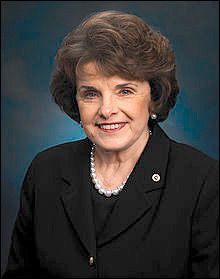
First, the California Democratic Party state convention, meeting in San Diego over the weekend, actually denied veteran Sen. Dianne Feinstein (D) the party endorsement. Though the delegates came close to endorsing state Senate President Kevin de Leon (D-Los Angeles), he also fell short.

In the vote to award the party endorsement for the 2018 US Senate race, it was state Sen. de Leon capturing 54 percent of the delegate votes as compared to only 37 percent for incumbent Sen. Feinstein. A total of 60 percent was needed for endorsement. This is not the first time that the liberal grassroots delegates have turned away from Feinstein. According to an NPR account of the convention proceedings, the party delegates chose then-Attorney General John Van de Kamp over Feinstein in the 1990 governor’s race.

The lack of an endorsement will not hurt the senator’s campaign, however. A January Public Policy Institute of California poll (Jan. 21-30; 1,705 California adults) favored Sen. Feinstein over Mr. de Leon, 46-17 percent, when tested in the jungle primary format. She has an even more commanding lead in campaign resources. The year-end Federal Election Commission disclosure report finds her holding just under $10 million in her campaign account as compared to an embarrassingly low $359,000 for de Leon.
Continue reading

The Tennessee Backtrack

By Jim Ellis

Sen. Bob Corker (R-TN)

Sen. Bob Corker (R-TN)

Feb. 20, 2018 — In late September, Sen. Bob Corker (R-TN) announced that he would not seek a third term in 2018, saying he wanted to work “thoughtfully and independently” for the months remaining in his senatorial tenure. For the past several days, it has been widely reported that he is in a period of reconsideration, however.

At one time, Sen. Corker was considered as a potential nominee for secretary of state, and had a strong relationship with President Trump. In the succeeding months, their friendship cratered into an abyss. Understanding that the president is still highly popular within the Volunteer State Republican voting base, Corker is beginning to make overtures toward making amends with the president, thus signaling that he is at least contemplating running again, after all.

If Sen. Corker is listening to individuals telling him that leading GOP senatorial candidate Marsha Blackburn could be vulnerable in either a primary or the general election, empirical data suggests that such counsel is erroneous. In fact, polling and fundraising data should lead any observer to conclude that the congresswoman is actually one of the strongest Republican statewide candidates not only for Tennessee, but also across the national political spectrum.

Continue reading

A Florida Polling Bonanza

By Jim Ellis

Feb. 9, 2018 — The 2018 Florida Senate race is on the cusp of becoming one of the top political campaigns in the country, but polling has been scarce … until yesterday.

Left: Sen. Bill Nelson (D) | Right: Gov. Rick Scott (R)

Left: Sen. Bill Nelson (D) | Right: Gov. Rick Scott (R)

Three different pollsters released data from their recent Florida electorate surveys, each testing the impending contest between Sen. Bill Nelson (D) and Gov. Rick Scott (R). Though the governor has not announced his candidacy, a loosely affiliated Super PAC has been spending heavily touting his accomplishments through various substantial statewide media buys. Since no other Republican candidate is even contemplating running, few doubt that the governor will make the race.

That being said, Florida Atlantic University, the University of North Florida, and Mason-Dixon Polling & Strategy all released surveys this week. Though each arrived at different ballot test results, and all three have some methodological flaws, it is clear that the overall conclusion tells us that the Florida campaign is already in the toss-up realm.

The FAU poll (Feb. 1-4; 750 registered Florida voters; 375 on-line, 375 via automated telephone system) returns the most surprising result. According to their sampling universe, Gov. Scott has a 10-point, 44-34 percent lead over Sen. Nelson. This seems far-fetched, especially in comparison with the two succeeding polls taken during the same time frame. Additionally, the polling sample contains too many Independents, and is a bit low for both Democrats and Republicans. This makes the ballot test response even more curious and suspect.

Continue reading