Category Archives: Polling

New York Polling Data:
Gov. Cuomo & Rep. Maloney

By Jim Ellis

July 20, 2018
— Though New Yorkers have already gone to the polls to choose their federal nominees, they must return on Sept. 13 to vote for their final state candidates. The Empire State is the only domain in the country that conducts separate primaries for federal and then state and local offices.

Actress Cynthia Nixon & New York Gov. Andrew Cuomo (D)

Actress Cynthia Nixon & New York Gov. Andrew Cuomo

With that in mind, Gov. Andrew Cuomo faces Democratic primary opposition against a well-known candidate who will appear on the general election ballot regardless of what happens on Sept. 13. Actress Cynthia Nixon is challenging the governor for the party nomination, but a new poll suggests that she is actually losing ground as the campaign progresses.

In a statewide race that might affect a congressional campaign, Rep. Sean Patrick Maloney (D-Cold Spring/West Point), after winning the Democratic nomination for re-election on June 26, announced that he would enter the open Sept. 13 primary for state attorney general. If he is successful in winning the party nomination, Maloney says he will end his congressional campaign. This will force the local Democratic leadership from the four counties that combine to form the 18th Congressional District to convene and choose a new nominee with barely a month remaining in the general election cycle.

With this background, Quinnipiac University comes forth with their latest New York survey (July 12-16; 934 registered New York voters, 415 likely New York Democratic primary voters). The pollsters see Gov. Cuomo expanding his Democratic primary advantage over Nixon. According to the May Q-Poll, Cuomo led Nixon 50-28 percent. In their new July study, the governor posts a stronger 59-23 percent margin, meaning a net gain of 14 percentage points. Because Nixon controls the Working Families Party ballot line, however, she will advance to the general election no matter what happens in the September state Democratic primary.

Continue reading

Gauging the Enthusiasm Gap

By Jim Ellis

i-vote-i-countJuly 13, 2018 — Much has been written over the past few elections cycles about voting enthusiasm and whether it is a predictive political factor. It has been seemingly apparent that the party members most interested in participating in an election, most particularly for a midterm or special election vote, generally see its candidates enjoy the greater success.

Yesterday, we looked at the extensive just-released Survey Monkey-Axios Media data that covered 13 US Senate races. The combined number of states also hosts a minimum of 15 competitive US House races. To re-cap, while the Survey Monkey analysts posted results under various turnout models in each of the tested states, it generally became clear about which candidate has the current advantage from the Senate contests in question.

Democrats were performing well in the Midwest and Mid-Atlantic regions, where incumbents in Pennsylvania, Michigan, Wisconsin, Ohio, and West Virginia all held substantial leads over their Republican opponents.

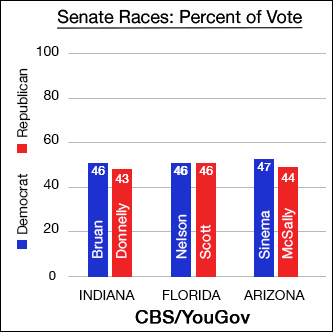
The GOP held the upper hand in Indiana and North Dakota challenge races. In the South, Republican Gov. Rick Scott looks to be topping Florida Sen. Bill Nelson, and US Rep. Marsha Blackburn (R-TN) has opened a substantial lead over Tennessee former Gov. Phil Bredesen.

Turning to the West, Democrats are moving ahead in both Arizona and Nevada and securely lead in Montana.

The Missouri contest between Sen. Claire McCaskill (D) and Attorney General Josh Hawley (R) stretches from a five-point Democratic lead all the way to a five-point Republican advantage depending upon the turnout model.

The Survey Monkey pollsters tested voter enthusiasm in all 13 states. They asked the following question:

Continue reading

Opposing Florida Gubernatorial
Candidates Both Ahead by 17 Points …

By Jim Ellis

Florida state Agriculture Commissioner and former US Congressman Adam Putnam (left) -- ahead by 17 percent; US Rep. Ron DeSantis (R-Palm Coast/Daytona Beach) leading by 17 percent

Florida state Agriculture Commissioner and former US Congressman Adam Putnam (left) — ahead by 17 percent according to polling; US Rep. Ron DeSantis (R-Palm Coast/Daytona Beach) — also ahead by 17 percent

July 10, 2018 — It’s not particularly unusual to find a political race where different pollsters see separate leaders in an election contest, but the open Florida Republican primary governor’s campaign may be setting a new standard.

As Ryan Nichol of the Florida Politics Blog reports, a new Remington Research poll (July 2-5; 2,900 likely Florida Republican primary voters via automated response) finds US Rep. Ron DeSantis (R-Palm Coast/Daytona Beach) leading state Agriculture Commissioner and former US Congressman Adam Putnam 43-26 percent in the upcoming open Aug. 28 Republican primary.

What’s unusual about this survey conducted for the Tenth Amendment Project, a group supporting DeSantis, is that the result provides the opposite margin when compared to two other recent independent news organization political polls that both project Putnam to be substantially ahead — one of which by the same 17-point spread that Remington sees for DeSantis. Another poll posts the Putnam advantage at 15 percentage points.

Marist College, conducting their poll for NBC News (June 17-21; 1,083 Florida adults, 947 registered Florida voters, 326 likely Florida Republican primary voters, 344 likely Florida Democratic primary voters via live telephone interviews), found Putnam’s edge to be 38-21 percent, which is similar to the Fox News survey (Anderson Roberts Research [D] and Shaw & Company Research [R]; June 15-19; 901 likely Florida Republican primary voters via live telephone interview) that forecast Putnam leading 32-17 percent.

Continue reading

California Poll Shows Nunes-Janz
Race As Being Competitive

By Jim Ellis
ca-22-devin-nunes-california-map
July 5, 2018
— A new Public Policy Polling survey conducted for the liberal group, End Citizens United (June 22-24; 632 registered California voters) of the race in CA-22, finds Democratic challenger Andrew Janz closing the gap between he and veteran Rep. Devin Nunes (R-Tulare/ Fresno) as the pair advance toward the November general election. According to the PPP results, Nunes, chairman of the House Intelligence Committee who is leading the House oversight of the Justice Department’s Russia campaign collusion investigation, leads Janz, 49-41 percent.

The poll suggests that Janz, an attorney and first-time candidate who had already raised over $1.8 million through the middle of May, is competitive in the central California congressional district. However, as we look more closely at the poll, it is also important to note that the sponsoring organization, End Citizens United, is in no way supportive of Rep. Nunes, could be a vehicle for an independent expenditure supporting Janz, and we see that push questions were offered in order to form a specific conclusion.

After the initial ballot test question was asked, if the reported questionnaire order was, in fact, how the queries were presented to the individual 22nd District respondents, a series of statements were recited to the respondents that cast negative aspersions over Rep. Nunes accepting campaign contributions from “corporate special interests,” and saying that Janz will accept no such money.

The actual verbiage is as follows: “Andrew Janz is not taking any money from corporate special interests. His campaign is primarily funded by real people. If elected, Andrew Janz will work for the people of the Central Valley, not special interests in Washington. Devin Nunes has accepted over $600,000 in corporate PAC money and voted to give corporations a massive tax cut while raising taxes on thousands of Central Valley families. Having heard this, let me ask you again: The candidates for Congress this November are Democrat Andrew Janz and Republican Devin Nunes. If the election was today, who would you vote for?”

Continue reading

New Nevada Poll Numbers Are Mixed

By Jim Ellis

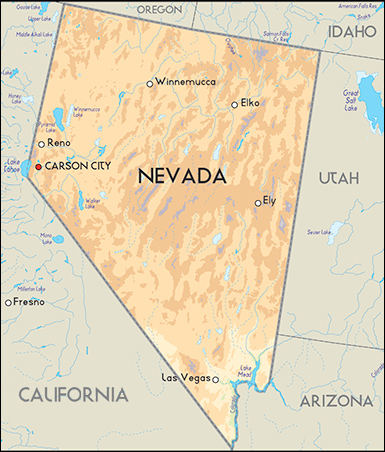
Nevada-mapJuly 3, 2018 — Gravis Marketing released their latest Nevada statewide poll (June 23-26; 630 likely Nevada voters “using an online panel of cell phone users and interactive voice responses”), and the findings provide some uptakes for both political parties.

According to the Gravis results, Rep. Jacky Rosen (D-Henderson) assumes a 45-41 percent lead over Sen. Dean Heller (R) in the critical US Senate race, while Republican Attorney General Adam Laxalt edges Democratic Clark County Commissioner Steve Sisolak, 43-41 percent in the open governor’s race.

We see mixed results throughout the poll on the underlying questions, thus leading one to believe that the two key Nevada campaigns are pure toss-ups.

Gov. Brian Sandoval (R) continues to post approval ratings that make him the most popular public official in the state. The Gravis favorability index posts the governor at 62:29 percent positive to negative. President Trump, not surprisingly from a state that he lost 48-45 percent, has a 43:53 percent upside-down job approval ratio. Interestingly, however, his approval numbers among Hispanics are dead even, with 46favorability approving of his job performance and an additional 46favorability disapproving. His numbers among White/Caucasian respondents are similar to what is found among Hispanics, 49:50favorability.

Continue reading

Critical NJ Race in Toss-Up Mode

By Jim Ellis

Navy veteran and attorney, Mikie Sherrill

Navy veteran and attorney, Mikie Sherrill (D) | Photo from campaign ad

June 28, 2018 — Democrats have high hopes of converting a northern New Jersey seat that has only elected Republicans during the past 34 years, and a new Monmouth University poll (June 22-25; 406 NJ-11 registered voters) projects a toss-up 11th District contest. The two major party nominees, chosen in early June, are state Assemblyman Jay Webber (R-Morristown) and attorney and Navy veteran Mikie Sherrill (D).

Monmouth polling is experimenting with new sampling methods that involve three different turnout projection models. Their full sample, or “potential” voter model is one that tests only people who have voted in at least one election since 2010 or who are newly registered voters. The second model is what they term a “standard midterm” sample, and the third is in place to monitor a “Democratic surge,” if such were to develop.

The latter phrase has been used frequently in polling and in political commentaries, but there is little evidence of a substantial increase in Democratic primary voting from most states. At this point, national turnout models based solely upon 2018 primary voter turnout suggest a pattern that is closely aligned with a typical midterm performance. So far, more Democrats have been voting in states that normally vote Democratic, and more Republicans are participating in places where GOP candidates dominate.

New Jersey state Assemblyman Jay Webber (R) | Photo from campaign ad

New Jersey state Assemblyman Jay Webber (R) | Photo from campaign ad

According to the full sample model, Democrat Sherrill leads Republican Webber by a scant 40-38 percent. Under the typical midterm model, the Democratic advantage increases to four points, 44-40 percent, but is still within the polling margin of error. Under their potential “Democratic surge” model, which may well prove illusionary when actual votes are counted, Sherrill increases her advantage to 45-39 percent.

The sample is weighted, but the draw does include more Independent voters (plus-three percent) than the raw percentage district total, and is four points less Democratic. But, the weighting formula is supposed to neutralize such discrepancies.

Continue reading

Poll: Manchin Up, But Questions Arise

By Jim Ellis

West Virginia Sen. Joe Manchin (D)

West Virginia Sen. Joe Manchin (D)

June 22, 2018 — A new West Virginia statewide survey testing the important US Senate race between Sen. Joe Manchin (D) and Attorney General Patrick Morrisey (R) done by Monmouth University was just released showing Manchin leading Morrisey 50-43 percent, but the polling sample spurs methodological questions.

Monmouth surveyed 653 West Virginia voters between the June 14-19 period, but 428 of them were from the 3rd Congressional District. The sample was heavy in the state’s open southern CD because the pollsters were also testing the US House contest between state Sen. Richard Ojeda (D-Logan) and state House Majority Whip Carol Miller (R-Huntington). The northern 1st District contributed only 87 voters to the sample, while 138 came from the 2nd CD.

To ensure a more representative statewide sample, the Monmouth pollsters weighted the data to compensate for the major discrepancy. But, the weighting still reports that 34 percent of respondents are from the 1st District, 34 percent from the 2nd, and 32 percent from the 3rd, which still gives the latter district the overwhelming preponderance of respondents.

Monmouth reports results under several turnout models. A “potential” voter is one who has participated in at least one election since 2010. A series of responses were also included under a “likely voter” model in what they describe as a “standard midterm election”, while a final response set comes from one that projects a “Democratic surge.”

Continue reading

Wisconsin Gerrymandering Ruling;
Greitens Still Lingering

By Jim Ellis

Wisconsin Congressional Districts

Wisconsin Congressional Districts

June 20, 2018 — The United States Supreme Court issued their long-awaited ruling on the Wisconsin political gerrymandering case on Monday, and it basically sends the parties back to the drawing board. At one time it was thought that Wisconsin was the vehicle for the high court to issue a definitive ruling regarding political gerrymandering, which continues to be the subject of many live redistricting lawsuits. Instead, on a rare 9-0 vote, the Supreme Court ruled that the plaintiffs did not have the necessary standing to bring the action.

The plaintiffs came from four Wisconsin Assembly districts who claimed they were personally harmed by the state legislative boundaries the legislature and governor adopted back in 2011. The court ruled that such plaintiffs did not have adequate standing to bring a statewide lawsuit.

The court did issue some orders, however, that will make later political gerrymandering suits more difficult to bring because certain technical standards must now be met in future action. As part of the plaintiffs’ standing ruling, the justices vacated the lower court ruling that ordered the state assembly districts re-drawn. It is now likely that political boundaries around the country are finally set for the 2018 election.

Continue reading

US Senate Candidate Ratings

By Jim Ellis

daily-kos-fox-news-pollingJune 19, 2018 — Two organizations just released 2018 US Senate race ratings, and though the differences are few it is worth analyzing the aggregate comparison.

Fox News and the Daily Kos Elections site published their updated ratings at the end of last week. Fox is a bit different in that they do not distinguish a “safe” race from one where the current favorite is a “likely” winner. Therefore, they have only five categories instead of the traditional seven.

While both organizations place eight Senate races in their Toss-up category, there are differences. The most glaring variance appears to be the Nevada race featuring Sen. Dean Heller (R) and Rep. Jacky Rosen (D-Henderson). The other is the Tennessee open campaign that finds Rep. Marsha Blackburn (R-Brentwood) and former governor, Phil Bredesen (D), vying to replace retiring Sen. Bob Corker (R). The Tennessee primary is not scheduled until Aug. 2, but there is no doubt that both will advance into the general election.

Daily Kos rates the Nevada race a toss-up, but Fox favors Rep. Rosen as it puts the campaign into the Lean Democratic column. The Fox rating is curious in that current polling is tight, Sen. Heller is the incumbent, winning in 2012 even though President Obama scored a 52-46 percent victory in the state over Mitt Romney, and he also has three other statewide conquests to his credit, as secretary of state, dating back as far as 1994.

Continue reading

Arizona Senate: Filing Closes,
New Poll Shows Surprise

Arizona-mapBy Jim Ellis

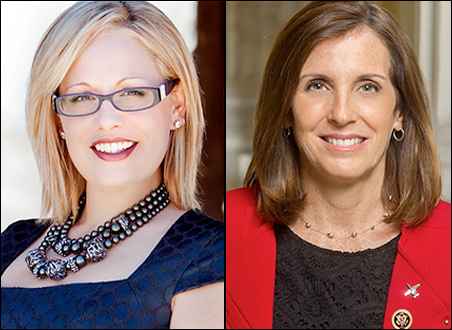
June 1, 2018 — Candidate filing closed in Arizona Wednesday for the state’s Aug. 28 primary election, and the US Senate candidate fields are now set. Little in the way of surprise — barring last minute filers who have not yet been reported, the Republicans, who are attempting to replace retiring Sen. Jeff Flake (R), number three in total: US Rep. Martha McSally (R-Tucson), former Maricopa County Sheriff Joe Arpaio, and ex-state senator and former US Senate candidate Kelli Ward. For the Democrat primary, US Rep. Kyrsten Sinema (D-Phoenix) faces attorney Deedra Abboud, a minor candidate.

Remington Research just released the results of their latest Grand Canyon State GOP primary survey conducted last week (May 23-24; 2,011 likely Arizona Republican primary voters via an interactive voice response system). According to the data, Rep. McSally attracts 42 percent support as compared to ex-Sheriff Arpaio’s 25 percent, while Ward tallies 23 percent. In two other polls conducted in April, Rep. McSally led in one and Ward the other.

While the McSally advantage is 17 and 19 points over Arpaio and Ward in the most current survey, she led the former sheriff and the ex-state legislator, 36-26-25 percent in a mid-April Magellan Strategies poll. OH Predictive Insights, however, found Ward jumping out to a 36-27-22 percent advantage over Rep. McSally and Arpaio in their early April study.

Continue reading