Category Archives: NEW YORK

Wisconsin Senate Race Tightens; House News; Surprising Governor Approval Ratings; New York Redistricting Map Rejected

By Jim Ellis

May 2, 2022:

Senate

Wisconsin: Dem Race Tightening — Marquette Law School released its quarterly survey of the Wisconsin electorate (April 19-24; 805 registered Wisconsin voters; 363 likely Democratic primary voters; live interview) and sees a tightening Democratic US Senate primary. The ballot test gave Lt. Gov. Mandela Barnes only a 19-16 percent lead over Milwaukee Bucks professional basketball club executive Alex Lasry. The result represents a net seven-point swing in Lasry’s favor since the last Marquette survey in February. Lasry has been advertising heavily in media buys. This race has time to gel. The Wisconsin primary is not until Aug. 9. The winner faces Sen. Ron Johnson (R) in November.

House

NC-11: Rep. Cawthorn in Position for Plurality Win — The Differentiators Data research organization, polling for GOPAC (April 25-26; 400 NC-11 likely Republican primary voters; live interview and text), finds that a majority of GOP sampled voters saying they would not vote to re-nominate Rep. Madison Cawthorn (R-Hendersonville), but his hard-core support group appears large enough to allow him to win a plurality election.

When asked if they would support Rep. Cawthorn in the North Carolina primary, 61 percent said they would choose another candidate. The 39 percent coalition that would vote to re-nominate him is large enough to win the primary in a state that has a runoff law, but with only a 30 percent threshold. With seven opponents opposing him, Rep. Cawthorn is clearly playing to his benefit.

Governor

Wisconsin: Kleefisch Continues to Lead — As mentioned above in the Wisconsin Senate section, Marquette Law School released a new Wisconsin survey (4/19-24; 805 WI registered voters; 375 likely Republican primary voters; live interview) and former Lt. Gov. Rebecca Kleefisch continues to lead the party nomination race. The numbers haven’t changed much since February, though this poll was taken before construction company executive and 2004 US Senate nominee Tim Michels entered the race. The ballot test finds Ms. Kleefisch holding a 32-10% lead over businessman and frequent candidate Kevin Nicholson. The winner will face Gov. Tony Evers (D) in the general election in what will be a highly competitive race.

Approval Ratings: Top 11 Governors are all Republican — The latest Morning Consult Governor approval ratings are out, and Republican governors led by Charlie Baker (R-MA), Phil Scott (R-VT), Larry Hogan (R-MD), and Jim Justice (R-WV) head a group of 11 GOP state chief executives who are the top rated in the nation. Of the 11, six are on the ballot for re-election this year including Gov. Scott, who has still not indicated that he will run for a fourth two-year term. Chris Sununu (R-NH), Kay Ivey (R-AL), Mark Gordon (R-WY), Doug Burgum (R-ND), and Mike DeWine (R-OH) are the other top-rated governors seeking re-election.

On the other end of the spectrum, the only two who have negative ratings above 50 percent, Govs. Kate Brown (D-OR) and David Ige (D-HI), are both retiring.

Redistricting

New York: High Court Rejects Dem Map — The New York Court of Appeals, the highest judicial body in the state, upheld the two lower court decisions to invalidate the Democrats’ 22D-4R congressional map. The high court ruled that the legislature did not have the power to usurp the created redistricting commission even though the members could not complete their task by the assigned date. The CoA also ruled that the map is a partisan gerrymander. The court remanded the map back to the lower court and instructed a special master be hired to draw the new congressional and state Senate maps. The court also recommended the June 28 state primary be moved to a time in August.


AZ, NJ, NY, TN Complete Filings

By Jim Ellis

April 12, 2022 — Candidate filing closed in Arizona, New Jersey, and New York for major party candidates, and for all candidates in Tennessee. The first three states noted each have later deadlines for minor party, independents, and write-in candidates.

Arizona

In Arizona, the Senate and governor races highlight the state’s political battles this year, and there were no surprise entries in either contest.

The Senate race features incumbent Sen. Mark Kelly (D), who is running for a full six-year term after winning the 2020 special election to fill the balance of the late Sen. John McCain’s (R) final term. He has no primary opposition. Republicans feature five candidates, but the battle is revolving around three of them for the party nomination — Attorney General Tim Brnovich, venture capitalist Blake Masters, and former solar energy company CEO Jim Lamon.

The open governor’s contest finds six Republicans and three Democrats vying to become their respective party standard bearers. Former news anchor Kari Lake, who former President Donald Trump endorses, and ex-congressman and 2000 gubernatorial nominee Matt Salmon appear to be the leading candidates. Secretary of State Katie Hobbs opens with a large polling lead over former state Rep. Aaron Lieberman and ex-Nogales mayor, Marco Lopez. This race will likely evolve into a toss-up general election battle.

Four key congressional general election races and a Republican primary are on tap in Arizona. Rep. David Schweikert (R-Fountain Hills) inherits a tougher new district, now numbered 1, that rates a R+7 according to the FiveThirtyEight data organization. His current 6th District is R+13. Physician Hiral Tipirneni (D), who held Rep. Schweikert to a 52-48 percent victory in 2020, is not returning for a re-match. Former Phoenix Suns executive Adam Metzendorf appears to be the strongest of the three filed Democrats. Rep. Schweikert drew two minor GOP primary opponents.

Rep. Tom O’Halleran (D-Sedona) has an R+6 rated 1st District under the current map, but the new 2nd District, despite having almost two-thirds of his current territory, increases to R+15, making him possibly the most endangered Democratic incumbent in the country. Six Republicans are vying for the party nomination, the leader of whom appears to be state representative and decorated Army veteran Walt Blackman.

Democratic representative and former Phoenix mayor, Greg Stanton (D-Phoenix), is also looking at a post-redistricting competitive general election. Seeing his Phoenix metro district move from D+15 to D+1 suggests that a Republican challenger will be a serious contender in November. Six Republicans are vying for the party nomination including two sports figures. Jerone Davison is a pastor and former member of the then-Oakland Raiders NFL franchise after playing football for Arizona State University. Tanya Wheeless is an attorney and former senior vice president for the Phoenix Suns NBA franchise.

The open Tucson-anchored 6th District is another commission-drawn CD designed to be competitive for the decade. Rep. Ann Kirkpatrick (D-Tucson) had she decided to seek re-election, would have run here. This is a must-win seat for Republicans if they are to capture a House majority. House GOP Leader Kevin McCarthy (R-CA) has already endorsed former Hispanic Chamber of Commerce official Juan Ciscomani among a field of five GOP candidates. Democrats feature a battle between state Rep. Daniel Hernandez (D-Sunnyside) and former state senator Kirsten Engel.

Rep. Debbie Lesko (R-Peoria) draws no opposition in her 8th District. In the new 9th CD, controversial Rep. Paul Gosar (R-Prescott) sees his home placed outside the new 9th, but faces only a Republican primary battle in a CD that contains 70 percent of his current constituency.

New Jersey

There is no 2022 New Jersey Senate race, and the governor’s contest was decided last year. Therefore, the US House races lead the top of the ticket. Redistricting saw the Democratic commission members strengthen the politically marginal districts of Reps. Andy Kim (D-Bordentown), Josh Gottheimer (D-Wycoff), and Mikie Sherrill (D-Montclair), but doing so made Rep. Tom Malinowski’s (D-Rocky Hill) 7th CD more Republican.

Continue reading

DCCC’s Red to Blue Targets

By Jim Ellis

March 14, 2022 — The Democratic Congressional Campaign Committee released their first targets in what they call their Red to Blue program or, in other words, the districts they hope to convert from Republican to Democrat. Curiously, two districts on the list are already blue.

Below is a look at the DCCC’s dozen released targets:


CA-22: Rep. David Valadao (R-Hanford)
2020 Win Percentage: 50.4% in District 21

• FiveThirtyEight: D+10
• Dave’s Redistricting App: 42.3% R / 55.1% D
Endorsed Candidate: State Assemblyman Rudy Salas (D-Bakersfield)

By the numbers, this is one of the Democrats’ best national targets, but Rep. Valadao has consistently won in Democratic seats. He lost in 2018, but won the seat back two years later. Assemblyman Salas is the Democrats’ top recruitment target. Despite the lopsided Democratic numerical advantage, the finish here will again likely be razor-thin.


CA-45: Rep. Michelle Steel (R-Orange County)
2020 Win Percentage: 51.1% in District 48

• FiveThirtyEight: D+5
• Dave’s Redistricting App: 45.8% R / 52.2% D
Endorsed Candidate: Jay Chen – Community College Trustee

Freshman Rep. Steel is another Republican to whom the California Citizens Redistricting Commission members were not kind. Moving into the more inland Orange County district from her coastal seat, Steel has been a well known figure in Orange County politics for many years, particularly with her service time on the Orange County Board of Supervisors before winning the congressional seat.

A D+5 seat is exactly the type the Republicans must win to achieve their goal of re-taking the majority. With national redistricting cutting against them, the GOP must win a sizable number of the 22 seats so far within the Even to D+5 category.


CO-7: Rep. Ed Perlmutter (D-Arvada) – Open Seat
2020 Win Percentage: 59.1%

• FiveThirtyEight: D+6
• Dave’s Redistricting App: 43.8% R / 51.7% D
Endorsed Candidate: State Sen. Brittany Petterson (D-Lakewood)

This district does not really belong on the list since it is already a blue seat. Democrats are favored to hold the seat and Sen. Petterson is clearly their candidate to do so.


IA-1: Rep. Mariannette Miller-Meeks (R-Ottumwa)
2020 Win Percentage: 50.0% (6 votes districtwide) in District 2

• FiveThirtyEight: R+4
• Dave’s Redistricting App: 49.7% R / 46.8% D
Endorsed Candidate: State Rep. Christina Bohannan (D-Iowa City)

Rep. Miller-Meeks won the closest race in the country in 2020, a literal six-vote affair against former state senator and 2018 lieutenant governor nominee Rita Hart (D). This year, the congresswoman will see a different opponent since Hart chose not to return for a re-match. State Rep. Bohannan has two Democratic opponents, but she should have little trouble in winning the party nomination on June 7.

This will be another close eastern Iowa campaign, and this district is actually one point more Democratic than the previous 2nd according to the FiveThirtyEight statistical organization. This is a top Democratic target, but Rep. Milller-Meeks will be favored assuming the political climate remains favorable for Republicans.


IA-2: Rep. Ashley Hinson (R-Marion/Cedar Rapids)
2020 Win Percentage: 50.0% in District 1

• FiveThirtyEight: R+6
• Dave’s Redistricting App: 51.1% R / 45.4% D
Endorsed Candidate: State Sen. Liz Mathis (D-Hiawatha)

In the first redistricting map presented last year, Rep. Hinson would likely have been defeated. With the legislature rejecting that draw, a new one emerged. This gives the congresswoman a more favorable seat but one this is still highly competitive. Democrats have recruited a strong candidate in Sen. Mathis. She has no primary opposition at this time. In a favorable GOP political climate, this seat would become difficult for the Democrats to convert despite its statistical closeness.
Continue reading

New York Rep. Kathleen Rice
Won’t Seek Re-Election

By Jim Ellis

New York Democratic Rep. Kathleen Rice (D-Garden City)

Feb. 17, 2022 — Four-term New York Democratic Rep. Kathleen Rice (D-Garden City) announced Tuesday, on her 57th birthday, that she will retire from Congress. Saying, “I have always believed that holding political office is neither a destiny nor a right. As elected officials, we must give all we have and then know when it is time to allow others to serve,” the congresswoman stated in her retirement release.

Prior to her election to the US House in 2014, Rice served as Nassau County District Attorney for 10 years after being a member of the prosecutorial staff. Rep. Rice is the 30th Democrat to not seek re-election to the House. The total number of open seats now rises to 51, when counting the open Democratic and Republican districts, and the seats created through reapportionment and redistricting from the various states.

The Rice retirement creates a fourth open seat in the NY delegation, and she is the fifth Empire State member to leave the House at the end of the current term. Rep. Tom Reed (R-Corning) announced his retirement early in the session, but his 23rd District is not technically an open seat because Rep. Claudia Tenney (R-New Hartford) has chosen to run there since her 22nd District was combined with retiring Rep. John Katko’s (R-Syracuse) CD to make a new Democratic seat.

Three of the state’s four open seats appear on Long Island. In addition to Rice’s 4th District, the 1st and 3rd are also open because Reps. Lee Zeldin (R-Shirley) and Tom Suozzi (D-Glen Cove) are both running for governor. This means that freshman Rep. Andrew Garbarino (R-Sayville) will be the most senior Long Island member in the next Congress.

While redistricting changed Rep. Zeldin’s 1st District into a more Democratic-friendly seat, Rep. Garbarino’s south shore Long Island seat became more Republican. Overall, the four Long Island districts needed to gain more than 148,000 new residents to meet the New York per district population goal of 776,971 individuals, or an average of adding just over 37,000 people per CD.

Though three of the four LI seats are constructed to elect a Democrat, the margins are not so strong as to eliminate competition. In wave Republican election years, and 2022 may be such, these open seats will be in play.

According to the FiveThirtyEight data operation, Rep. Zeldin’s 1st District moves from a R+10 to a D+6. Dave’s Redistricting App projects the composite Democratic vote to be 57.0 percent as compared to just 41.0 percent for Republicans. President Biden would have carried the new 1st, which moves east to west from the Hamptons to Bethpage State Park, by a 10.8 percent margin.

Continue reading

Dissecting the New York Map

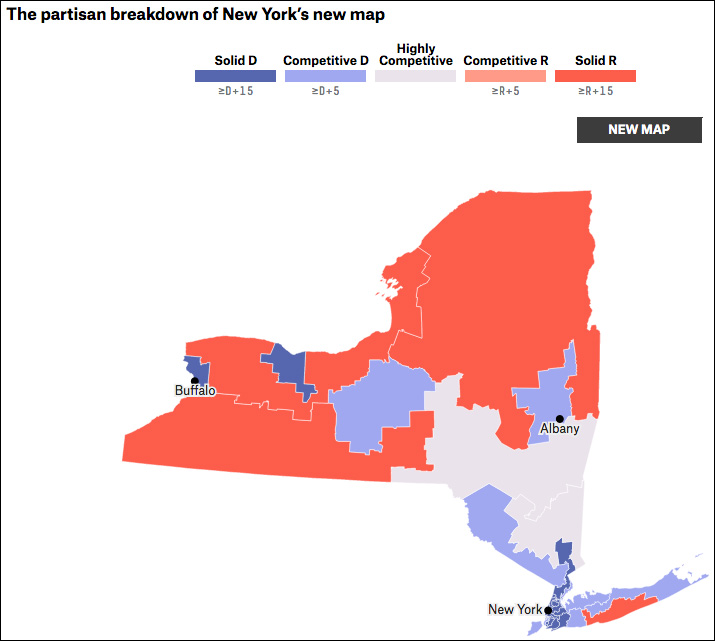
The recently enacted New York congressional map (go to FiveThirtyEight.com to see fully interactive map, or click on the map above.)

By Jim Ellis

Feb. 10, 2022 — The recently enacted New York congressional map is one of the most gerrymandered in the country and designed to reduce the Republican contingent to just four of 26 seats. While Republicans will no doubt challenge the map in court, some of the moves, however, will prove justifiable.

Since the Democrats control the redistricting process in only four states, national pressure came upon the party’s legislative leaders in New York, Illinois, New Mexico, and Oregon to draw the maximum partisan maps. They did so in each case, but when such a map is constructed, invariably some of the majority seats are weakened to the point of being competitive in wave election years for the opposite party. Such appears to be the case with the New York lines.

To begin, the map drawers were able to cut the Republican contingent in half by executing several fundamental strategic moves.

First, they reduced Democratic strength (even with the current map or weaker) in 15 of the current 19 party held districts but still made the seats untouchable. Second, the remaining four Republican districts saw an increase in GOP loyalty. Third, the Republicans were forced to absorb the seat the state lost in national reapportionment, and the Dems were able to take advantage of three GOP members not seeking re-election: Reps. Lee Zeldin (R-Shirley; running for governor), Tom Reed (R-Corning; retiring) and John Katko (R-Syracuse; retiring).

Using the FiveThirtyEight statistical organization’s rating of each new district, we can draw conclusions about party performance in each of the new 26 CDs.

The Democratic members receiving politically safe seats ranging from D+20 all the way to D+77 are mostly from New York City: Reps. Gregory Meeks (D-Queens; D+54), Grace Meng (D-Queens; D+24), Nydia Velazquez (D-Brooklyn; D+65), Hakeem Jeffries (D-Brooklyn; D+55), Yvette Clarke (D-Brooklyn; D+55), Jerrold Nadler (D-New York City; D+52), Carolyn Maloney (D-Manhattan; D+67), Adriano Espaillat (D-Bronx; D+77), Alexandria Ocasio-Cortez (D-Bronx; D+50), Ritchie Torres (D-Bronx; D+72), Jamaal Bowman (D-Yonkers; D+36), and Brian Higgins (D-Buffalo; D+20).

The four safe Republican seats are mostly in upstate New York, with one Long Island exception. Those seats are for Reps. Andrew Garbarino (R-Sayville; R+20), Elise Stefanik (R-Schuylerville; R+23), Claudia Tenney (R-New Hartford; R+26), and Chris Jacobs (R-Orchard Park; R+25).

The collapsed seat is actually Rep. Tenney’s current 22nd District. It was justified combining the 22nd with Rep. Reed’s 23rd because those districts, located adjacent to one another, are the two lowest in population.

The current 22nd District was then combined with Rep. Katko’s current 24th to make the new open 22nd District, which resulted in a D+13 rating and a district again anchored in Syracuse. The voting trends in the new 22nd increase from the D+4 rating that the current 24th carries.

The new draw and Rep. Reed’s retirement allows Rep. Tenney to run in the new 23rd where she will likely have to win a competitive Republican primary, but would have a safe seat in the general election. The new 23rd, however, contains only 10 percent of her current constituency.

Rep. Jacobs’ current 27th District is then pushed northward from his Buffalo and Rochester outer suburbs district into a new safely Republican 24th CD that contains just under 60 percent of his current constituency. He, too, could face GOP primary opposition but will have a safe seat for the general election.

Democrats will have a strong chance of converting open District 1 on Long Island. This seat goes from a R+10 rating that Zeldin held to a D+6. Currently, with Suffolk County Legislators Bridget Fleming and Kara Hahn in the race, along with ex-Babylon Town Councilwoman Jackie Gordon who was the District 2 nominee in 2020, the Democrats have the stronger early contenders. The candidate filing deadline is not until April 7 for the June 28 primary, so the GOP has time to coalesce around a viable candidate of their own.

Rep. Tom Suozzi’s (D-Glen Cove) Long Island-anchored 3rd District increases to D+10 from D+6. He is running for governor and leaves behind a crowded Democratic primary field. The winner will face consensus Republican candidate George Santos (R) who performed surprisingly well as the 2020 nominee.

Continue reading

Redistricting Boom Hits

New York 2022 redistricting map. (Click on map to go to FiveThirtyEight.com’s interactive map to see breakdown of each Congressional district.)


By Jim Ellis

Feb. 2, 2022 — The redistricting boom that political observers were awaiting has hit. The New York legislature unveiled their new congressional map, and akin to what the Democratic leadership passed in Illinois, the Empire State plan decimates the Republicans just as expected.

As we will remember, New York lost one congressional seat in national reapportionment (by just 89 people statewide) thereby reducing the delegation size to 26 seats. The current 27-district map yields 19 Democrats and 8 Republicans. The new map is projected to reduce the GOP contingent to just four seats.

Starting on Long Island and knowing that Rep. Lee Zeldin (R-Shirley) is leaving his 1st District to run for governor and understanding that the four districts covering the island are a cumulative 148,780 people short of the per congressional district quota of 776,971 residents, means major differences for these seats.

The map drawers brought the 1st District further west, the only thing they could do to capture the number of needed new people, and as a result were able to turn this R+10 district according to the FiveThirtyEight statistical site into a Biden +10.8 percent seat according to an analysis in the Washington Post.

Note that because the New York presidential election was so lopsided, largely because the Trump campaign never tried to become competitive, using just the 2020 presidential numbers to project voter history is likely slanted even more distinctly toward the Democrats. Once more analyses come into the public domain, we will be better able to pinpoint the partisan trend in each new district.

The 1st District draw makes Rep. Andrew Garbarino’s (R-Sayville) 2nd much redder. His CD, designed to now follow the open 1st District’s borderline to the south, would register as a Trump +14.3 percent district as compared to the previous R+8 calculation from FiveThirtyEight.

The plan would then improve both Rep. Tom Suozzi’s (D-Glen Cove) open 3rd District (Biden +14.2 percent) as it moves further into Queens, and Rep. Kathleen Rice’s (D-Garden City) 4th CD. The latter district would record a 12.1 percent Biden performance, up from the 538 total of D+9.

All of the New York City Democrats would again retain safe seats. The big change would come in the Staten Island-Brooklyn district of freshman Rep. Nicole Malliotakis (R-Staten Island). Her current 11th CD voted for Trump in 2020 by a 10.5 percent margin (538: R+13). Under this plan, the Washington Post rates the newly configured 11th for Biden with a +9.9 percentage point spread. Former Rep. Max Rose (D), who Malliotakis unseated in 2020, is back for a re-match. If this map becomes law, as expected, the 11th District playing field will be greatly altered.

The upstate region also significantly changes. Freshman Rep. Mondaire Jones’ (D-Westchester County) district becomes slightly more competitive, from a D+17 to a Biden +13.3 percent. Rep. Sean Patrick Maloney (D-Cold Spring) would go from representing a district that 538 rated as even between the two parties to a Biden +8.3 percent edge. Rep. Antonio Delgado (D-Rhinebeck) would see his 19th CD strengthen from R+4 to Biden +10.0 percent.

Continue reading

New York Rep. John Katko to Retire

New York Rep. John Katko (R-Syracuse)

By Jim Ellis

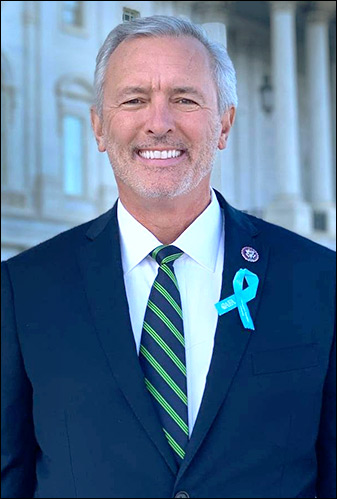
Jan. 18, 2021 — New York Rep. John Katko (R-Syracuse) announced Friday that he will not seek a fifth term later this year, creating a 47th open seat for the 2022 US House elections.

Katko, who indicated that he and his wife buried all four of their parents during the past three years, which he said was “gut-wrenching,” says he now desires more time with his family. He leaves a seat where he has averaged 56.5 percent of the vote as one of only eight Republicans from the 27-member Empire State delegation.

Other factors may also have played a role in his retirement decision. Redistricting appeared to be creating some re-election problems for Rep. Katko, as had former President Donald Trump.

New York lost a seat in reapportionment — a district collapse that will come from the Upstate region. Early maps suggested that Katko’s Syracuse-anchored seat would be combined with Rep. Claudia Tenney’s 22nd District, which would result in a paired incumbent situation before the primary winner likely would face another competitive general election campaign.

In the past two election cycles, Rep. Katko’s opponent was college professor Dana Balter (D), and her challenges resulted in expensive and hard fought 53-43 percent (2020) and 52-47 percent (2018) victories. Balter spent $2.7 million and $3.3 million in her two successive races against Rep. Katko, totaling $6 million, which he countered with a combined $6.3 million. Additionally, both candidates received hundreds of thousands of dollars in support from their respective political parties and outside groups.

The NY-24 seat is one of only nine districts where the electorate supported President Biden and elected a Republican to the House. In the current Congress, the 24th is one of just three districts that Hillary Clinton carried while electing a Republican Representative. Katko had repeatedly proven himself as an effective and successful political candidate.

In a paired 2022 situation against Rep. Tenney, however, the retiring congressman would have faced increasing pressure from his political right largely because of his vote to impeach former President Trump. Additionally, the New York Conservative Party leadership said they would not allow Katko to run with their ballot line in the 2022 general election. In New York, a candidate can run with more than one party designation.

Continue reading

Rep. Suozzi Announces for
New York Governor

Long Island US Rep. Tom Suozzi (D-Glen Cove)

By Jim Ellis

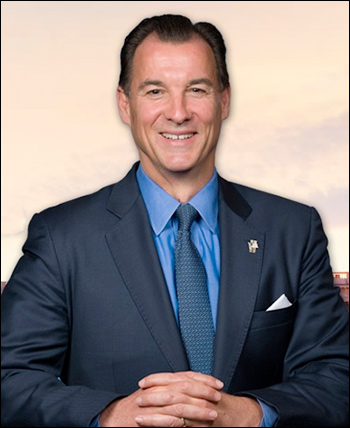
Dec. 1, 2021 — Turning down NYC Mayor-Elect Eric Adams’ offer of becoming one of the city’s deputy mayors, Long Island US Rep. Tom Suozzi (D-Glen Cove) instead announced Monday that he is joining the fast-growing Democratic primary for governor.

Already in the statewide race is the new incumbent, Gov. Kathy Hochul, Attorney General Tish James, and NYC Public Advocate Jumaane Williams. On the Republican side, Long Island Rep. Lee Zeldin (R-Shirley) is clearly the leading candidate for his party’s gubernatorial nomination, having already clinched the official New York Republican Party endorsement.

This is not the first time Suozzi has run for governor. In the 2006 Democratic primary, ill-fated, then-Attorney General Eliot Spitzer crushed Suozzi, 82-18 percent.

The Suozzi strategy is to take advantage of a crowded Democratic field where the other participants are all campaigning to the left. Therefore, he is calling himself the “moderate, common sense Democrat.” In a plurality election, his strategy has a chance of being successful, but the bigger question may revolve around whether he will have adequate resources to effectively communicate his message to a statewide electorate in order to develop such a fractured winning coalition.

With Rep. Suozzi foregoing re-election, it creates an additional open Democratic US House seat, a number that has grown significantly in the past two weeks, and also potentially alters the New York redistricting process.

Suozzi was first elected to the House in 2016 and twice re-elected, but failed to reach 60 percent in any of his congressional campaigns. Prior to his service in Congress, Suozzi held the Nassau County Executive position for two terms but was defeated when trying for a third. Four years later, in 2013, trying to regain his lost position, Suozzi was again defeated, this time by a strong 59-41 percent margin. Before winning his countywide position, Suozzi was twice elected as mayor of his hometown of Glen Cove, NY.

Suozzi’s 3rd Congressional District sits in Long Island’s center-west sector, hugging the north shore. The four districts that are self-contained on Long Island are a combined 148,780 people short of meeting the per-district population quota of 776,971 individuals in each of the state’s 26 congressional districts.

Continue reading