Author Archives: Jim Ellis

Sans Sununu, New Hampshire Republican Candidates Still in Favorable Position

By Jim Ellis

US Senate candidate Corky Messner (R) | Photo by Amanda Blundo, Corky for Senate Campaign

Dec. 6, 2021 — A new Tarrance Group poll of the New Hampshire general electorate conducted for potential US Senate candidate Corky Messner (R) shows the Republicans in a favorable position to challenge Sen. Maggie Hassan (D) even without Gov. Chris Sununu (R) as her opponent.

The survey (Nov. 14-17; 500 likely 2022 New Hampshire general election voters, live interview) finds Messner lagging only two points behind the first-term senator, 47-45 percent. This type of ballot test result shows a weaker standing for the Republican nominee than when Gov. Sununu was paired with Hassan — in virtually every poll during the past year, the governor was leading — but a lesser known candidate’s support figure lying within the polling margin of error is certainly a positive sign for Republican chances.

Digging deeper into the poll, we find positives for both candidates. Sen. Hassan’s job approval rating is in positive territory at 50:45 percent, with a personal favorability index of 48:44 percent. Though her numbers are not stellar, considering the generic question (would you vote for a Republican or Democrat for US Senate) actually favored the GOP by a 45-42 percent count, her standing is at least stable within the context of what, for her, is an adverse political climate. Typically, the Democrats almost always lead on the generic question.

Perhaps the biggest positive for Messner from this data revolves around a ballot test within the cell group of respondents who are familiar with both candidates. This is a particularly large cell, since 74 percent of the sample participants expressed knowledge of both contenders. In looking at the ballot test figures within just this group, Messner forges into the lead, 50-43 percent.

Assuming the electorate at large would also behave in such a manner upon gaining adequate familiarity with both candidates, such a finding would be highly significant and reinforces the analysis that New Hampshire remains the Republicans’ strongest conversion opportunity.

Messner has not yet announced for the Senate, only saying he is considering becoming a candidate. He was the party’s 2020 Senate nominee, losing to Sen. Jeanne Shaheen (D), 57-41 percent, with the senator outspending Messner, $17 million to $7 million.

Continue reading →

MASSACHUSETTS REDISTRICTING UPDATE

Gov. Charlie Baker (R) is considering a map the legislature passed that would continue sending the state’s 9D-0R delegation to Washington for most, if not all, of the current decade.

The biggest change is Ways & Means Committee chairman Richard Neal’s (D-Springfield) western district having to gain 50,635 individuals. Otherwise, the core of the Massachusetts’ CDs remain intact.

MAINE REDISTRICTING UPDATE

Maine Congressional Districts

The new Maine map made changes in the Augusta area, transferring the region from Rep. Chellie Pingree’s (D-North Haven/Portland) 1st District to Rep. Jared Golden’s (D-Lewiston) expansive 2nd District. The move meant 23,031 people were moved from the 1st to the 2nd.

Maine’s districts are important in that this is one of two states where congressional seats carry their own electoral votes in the presidential race. Though Maine went for Joe Biden in 2020 and Hillary Clinton in 2016, Donald Trump gained an electoral vote in each election because he carried the 2nd District. Under the new map, the Augusta area addition makes the 2nd slightly more Democratic, but it will remain competitive

Rep. Peter DeFazio to Retire

By Jim Ellis

Rep. Peter DeFazio (D-Springfield)

Dec. 3, 2021 — Saying that he “…need[s] a little more time for myself, for my health and well-being, for my wife, my family, and the things I love in Oregon,” veteran Beaver State Rep. Peter DeFazio (D-Springfield), chairman of the House Transportation & Infrastructure Committee, announced Tuesday that he will retire after completing his 18th term next year. He ranks sixth in House seniority.

Rep. DeFazio becomes the 19th Democrat, and third full committee chair, to not seek re-election in this cycle. The other retiring chairs are Reps. John Yarmuth (Budget) and Eddie Bernice Johnson (Science, Space, and Technology).

Through his 18 congressional elections, DeFazio averaged 64.4 percent of the vote, but his victory margins dropped precipitously since 2010. His 2020 performance, scoring just 51.5 percent of the vote, was the lowest of his long career. Since the 2010 election, inclusive, he failed to reach the 60 percent threshold and averaged 55.9 percent in a district that was becoming more Republican as the population grew substantially.

In all but the 2020 election during this 12-year period, Rep. DeFazio faced the same Republican opponent, college professor Art Robinson. Though Robinson ran five consecutive times from 2010 through 2018, he would make a maximum effort in only three of the campaigns.

In the most recent contest, a battle that DeFazio won 51-46 percent against Afghan War veteran and anti-terrorist hero Alex Skarlatos, the Republicans did target the contest. Skarlatos’ campaign committee spent almost $5.2 million, not counting the substantial independent expenditures that came into the district.

The 4th District of Oregon hugs most of the state’s beautiful Pacific Ocean coastline, and encompasses the Eugene-Springfield metro area as its population anchor. At the time of the 2020 election, 595,443 people were registered to vote in this congressional district, the second-highest total in the state. Of that number, 32.6 percent were registered Democrats, and 31.2 percent registered as non-affiliated, while 28.8 percent chose the Republican Party.

Despite the high number of registered voters, the 4th District’s population shed figure was 117,399 individuals, very large for most states, but actually the lowest total among Oregon’s five CDs. Such is the principal reason the state gained a sixth district in reapportionment.

When the new map was drawn, the state legislative leadership had a goal of creating a 5D-1R map. In order to achieve this ratio, at least one of the Democratic seats would be weak from a partisan perspective.

Continue reading →

OKLAHOMA REDISTRICTING UPDATE

Oklahoma Congressional redistricting map

The Sooner State was both a long way from gaining and losing a seat under the 2020 census, so the state remains constant with five congressional districts. Three of these districts will now come into Oklahoma County, the entity housing the state’s largest metropolis, Oklahoma City.

The big change, aside from feeding the 2nd District (Rep. Markwayne Mullin-R) with 69,793 additional residents needed to bring this seat into population balance, comes in the capital city area. Bringing Rep. Frank Lucas’ (R-Cheyenne) rural western state 3rd District into Oklahoma County and adding more rural territory into freshman Rep. Stephanie Bice’s (R-Oklahoma City) district creates a much safer 5th CD for her and yields a stronger 5R-0D delegation for the GOP.

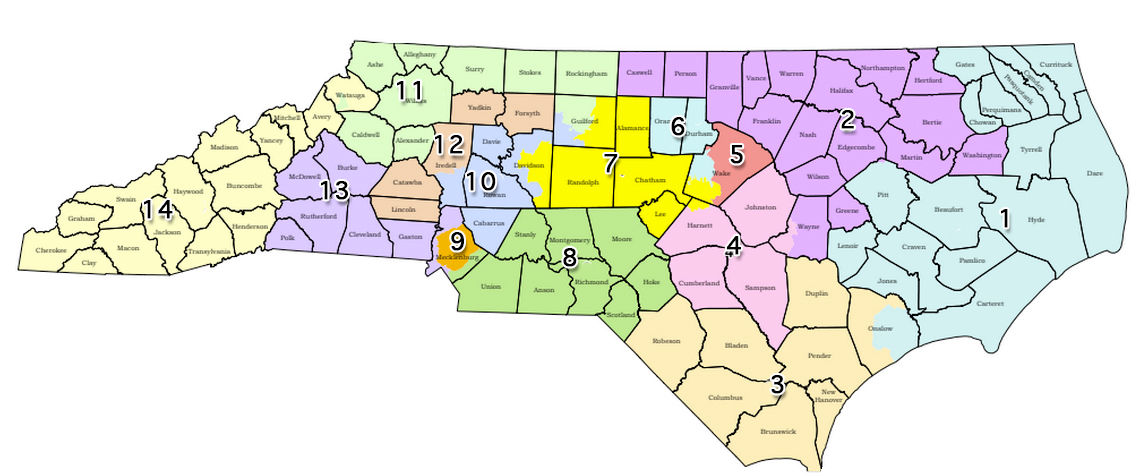
NORTH CAROLINA REDISTRICTING UPDATE

(Please click on map for expanded view.)

Rep. G.K. Butterfield’s (D-Wilson) retirement announcement throws the state’s new 2nd District into the slightly competitive range. President Biden would have carried this seat only with a 51-48% margin, thus meaning it could become competitive in a strong Republican year with a viable GOP candidate. Such could be the situation in 2022.

With the 2nd District potentially in play, even the state’s projected 10R-4D delegation split could possibly tilt even more toward the Republicans. That could be balanced, however, because the new 14th District in western North Carolina is more attainable for the Democrats. Rep. Madison Cawthorn (R-Hendersonville) deciding to run in District 13 means the more politically marginal 14th will move into the open seat category for 2022.

MONTANA REDISTRICTING UPDATE

Missoula Current news site

The Montana Districting and Apportionment Commission passed a congressional map that will likely send two Republicans to Washington, though the new western 1st District is potentially competitive. The map passed because one of the Democratic commissioners voted for the Republican plan.

Montana is the first state in history to be reduced to at-large status – this happened in the 1990 census – only to regain their lost seat. The state was awarded a second district in the current national reapportionment.

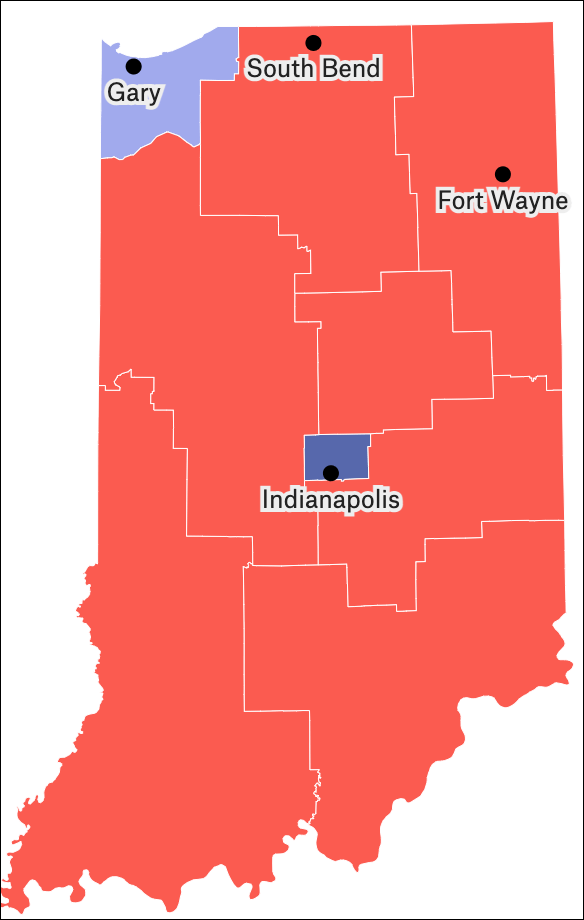
INDIANA REDISTRICTING UPDATE

FiveThirtyEight.com

Gov. Eric Holcomb (R) signed the new congressional redistricting legislation in early October, becoming one of the first states to complete the decennial re-drawing process.

The main change in the nine-district map was to make freshman Rep. Victoria Spartz’s (R-Noblesville) seat more Republican by sending the previous 5th District’s Marion County precincts to other congressional districts. The Spartz seat was the most over-populated district in the state, having to release 50,921 individuals to other districts. Therefore, this district became the focal point of the new map.

The Indiana legislature drew a map that should return a 7R-2D delegation to Washington for most, if not all, of the current decade.

IDAHO REDISTRICTING UPDATE

Idaho Press.com

The Gem State map was enacted with little change to the state’s two-district map. A total of 35,338 people were switched from Rep. Russ Fulcher’s (R-Meridian) 1st District to Rep. Mike Simpson’s (R-Idaho Falls) 2nd District. With a per district state population quota of a huge 919,553 residents, the nation’s second-fastest growing state during the past decade is in strong position to gain a third district in the 2030 reapportionment.

For the current decade, expect Idaho to retain a 2R-0D congressional delegation.

The Open and Collapsed Seats

By Jim Ellis

A look at how things might play out in key states in the redistricting tug of wars

Dec. 2, 2021 — In a redistricting year, tracking the open seats can be a bit confusing. Not only do we record retiring members and those seeking other offices, as we do in every election cycle, but in a redistricting year we also see new seats awarded to states in reapportionment, new districts created through map drawing, and collapsed seats. This, in addition to members being paired and certain incumbents choosing to run in districts other than the one they currently represent.

The open seat numbers have grown significantly during the past month. As a result, we see 24 members leaving their current districts either for retirement or to run for another office. Sixteen are from the majority Democratic conference, with eight coming from their Republican counterparts.

One seat, FL-20, remains in special election cycle and will be filled on Jan. 11. At that point, the House will have its full compliment of 435 members for the first time in this Congress.

Reapportionment changed locations within states for seven congressional seats, and map drawing has added an additional four new seats to date for a total of 11 nationally. The new seats also lead to a commensurate number of incumbent pairings or collapsed districts.

Adding the numbers from all of these categories tells us that 43 House seats have been affected in addition to four members who have declared for seats they don’t currently represent.

The collapsed seats tell their own story. In this category, certain members have nowhere to run, typically in states that lost a seat in reapportionment. In many instances, the member without a place to run is one who had previously indicated that he or she is leaving the House.

In California, the first draft redistricting map shows that Rep. Karen Bass’ (D-Los Angeles) seat would be the one collapsed, because the state is, for the first time in history, losing a district. Bass, however, previously announced that she is running for mayor of Los Angeles, so seeing her seat as the one forfeited was not a surprise.

Illinois Rep. Adam Kinzinger (R-Channahon) was geographically in a difficult position because the map drawers needed the leftward voters in his district to enhance two adjoining Democratic seats. Therefore, he became the odd man out.

Continue reading →