
By Jim Ellis — Tuesday, August 25, 2026
Alaska Races
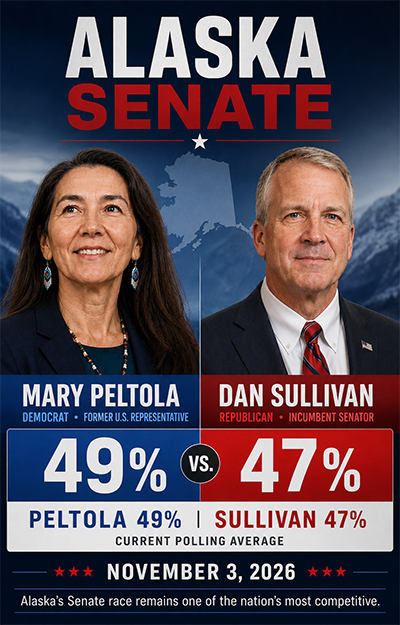 While recent polls projected Alaska Sen. Dan Sullivan (R) as slightly trailing former at large Rep. Mary Peltola (D) in this year’s US Senate race, the primary vote suggests that something beyond questionable polling may be unfolding in the Last Frontier, which is normally a reliable Republican domain.
Seeing tight early Alaska polling is typical, which is usually a prelude to the Republican candidate pulling ahead in the final weeks to win comfortably. The Aug. 18 primary results, however, indicate that the Senate contest is more favorable for Democrats than other statewide races – an ominous sign for the GOP’s majority prospects.
In last week’s primary, Peltola led with 48.1 percent of the vote compared to Sen. Sullivan’s 42.7 percent, a margin between the two of 7,144 votes. Under Alaska’s top four jungle primary, the four highest vote-getters advance to the general election regardless of party affiliation or percentage attained. This means Daniel J. Sullivan Jr. – whom some believe Democrats encouraged to run in order to siphon votes from the incumbent – and the eventual fourth place finisher will join the general election field.
Fourth place remains undecided due to a significant number of uncounted ballots from the outlying areas. Daniel Sullivan Jr. advances with just 2.4 percent of the vote, while Democrat David Leslie (1,502 votes) and Republican Gerald Heikes (1,485 votes) are separated by only 17 votes, each below 1.2 percent. Estimates project that as many as 34,000 ballots may still remain meaning that either Leslie or Heikes can claim the fourth and final general election ballot position.
The third- and fourth-place finishers will largely determine whether the leading general election candidate reaches a majority. If no one surpasses the 50 percent majority threshold, Ranked Choice Voting activates, meaning a redistribution of second and third choice preferences from people who voted for lower tier candidates.
The major warning sign for Sen. Sullivan is how the Senate primary compares to the other statewide contests. Peltola and the other two Democratic candidates combined for 66,183 votes in the Senate race, while the six Republicans amassed an aggregate 63,888.
In the open Governor’s race, Republicans (12 candidates) combined for 67,198 votes, significantly ahead of the Democrats’ 54,790. In the at-large House race featuring freshman Rep. Nick Begich III (R Chugiak), Republicans totaled 64,011 votes; Independents and minor party candidates followed with 45,215, while Democrats drew only 21,185.
More troubling for Sen. Sullivan was his performance across Alaska’s 40 state House districts, the unit the state uses instead of counties to report vote totals. The Dave’s Redistricting App statisticians estimate that Republicans hold a partisan lean advantage in 25 of the districts compared to the Democrats’ 15. Yet, Sen. Sullivan carried only 13 of the 25 state House districts that typically lean Republican.
Alaska is a state Senate Republicans cannot afford to lose. With what appears to be a highly likely loss in North Carolina, Republicans are already on defense in Iowa, Maine, Ohio, and Texas. A devastating loss in Alaska – even if Republicans flip Michigan – could reopen the door to a Democratic majority.
Time remains for Sen. Sullivan and the GOP to improve their standing and, as previously mentioned, Republican candidates usually get a bump in support as election day approaches.
If the incumbent, however, enters November slightly ahead or slightly behind Peltola, the nation may wait weeks to learn which party controls the Senate, as Alaska routinely requires extended time to count late arriving ballots from its vast wilderness areas.