Tag Archives: Rep. Matt Rosendale

Rosendale Leads GOP Primary Poll; Former Michigan Rep Files Senate Exploratory Committee; Another Challenger in NY-3; Afghan War Vet to Return to NC-14 Race

By Jim Ellis — Tuesday, Sept. 5, 2023

Senate

Montana Rep. Matt Rosendale (R-Glendive)

Montana: Rep. Rosendale Leads GOP Primary Poll — A J.L. Partners survey released to the Semafor online news site (Aug. 12-17; 418 likely Montana Republican primary voters; live interview) projects two-term Congressman Matt Rosendale (R-Glendive) holding a big 55-19 percent lead over aerospace company CEO and retired Navy SEAL Tim Sheehy (R).

Sheehy is the party-endorsed candidate. He has support from Sen. Steve Daines (R-MT), chairman of the National Republican Senatorial Committee, Gov. Greg Gianforte (R-MT), and 1st District Congressman and former US Interior Secretary Ryan Zinke (R-Whitefish).

Both men fare well against Sen. Jon Tester (D). Rep. Rosendale, who lost to Sen. Tester 50-47 percent in 2018, would lead this race 46-42 percent. Sheehy would hold a similar 46-43 percent edge over the senator.

Michigan: Ex-US Rep Files Senate Exploratory Committee — Former Congressman Peter Meijer, who was elected in 2018 but failed to win renomination for a second term in the 2020 Republican primary, has filed a US Senate exploratory committee with the Federal Election Commission. Meijer, however, came far short of saying he would enter the Senate race, only that he remains in a consideration phase.

Former Congressman Mike Rogers (R) is soon expected to enter the Senate race. Michigan Board of Education member Nikki Snyder is the only Republican elected official who has joined the Senate field. Rep. Elissa Slotkin (D-Lansing) leads a host of candidates for the Democratic nomination. Sen. Debbie Stabenow (D) is retiring after serving what will be four terms at the end of this Congress.

House

NY-3: Another Republican to Challenge Rep. Santos — The Security Traders Association CEO, Jim Toes, announced that he will join the growing Republican field who are challenging beleaguered Rep. George Santos (R-Long Island) for renomination. Toes becomes the eighth announced Republican candidate, but possibly the most accomplished. A total of six Democrats have declared their candidacies.

The FiveThirtyEight data organization rates NY-3 as D+4, while Dave’s Redistricting App calculates the partisan lean at 56.4D – 42.0R. President Joe Biden carried the district 54-45 percent. This is one of several New York US House seats that will be difficult for the Republicans to protect in the 2024 election.

NC-14: 2022 Nominee Likely to Return — Afghan War veteran and 2022 Republican congressional nominee Pat Harrigan (R) is likely to return for another attempt, though the Charlotte anchored 14th District will likely be radically different after the legislature redraws the North Carolina congressional map in the next few weeks.

The redraw will play to the Republicans favor, which likely means that freshman incumbent Rep. Jeff Jackson (D-Charlotte) will run for attorney general. This would be good news for Harrigan, but his more difficult election would be in the Republican primary particularly if state House Speaker Tim Moore (R-Cleveland County) draws the seat for himself.

Unusual NH Presidential Poll; Republican Primary Developing in Montana; VA-7 Candidates Coming Forward; NH Governor News

By Jim Ellis — Thursday, Aug. 17, 2023

President

Former New Jersey Gov. Chris Christie (R) / Photo by Gage Skidmore

New Hampshire: New Poll; Unique Info — The new Emerson College survey (Aug. 9-11; 837 registered New Hampshire voters; interactive voice response system, text & online) provides new information not seen in any other similar study.

For example, the results find:

  • Former New Jersey Gov. Chris Christie moving into second place
  • No candidate but former President Donald Trump landing in double digits
  • Cornel West’s influence level is confirmed at four percent, which appears to come from President Joe Biden’s vote pool
  • Businessman Perry Johnson attracting enough support to be recorded on a poll
  • Former Vice President Mike Pence flirting with last place

It remains to be seen if this survey is an outlier, or if new trends are forming.

House

MT-2: Republican Primary Developing — We reported that Montana Superintendent of Public Instruction Elsie Arntzen (R) filed a congressional exploratory committee in anticipation that Rep. Matt Rosendale (R-Glendive) will run for the Senate. Now we see State Auditor Troy Downing (R) doing the same.

Both qualify that their interest in the 2nd District seat is present only if Rep. Rosendale foregoes re-election and formally enters the Senate race. Downing has run for Congress before. He entered the 2018 US Senate primary and placed third with 19.1 percent of the vote. Rosendale won the nomination with 33.8 percent, and then lost 50-47 percent to Sen. Jon Tester (D) in the associated general election.

VA-7: GOP Candidates Coming Forward — Political speculation suggesting that Virginia Rep. Abigail Spanberger (D-Glen Allen) will not seek re-election in order to prepare for a 2025 open governor’s race has already encouraged potential Republican candidates to come forward. Several are now testing the political waters for a 2024 run in the politically marginal 7th Congressional District.

Two military veterans — retired Navy SEAL and defense contractor Cameron Hamilton and Iraq War veteran Jon Myers, a retired Marine Corps officer — have both filed congressional campaign committees with the Federal Election Commission. Business consultant Bill Moher and Army veteran Shaliek Tarpley are previously announced Republican candidates.

Should Rep. Spanberger retire, we can expect a very crowded Republican and Democratic primary season. Republicans will likely hold either a nominating convention or what they term as a “firehouse primary” (where only a few polling places are open throughout the sprawling district), while Democrats typically hold a traditional primary. The FiveThirtyEight data organization rates VA-7 as a highly competitive D+2.

Governor

New Hampshire: Ayotte Leads in Early Poll — Former US Sen. Kelly Ayotte (R) is starting her campaign for governor with a lead according to a new Emerson College poll (Aug. 9-11; 837 registered New Hampshire voters; interactive voice response system, text & online). According to the results, Ayotte would lead Manchester Mayor Joyce Craig (D) 46-37 percent, and Executive Councilor Cinde Warmington (D) by a larger 47-34 percent span.

The poll did not test the Republican primary. At this point, former state Senate president and 2022 US Senate candidate Chuck Morse is opposing Ayotte for the Republican nomination and others are expected to enter. Incumbent Gov. Chris Sununu (R) is not seeking a fifth term.

General to Oppose Marjorie Taylor Greene; Montana Candidate Filing; Another Opponent for Wisconsin Rep. Steil; Republican Candidate for Houston Mayoral Race

By Jim Ellis — Wednesday, Aug. 16, 2023

House

Georgia Rep. Marjorie Taylor Greene (R-Rome) / Photo by Gage Skidmore

GA-14: Retired General to Oppose Rep. Greene — Retired Army Brigadier Gen. Shawn Harris (D) announced that he will enter the Democratic primary to hopefully challenge two-term Georgia Rep. Marjorie Taylor Greene (R-Rome).

Defeating Rep. Greene in the general election is the longest of shots. The FiveThirtyEight data organization rates GA-14 as R+45. Dave’s Redistricting App calculates the partisan lean at 69.4R – 28.8D. The question as to whether Greene is even vulnerable to a Republican primary challenge remains doubtful. In the 2022 race, the congresswoman was re-nominated with 69.5 percent of the vote with five opponents dividing the remaining 30.5 percent.

MT-2: Republican Files Exploratory Committee in Anticipation — Montana Superintendent of Public Instruction Elsie Arntzen (R) filed a congressional exploratory committee Monday in anticipation that Rep. Matt Rosendale (R-Glendive) will run for the Senate. Arntzen, who is ineligible to seek a third term in her current statewide position, says she will only enter the US House contest if Rosendale vacates the seat for another statewide race.

Should he depart for the Senate, the 2nd District Republican primary figures to host a very crowded and competitive open primary. Carrying a R+30 rating from the FiveThirtyEight data organization and a 59.8R – 37.9D partisan lean factor that the Dave’s Redistricting App statisticians calculate, a succession battle here would be decided in the Republican primary. The 2nd District covers central and eastern Montana and encompasses the cities of Billings, the state’s largest municipality, Great Falls, and the state capital of Helena.

WI-1: Second Democrat Announces Against Rep. Steil — Lorenzo Santos (D), a Racine County Emergency official, joined the Democratic primary with the goal of challenging three-term Rep. Bryan Steil (R-Janesville) next year. Already running is former local official Anthony Hammes (D).

This race is beginning to attract attention because of the possibility that the Wisconsin congressional map will be redrawn. If that happens, there is a strong probability the 1st District becomes more Democratic and enhances the possibility that Rep. Steil may opt for a Senate bid. We can expect further action coming from southern Wisconsin as the potential of a district reconfiguration begins to grow.

Cities

Houston: Republican Emerges — Hoping to split the Democratic vote between US Rep. Sheila Jackson Lee (D-Houston) and veteran state Sen. John Whitmire (D-Houston), former at-large City Councilman Jack Christie (R) announced that he will now compete in the open mayoral race scheduled for Nov. 7. The structure is a jungle election contest where all 14 declared candidates would appear on the same ballot. If no contender receives 50 percent of the vote in the first election, a runoff will be scheduled between the two top finishers.

Though the field is large, polling suggests that Sen. Whitmire and Rep. Jackson Lee are well ahead of the remaining candidates who comprise the pool. Therefore, Christie’s strategy of coalescing the minority Republican vote and coming from the outside to capture a runoff position could potentially become viable. Incumbent Mayor Sylvester Turner (D) is ineligible to run for a third term.

Burgum Qualifies for GOP Debate; Support for Montana Senate Candidate Wans; Democratic Competition in CA-22; Returning Candidate in FL-9

By Jim Ellis — Thursday, July 27, 2023

President

North Dakota Gov. Doug Burgum (R)

Gov. Doug Burgum: Qualifies for GOP Debate — North Dakota Gov. Doug Burgum’s campaign team announced that the candidate has qualified for the first Republican debate on Aug. 23 in Milwaukee. Gov. Burgum is showing an uptick in backing from both Iowa and New Hampshire and has attracted enough small dollar contributions and polling support to qualify for a podium on the debate stage.

Gov. Burgum is the seventh debate participant joining former President Donald Trump, Florida Gov. Ron DeSantis, Sen. Tim Scott (R-SC), ex-UN Ambassador Nikki Haley, former New Jersey Gov. Chris Christie, and businessman Vivek Ramaswamy. Ex-Vice President Mike Pence remains the most well-known candidate who has not yet qualified.

Senate

Montana: Club for Growth Hedges on Support for Rosendale — The Club for Growth leadership several months ago said they would back US Rep. Matt Rosendale (R-Glendive) to the tune of $10 million if he decided to challenge Sen. Jon Tester (D), as he did five years ago. In the 2018 election, Rosendale, then the state auditor, lost to Sen. Tester, 50-47 percent.

Now, CfG president David McIntosh, himself a former Republican congressman, is hedging on such a support level, saying that retired Navy SEAL and aerospace company CEO Tim Sheehy is an impressive candidate and Rep. Rosendale is needed in the House. Rosendale has long been a presumed Senate candidate but has yet to come forward and formally announce his political plans.

House

CA-22: Democratic Competition — In November, Golden State Rep. David Valadao (R-Hanford) defeated then-state Assemblyman Rudy Salas (D), 51.5 – 48.5 percent, in a district the FiveThirtyEight data organization rates as D+10. Salas, who many regard as the congressman’s most difficult opponent from the group of candidates he faced during his five victorious federal campaigns, has already announced that he is returning for a rematch. Now, however, further competition looms on the horizon. State Sen. Melissa Hurtado (D-Sanger/Bakersfield) is reportedly preparing to announce for Congress and will enter the March 5, 2024, all-party jungle primary.

While Hurtado’s Senate district covers just over 96 percent of the 22nd Congressional District, she was only re-elected in November by just a 22-vote margin from more than 138,000 ballots cast. Therefore, it appears that Salas should still be favored to advance into the general election against Rep. Valadao.

FL-9: Republican to Try Again — Former state Rep. John Quinones (R), who ran for the 9th District seat in 2012 but lost soundly (63-37 percent) to then-Rep. Alan Grayson (D), is returning to run again in 2024, this time hoping to challenge incumbent Rep. Darren Soto (D-Kissimmee). The 9th District, which contains the south Orlando area, was the most over-populated of the 27 Florida congressional districts prior to reapportionment and redistricting. It has 30 percent different territory from when Quinones ran the first time.

Rep. Soto was re-elected to a fourth term in November with a 54-46 percent margin, which was much lower than expected against an opponent who spent less than $600,000. The FiveThirtyEight data organization rates FL-9 at a substantial D+16, with a partisan lean calculation from Dave’s Redistricting App of 58.8D – 39.2R.

Trump, Biden Ahead by Wide Margins in New Poll; Navy SEAL Declares in Montana; Redistricting News from Alabama, North Carolina

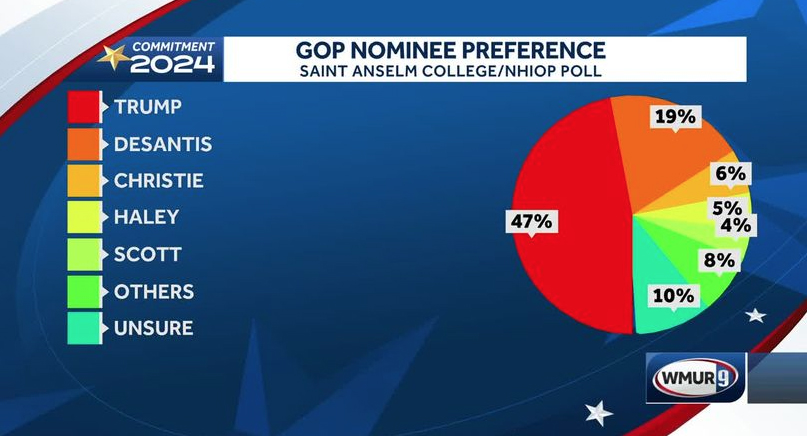
New Hampshire GOP presidential poll results / WMUR TV graphic

By Jim Ellis — Thursday, June 29, 2023

President

New Hampshire Poll: St. Anselm College Releases Regular Poll — The New Hampshire Institute of Politics of St. Anselm College published their latest regular survey of Granite State voters (June 21-23; 1,065 registered New Hampshire voters; live interview) and sees former President Donald Trump gaining strength in the Republican primary while principal challenger Gov. Ron DeSantis is losing support. The partisan primary numbers find Trump leading Florida Gov. DeSantis, 47-19 percent with no other candidate exceeding six percent support.

On the Democratic side, President Joe Biden dominates Robert F. Kennedy Jr. and author Marianne Williamson, 69-9-8 percent. These numbers exceed how the president is performing nationally. Since the state is unlikely to agree to moving their primary to comply with the new Democratic National Committee calendar, these numbers suggest that Biden could win a write-in campaign against his two intra-party challengers even if he doesn’t enter the official Democratic primary.

In hypothetical general election pairings, President Biden would lead both former President Trump and Gov. DeSantis with the same 49-40 percent spread. This data suggests there is less chance that New Hampshire will become a major general election Republican conversion target.

Senate

Montana: Retired Navy SEAL Declares Candidacy with NRSC Endorsement — Retired Navy SEAL and aerospace company CEO Tim Sheehy (R) announced his US Senate candidacy Tuesday. Immediately, the National Republican Senatorial Committee, with its chairman being Montana’s junior Sen. Steve Daines, endorsed Sheehy’s candidacy. The Montana Senate race is expected to be one of the hottest campaigns in the country as Republicans attempt to deny incumbent Sen. Jon Tester (D) a fourth term.

Rep. Matt Rosendale (R-Glendive), who is also expected to join the race, responded with a Tweet saying, “congratulations to Mitch McConnell and the party bosses on getting their chosen candidate. Now Washington has two candidates – Tim Sheehy and Jon Tester – who will protect the DC cartel.” Early polling shows Rep. Rosendale beginning the race with a substantial lead, so we can expect both a hot general election campaign, and an equally tough Republican nomination contest next year in Big Sky Country.

House

Alabama: Governor Calls Special Redistricting Session — To comply with the US Supreme Court ruling on the Alabama racial gerrymandering case that went against the state, Gov. Kay Ivey (R) said that she will call a special redistricting session for the purposes of drawing a new map to comply with the decision. The legislature will report on July 17 to begin the process.

Since Alabama is a Super Tuesday state and is holding its regular primary on March 5, time is short to draw a new map and obtain the necessary judicial approvals. The ruling and new map is expected to give the Democrats an extra seat in the Alabama US House delegation that currently stands at 6R-1D.

SCOTUS: North Carolina Case Ruling — In an unsurprising 6-3 ruling, the US Supreme Court ruled against the state of North Carolina on the subject of redistricting. Legal analyst Derek Muller of the Election Law Blog describes the crux of the state’s argument as saying, “the state constitution or state judiciary cannot constrain the state legislature exercising power under the Elections Clause.” Predictably, the justices ruled that the judiciary does have the authority to involve itself in redistricting decisions but underscored that the Supreme Court has the power to restrain lower courts from taking too much power away from the legislative bodies.

Largely because the North Carolina state Supreme Court has already reconsidered its previous partisan gerrymandering decision, the high court confined itself to the judicial power question.

Blunt Rochester Announces in Delaware; Montana’s Rosendale Way Up; An NV-1 Rematch Shaping Up;
OR-5 Democratic Primary Forming

By Jim Ellis — Friday, June 23, 2023

Senate

Rep. Lisa Blunt Rochester (D-Wilmington)

Delaware: Rep. Blunt Rochester Announces — As expected, Delaware at-large US Rep. Lisa Blunt Rochester (D-Wilmington) officially declared her US Senate candidacy. The move became obvious when Sen. Tom Carper (D) announced his retirement in May, and as part of his address encouraged the congresswoman, a former aide and appointee when Carper was governor, to run for the seat.

Rep. Blunt Rochester, first elected in 2016, is expected to have little opposition both in the Democratic primary and general election. The Senate seat will remain in the Democratic column. There could be developing competition brewing for Blunt Rochester’s open House seat, however.

Montana: Rep. Rosendale Way Up in GOP Primary Poll — Public Policy Polling tested the Montana Republican Senate primary (June 19-20; 51 likely Montana Republican primary voters; live interview & text) and sees US Rep. Matt Rosendale (R-Glendive) as the big early leader. According to the ballot test, Rep. Rosendale posts ahead of retired Navy SEAL Tim Sheehy, 64-10 percent. The congressman faced seven different Montana electorates in the past seven elections and won five times.

The National Republican Senatorial Committee leadership would prefer a different candidate since Rep. Rosendale is viewed as part of the far right flank of the Republican Conference and lost to Sen. Jon Tester (D) in the 2018 campaign, but the statewide GOP polling sample propelled him to a huge lead for a potential 2024 Senate race. Thus, whether the national Republican leadership likes it or not, Rep. Rosendale, when he announces for the Senate, must be viewed as the clear favorite to win the Republican nomination. He would then advance into the general election for a re-match with Sen. Tester, the lone Democratic statewide office holder in Montana. This is one of top three Republican conversion opportunities in the nation.

House

NV-1: Re-Match Possibility — In November, financial planner Mark Robertson (R) held Nevada Rep. Dina Titus (D-Las Vegas) to a 52-46 percent re-election victory in a district that had been drastically changed through redistricting. Many, however, viewed the result as a Republican under-performance in a district that the FiveThirtyEight data organization rates as D+4.

Whether Robertson gets another chance to oppose Rep. Titus remains a question. He has Republican primary opposition from business consultant Ron Quince and restaurant chain owner Flemming Larsen.

All three Las Vegas Democratic seats have competitive potential. With such a slim House majority and the Alabama racial gerrymandering ruling from the Supreme Court favoring the Democratic position, the Republicans will pursue as many offensive opportunities as possible. Therefore, expect Nevada to become another hotbed of political activity in 2024.

OR-5: Democratic Primary Forming — Two weeks ago, Oregon Metro President Lynn Peterson (D) announced her entry into the Congressional District 5 Democratic primary; Wednesday, state Rep. Janelle Bynum (D-Happy Valley) filed a committee with the Federal Election Commission to join her as the perceived two top candidates. The winner will advance to challenge freshman Rep. Lori Chavez DeRemer (R-Happy Valley).

The 5th District race will be hotly contested. Chavez-DeRemer defeated Democrat Jamie McLeod-Skinner by a 51-49 percent margin in November. McLeod-Skinner, a first-time candidate in Oregon but former local office holder in California, had already defeated incumbent Rep. Kurt Schrader in the Democratic primary. She is also a potential 2024 candidate. The district carries a D+3 rating from the FiveThirtyEight data organization and is categorized as a swing district. This will be a top Democratic conversion opportunity seat and will attract national political attention.

Gallego Ahead in Arizona; Montana Senate Race Update; Republican Garcia Draws Opponent in Calif.; First Major Candidate Announces in R.I.

By Jim Ellis — Monday, March 13, 2023

Senate

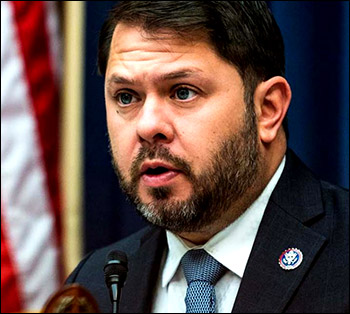
Arizona Rep. Ruben Gallego (D)

Arizona: Gallego Leads & Sinema Gains in New Poll — With no Republican as of yet announcing for the 2024 Arizona Senate race, frequent Arizona pollster OH Predictive Insights released their latest Senate poll. The survey (Jan. 31-Feb. 9; 1,000 registered Arizona voters) gives US Rep. Ruben Gallego (D-Phoenix) the lead under all configurations. The pollster continues to add former Gov. Doug Ducey to the Republican candidate mix even though he has repeatedly said that he is not running. Therefore, we will eliminate covering polling results that include him.

Rep. Gallego polls between 31 and 34 percent in scenarios that include former gubernatorial candidate Kari Lake, ex-US Senate nominee Blake Masters, and former governor candidate Karrin Taylor Robson. The Republicans post scores between 24 and 26 percent. Sen. Kyrsten Sinema, who left the Democratic Party to become an Independent, improves her standing from previous polling. She would take between 19 and 22 percent under the various scenarios.

With a late primary in August 2024, much will happen to develop the ultimate candidate lineup. This poll, as do others, suggest a wide-open three-way race where either Gallego, a Republican, or Sinema ultimately could eventually win. Arizona will once again be at the forefront of the battle for the Senate majority.

Montana: Rep. Rosendale Leads in Primary & General — The OnMessage Republican polling firm released the results of their latest Montana US Senate poll (Feb. 18-21; 600 likely Montana voters with an over-sample of 100 Republicans for GOP primary questions; live interview) and the results provide good news across the board for US Rep. Matt Rosendale (R-Glendive).

Though no one has announced a Senate bid against three-term incumbent Jon Tester (D), OnMessage tested a hypothetical Republican primary consisting of Reps. Rosendale and Ryan Zinke (R-Whitefish) along with former Secretary of State Corey Stapleton. For this question, Rep. Rosendale posted a 36-26-6 percent lead over Zinke and Stapleton. Attorney General Austin Knudsen (R), who has also been mentioned as a possible Senate candidate, was not tested.

In the general election, in a reversal of a previous Political Company survey result, OnMessage finds Rep. Rosendale topping Sen. Tester, 46-41 percent. There is no report as to whether the pollsters tested the other candidates singularly against Sen. Tester.

House

CA-27: Rep. Garcia Draws New Opponent — GOP Rep. Mike Garcia (R-Santa Clarita) has won three elections in a seat that favors the Democrats against former state Assemblywoman Christy Smith (D), but he’s almost certain to see a new challenger in 2024.

Franky Carrillo (D) was falsely imprisoned for 22 years, convicted for a murder later proven he did not commit and was awarded $11 million in compensation after winning a lawsuit against the state of California. Since then, Carrillo has been appointed as a Los Angeles County Probation Oversight commissioner. Last week, he announced that he will run for the US House next year.

It’s clear that the Democrats must change the paradigm against Rep. Garcia, and it remains to be seen if Carrillo is the type of candidate who can alter the partisan flow of this northern Los Angeles County CD against an incumbent who has proven he can draw crossover votes.

RI-1: First Major Candidate Announces — Last week, Rhode Island Rep. David Cicilline (D-Providence) announced that he is resigning his seat on June 1 to accept a position with a non-profit organization. While the list of potential Democratic candidates who might declare for the impending special election to be scheduled later this year is long, the first major contender just announced her plans late last week. Lt. Gov. Sabina Matos (D), the former president of the Providence City Council, formally declared her congressional candidacy.

The real political battle for this seat will be fought in the Democratic primary. In a district the FiveThirtyEight data organization rates as D+32, it is a foregone conclusion that Rep. Cicilline’s eventual successor will be a Democrat. Expect a crowded field and a plurality primary victory that will lead to an easy Democratic special general election win.

RFK Jr., Vivek Ramaswamy Heading to NH; Montana’s Tester on Top; Candidate Filing in CA-13

By Jim Ellis — Wednesday, Feb. 15, 2023

President

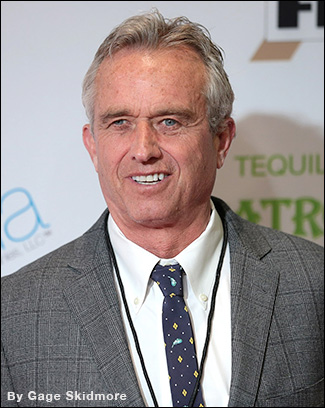
Robert F. Kennedy Jr.

New Hampshire: Two Interesting Visitors — A pair of individuals are soon making trips to New Hampshire with obvious presidential intentions. Robert F. Kennedy Jr. (D), son of the late US senator and Attorney General Robert F. Kennedy and anti-vax proponent, is scheduling public appearances. Should he enter the New Hampshire Democratic primary, we could see some interesting ramifications develop.

Entrepreneur Vivek Ramaswamy, who runs an investment firm specializing in the healthcare and technology sectors, is a best-selling author and made national news opposing the corporate woke culture and Environmental, Social & Governance (ESG) investing, is also making public appearances in the Granite State. Ramaswamy’s personal wealth is reportedly in the hundreds of millions range, so he will have the assets necessary to deliver a message in many primary states. It is presumed he would enter the Republican primaries.

Senate

Montana: New Poll Gives Sen. Tester Small Leads — The Political Company, a Montana-based survey research firm, just released hypothetical numbers for the state’s upcoming 2024 Senate race, sure to be one of the top such contests in the country. The poll (Jan. 30-Feb. 1; 53 likely Montana general election voters; live interview & text) finds Sen. Jon Tester (D), who has yet to announce his 2024 political intentions, either leading or tied with what would presumably be his top three potential challengers.

The senator’s strongest opponent would be Gov. Greg Gianforte (R), who would begin in a 45-45 percent ballot test tie with Sen. Tester according to the new data. Sen. Tester would post small leads against Reps. Matt Rosendale (R-Glendive) and Ryan Zinke (R-Whitefish). Opposite Rep. Rosendale, the senator’s advantage would be 45-40 percent, while he would fare slightly better against Rep. Zinke at 46-40 percent. None of the three has yet announced they will run for Senate, but Rep. Rosendale is reportedly the most likely to launch a campaign. Gov. Gianforte is also on the ballot for re-election in 2024.

Clearly the state has moved to the right since Sen. Tester defeated Rosendale 50-47 percent in 2018. The fact that he is well below 50 percent against all three men is a clear signal that he will be in a dogfight for re-election should he seek a fourth term. The senator said he will make his decision about running again before the end of March.

House

CA-13: Adam Gray (D) Files 2024 Committee with FEC — California former state Assemblyman Adam Gray (D), who lost the second closest 2022 congressional election — a 565-vote result opposite now freshman-Rep. John Duarte (R-Modesto) — has filed a new 2024 committee with the Federal Election Commission. Prior to this action, Gray had said little about running again.

Viewed as the clear favorite at the beginning of the ’22 race, Gray failed to win the seat, and even placed behind Duarte in the June jungle primary. On paper, the new 13th District favors the Democrats. The FiveThirtyEight organization rates the seat D+7, while Dave’s Redistricting App scores the partisan lean as 53.7D – 43.9R. At this point, Democrats Phil Arballo, a former two-time congressional contender, retired Army Col. Brad Boyd, and educator Angelina Rosario Sigala have all declared their candidacies. Regardless of who becomes the Democratic finalist, this race will be a top-tier national Democratic conversion target.

House Speaker Vote Today;
Biden’s Approval Rating & A Beginning of the Election Cycle

By Jim Ellis — Tuesday, Jan. 3, 2023

House

House Republican Speaker nominee Kevin McCarthy (R)

Speaker Vote Today: Likely to Require More than One Ballot — For the first time in a century, it appears the Speaker’s election that will convene the 118th Congress, will require more than one roll call. With Republicans holding only a 222-212 majority with one Democratic seat vacant due to the death of Rep. Donald McEachin (D-VA), Republican Speaker nominee Kevin McCarthy (R-CA) does not appear to have the 218 votes that he needs to claim the gavel for the ensuing session.

Five Republican members have publicly said they will vote against McCarthy, and one of them, Arizona Rep. Andy Biggs (R-Gilbert) is an announced candidate for the position as he was in the Republican conference vote. The other four are Reps. Matt Gaetz (R-FL), Bob Good (R-VA), Ralph Norman (R-SC), and Matt Rosendale (R-MT).

Another group of nine members signed a public letter questioning McCarthy’s ability to be a successful Speaker while stopping short of saying the signees will vote against him. They are Reps and Reps-Elect Dan Bishop (R-NC), Andrew Clyde (R-GA), Eli Crane (R-AZ), Paul Gosar (R-AZ), Andy Harris (R-MD), Anna Paulina Luna (R-FL), Andy Ogles (R-TN), Scott Perry (R-PA), and Chip Roy (R-TX). It is these 14 members who will be key on the first roll call. Not voting for McCarthy within this group will certainly send the voting to a second ballot.

The other group to watch, possibly led by Nebraska Rep. Don Bacon (R-Papillion/Omaha), are moderate Republicans who would coalesce with moderate Democrats to attempt to elect a compromise candidate. If the ballot drags on for more than two roll calls, it will be interesting to see which group begins to develop cracks. The membership will vote until one individual reaches the 218-vote threshold and thereby claims the Speakership.

President

Biden Approval: A Benchmark to Begin the Election Cycle — With the new Congress being sworn into office today, we begin the 2024 election cycle. Such being the case, let’s take a look at where President Biden’s job approval rating stands as he likely begins to prepare for a re-election run.

The two most recent survey reports during this holiday period came from Rasmussen Reports and the Morning Consult firm. Both organizations continually track presidential job approval on a daily basis. Rasmussen (sampling conducted through Pulse Opinion Research; Dec. 27-29; 1,500 US registered voters) projects the President to have a 47:51 percent favorable to unfavorable ratio. Morning Consult, which has been closer to a more consensus ratio among the plethora of typical job approval polling (Dec. 21-27; 45,000 US adults; online) finds Biden’s favorability index at worsened 42:51 percent favorable to unfavorable clip.

Comparing these two polls produces typical results since President Biden has always fared better with registered voter samples than among a respondent pool of adults. Still, it is clear that the president will begin the road to re-election with more people disapproving of his performance in office than those who approve.

McCarthy’s Math

By Jim Ellis — Thursday, Dec. 1, 2022

House

House Minority Leader Kevin McCarthy (R-CA)

Leadership — The announcement from several Republicans saying they will not vote for Minority Leader Kevin McCarthy (R-CA) in the election for Speaker of the House even after he was overwhelmingly chosen the party nominee for the position makes the mathematics of his achieving a majority vote a bit tricky. The leadership election will be decided when the new members are sworn into office on Jan. 3. 

The sudden and unfortunate passing of Rep. Donald McEachin (D-VA) reduces the number of members taking the oath of office on commencement day to 434. Even so, McCarthy would still need 218 votes if all are present and voting. Therefore, the McEachin death does not reduce McCarthy’s majority quota, but it could become a factor if a “present” vote strategy were to come into play.

Another complicating factor is the outcome of the lone outstanding House race, the CA-13 contest in the Fresno Valley. Republican candidate John Duarte, a local farmer and agri-businessman, predicted that he will eventually win the election once officials finally count all the ballots. 

Duarte supports his prediction by pointing out that most of the uncounted ballots are from Fresno and San Joaquin Counties in areas where the Republican performed better than his opponent, state Assemblyman Adam Gray (D-Merced). Currently, the district-wide count is stalled with Duarte clinging to a 593-vote lead. If the remaining votes from the five counties perform like the counted ballots, Duarte would win by approximately 483 votes. There is, however, no guarantee that the uncounted ballots will fall in similar fashion, thus the race is still up for grabs.

A Duarte win, however, would increase the Republican Conference size to 222, and that extra vote would be important for the McCarthy-Speaker equation. It is also possible that recounts and legal challenges to individual ballots will hold up the certification of a winner in that race for an undetermined amount of time, thus possibly delaying a new member from being sworn in until after the Speaker vote. If this were to happen, the total House membership would drop to 433, and McCarthy would then need 217 votes to establish a majority as opposed to 218.

His bigger problem is that six Republican members have publicly stated they either will not support him in the floor vote or questioned his leadership ability. According to press reports, the four saying they will not support McCarthy on the floor are Reps. Andy Biggs (R-AZ), Matt Gaetz (R-FL), Bob Good (R-VA), and Ralph Norman (R-SC). The pair publicly questioning his leadership ability are Reps. Matt Rosendale (R-MT) and Chip Roy (R-TX). 
 
There has been some talk that members voting “present” would actually reduce the number of votes to determine a voting majority. While this theory would be open to legal or parliamentary challenge, for the purposes of this example let’s see if such a strategy would work.

If the six members either committing to vote against McCarthy, or possibly doing so, were to simply vote present, and the majority number is truly reduced, then McCarthy would look to have 216 votes as compared to the Democratic likely Speaker candidate, Rep. Hakeem Jeffries’ (D-NY), 212 votes. Within this scenario, the “present” strategy would work because the aggregate counted votes would be 428, thus making the majority number 215.

If those six members, or any others, would vote for an individual other than McCarthy when answering the initial House roll call, then the result would be costly. Under this vote count, McCarthy would be one short of securing the majority.

The other idea being bandied about is having some of McCarthy’s supporters vote “present” in order to reduce the number necessary for securing a majority vote. This would be a very dangerous strategy because his margin is so small that he would come precariously close of dropping below Mr. Jeffries’ 212 votes, assuming the Democratic Conference votes in lock-step. Even one miscount on the roll call vote could elect Jeffries if this idea were attempted.

If McCarthy has 216 votes and the six opposition Republicans were to all vote for other individuals, then the supporter “present” strategy simply wouldn’t work because the McCarthy-committed vote would drop commensurately with the number needed for a majority.

Therefore, the only true path for McCarthy to win the Speakership race is to, first, ensure that no other fall-off is coming from the Republican ranks; second, that no other GOP candidate emerges with potentially more strength; third, that no hybrid coalition forms with the Democrats; and fourth, reaching an arrangement with his six Republican opponents to at least vote “present” in order to allow for a smaller majority number.