Tag Archives: Redistricting

Alabama’s Battle for Second; Conflicting Polls in Missouri;
de Blasio Returns in NY

By Jim Ellis
May 19, 2022

Senate
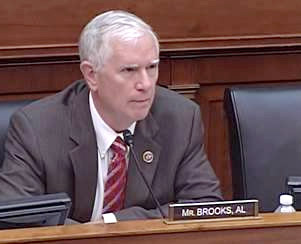
Alabama Rep. Mo Brooks (R-Huntsville)

Alabama: Battling for Second — Emerson College released a new survey for next Tuesday’s Alabama Senate primary, and the results again show that US Rep. Mo Brooks (R-Huntsville) has made a competitive comeback after former President Donald Trump rescinded his endorsement because he felt the congressman was running a poor campaign. For the third time, a recent poll shows Brooks rebounding to a virtual tie for the second runoff position.

For the three contenders, former Business Council of Alabama president and CEO Katie Britt, retired “Black Hawk Down” pilot Mike Durant, and Brooks, advancing to a secondary runoff election is a virtual certainty. In Alabama, candidates must achieve majority support to win a party nomination.

The Emerson College survey (May 15-16; 706 likely Alabama Republican primary voters; live interview; interactive voice response system and text) again finds Britt claiming first place with 32 percent, while Durant and Brooks closely follow with 26 and 25 percent, respectively. In other words, the latter two are in an effective tie for the second position. Assuming no one receives majority support Tuesday, the top two finishers will advance to a June 21 secondary runoff election. The Republican nominee then becomes a lock to succeed the retiring Sen. Richard Shelby (R) in November.

Missouri: Conflicting Polls — Former Gov. Eric Greitens (R), who was forced to resign from office due to a sex scandal and is now dealing with abuse accusations from his ex-wife, has catapulted back into the lead according to a new Survey USA poll. The study (May 11-15; 1,412 likely Missouri general election voters; 642 likely Missouri Republican primary voters; 500 likely Missouri Democratic primary voters; online) projects Greitens to a 26-17-11 percent lead over Attorney General Eric Schmitt and US Rep. Vicky Hartzler (R-Harrisonville/Columbia). The Democratic candidates, led by Iraq War veteran Lucas Kunce and philanthropist Trudy Busch Valentine, are all lagging around the 10 percent mark in primary support. All Republicans defeat the Democratic candidates in preliminary general election pairings.

This S-USA poll is a significant change from previous polling and is in direct conflict with the latest Remington Research Group survey taken within the same period (May 11-12; 945 likely Missouri Republican primary voters; interactive voice response system). These results find AG Schmitt with a 29 percent lead over Rep. Hartzler’s 23 percent, and Greitens trailing with 21 percent. The Missouri primary is Aug. 2.

House

NY-10: de Blasio, State Senator Announce — The revised New York congressional map has not yet received final judicial approval, but candidates are starting to make moves in anticipation of this being the active 2022 district plan. Because the map pairs NYC Democratic incumbents Carolyn Maloney and Jerry Nadler, another safe Democratic open seat was created adjacent to the hotly contested 12th CD. The new 10th District will be decided in the Democratic primary.

Yesterday, former New York City Mayor Bill de Blasio announced his congressional candidacy, but so did state Sen. Brad Holyman (D-NYC). Assuming the map is approved, this will be a hotly contested primary election that should attract national attention. Because the original congressional map and that of the state Senate were disqualified, the judge postponed the primary election for races in these categories until Aug. 23.

Redistricting

Kansas: High Court Overturns — In April, a Kansas district court disqualified the legislature’s congressional map as a partisan gerrymander. Gov. Laura Kelly (D) originally vetoed the map, but the legislature was able to override her action with two-thirds support in both houses. The Kansas state Supreme Court has overturned the lower court ruling, meaning the original map that puts the state’s 3rd District, in and around Kansas City, into competitive status is back for the 2022 cycle. Two-term Rep. Sharice Davids (D-Roeland Park) currently represents the district. This seat will again become a 2022 Republican conversion target.

States

Idaho: Ex-US Rep Defeats Incumbent AG — Former Congressman Raul Labrador, who served four terms in the House, will return to elective office. In the Idaho Republican primary, Labrador unseated the incumbent Attorney General Lawrence Wasden by a substantial 51-38 percent result. Prior to his service in Congress, Labrador was twice elected to the state House of Representatives. He ran unsuccessfully for governor in 2018, losing to current Gov. Brad Little, who also won his primary challenge on Tuesday. After leaving Congress, Labrador was elected as chairman of the Idaho Republican Party.

Vance on the Move Up in Ohio; Kemp Leads in Georgia While McKee Trails in Rhode Island; Redistricting News

By Jim Ellis

May 3, 2022:

Senate

Author J.D. Vance, Ohio Senate Candidate

Ohio: Vance Continues Upward Swing — A pair of ending polls were released late last week as the Ohio Senate candidates move toward today’s primary election. Fabrizio Lee & Associates survey (April 25-26; 800 likely Ohio Republican primary voters) and Emerson College (April 28-29; 885 likely Ohio Republican primary voters) both see author J.D. Vance forging into the lead.

FL&A, polling for the Protect Ohio Values PAC, posts Vance to his largest lead of the campaign, 31-19-12-12-8 percent over former state treasurer, Josh Mandel, businessman Mike Gibbons, state Sen. Matt Dolan (R-Chagrin Falls), and ex-Ohio Republican Party chair Jane Timken, respectively. Emerson College sees a similar division, but with Vance holding a much smaller edge, 24-22-18-14-7 percent over Mandel, Dolan, and Gibbons, with Timken again trailing behind. It has become clear that both Vance and Dolan have upward momentum, while Gibbons and Timken have lost their earlier political steam. Mandel continues to poll relatively well but appears unable to expand his base of support.

The numbers are close enough that any of the current top four candidates, meaning Vance, Mandel, Dolan, and Gibbons could win the nomination vote.


Governor

Georgia: Gov. Kemp Takes Commanding Lead — Survey USA largely confirms the University of Georgia poll that found Gov. Brian Kemp (R) establishing a firm lead in his battle against former US Sen. Davide Perdue, who former President Donald Trump endorses. The S-USA poll (April 22-27; 2,000 Georgia adults; 1,587 registered Georgia voters; 559 likely Georgia Republican primary voters; online) posts Gov. Kemp to a strong 56-31 percent advantage, suggesting that he would win the Republican nomination outright on May 24. Should all candidates be held under the majority mark, however, the top two would advance to a July 26 runoff election.

The general election ballot test gave Gov. Kemp a 50-45 percent edge over former state House Minority Leader and 2018 gubernatorial nominee Stacey Abrams (D).

Rhode Island: Gov. McKee Trailing — A Lake Research Partners survey for the Nellie Gorbea gubernatorial campaign was released on Friday (April 11-14; 600 likely Rhode Island Democratic primary voters; live interview) and the results project Rhode Island Gov. Dan McKee as falling behind Secretary of State Gorbea as the candidates move toward the late Sept. 13 Democratic primary. The ballot test posts Gorbea to a 30-24-10 percent edge over Gov. McKee and ex-Secretary of State Matt Brown. All other candidates fell below the 10 percent threshold. Gov. McKee ascended to his position in March when then-Gov. Gina Raimondo (D) resigned to accept her appointment as US Commerce Secretary.


Redistricting

New York: Deadlines; Primary Moved — Steuben County Surrogate Court Judge Patrick McAllister, who first declared the New York congressional and state Senate maps unconstitutional in reference to the New York constitution, now has the responsibility of drawing the new plans. He has appointed Dr. Jonathan Cervas of the Institute of Politics and Strategy at Carnegie Mellon University as the special master who will prepare the maps for judicial review. He was given a May 16 deadline to submit the plans, and the court has set May 20 as the date to publicly announce the final maps for the 2020 election cycle.

Additionally, the judge moved the date of at least the congressional and state Senate primary from June 28 to Aug. 23. The legislature now has the opportunity of moving the races not affected by the congressional and state Senate redistricting maps to join those who are now scheduled for Aug. 23. If the legislators take no action, New York will have two primary dates this year.


States

Georgia: Sec of State Race Runoff Bound — As mentioned above in the Georgia governor’s section, Survey USA conducted a statewide Peach State poll. Secretary of State Brad Raffensperger (R), who was at the focal point of the state’s post-election voting controversy, has captured the lead in the Republican primary ballot test, but with just 31 percent. While enjoying an 11-point lead over US Rep. Jody Hice (R-Greensboro), Raffensperger is well short of reaching the 50 percent mark in order to clinch the nomination. Therefore, the most likely scenario is he and Rep. Hice will advance to a July 26 runoff election.

Southern incumbents who are forced into secondary votes typically fail to finish on top, so even if he places first on May 24, Raffensperger will likely be regarded as an underdog for the run-off election.

Wrapping Up Redistricting

2022 Louisiana Congressional Redistricting Map (click on above map or here to go to an interactive version: Louisiana)

By Jim Ellis

April 1, 2022 — Looking at Wednesday’s redistricting finishing action in Louisiana and beyond, the only outstanding states in terms of drawing new congressional lines are Florida, Missouri, and New Hampshire. A total of 397 of the 435 districts nationwide have been completed, though many will eventually face legal action.

According to the FiveThirtyEight data organization, of the 397 districts, a total of 22 seats rate Even to D+5, with an additional 18 CDs categorized as D+6 through D+9. Of these combined 40 seats that statistics find at least slightly favoring the Democrats, Republicans hold seven. Conversely, the new maps yield a total of 14 Even to R+5 Republican districts, with another 16 rated as R+6 through R+9. In these 30 GOP-leaning seats, Democrats actually hold almost half, for a total of 13.

Members of the opposite party also hold five seats of 10-point partisan spreads or greater. Democrats claim three of the newly configured strong Republican seats in Arizona (Rep. Tom O’Halleran), Maine (Rep. Jared Golden) and Tennessee (Rep. Jim Cooper – retiring), while GOP members hold similarly stout Democratic CDs in California (Rep. David Valadao) and New York (Rep. John Katko – retiring).

It is clear the major competitive 2022 races will come from this aforementioned combined political universe of 75 seats.

Louisiana

For only the third time in state history, the Louisiana legislature voted to override a governor’s veto. The state Senate joined the state House Wednesday in voting to bypass Gov. John Bel Edwards’ (D) rejection of the new congressional map. The plan largely keeps the 5R-1D delegation split intact, with little change from the current map.

Gov. Edwards vetoed the bill, saying that a second black district can be drawn in and around the major population centers of New Orleans and the capital city of Baton Rouge. The override means the new map becomes law, but lawsuits can certainly be filed against the plan. Unless and until such is done and a court strikes the map down, the Louisiana 2022 redistricting cycle is now completed.

Maryland

The Maryland legislature is complying with the state judge’s schedule to return a less partisan map to the court. Senior Judge Lynne Battaglia last week struck down Maryland’s new congressional map as an “impermissible partisan gerrymander.”

Continue reading

Rep. Vela to Resign; Another Special?

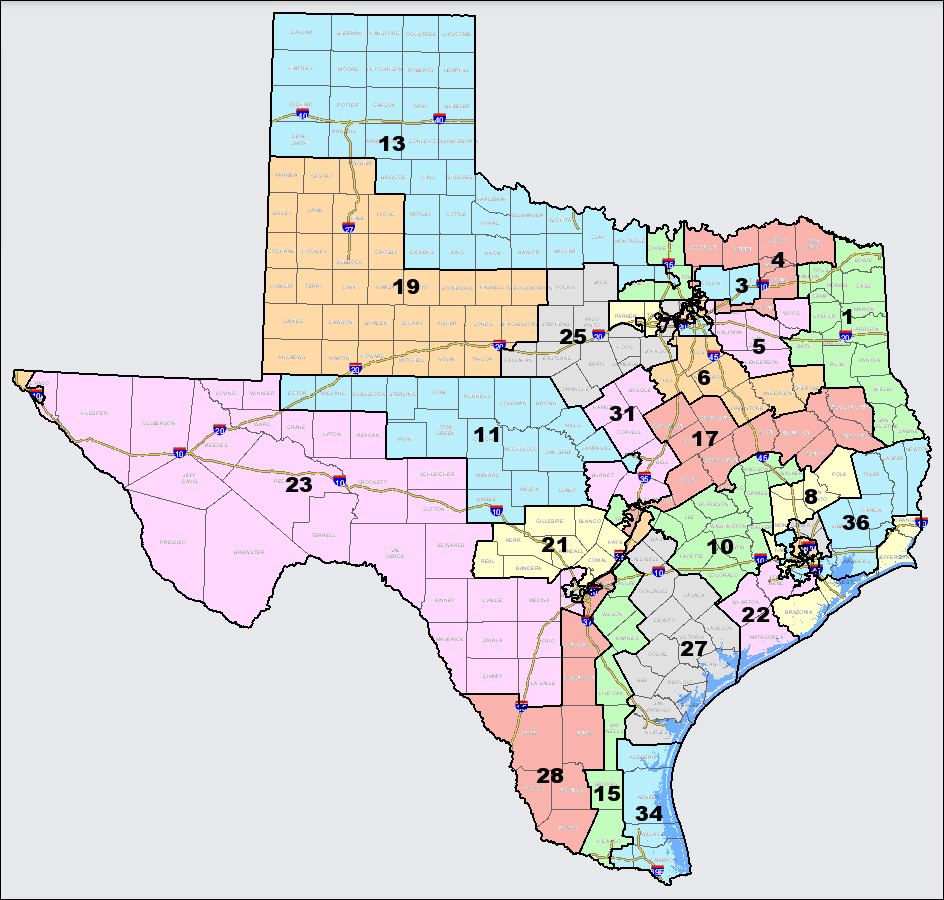
Texas Congressional Redistricting Map (click here or on map to see larger, interactive version)

By Jim Ellis

March 28, 2022 — If the upcoming Alaska special election isn’t complex enough, with the top-four jungle primary feature complete with Ranked Choice Voting that will be used to replace the late at-large Rep. Don Young (R-Ft. Yukon), the developing situation in Texas may be even more confusing.

A year ago March, five-term South Texas Rep. Filemon Vela (D-Brownsville) announced that he would not seek re-election in 2022, becoming one of the first sitting incumbents to enter into lame duck status. Late last week Vela made public his intention to resign in the “next few weeks” in order to accept a position with the Akin Gump law firm.

Texas election law states that a vacancy in office must be filled at the next regular election, or earlier if the governor rules that an emergency exists. In a similar situation before the regular 2018 election, Gov. Greg Abbott (R) called an emergency special election to immediately replace resigned GOP Rep. Blake Farenthold. Current Rep. Michael Cloud (R-Victoria) won his initial election as a result.

In the current political climate, with the country facing record inflation, sky-high energy prices, a border crisis, oil and gas production limitations as a matter of policy, and a hostile invasion in eastern Europe not seen since the days of Adolph Hitler in the pre-World War II period, the governor could easily claim that enough issues need addressing by a full Texas delegation. Therefore, he could justify calling an immediate special election.

If so, the situation becomes interesting. The winner of Rep. Vela’s 34th District open Democratic primary on March 1 was sitting 15th District Congressman Vicente Gonzalez (D-McAllen). He is seeking re-election in the 34th with Rep. Vela’s endorsement instead of in his original district that is trending more Republican. Therefore, if a special election is held prior to the regular election, Rep. Gonzalez would have to resign his 15th CD seat upon winning the subsequent election, thus creating another short-term vacancy.

Continue reading

Redistricting-Forced
Contested Pairings

By Jim Ellis

March 25, 2022 — Redistricting has largely been responsible for six sets of congressional pairings — that is where two incumbents are forced to compete against each other in one new district. Each party sees three intra-party pairings, with the first being decided in West Virginia on May 10.

New polling was released in the Mountain State contest, which features Reps. David McKinley (R-Wheeling) and Alex Mooney (R-Charles Town) battling in a new northern 2nd District. West Virginia lost its third district in national reapportionment, and even though the GOP controls the redistricting pen, the party obviously had to absorb the lost seat since all three current House members are Republicans.

Rep. Mooney, being in the middle district of the original three, always the least advantageous geographical position, had his district split between the northern and southern seat. All but one percent of Rep. McKinley’s current 1st District is contained in new District 2, while just 49 percent of Rep. Mooney’s current 2nd carries over to the new 2nd. All of Rep. Carol Miller’s (R-Huntington) current 3rd District is fully contained within the new 1st as well as 51 percent of Rep. Mooney’s current WV-2.

Two early 2022 surveys, in January from Public Opinion Strategies and February from WPA Intelligence, found similar leads of 45-32 percent and 43-28 percent for Rep. Mooney. This week, however, the West Virginia Chamber of Commerce released their North Star Opinion Research survey (March 13-15; 400 WV-2 likely voters) and their results found Rep. McKinley rebounding to record a 38-33 percent edge. With polling showing a tightening of the race, we can expect a close finish in what should be regarded as a toss-up campaign.

Georgia

The Georgia Democrat pairing between Reps. Carolyn Bourdeaux (D-Suwanee) and Lucy McBath (D-Marietta) in the new Atlanta suburban 7th CD looks to be leaning toward the latter woman even though she sees a very low constituent carryover factor from her current 6th District.

This race will likely be decided on May 24, but since Georgia is a runoff state, there is always the mathematical possibility that the minor candidates could force a secondary election because their combined vote could be enough to keep both major contenders from reaching the 50 percent plateau.

An early January Data for Progress survey found Rep. McBath holding a nine point lead, 40-31 percent, despite the fact that only 12 percent of the new 7th comes from Rep. McBath’s 6th, as compared to 57 percent of the new population base who currently live in Rep. Bourdeaux’s district. On the other hand, McBath is much stronger with the regional Democratic base voter than is Bourdeaux.

Michigan

Two other paired contests are even tighter. Though the Michigan Democratic pairing between Reps. Haley Stevens (D-Rochester Hills) and Andy Levin (D-Bloomfield Township) won’t be decided until the Aug. 2 Democratic primary, two recently released surveys already detect a dead heat.

Lake Research Partners released data from their Feb. 15-20 survey that found the two Democratic members tied with 36 percent support apiece. Earlier in the month, Target Insyght found an almost identical conclusion from their ballot test question, with Reps. Stevens and Levin tied at 41 percent. In January, Impact Research released their study that posted Rep. Stevens to a seven-point advantage, 42-35 percent.

In this situation, Rep. Stevens sees a 45 percent carryover factor from her current 11th District, while Rep. Levin will have only 25 percent of his current 9th District constituency in the new 11th.

In Congressman Levin’s favor, however, is home base status. The Bloomfield Township region, which provided the base vote for his father, Sander Levin, whose career in the House lasted 36 years, and his uncle, the late Sen. Carl Levin who served his own 36 years in Congress, is fully intact within the new 11th. Conversely, Stevens’ home precincts within the Rochester Hills area are not included in the new 11th. This likely gives Levin the advantage of having the more driven supporters, which matters greatly in a lower turnout primary election.

Illinois

Turning to Illinois, in a race that will be settled in the June 28 primary, Reps. Sean Casten (D-Downers Grove) and freshman Marie Newman (D-La Grange) also appear locked in a tight battle for political survival in the western Chicago suburbs. Unlike all the other paired districts that are safe for the winning paired member, the IL-6 CD could become a general election battleground.

In the new 6th, Rep. Newman sees more of her constituents comprising the new district, as just over 41 percent of her current 3rd District voters will be present in the new 6th. This number compares favorably to Rep. Casten’s constituent carryover factor of just 23.5 percent coming from the current 6th. Like in the aforementioned Michigan pairing, one member’s home base is within the district, in this case Casten’s, while the other, Newman’s La Grange region, is not.

Also, as in two of the other pairings, we see an early cycle even split between the two candidates. According to a Victoria Research Feb. 10-15 survey, the two House members were tied at 37 percent apiece.

No polling data is available for the other two pairings — the Illinois Republican battle between Reps. Rodney Davis (R-Taylorville) and Mary Miller (R-Oakland) in the new 15th CD, and Michigan Reps. Bill Huizenga (R-Holland) and Fred Upton (R-St. Joseph) in their state’s new District 4.

Davis has the advantage with the establishment Republicans while Rep. Miller, with former President Trump’s endorsement, is the ideological base vote favorite.

Despite running more than $200,000 in ads for the upcoming primary, Michigan Rep. Upton still says he has not yet committed to running again. He has until the April 19 candidate filing deadline to make a final decision. Upton has the geographical advantage in the new 4th (64 percent carryover to 25 percent), but Huizenga has the Trump endorsement and is stronger with the ideological base.


House redistribution statistics can be found on the Daily Kos Elections website.

North Carolina Races Set – Part I

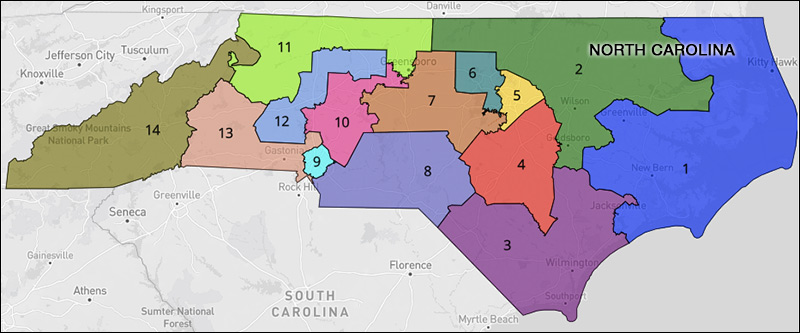
2022 North Carolina Congressional Redistricting Map

By Jim Ellis

March 8, 2022 — The chaotic Tar Heel State political scene quelled on Friday as the postponed candidate filing period finally came to a close. Today we look at the recent North Carolina redistricting past and future, along with an analysis of the open Senate race. Tomorrow, we examine the state’s 14 new US House districts.

The North Carolina state Supreme Court’s approved map will be in place for the 2022 midterm election, and as a result the candidate slate is less competitive than the originally conceived congressional plan would have yielded. While the Democrats won this most recent political battle, the state’s redistricting war, a fight between the legislature and state Supreme Court that has resulted in four different congressional maps being in passed into law and ultimately rejected since 2010, will likely continue.

The Republican legislature controls the redistricting pen because the North Carolina governor, in this case Democrat Roy Cooper, has no veto power over this subject matter. Democrats control the state Supreme Court with a 4-3 partisan majority, but there is at least an even chance that the balance of power will change after the midterm election.

Two of the Democratic judges are on the ballot this year and no Republicans. One of the two, Justice Robin Hudson, is not seeking re-election, so GOP chances of winning at least one of the two races are enhanced. If they succeed, Republicans will hold the court majority after the first of the year.

Since a court map is only an interim plan, the legislature can replace it at any time. Since the state high court did approve the legislature’s latest version of the state House and Senate maps, Republicans stand a strong chance of maintaining their majorities in both houses. Therefore, re-drawing the congressional map in 2023 should the NC Supreme Court have a different complexion could mean that the GOP would be able to enact a stronger plan next year.

Originally, North Carolina arguably looked to be the Republicans’ most important redistricting state in that it was one of just two places where the party could gain multiple congressional seats and the only one where a potential three-seat increase was within the realm of possibility. The outlook for the final 2022 map, however, gives the Democrats an advantage. It now appears more likely that the Dems will gain one or even two seats in the delegation.

The North Carolina judicial decision is a major blow to House Republican national prospects. While the party still has a good chance of re-taking the majority they lost in the 2018 election, the difficulty factor has increased through adverse court decisions here and in several other states.

Continue reading

North Carolina Redistricting II

2022 North Carolina Congressional Redistricting Map (click on image or here to go to interactive map: Dave’s Redistricting App)

By Jim Ellis

Feb. 23 2022 — Both houses of the North Carolina state legislature have now passed a new congressional map to replace the original version that the state Supreme Court previously rejected.

The new plan now undergoes judicial review as early as tomorrow before final enactment. The legislators agreed upon a plan to meet the pre-determined judicial schedule. The districts must be set to meet an impending March 4 candidate filing deadline for the March 8 primary that was initially postponed to May 17. Any further redistricting delays will likely move the primary once more, this time to June 7.

The high court struck the plan because the justices determined the map was a political gerrymander and, on the original map, that Democrats were under-represented.

The previous map would likely have produced 10 Republican victories as opposed to four Democratic wins. The current division in 8R-5D. The state gained a new seat in national reapportionment, thus increasing the Tar Heel state delegation to 14 members.

The proposed map is certainly more competitive. Preliminary analysis suggests that the Republican nominee would be favored in six of the seats and the Democrats four, with an additional four being cast into a highly marginal category.

The legislature also restored the previous numbers to the districts, making statistical comparisons easier to understand. The members receiving what should be favorable districts are: Reps. Deborah Ross (D-Raleigh; District 2), Greg Murphy (R-Greenville; District 3), Virginia Foxx (R-Banner Elk; District 5), Richard Hudson (R-Concord; District 8), Dan Bishop (R-Union County; District 9), Patrick McHenry (R-Lake Norman; District 10), Madison Cawthorn (R-Hendersonville/Asheville; District 11), and Alma Adams (D-Charlotte; District 12).

Democrats would then be favored in open District 1 (Rep. G.K. Butterfield (D-Wilson) retiring) and open District 4 (Rep. David Price (D-Chapel Hill) retiring).

Incumbents relegated to highly competitive seats are Reps. Kathy Manning (D-Greensboro; District 6) and David Rouzer (R-Wilmington; District 7). The Dave’s Redistricting App statistical organization rates the Manning 6th District as a seat having a voting pattern that divides the two parties by less than one percentage point: 49.44 percent for Republicans and 49.18 percent for Democrats. The Rouzer District 7 breaks similarly: 49.39 percent for the Democrats and 49.04 percent for Republicans.

According to the FiveThirtyEight statistical organization that has not yet scored the new plan, the previous Manning 6th District rated as a D+21 and the Rouzer 7th CD, an identical partisan spread of R+21. Therefore, these two districts going to an even rating clearly changes the entire map’s outlook, and obviously so for this pair of incumbents.

Continue reading