Tag Archives: President Obama

Romney Strikes Back

Just before the Oct. 3 presidential debate, conventional wisdom held that the national race had effectively ended and President Obama was on the threshold of clinching re-election. He was consistently ahead in all nationwide polls, and in every key swing state. Oh, what a difference a week makes.

With his debate performance as the catalyst propelling Republican nominee Mitt Romney back into contention, a series of new polls now shows a complete race reversal.

Eight national surveys were released yesterday and, for the first time, it is Romney who leads or is tied in the preponderance of them. Gallup, the American Research Group (ARG), Public Policy Polling, and the Investors Business Daily’s TIPP poll all post Romney to a lead of one or two points. Two studies, Ipsos/Reuters and Rasmussen Reports, project a tie between the two candidates, while UPI/CVoter and Zogby Research for The Washington Times still find the President leading by a lone percentage point.

But the national data tells only part of the story. In the most important core and secondary states of North Carolina, Ohio, Colorado and Nevada, Romney has gained strong momentum and leads in several polls.

North Carolina, by all accounts a critical core conversion state, yields to a Gravis Marketing study (Oct. 6-8; 1,325 likely North Carolina voters) that projects Romney to a major 50-41 percent lead, obviously his biggest margin of the campaign in the Tar Heel State. Along with Florida, Ohio and Virginia, North Carolina is in virtual must-win status for the Romney campaign.

Ohio, another of the four core states, features trends that are mixed in declaring a leader, but all polls show significant movement for Romney. The American Research Group (Oct. 5-8; 600 likely Ohio voters) gives the challenger a one-point 48-47 percent edge. Survey USA (Oct. 5-8; 808 likely and actual Ohio voters) also finds a one point difference between the candidates, but their data still has the President in front, by a scant 45-44 percent margin. Finally, in better news for Obama, the CNN/ORC survey (Oct. 5-8; 888 likely voters) gives the president a 51-47 percent lead.

In the secondary states, the places Romney would need to win should he fail to carry all four of the core states, are also turning in favorable numbers for the GOP challenger. Colorado, a state trending blue in 2008 and electing a Democratic senator in the Republican landslide year of 2010, has been showing signs of returning to the GOP column. The latest ARG poll (Oct. 5-8; 600 likely Colorado voters) gives Romney his first Centennial State lead, 50-46 percent, after following closely behind Obama even in the days when the president was beginning to break away in other places.

Staying out west in Nevada, another state showing signs of returning to the Republican fold after four years of relatively consistent Democratic voting patterns, Rasmussen Reports (Oct. 8; 500 likely Nevada voters) projects the two candidates being tied at 47 percent.

The latest swing toward Romney is actually quite consistent with voter behavior throughout this election cycle. The electorate has often moved both quickly and wildly in responding to late-breaking events. Such is the case with the Romney debate performance. It remains to be seen if this direction holds or if voters will soon snap back toward the president.

The next two presidential debates have now assumed an aura of much greater importance in determining the final outcome of this hotly contested race. Will Romney again be dominant? Will the president rebound? Is the swing toward Romney the beginning of a trend, or a mere blip? Time will soon bring us the answers.
Romney’s Debate Win Has Legs

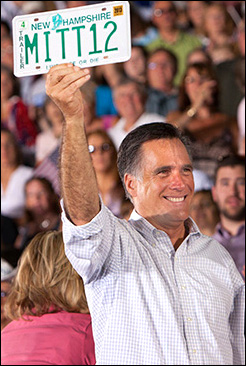
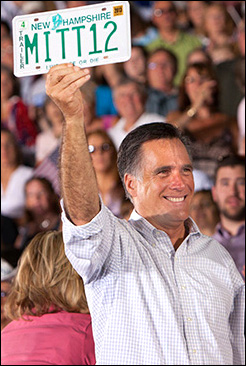
Mitt Romney

The Gallup organization projects Mitt Romney to be the most decisive debate winner in the history of the presidential debates. According to a cell sample of 749 debate watchers questioned over a two-day period following the Oct. 3 forum, Romney was viewed to have won by a 72-20 percent margin, the largest-ever spread. But, does a debate win really carry over into the presidential campaign itself? At least in the short-term, apparently so. Gallup shows the race closing to 48-46 percent in favor of President Obama from the previous 50-45 percent, and the post-debate track reveals a dead even 47-47 percent result.

The Pew Research Center was also in the field during this same time period (Oct. 4-7), recording the responses of 1,112 likely voters from a polling universe of 1,511 adults. Though a few more Republicans were polled than Democrats (403-396), all the aggregate answers were weighted to bring the sampling universe in line with the actual national totals. The weighted responses gave Romney a similar 66-20 percent split in terms of perceiving the debate winner.

Pew also found Romney gaining in some other key areas. In terms of answering which of the two candidate has new ideas, it is now the Republican who is perceived to have them by a 47-40 percent margin, and he’s pulled even with Obama (47-47 percent) as to who is the stronger leader. Romney also is favored to be more successful in reducing the federal budget deficit (51-36 percent), improving the job situation (49-41 percent), and in handling tax policy (47-43 percent). The president is still perceived as the better person to handle Medicare (51-38 percent), health care (47-44 percent, though that margin swung a net 10 points in Romney’s favor since their Sept. 12-16 poll), and in making wise foreign policy decisions (47-43 percent).

The next presidential debates, scheduled for Oct. 16 and 22 will take on a whole new aura and meaning, after what happened in the first meeting. If Romney has accomplished anything, he has put national debating on center stage.

Romney Gaining in Key States

Based upon the media coverage of the first presidential debate, it’s not surprising to witness at least a short-term tightening of the national campaign. Fortunately for Republican nominee Mitt Romney, his standing is also improving in the most important swing states.

In Florida, two polling firms now are projecting Romney to be leading President Obama. The Sunshine State is the Republican’s most important conversion entity because there is simply no way to compensate for losing its 29 Electoral Votes. According to Rasmussen Reports (RR) on the day after the presidential debate (Oct. 4; 500 likely Florida voters), the GOP challenger has taken a two-point, 49-47 percent lead. We Ask America (WAA), which ran approximately 1,200 sample automated polls in the three most important swing states also on Oct. 4, finds Romney now leading in Florida, as well. Their margin is 49-46 percent.

Similar results are found in Virginia, another of the critical four core states. Romney’s easiest path to victory is to convert each of the cores (Florida, North Carolina, Virginia and Ohio), and then take at least one more Obama state that is larger than Vermont or Delaware. The President wins re-election, for all intents and purposes, if he takes Florida or any two of the core states.

Rasmussen Reports, testing 500 Old Dominion state likely voters on Oct. 4, found a 49-48 percent Romney lead in Virginia. We Ask America, also on the same date, detected a 48-45 percent GOP challenger advantage.

In Ohio, RR still forecasts the President to be leading, but by just one point, 50-49 percent. WAA, however, sees Romney forging ahead in this critical state, up by the same one-point spread, 47-46 percent.

Regardless of whether these small margins are completely accurate, they do tell us that Romney did receive, at the very least, a quick momentum surge that penetrated into the states that will have the largest say in determining the final outcome of this presidential election.

It remains to be seen if the Romney debate bump sustains itself for more than a few days. The electorate, throughout the 2012 election cycle, seems all too willing to shift on a dime and the challenger’s improved standing could be yet one more example of this phenomenon. If so, then the vast majority of polling between now and the last week of October won’t tell us too much because we know things can quickly change based upon external events. If Romney’s improved standing holds through the next week, though, then a new, firmer Republican base may well be formulating.

What we can confidently determine is that 39 states and the District of Columbia have made their decision about this presidential contest. Among the decided states, the President enjoys a 201-176 advantage. This means Pres. Obama needs to convert 69 of the remaining 161 Electoral Votes, or 43 percent of them. Romney, on the other hand, needs 57 percent — or 94 of the remainder.

    The 11 undecided states are, from west to east:

  • Nevada (tilting Obama, but approaching toss-up status)
  • Colorado (tilting Obama, but approaching toss-up status)
  • Iowa (pure toss-up)
  • Wisconsin (tilting Obama, but approaching toss-up status)
  • Michigan (leaning Obama)
  • Ohio (leaning Obama)
  • Pennsylvania (leaning Obama)
  • New Hampshire (leaning Obama)
  • Virginia (tilting Obama, but approaching toss-up status)
  • North Carolina (leaning Romney)
  • Florida (tilting Romney, but again approaching toss-up status)

Understanding where the states currently stand, and even giving Iowa to Romney, the president would win re-election with 297 Electoral Votes. But, make no mistake, his political position is precarious. For an incumbent to be this close to losing a month away from Election Day is a bad sign for him because the majority of voters are not yet positively convinced after four years of performance from which to judge. This race remains undecided.

Is Maine’s King Losing His Luster?

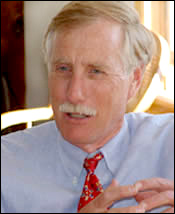
Angus King

Perhaps until right now, it had been a foregone conclusion that Maine’s Independent former governor Angus King was the prohibitive favorite to replace the retiring Sen. Olympia Snowe (R). After the National Republican Senatorial Committee (NRSC) and other outside advocacy organizations unleashed heavy anti-King media spending, however, the former two-term state chief executive’s polling numbers have come back to earth. And, in a three-way race where the majority of voters will likely vote for someone other than the eventual winner, virtually anything can happen.

The race pits King against GOP Secretary of State Charlie Summers and Democratic state Sen. Cynthia Dill. King, who champions liberal causes as indicated by his support from the trial lawyers PAC, the Council for a Livable World, and Google PAC, is portraying himself as an independent moderate, even going so far as having actor Sam Waterston appear in a television commercial to echo his campaign theme.

A new GS Strategy Group survey conducted for the NRSC shows King’s lead diminishing severely. Though he continues to place first, his margin is now only 37-33-17 percent over Summers and Dill. In another poll released to MaineToday Media on Sept. 20, King leads 50-28-12 percent. But, driving below the original ballot test numbers for that particular survey, the King supporters who say they are definitely voting for him register only 32 percent.

Maine has a penchant for electing candidates who don’t belong to either major political party. In addition to King, Independent Jim Longley was elected governor in 1974. Two years ago, Independent Eliot Cutler finished a strong second to Republican Paul LePage, losing by less than two points. It is the latter election that Charlie Summers is hoping to emulate. Assuming he holds the base Republican vote of 37-39 percent, Democrat Dill topping 20 percent would give him a chance to slip past King. This would be virtually identical to the vote dispersion that elected LePage.

The Maine Senate race is an interesting one, because if President Obama is re-elected and the Republicans hit 50 in the Senate, both of which are quite possible, it would be King alone who would decide which party would assume majority control. Most believe that he will caucus with the Democrats, which is most likely, but stressing his independence certainly makes it more difficult for him to immediately fall into the Democratic fold. Even his slogan, “… as Independent as Maine,” stresses that Mr. King is not inclined to easily conform to Washington’s over-heated partisan divisions.

The Chamber of Commerce has run a series of ads playing upon King’s name, referring to him as “the King of spending” during his tenure as governor. The claim that he over-spent and then left the state with a huge deficit is resonating in this political climate and is a probable reason for King’s decline. The former governor retorts that he cut taxes, improved education, and protected Maine’s open space.

But the more intriguing part of the campaign revolves around Dill. She has little in the way of campaign funding, so outside organizations are trying to improve her standing. The NRSC, in a negative way, but designed to improve her standing among Democrats, is illustrating that she is even more liberal than King. Meanwhile, outside groups are driving home the message that King is flawed and Dill is the preferred progressive candidate.

The dynamics of the Maine Senate race are the most unusual in the nation, and much more is potentially riding upon the election outcome than who represents the state in Washington. Under the proper circumstances, the entire Senate majority may rest upon this one campaign.

Two Long Shot Races Turning

A pair of under-the-radar Senate races are now becoming competitive, recent polls indicate. In Arizona and Pennsylvania new publicly released surveys put a Democratic and Republican underdog in the national spotlight for the first time.

In the Grand Canyon State for the seat of retiring Sen. Jon Kyl (R), polling results from Democratic nominee Richard Carmona, the former U.S. Surgeon General under President George W. Bush, places him in a virtual tie with his favored Republican opponent, Rep. Jeff Flake (R-AZ-6). Anzalone Liszt Research, polling for the Carmona campaign, surveyed 600 likely voters over Sept. 18-23 period and projected 44-43 percent results. Other recent surveys also put the Arizona seat in play, but their margins still favor Flake beyond the margin of error. Rasmussen Reports publicized a study earlier this week giving the congressman a six-point, 47-41 percent lead, and the international research firm YouGov posted mid-September data that projected the Republican nominee to be enjoying a similar 43-37 percent margin.

Flake, a six-term congressman from Mesa, Ariz., is best known as one of the leaders of the movement to end spending earmarks. Opposed in the late August Republican primary, he easily defeated wealthy businessman Wil Cardon. Many Democratic strategists believe that Dr. Carmona, an Independent-turned-Democrat who President Obama and Senate Majority Leader Harry Reid encouraged to run, can score an upset win. While current polling is beginning to show serious competition, voting history nonetheless yields a conclusion that the seat will stay red.

In the Keystone State of Pennsylvania, we see another Senate race growing tighter as we inch closer to Election Day. Incumbent Democratic Sen. Bob Casey Jr. has maintained a sizable lead throughout the campaign, however, his challenger, a self-funding former Democrat, appears to be making a move. Recently the seat has moved from “likely” to “lean Democratic” proving that GOP nominee Tom Smith is gaining ground against the incumbent. With President Obama polling well in Pennsylvania, Smith will have to run substantially ahead of his own presidential nominee to record a surprise win, making his uphill task even more difficult.

Tom Smith is a former coal company chief executive officer who handily won the Republican primary with multi-million dollars in personal expenditures. Smith is making a strong issue of his coal background and using recent plant closings as a way to draw a contrast between himself and Casey. Smith will attempt to take advantage of Obama’s Cap & Trade legislative initiative that proved so lethal to Democrats in the 2010 elections. Pennsylvania is the nation’s fourth largest coal producer, providing over 5 percent of the nation’s aggregate total.

Recent polls do suggest positive movement for Smith, leaving the Democrats a bit uneasy. A Quinnipac University poll (1,180 likely voters, +/- 2.9% error factor) released this Wednesday showed Sen. Casey leading the Republican just 49-43 percent, a drop all the way from 55-37 percent (a net swing of 12 points) in late July. Another contemporary Susquehanna Research survey published in the Pittsburgh Review Tribune newspaper also showed a similar split with Casey only leading 46-41 percent.

It’s clear from the political metrics that Smith is making gains, but is it too little, too late? With Obama consistently leading Mitt Romney here and Sen. Casey maintaining at least a small edge over challenger Smith, the patterns still suggest the Pennsylvania Senate seat will remain in the blue column.

Matheson Gets No Love

Rep. Jim Matheson

A new internal Public Opinion Strategies poll for Utah congressional candidate Mia Love shows the challenger opening up a huge lead over six-term incumbent Jim Matheson (D-UT-2). The two contenders are running for the state’s new 4th Congressional District, a seat awarded the state in the 2010 reapportionment formula. The new UT-4 stretches from the southern Salt Lake City suburbs to the center of the state and includes such communities as South Salt Lake City, Millcreek, West Jordan and South Jordan, and Love’s home town of Saratoga Springs. Matheson only represents 33 percent of the new district, but it does contain the most Democrats of the state’s four congressional seats. Still, President Obama could only register 41 percent support here in 2008 and figures to do worse this time with semi-favorite son Mitt Romney leading the Republican ticket.

The new POS data for the Love campaign (Sept. 10-11; 400 likely UT-4 voters) gives the Republican a whopping 51-36 percent lead over Rep. Matheson. Though the congressman still has a positive image (57:33 percent favorable to unfavorable), a full 50 percent of those questioned now say they want a new representative.

Mia Love, 36, born of Haitian parents and elected to the city council and now mayor of her home town, received a prime speaking position at the Republican National Convention and scored rave reviews for her message and performance. The address jump-started her campaign and this new poll evidences that she is one of the country’s top Republican challengers. Expect to see a Matheson counter poll released shortly. Failure to do so will silently confirm the POS results.

The Conflicting Trends

Though we spend a great deal of time writing about and analyzing polls, it is important to remember that even though individual ballot test data is helpful and allows us to gauge campaign trends, the isolated individual polls themselves can be misleading. Today’s examples coming from Nevada and Ohio are a case in point. In both states, polls conducted during the same sampling period are producing considerably different results.

In Nevada, Public Policy Polling (Sept. 18-20; 501 likely Nevada voters) and Public Opinion Strategies (Sept. 19-20; 500 likely Nevada voters) can’t even agree on which Senatorial candidate is leading the race. A similar range conflict is found in the Ohio Senate race between Gravis Marketing (Sept. 21-22; 594 likely Ohio voters) and the Washington Post (Sept. 19-23; 759 likely Ohio voters), though the incumbent, Sen. Sherrod Brown (D), leads in both studies.

Looking at the Silver State, PPP projects Democrat Shelley Berkley to have a 48-44 percent lead over appointed Sen. Dean Heller (R). But POS is posting Heller to the opposite position, as they show the Senator topping Berkley 44-39 percent. Among the Buckeye State likely voters (the Washington Post poll provides separate results for their larger sampling universe of 934 registered voters and the whittled down cell segment of 759 likely voters), the WP Poll gives Sen. Brown a substantial 51-43 percent advantage, while Gravis sees only a one-point difference (Brown over state Treasurer Josh Mandel (R) 44-43 percent) between the two candidates.

Examining the aggregate for all four polls, the net swing in Nevada is D minus 7 points from PPP to POS, while both show the same level of support for Republican Heller (44%). Interestingly, the Gravis and Washington Post Ohio polls reveal a similar effect. While Democrat Brown swings seven points between the two surveys, Republican Mandel scores the same level of support in both, 43 percent.

The presidential numbers in both states also show similar divisions. PPP gives President Obama a 52-43 percent lead over Mitt Romney in Nevada, while POS shows the two candidates tied at 46 percent. In this case, PPP is six points higher for the Democratic candidate and three points lower for the Republican for a net swing of nine points. In Ohio, the Washington Post gives Mr. Obama a 52-44 percent edge among likely voters while Gravis Marketing projects only a one-point 45-44 percent margin in the President’s favor. Again, the two polls detect the same level of support for the Republican candidate, but vary rather substantially (once more, a difference of seven points) for the Democratic contender.

All four of these polls are live interview surveys, as compared to those using the Interactive Voice Response method, so these studies are all in the “apples to apples” comparison category. All are making their own unpublished determination as to what they define as a “likely voter.” The pollsters weight the responses to mirror the state’s population and voter registration and preference history but don’t reveal their particular weighting equations. And, clearly, this distinction is key in relation to the Democratic scale because the Republican numbers among these various studies remains constant, or virtually constant (GOP presidential number in Nevada is different).

What does this tell us? Again, looking beyond the original ballot test numbers, we are seeing clear variance, particularly on the Democratic side. This is more than likely the result of the particular pollster’s sample selection, weighting equation, and likely voter determination while, of course remembering that all polls are a mere snap shot in time of a very small group of people. This is why contrasting multiple polls to obtain a picture of a particular campaign is so important, because the comparison tells a much different story than looking at any one of these polls individually.

Throughout this election cycle, pollsters have been detecting an electorate that is inconsistent and can abruptly swing. The polls we compare today certainly continue to show such characteristics. This means, to a large extent, that we are flying blind into Election Day, and that the final determining factors either haven’t yet happened or are not fully cemented.

Battleground Poll: Favorable Romney Trends

Mitt Romney

The Battleground Poll, now in partnership with George Washington University, released a new survey (Sept. 16-20; 1,000 likely voters) yesterday that contains some surprising trends. The Battleground survey is a joint, long-standing, non-partisan effort from Republican pollster Tarrance & Associates and the Democratic survey firm of Lake Research. Their new data posts Republican Mitt Romney to a substantial lead within critical swing demographic segments despite President Obama scoring a 50-47 percent national advantage.

Rather stunningly, Romney has a nine-point lead among white women and a seven-point advantage among people 45 years of age and older. Considering the Obama campaign strategy has been to paint the Romney-Ryan ticket as the enemy of senior citizens, this poll suggests that this tactic has not gained any traction within the targeted segment. A bit less surprising are Romney’s 14-point positive numbers with married respondents.

But, perhaps the most significant part of the data pertains to the candidates’ middle-class performance. According to Battleground, it is Romney, despite all of the middle-class emphasis put forth from the Obama campaign, who has a 14-point edge within this economic demographic sector.

If the Battleground data is accurate, it is telling us that the Obama campaign is failing in two of its core strategic objectives: creating the Romney negative image they want voters to envision as it relates to cutting Medicare, and middle-class tax policy. If true, the ballot test numbers should soon begin swinging Romney’s way.

Republican House Prospects Looking Strong

Last week, Anne Brady, former finance director of the Democratic Congressional Campaign Committee, analyzed the House races from her perspective. Today, Jeff Burton, the Deputy Executive Director of the National Republican Congressional Committee, offers the GOP analysis.

House Democrats held a press conference last Thursday where Minority Leader Nancy Pelosi proclaimed that her party has a “very excellent chance” of winning the majority in the upcoming general election. There’s just one problem – just about every pundit disagrees. Even other Democrat Party leaders fail to share their former Speaker’s opinion. Whoops. Last Monday, Senate Democratic Whip Dick Durbin (IL) said he expects the House to remain in Republican hands, and Robby Mook, Executive Director of the DCCC, said just a few weeks ago, “Today, we are in a neutral environment. It is a pretty steep climb in a neutral environment. It’s tough.”

Democrats need to pick up a net of 25 seats to take control. With a month and a half before Election Day, Republicans stand an excellent chance of not only keeping control, but also gaining seats and expanding our majority in the House.

Here’s why:

History is on Our Side – Only once since WWII has the party holding the White House gained more than 15 House seats in a presidential election year. That was in President Johnson’s 1964 landslide win over Sen. Barry Goldwater. President Obama’s negatives (ObamaCare, Cap & Trade, stimulus, economy & jobs) are so ingrained with voters that there is virtually no chance of a Democratic landslide.

Republicans on Offense – In 2010, the NRCC spent over 98 percent of our election money on offense. Going in to 2012, our strategy was to stay on offense and not let the Democrats spend the bulk of their money in Republican seats. Currently, of the $50+ million that the NRCC has reserved for TV this fall, we are spending 40 percent of it on offense, with Democrats following us in most places in an attempt to defend their endangered seats. Needless to say, a majority is not won by spending the bulk of your resources playing defense.

Message – Recent polling shows voters are putting more and more blame for the bad economy on President Obama. The Obama economy has precipitated the worst economic recovery in our nation’s history, and voters aren’t ready to let Democrats get away with it. Despite the Supreme Court ruling, ObamaCare is still an albatross around the necks of congressional Democrats. The Congressional Budget Office just upped both the overall cost of ObamaCare and the commensurate amount of Medicare cuts for current seniors that offset the massive new federal expenditure. Our message of reducing spending & debt, creating jobs, and repealing and replacing ObamaCare continues to resonate with voters. Our incumbents and candidates have done a great job of communicating this message.

Resources – The Democratic Congressional Campaign Committee (DCCC) talks a lot about how they have out-raised the NRCC for the cycle. But, as any small business owner will say, ‘you can’t spend gross, you can only spend net’. According to the last report (end of August), the NRCC had $10 million more cash-on-hand than the DCCC. What does $10 million buy? It buys a month of television in Chicago, Sacramento, Denver and Las Vegas: all expensive markets where both parties are playing both offense and defense in multiple districts.

The Drive for 25 – This was the slogan the Democrats came up with after they lost the majority in record-breaking fashion back in 2010. Their math, however, doesn’t add up. Because of redistricting and key Democrat retirements in seats like OK-2 (R+14), AR-4 (R+9) and NC-13 (R+10), Republicans have a number of “gimmies” that we should pick up without spending any money. This, coupled with DCCC recruiting failures in seats in New York, Arkansas, Pennsylvania, California, Illinois and Florida, and redistricting victories in North Carolina and across the country, provides the basis for every non-partisan political analyst (and even the liberal New York Times) to say that Democrats really need to pick up somewhere between 35-40 Republican seats to win the majority.

All these factors lead to a neutral political environment. Head to head, I would take our incumbents and challengers over theirs any day. So Nancy Pelosi’s “very excellent chance” to take back the House is nothing more than a pipe dream. She won’t be wielding the Speaker’s gavel anytime soon. Hopefully, she never will again.

Three Senate Races Turn Again

Yesterday we reported on recent Senate trends that looked favorable for Republicans, but new just-released polling shows a trio of races producing positive Democratic numbers. Within the last week Republican candidates were pulling ahead in Indiana, Massachusetts and Wisconsin. Now Democratic sources say those races have abruptly turned around.

In the Hoosier State, the Global Strategy Group, polling for the Joe Donnelly campaign (Sept. 8-10; 800 likely Indiana voters), reports that their candidate is leading Republican nominee Richard Mourdock by a 45-42 percent count.

Western New England University (Sept. 6-13; 545 registered Massachusetts voters), which has previously polled the Massachusetts Senate race and posted Sen. Scott Brown to a lead, now shows challenger Elizabeth Warren to be opening up a six-point, 50-44 percent advantage. This poll has a small sample and a long interview period, both negative reliability factors. Additionally, Public Policy Polling (Sept. 13-16; 876 likely Massachusetts voters) also puts Warren ahead of Brown, but by a smaller, and probably more realistic, 48-46 percent margin.

Turning to the Badger State of Wisconsin, where all post-August primary polls have shown former governor Tommy Thompson to be enjoying leads of varying sizes over Rep. Tammy Baldwin (D-WI-2), the Democrats are producing new surveys touting a different result. The Feldman Group for the Baldwin campaign (Sept. 9-12; 800 likely Wisconsin voters) gives their candidate a 50-45 percent lead over the Republican nominee. Public Policy Polling, conducting a survey for the liberal organization Democracy for America (Sept. 12-13; 959 likely Wisconsin voters) gives Baldwin a three-point, 48-45 percent slight edge. This poll also shows President Obama clinging to the barest of leads over Mitt Romney in Wisconsin, a 49-48 percent count.

The campaigns are fluid, so these snap-shot numbers could be accurate, at least in the short term. The Indiana data is internally sourced from the Democratic campaign, which is always suspect without viewing the entire questionnaire. On the other hand, the Mourdock campaign has yet to release countering data of its own. The Western New England University poll likely has a large error factor and should be discounted. The Wisconsin studies could have validity because Thompson has not yet countered two solid weeks of heavy negative advertising against him. Expect more twists and turns in all of these races before November arrives.