Tag Archives: NRCC

GOP Starting to Spend

By Jim Ellis — Thursday, September 24, 2026

Finance

While national Republican organizations hold a sizable cash‑on‑hand advantage over their Democratic counterparts, the GOP is now beginning to spend aggressively — and they have substantial resources to deploy.

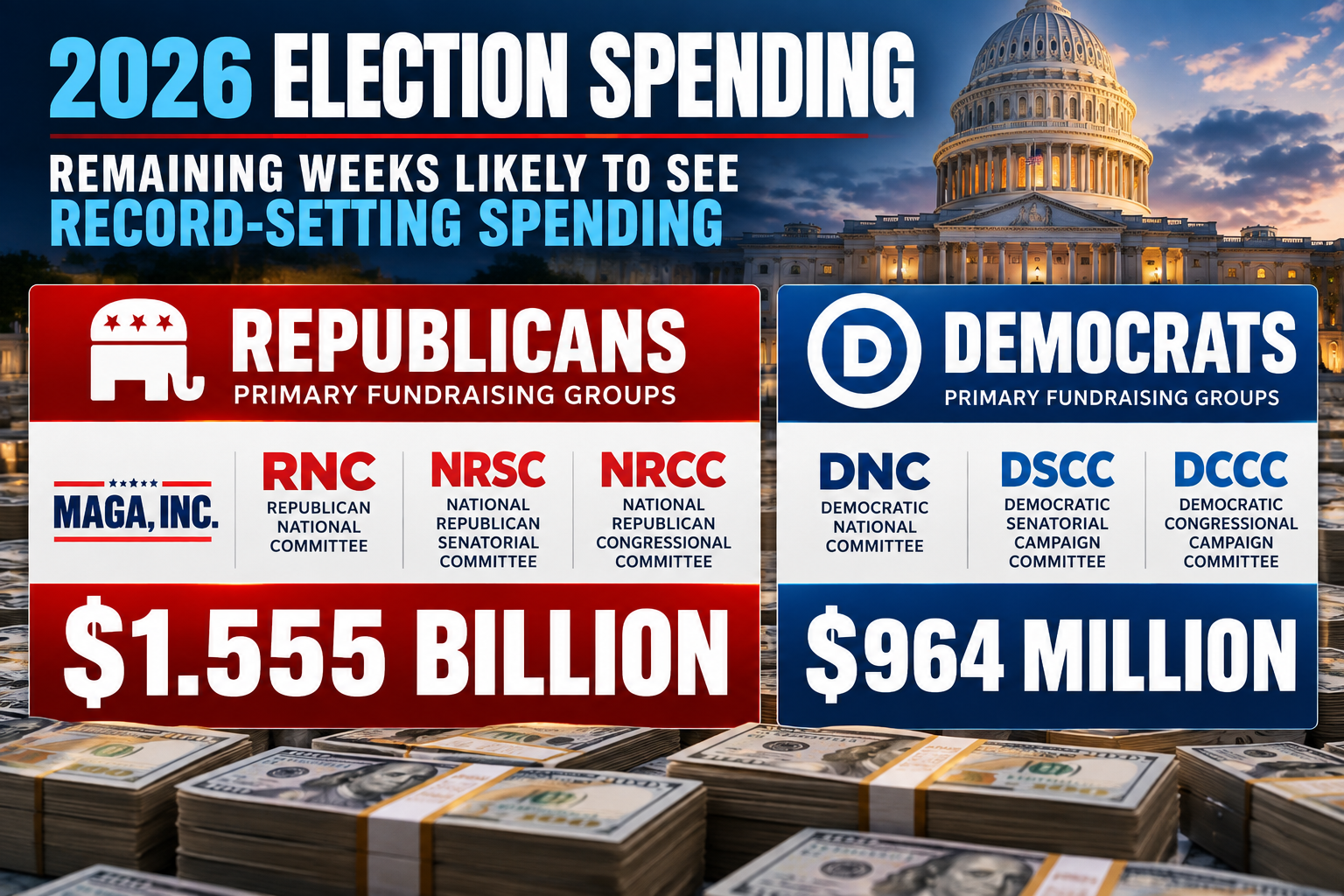
Among the major presidential and party committees, Republicans are led by President Trump’s MAGA, Inc., along with the Republican National Committee (RNC), the National Republican Senatorial Committee (NRSC), and the National Republican Congressional Committee (NRCC). Democrats counter with the Democratic National Committee (DNC), the Democratic Senatorial Campaign Committee (DSCC), and the Democratic Congressional Campaign Committee (DCCC).

Each party also benefits from major outside spending arms aligned with congressional leadership: the Senate Leadership Fund and Congressional Leadership Fund on the Republican side, and the Senate Majority PAC and House Majority PAC for Democrats.

Collectively, these committees have raised more than $2.5 billion in the current election cycle. The largest single entity is President Trump’s MAGA, Inc., which reported an extraordinary $424,389,502 raised through the Aug. 31 monthly filing. The RNC follows with $316,215,037. In aggregate, Republican committees have taken in $1.555 billion for the 2026 cycle, compared to $964 million for the Democratic committees.

Democrats, however, have been the more aggressive early spenders. Across all major party and party‑affiliated committees, Republicans report a combined cash‑on‑hand total of $1.029 billion, while Democrats hold 38 percent of the GOP total: $392 million.

All financial figures come from committee disclosure reports filed on Aug. 31, except those from the Senate Leadership Fund, Congressional Leadership Fund, and Senate Majority PAC, whose next reporting deadline is Sept. 30, with public access beginning Oct. 15.

Another major funding channel for both parties is their online donor platforms, which serve as conduits for small‑dollar contributions to individual campaigns. These entities act as holding companies, transferring funds to campaigns upon receipt. Though campaigns pay significant fees for the service, they benefit from streamlined fundraising without major overhead.

In this arena, Democrats dominate. Despite ActBlue — the party’s flagship online fundraising platform — facing a congressional investigation over potential foreign contributions and other alleged irregularities, and its leaders invoking their Fifth Amendment rights before congressional committees, the organization continues to operate at full speed.

In this cycle, ActBlue has transferred an extraordinary $2.26 billion to Democratic Senate and House candidates. The Republican counterpart, WINRED, has moved more than $748 million to GOP candidates, or 33 percent of Act Blue’s total.

Even with the significant Democratic advantage in online fundraising, the umbrella Republican apparatus still maintains a $564 million overall financial edge. The next question is how the GOP intends to deploy these resources. The first major answers come in Texas and Ohio.

According to AdImpact, the Senate Leadership Fund — through its Texas affiliate — is reserving $100 million in advertising to support Republican Senate nominee Ken Paxton against Democratic state Rep. James Talarico of Austin. The investment is critical for Paxton, whose campaign reported just $1.75 million in cash on hand as of June 30, compared to Talarico’s $21.5 million.

AdImpact also reports that Ohio Sen. Jon Husted’s campaign is positioned to outspend former Democratic Sen. Sherrod Brown by a $90 million to $60.2 million margin in reserved ad time, not including a newly announced $30 million expenditure from the cryptocurrency‑aligned Super PAC Fairshake.

Fairshake spent heavily in 2024 to help defeat Sen. Brown, who, as chairman of the Senate Banking Committee, was one of Washington’s most outspoken cryptocurrency critics.

The remaining weeks of the 2026 election cycle are likely to see record‑setting spending. This cycle has already established a new fundraising benchmark, but it will almost certainly be surpassed, and in short order.

Expect the 2028 presidential cycle to be the most expensive in American campaign history — and the gap between first and second place election cycle spending will not even be close.

House Democrats Release “Frontline Program” Targeting Perceived
Vulnerable GOP CDs

By Jim Ellis

Feb. 12, 2019 — Countering the previously announced National Republican Congressional Committee Patriot Program targeting list, the Democratic Congressional Campaign Committee released their Frontline Program protection listing late last week.
Since the Democrats are now in the House majority, their list is wholly defensive in nature while the Republicans are the minority challengers, a juxtaposition of roles from the past four election cycles. Of the 44 Frontline defense districts, 43 are also GOP Patriot Program targets. The lone exception is Connecticut freshman Jahana Hayes (D-Wolcott), a former national Teacher of the Year award winner who won a 56-44 percent victory in her maiden general election campaign.

The targeting organizational programs are important because both official political party apparatuses help the candidates with fundraising, a campaign element where Democrats overwhelmed Republicans in the 2018 election cycle. Therefore, it is likely that the Patriot Program is more important to the previously identified GOP members than the Frontline operation is to the Democratic incumbents, most of whom raised multi-millions in their own right.

Comparing the lists, the 43 top Democratic protection members who are also found on the Republican register could more realistically be narrowed to 27 campaigns that should reasonably be placed in the highest vulnerability category.

In 19 of the 27, President Trump carried the district over Hillary Clinton, and four years earlier Mitt Romney topped President Obama in 17 of the CDs. The Republicans had won all three post-redistricting congressional elections (2012, ’14, ’16) in 22 of the 27 districts prior to the 2018 vote.

Continue reading →

The Spending Clues

By Jim Ellis

nrcc-dcccSept. 28, 2018 — The old saying, “put your money where your mouth is,” certainly applies to campaign politics, and we have new evidence of that. Currently, there is much conjecture and banter about which candidates are going to win various House races, including media prognosticators making predictions about how the Nov. 6 election will unfold, but a better clue as to what the party leaders actually believe can be found in their spending reports.

Looking at the most recent independent expenditures from the Democratic Congressional Campaign Committee (DCCC) and the National Republican Congressional Committee (NRCC) tells us which races the party leadership believes are their top current priorities. For a full report on all recent expenditures, check the Daily Kos Elections blog, Daily-Kos-Elections-Live-Digest-9-26.

Though the latest expenditure reports tell us which are the hot, undecided races, they don’t provide the entire picture. Media market size and previous expenditure amounts also must be considered, particularly the former. For example, a $378,000 DCCC media buy in the 2nd District of Kansas is major, whereas spending $375,000 in Nevada’s 3rd District wholly contained in the expensive Las Vegas market isn’t nearly as large even though the dollar amounts are equivalent.

That being the said, the districts where the DCCC is spending more than $500,000 in current expenditures are:
• VA-10: Against Rep. Barbara Comstock (R-McLean) – $567,000
• MN-1: Open seat defense district – $539,000
• WA-8: Open seat conversion opportunity – $518,000
• NV-4: Open seat defense district – $508,000
• MN-8: Open seat defense district – $500,000

The NRCC is spending similar amounts but not as much in:
• WA-8: $484,000
• FL-26: Protecting Rep. Carlos Curbelo (R-Miami) – $435,000
• VA-10: $422,000

Obviously, the VA-10 and WA-8 races are very hot because both districts are at the top of each party’s expenditure lists.
Continue reading →

The Healthcare Attacks

By Jim Ellis

Sept. 27, 2018 — Now that the economy is rolling, surveys are beginning to show that jobs and taxes are lesser campaign issues.

Some state and district polls indicate that the economy is dropping from the most important issue commonly cited all the way down to number three. Depending on the district or state location, immigration moves into the second slot, while healthcare now becomes the top concern. Most research consistently finds these three issues, in some order, as the most important set of topics that could move voters in an election, however.

Therefore, it is not surprising to see the two major party congressional arms attacking their opponents about healthcare, but from very different perspectives. The method of attack is becoming prevalent in virtually all of the top campaigns.

Democratic Congressional Campaign Committee (DCCC) ad attacking Rep. Peter Roskam (R-IL) in a suburban Chicago race

Democrats, usually using the DCCC as their message delivery entity, though the House Majority PAC, which is the Democrats’ main outside organization commonly involved in congressional races, is also a major part of the attack portfolio, hits Republican incumbents for voting to end coverage for pre-existing conditions.

Continue reading →

They’re At It Again

By Jim Ellis

May 27, 2016 — Now the Republicans are doing it.

Before the May 10 Nebraska primary, we detailed how the Democratic Congressional Campaign Committee was running television ads under their own acronym, advising Omaha Republican voters about who was the most conservative candidate. As we chronicled, the Democrats’ ploy to promote former state senator and Douglas County Commissioner Chip Maxwell because they believed him to be the weaker contender, had little effect since retired Gen. Don Bacon (R) won a landslide Republican nomination victory.

Now, Republicans are replicating the tactic in California. Feeling they have a chance to advance a pair of Republicans in the open June 7 CA-24 jungle congressional primary, the National Republican Congressional Committee, under the disclaimer “NRCC”, is now attempting to “educate” the Democratic electorate about who is the more liberal candidate.

The new ad targets Santa Barbara County Supervisor Salud Carbajal, who the NRCC and most political analysts believe is the strongest Democratic candidate. The 24th District is open this year because veteran Rep. Lois Capps (D-Santa Barbara) is retiring.

Continue reading →

New GOP House Data

Sept. 24, 2015 — The National Republican Congressional Committee (NRCC) commissioned Harper Polling (HP) to conduct surveys in presumed vulnerable incumbent districts for next year. In five of the situations where the Democrats have already recruited credible candidates, the preliminary data is favorable for the party office holders. Still, an eventual shift in the political tide could easily make these campaigns highly competitive for 2016.

The quintet of released polls feature representatives Martha McSally (R-AZ-2), Mike Bost (R-IL-12), Tim Walberg (R-MI-7), Elise Stefanik (R-NY-21), and John Katko (R-NY-24).

Rep. McSally won the closest of all 2014 elections, a 167-vote victory over then-Tucson Democratic incumbent Ron Barber. Though the Harper data projects McSally with a discernible lead, there is little question that the succeeding 2016 contest will again be close.

All four of these polls were conducted during the Sept. 12-16 period. In Arizona’s 2nd District, 484 likely general election voters were sampled. The sample’s partisan division was a reflective 39 percent Democratic, 36 percent Republican, 25 percent Independent, which is an accurate depiction of the district as a whole. Today, HP finds Rep. McSally holding almost identical leads over her two Democratic opponents, both of whom have state legislative experience.

Continue reading →

The Dems’ Problem


DCCC Ad “Failure”

While recent polling numbers are improving for Democrats or their allies in a number of key Senate races (North Carolina, Colorado, Louisiana, and Kansas), a look at the party’s new ad buy in congressional races capsulizes their plight in the House.

While Republicans announced electronic ad Continue reading >

NRCC Spending Targets Perceived Opportunity; Polls Show a Surly N.C. Electorate

The National Republican Congressional Committee just released their upcoming media buys, which total $18 million across 26 different districts. Much more will be spent, but this opening public salvo provides us a window into where the committee sees opportunity or the need to defend.

The top incumbent defense is found in Colorado’s 6th District, where three-term Rep. Mike Coffman (R) faces former state House Speaker Andrew Romanoff (D) in a battle where the combined candidate fundraising total already exceeds $6 million. The NRCC bought media time in the Denver broadcast market worth $3.3 million.

The 6th District race is turning into the most expensive congressional campaign in the country. Located in the eastern and northeastern Denver suburbs, the 6th is now a marginal political district that is beginning to trend more Democratic despite it electing a Republican congressman. Coffman was re-elected in a post-redistricting 2012 campaign, but with only 48 percent of the vote. The midterm  Continue reading >

NRCC Announces More Patriots

The National Republican Congressional Committee has released the names of their second round of Patriot Program members, those congressmen who the NRCC believes are its most vulnerable incumbents. Back in April, the Committee publicized the first group of 11 GOP members facing the most competitive political situations.

Yesterday, nine more Representatives became “Patriots.” The program is designed to recruit incumbents in safe political situations to help raise and/or contribute funds to the designated colleagues.

The nine new members are:
• Dan Benishek – MI-1
• Michael Grimm – NY-11
• Bill Johnson – OH-6
• Tom Latham – IA-3
• Gary Miller – CA-31
• Tom Reed – NY-23
• Scott Rigell – VA-2
• Keith Rothfus – PA-12
• Lee Terry – NE-2

Two are rather obvious choices who did not make the first cut when the original Patriots were tabbed three months ago. Rep. Benishek won a second term last November, but with just 48 percent of the vote, outlasting by one point the same opponent he topped in double digits just two years before. Rep. Miller holds the most Democratic seat, at least in terms of the 2012 presidential vote, of any Republican House member.

Rep. Grimm represents the Staten Island seat that generally votes Republican, but did elect a Democrat for a term in the original Obama presidential year of 2008. Announced Democratic candidate Domenic Recchia, a New York City councilman, has already raised more money than Grimm, hence the sophomore congressman being added as a Patriot Program participant.

Representatives Johnson, Rigell, and Terry all hold marginally swing districts. In the majority of political circumstances they, as Republican incumbents, should maintain their seats.

Rep. Reed scored only a 49-46 percent win last November in a district that is more Democratic than his original pre-redistricting 29th CD. Even with the change, the three-point victory was an under-performance.

Rep. Rothfus upset Democratic incumbent Mark Critz in 2012, taking advantage of a favorable Republican redistricting map. The fact that Critz is considering seeking a re-match lands Rothfus in the Patriot Program.

Rep. Latham won a huge victory (52-43 percent) over fellow Congressman Leonard Boswell (D) last November in an incumbent pairing situation, but the district is still very attainable for the Democrats who plan to make the seat a target. It’s unlikely they’ll succeed, but the NRCC action signals that their party will take no chances here.

NRCC Moving Targets

The National Republican Congressional Committee (NRCC) just launched a new early attack campaign against several presumed Democratic targets, but their message delivery medium is rather unique. The Committee is testing a theme that we will hear often, but their first communication foray is not via television or radio as we’ve become accustomed.

Against four incumbent Democratic House Members — representatives John Barrow (D-GA-12), Ann Kirkpatrick (D-AZ-1), Ron Barber (D-AZ-2), and Collin Peterson (D-MN-7) — the NRCC is beginning the process of relating the IRS scandal to the members’ vote for Obamacare.

The message moves throughout the assigned district attached to a vehicle or series of vehicles as a billboard-style advertisement. It simply identifies the member with picture and calls attention to their vote for Obamacare by highlighting their support in giving the Internal Revenue Service control over healthcare. As we know, the IRS is currently embroiled in an investigation over their practice of targeting conservative groups.

Since the investigation is likely to go on for some time, we can expect to hear much about the IRS’ major role in administering the Obamacare law throughout the election cycle. Since IRS officials have already admitted that the government enforcement agency unfairly targets conservatives, the NRCC is quickly beginning to test the message. If it resonates, and early indications seem to suggest that people are troubled by the agency’s actions, this issue is likely to become a major focal point all the way through the 2014 elections.

The four selected members are an interesting group. Rep. Barrow, fresh from his announcement that he won’t run for the open Georgia Senate seat, is an obvious choice because he represents a strong Republican seat (Obama ’12: 43.6 percent) and the mid-term turnout model is more likely to cut against a Democratic incumbent.
 Continue reading >