Tag Archives: Oregon

Rep. Titus (D) Decries Nevada Dem Map

By Jim Ellis

Nevada Congresswoman Dina Titus (D-Las Vegas)

Dec. 21, 2021 — Nevada Congresswoman Dina Titus (D-Las Vegas) is drawing a great deal of recent media attention largely for the vulgar way in which she described the Democrats’ new Sliver State congressional redistricting map before a meeting of the Nevada AFL-CIO.

She is upset because her once politically rock-solid downtown Las Vegas-anchored district is now in the competitive realm, and she believes the legislators not only did her a disservice, but endangered, from a Democratic partisan context, all of the Clark County districts.

At the labor meeting, Titus described what the state Democrats did by saying, as quoted in the Nevada Current online publication:

“… you read that the Republicans are using gerrymandering to cut out Democratic seats, but they didn’t have to in this state. We did it to ourselves.”

Nevada is one of the 15 Democrat trifecta states — which is where one party controls the governor’s office, the state Senate, and state Assembly — and therefore holds the redistricting pen. The number of places where they can actually gain congressional seats through the re-draw process, however, is only four: Illinois, New Mexico, New York, and Oregon, which is why it is critical for the Nevada Democrats to hold their three Silver State seats. Rep. Mark Amodei’s (R-Carson City) northern 2nd District, for geographic and political reasons, must remain safely Republican.

Rep. Titus, however, believes the final map puts all three of the state’s Democratic districts in jeopardy. Predicting what could be a difficult year for the party in Nevada, Rep. Titus apparently thinks Republicans could sweep the state’s four congressional seats in the 2022 election.

She further stated, again as the Nevada Current reported, that,

“Republicans are going to turn out, and they are excited. Democrats are kind of ‘meh, I have to pay more gas prices. Hispanics aren’t going to want to turn out if we don’t get something for immigration. I mean, why would they?”

Titus remembers the 2014 election cycle when Democratic turnout was so poor in a down year for her party that Republicans swept the ticket from top to bottom.

Continue reading

Rep. Peter DeFazio to Retire

By Jim Ellis

Rep. Peter DeFazio (D-Springfield)

Dec. 3, 2021 — Saying that he “…need[s] a little more time for myself, for my health and well-being, for my wife, my family, and the things I love in Oregon,” veteran Beaver State Rep. Peter DeFazio (D-Springfield), chairman of the House Transportation & Infrastructure Committee, announced Tuesday that he will retire after completing his 18th term next year. He ranks sixth in House seniority.

Rep. DeFazio becomes the 19th Democrat, and third full committee chair, to not seek re-election in this cycle. The other retiring chairs are Reps. John Yarmuth (Budget) and Eddie Bernice Johnson (Science, Space, and Technology).

Through his 18 congressional elections, DeFazio averaged 64.4 percent of the vote, but his victory margins dropped precipitously since 2010. His 2020 performance, scoring just 51.5 percent of the vote, was the lowest of his long career. Since the 2010 election, inclusive, he failed to reach the 60 percent threshold and averaged 55.9 percent in a district that was becoming more Republican as the population grew substantially.

In all but the 2020 election during this 12-year period, Rep. DeFazio faced the same Republican opponent, college professor Art Robinson. Though Robinson ran five consecutive times from 2010 through 2018, he would make a maximum effort in only three of the campaigns.

In the most recent contest, a battle that DeFazio won 51-46 percent against Afghan War veteran and anti-terrorist hero Alex Skarlatos, the Republicans did target the contest. Skarlatos’ campaign committee spent almost $5.2 million, not counting the substantial independent expenditures that came into the district.

The 4th District of Oregon hugs most of the state’s beautiful Pacific Ocean coastline, and encompasses the Eugene-Springfield metro area as its population anchor. At the time of the 2020 election, 595,443 people were registered to vote in this congressional district, the second-highest total in the state. Of that number, 32.6 percent were registered Democrats, and 31.2 percent registered as non-affiliated, while 28.8 percent chose the Republican Party.

Despite the high number of registered voters, the 4th District’s population shed figure was 117,399 individuals, very large for most states, but actually the lowest total among Oregon’s five CDs. Such is the principal reason the state gained a sixth district in reapportionment.

When the new map was drawn, the state legislative leadership had a goal of creating a 5D-1R map. In order to achieve this ratio, at least one of the Democratic seats would be weak from a partisan perspective.

Continue reading

Maps to the Max

By Jim Ellis

Oct. 13, 2021 — We’re beginning to see preliminary congressional redistricting plans appear around the country, and it seems both parties are attempting to draw maps to their maximum political advantage where possible.

We’ve seen the Democrats attempt to draw a 5D-1R map in Oregon. It appears on the surface that they may have succeeded, but at the very least, Rep. Kurt Schrader’s (D-Canby/Salem) 5th District looks to be highly competitive in the general election, so such a party division outcome is not yet a given.

Speculation coming from New York, Illinois, and New Mexico, suggest the Democrats will attempt to stretch their advantage in those states, the only ones they fully control for redistricting, to a risky maximum. Sources in New York indicate the Democratic leadership is attempting to craft a map that would convert five of the Republicans’ current eight seats in the state delegation to the Democrats.

In Illinois, the potential plan suggests the Democratic leadership will attempt to take the Republicans down to just three seats in the delegation from their current five. Illinois lost a seat in reapportionment, meaning the Land of Lincoln delegation will return to Washington with 17 instead of 18 members.

In New Mexico, plans have surfaced to attempt to draw the state’s lone Republican 2nd District into the Democratic column. This requires bringing the 2nd into the Albuquerque metro area for the first time since becoming a three-seat state.

While the aforementioned draws are possible, doing so could create enough politically marginal districts that the plans backfire at least to a degree.

Republicans look to be retaliating in the states that they control outright, meaning places that have not created a redistricting commission or where they don’t already control the maximum number of seats.

The first North Carolina plan was just released, and if passed, the Republicans could net three seats, gaining two when compared to the current plan, while the Democrats lose one. North Carolina is another of the states that is gaining a congressional district from national reapportionment.

The proposed map looks to make major changes and takes advantage of Rep. Ted Budd (R-Advance) leaving the delegation to run statewide for the Senate. This allows the GOP to effectively draw two new seats instead of one. Though the Democrats control the governorship in the person of Roy Cooper, under North Carolina law the state chief executive has no role in redistricting. Therefore, if maps pass both houses of the state legislature, they are enacted. Republicans have significant majorities in both the state House and Senate.

Continue reading

New Redistricting Numbers

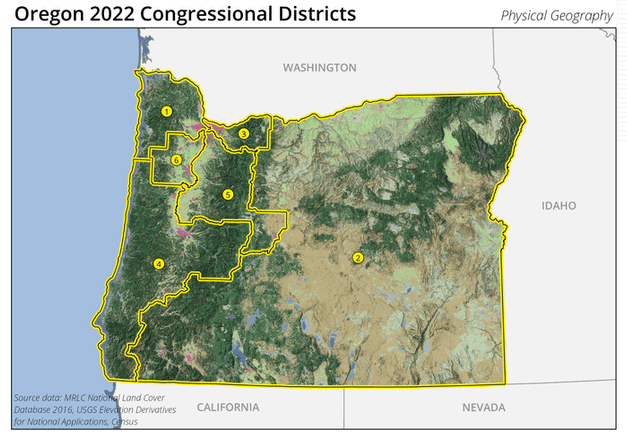
Oregon 2022 Congressional Districts (Go to Daily Kos story on Oregon’s new House map)

By Jim Ellis

Oct. 12, 2021 — The Daily Kos Elections website’s statistical team has already published presidential election numbers for some of the states that have completed their redistricting process. Therefore, we have a bit more information about the new districts in Oregon and Maine, which allows us to better analyze the political landscape.

In Oregon, the Daily Kos team has published the Biden-Trump 2020 numbers for the new six Beaver State congressional districts, which makes comparing with previous data possible.

Rep. Suzanne Bonamici’s (D-Washington County) 1st District actually makes her previously safe northwestern Oregon seat even stronger. This new district gives her all of downtown Portland. President Biden posted a 68-29 percent margin in the new 1st, a net 10-point increase from his spread in the current district (63-34 percent).

The state’s lone Republican district, OR-2, also sees its percentages increasing for the incumbent’s benefit, who is freshman Rep. Cliff Bentz (R-Ontario/East Oregon). Instead of finding a 56-42 percent margin in former President Donald Trump’s favor, the new 2nd expands to 61-37 percent, a similar net 10-point improvement for the GOP as the Democrats saw in District 1.

Making the 2nd District so overwhelmingly Republican is reflective of the Democratic legislature’s plan to pack as many GOP voters as possible into the 2nd to facilitate achieving their goal of drawing a 5D-1R statewide map.

Rep. Earl Blumenauer’s (D-Portland) 3rd District, previously the Democrats’ safest Oregon seat, remains so, but with a slightly smaller margin. Under the newly adopted district lines, President Biden would have recorded a 73-25 percent victory as opposed to his 74-23 percent spread under the current map.

Perhaps the biggest change on the Oregon map, other than adding a new district, was making the Eugene-anchored 4th District safer for veteran representative and House Transportation and Infrastructure Committee Chairman Peter DeFazio (D-Springfield).

The Biden margin in the previous 4th was 51-47 percent, and the congressman only recorded 51.5 percent in his 2020 re-election victory, one of the smallest of his 18 electoral triumphs. In the new 4th, President Biden’s victory spread would have been 55-42 percent, a net Democratic gain of nine percentage points.

Continue reading

The Trifecta States

By Jim Ellis

In the trifecta of political parties controlling the House, Senate and Executive branches in a state, how many will actually benefit from that power in the redistricting process?

Oct. 11, 2021 — As the redistricting cycle moves forward, predictions are being made as to which party will benefit most through the decennial district boundary drawing process. Most analyses favor the Republicans as the party best positioned to gain under 2021 redistricting largely because of the number of states they control outright, but this could be an over-statement.

When a state features one party in control of the governor’s mansion, state House, and state Senate, the horse racing term of “trifecta” is used to describe such a political situation. Since Republicans hold 23 trifectas and Democrats just 15, it appears on the surface that the GOP will be the big gainer in redistricting.

Let’s look a bit closer because the aggregate trifecta number doesn’t tell the whole story.

On the Republican side, though they control 23 states, their redistricting position is lessened when examining their ability to extract a net gain of congressional seats.

Of their 23, in one, West Virginia, they are a sure bet to lose a seat. In this case, Republicans hold all three of the state’s CDs, but reapportionment reduces the Mountain State to two districts. Therefore, Republicans will unavoidably absorb the loss.

In two of their states, Arizona and Montana, a non-politician commission will draw the maps. In another dozen (Alabama, Arkansas, Idaho, Indiana, Mississippi, Missouri, Nebraska, North Dakota, South Carolina, South Dakota, Utah, and Wyoming) the GOP is already at the max level of partisan members and can’t stretch the new plan further.

In Iowa and Texas, though Republicans have trifecta control, legislative rules lessen their complete power; hence, the redistricting outcome is affected.

Finally, the GOP only has effective redistricting control in six states, and in two of those, Oklahoma and Tennessee, it could arguably backfire if the party tries to expand their ratio further. Therefore, it is in really just four states, Florida, Georgia, New Hampshire, and Ohio where we could see Republican redistricting gains.

The Democrats find themselves in similar position. From their 15 trifectas, they only have redistricting control in five, possibly, and realistically, three states. In five of their 15 (California, Colorado, New Jersey, Virginia, and Washington) redistricting goes to a citizens’ commission.

Continue reading

Bass for Mayor; Redistricting Update

By Jim Ellis

California Rep. Karen Bass (D-Los Angeles)

Sept. 29, 2021 — Reports were surfacing last week that California Rep. Karen Bass (D-Los Angeles), who had been on candidate Joe Biden’s short list for the vice presidential nomination, was deciding whether to eschew re-election next year for a chance to run for LA mayor. Now, she has made the decision. On Monday, Rep. Bass formally entered the citywide race.

The mayor’s election likely will be semi-open. Mayor Eric Garcetti (D) has been nominated as US ambassador to India, and upon obtaining his Senate confirmation, the City Council will be empowered to appoint an interim mayor. That individual will have the opportunity of then seeking a full four-year term during the regular election cycle. Certainly, Rep. Bass could be a potential appointee. Should Mayor Garcetti not receive a timely confirmation as ambassador, he would be ineligible to seek a third term, so in any event, the mayor’s contest will be highly competitive.

From a federal perspective, Bass running for mayor means her 37th Congressional District will be open. Of the 18 congressional districts that are wholly or partially contained within Los Angeles County, 17 of them need a population influx. With California losing a seat, it appears that the Los Angeles area will absorb the reduction.

Since Rep. Bass is the first Golden State House member to announce that he or she won’t seek re-election, her 37th District that needs 38,173 people to meet the state’s CD population quota of 760,350 people for the new 52 district map – a west Los Angeles County seat centered around the Culver City community – now becomes a prime target for elimination.

In the mayor’s race, Bass will at least face Los Angeles City Council President Pro Tempore Joe Buscaino, LA City councilman and former state Senate president and ex-US Senate candidate Kevin de Leon, and LA City Attorney Mike Feuer. It is likely others will enter the race once the political situation surrounding Mayor Garcetti is defined, and the congressional and legislative redistricting picture becomes clearer.

Redistricting Update

Several states are making progress in drawing new congressional maps. Colorado will send a final plan to the state Supreme Court as early as today. Indiana and Maine are close to finalizing maps that will strengthen both states’ political divisions, 7R-2D in the Hoosier State, and 2D-0R in the latter.

Oregon is also moving toward completion of a map that may prove a reach for the Democratic majority. Gaining a sixth seat in national reapportionment, the Democrats are trying to craft a 5D-1R map. Though Republicans have a significant base in the state, the Democrats maintain a tight grip on the statewide races thanks to dominant Portland, which serves as the lynchpin to their Beaver State political success.

Therefore, though the Dems have a clear edge in five of the new CDs, the early partisan analysis figures suggest that the Republicans would have at least an outside chance of prevailing in one of the districts, most likely that of Rep. Kurt Schrader (D-Canby/Salem), and possibly in the new 6th District open seat. More will be known when in depth political data is available and candidates begin to come forward.

The Texas Republican Senate’s congressional map was unveiled yesterday. As predicted, the GOP map drawers used the state’s two new seats as somewhat of a buffer, at least in the Austin area, to strengthen districts that were showing weakness. Should this map be enacted, Reps. Chip Roy (R-Austin), Michael McCaul (R-Austin), John Carter (R-Round Rock), and Roger Williams (R-Austin) all receive much stronger Republican seats. In exchange, one of the new seats goes to Travis County and will await a new Democratic inhabitant.

The other new seat appears destined for Harris County. There, sophomore Rep. Lizzie Pannill Fletcher (D-Houston) moves from a political marginal district to a rock solid Harris-Ft. Bend County Democratic District. This allows the second new seat to fall to a Republican and be fully contained within Harris County. In the northern part of the region, Rep. Dan Crenshaw (R-Houston) receives a substantially better district, and assumes part of Republican Montgomery County.

In the Dallas-Ft. Worth Metroplex, the region doesn’t get a new district, but a reconfiguration allows all incumbents, both Republicans and Democrats, to improve upon their present internal political standing.

This Texas map is a long way from enactment. The state House Democrats are unified to vote against any Republican map, and while the GOP has the strength to pass what they want in the Senate, the state House is a different story. It is likely we will see the current 30-day special session end in deadlock, with another 30-day session to follow. The Democratic strategy is to force the redistricting process to court, while the Republicans will attempt to pass a series of maps into law. Expect this story to be with us for many weeks to come.

The New Mexico Ploy

By Jim Ellis

Sept. 15, 2021 — During the last week reports were surfacing that suggested the New Mexico State Democratic leadership was considering ways to turn the current 2D-1R congressional map into a 3D-0R plan. This might be easier said than done, however.

New Mexico is one of the Democrats’ 15 “trifecta states,” meaning the party controls all three legs of the redistricting stool: the state Senate, state House, and governor’s mansion. Republicans have 23 trifectas. Therefore, if the Democrats are to minimize the redistricting damage, or even possibly come out slightly ahead, they must fully use their political leverage in the states they control.

Of the Democrats’ 15 trifectas, however, five of the states handle redistricting through a commission, and in another five the party already controls all the congressional seats. Therefore, if they are to make a national redistricting play they must take maximum advantage in Illinois, Nevada, New Mexico, New York, and Oregon. The lay of the land, however, makes it very difficult to expand their fortunes in Nevada and possibly Oregon, which is why trying to take an extra seat from New Mexico makes some sense from a national Democratic perspective.

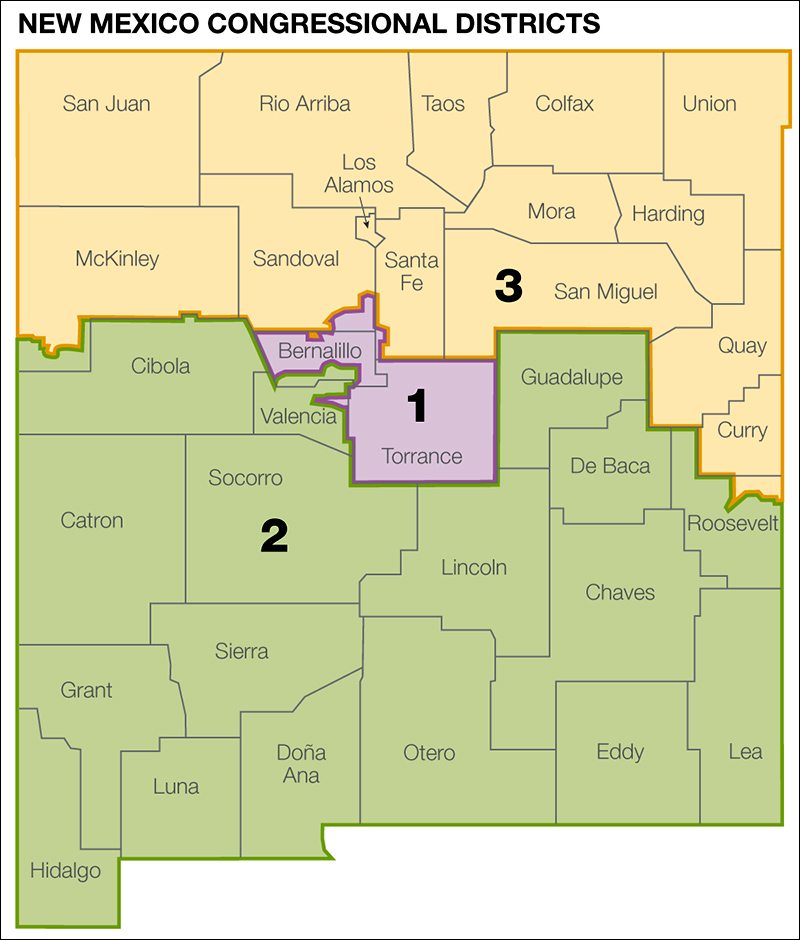
New Mexico has three congressional seats, all of which a freshman represents. The 1st (Rep. Melanie Stansbury; D-Albuquerque) and 3rd Districts (Rep. Teresa Leger Fernandez; D-Santa Fe) in the northern part of the state are safely Democratic.

The southern 2nd District (Rep. Yvette Herrell; R-Alamogordo), which encompasses almost all of the territory south of Albuquerque, has performed as a Republican seat at the congressional level in 19 of the last 21 elections. Democrats picked up the district in their recent wave election years (2006; 2018) with open seat victories, but the voters favored the Republican challenger in both successive elections. This, despite NM-2 being a majority Hispanic district: 53.7 percent of the overall population according to the previous census data.

Additionally, the current seats are not widely out of population balance. The 1st District needs to gain just 11,264 people, while the 2nd must shed 8,181 individuals, and the 3rd must relinquish 3,082 residents. Therefore, a radical re-draw that results in a sweep of the three districts for one party when the population swings are so small would certainly draw a political gerrymandering lawsuit upon adoption of the new map. Whether such a lawsuit would succeed of course is a question that can only be answered when the final map is drawn and enacted.

Likely, the only way to draw a 3D-0R map in New Mexico would be to keep the northern 3rd District Democratic seat virtually intact, and then draw the Republican 2nd into Albuquerque. This would cause the city and Bernalillo County to be split resulting in the 1st and 2nd then appearing as southwestern and southeastern seats that divide Albuquerque, and subsequently stretch all the way to the Mexican border.

Even this draw might make it difficult to create three Democratic seats because the southeastern district would still have the potential of being Republican enough to make the party’s candidate, in this case Rep. Herrell, strong enough to have a chance of winning a general election.

New Mexico is a good example as how a largely internal state exercise can transform itself to help achieve a national partisan goal. It remains to be seen just how bold the New Mexico Democrats will be, as this small and sometimes obscure state steps into the national redistricting limelight.

Census by District

By Jim Ellis

Aug. 17, 2021 — We can now see exactly where each congressional district in the country stands in terms of population. The Census Bureau delivered the state redistricting data last week, and the Daily Kos Elections site data team segmented the numbers into individual congressional districts.

Below is a chart of the 38 states that have more than two districts, isolating the CDs that are the most over and under populated. The “High” column depicts the district that is the most over-populated in the state, while the “Low” is the one requiring the most new residents. The “+/-” column shows how many districts in the particular state are over and under populated.

The most robust district is that of Texas freshman Rep. Troy Nehls (R-Richmond). His southwest Houston seat houses just under one million people, at an exact count of 972,309. The least populated seat is West Virginia’s 3rd District (Rep. Carol Miller-R): 326,267 people under quota. With all of the Mountain State seats seriously down, it is clear as to why West Virginia lost a seat in reapportionment.

There are only two states, Colorado and Oregon, where all of the current districts are over-populated. Both entities gain one seat in reapportionment. On the other end of the spectrum, Michigan and Pennsylvania saw all districts falling below their new population quota, and in Illinois, 17 of their current 18 do as well. All three states are losing a district.

It is not surprising that California lost a seat for the first time in history. A total of 35 of their current 53 seats require more population versus 18 that must shed residents. New York barely lost a seat, by just 89 people statewide, which is surprising when seeing 23 of their current 27 districts requiring additional population.

The states are now converting their new data into their redistricting software systems. After that, most will hold hearings for public input prior to district construction beginning.

STATE DIST INCUMBENT HIGH LOW +/-
Alabama 5 Mo Brooks (R) 43,348 4, 3
7 Terri Swell (D) -53,143
Arizona 5 Andy Biggs (R) 86,414 3, 6
2 Ann Kirkpatrick (D) -50,133
Arkansas 3 Steve Womack (R) 86,266 2, 2
4 Bruce Westerman (R) -66,283
California 45 Katie Porter (D) 53,645 18, 35
-1 40 Lucille Roybal-Allard (D) -70,139
Colorado 4 Ken Buck (R) 148,823 7, 0
+1 3 Lauren Boebert (R) 36,543
Connecticut 4 Jim Himes (D) 25,627 2, 3
2 Joe Courtney (D) -21,288
Florida 9 Darren Soto (D) 186,381 21, 6
+1 13 Charlie Crist (D) -41,756
Georgia 7 Carolyn Bourdeaux (D) 94,304 8, 6
2 Sanford Bishop (D) -92,108
Illinois 7 Danny Davis (D) 10,986 1, 17
-1 17 Cheri Bustos (D) -79,907
Indiana 5 Victoria Spartz (R) 50,921 5, 4
8 Larry Bucshon (R) -38,579
Iowa 3 Cindy Axne (D) 61,382 1, 3
4 Randy Feenstra (R) -31,730
Kansas 3 Sharice Davids (D) 57,816 1, 3
1 Tracey Mann (R) -33,697
Kentucky 6 Andy Barr (R) 33,300 4, 2
5 Hal Rogers (R) -57,592
Louisiana 6 Garret Graves (R) 40,173 3, 3
4 Mike Johnson (R) -47,947
Maryland 4 Anthony Brown (D) 26,772 6, 2
7 Kweisi Mfume (D) -68,401
Massachusetts 7 Ayanna Pressley (D) 18,714 4, 5
1 Richard Neal (D) -50,635
Michigan 11 Haley Stevens (D) -17,368 0, 14
-1 5 Dan Kildee (D) -104,476
Minnesota 3 Dean Phillips (D) 24,586 5, 3
7 Michelle Fischbach (D) -39,978
Mississippi 4 Steven Palazzo (R) 37,196 3, 1
2 Bennie Thompson (D) -65,829
Missouri 3 Blaine Luetkemeyer (R) 35,121 6, 2
1 Cori Bush (D) -54,618
Nebraska 2 Don Bacon (R) 47,170 2, 1
3 Adrian Smith (R) -53,152
Nevada 3 Susie Lee (D) 79,374 2, 2
1 Dina Titus (D) -73,332
New Jerseyy 8 Albio Sires (D) 47,314 5, 7
2 Jeff Van Drew (R) -41,606
New Mexico 2 Yvette Harrell (R) 8,181 2, 1
1 Melanie Stansbury (D) -11,264
New York 12 Carolyn Maloney (D) 34,717 4, 23
-1 23 Tom Reed (R) -83,462
North Carolina 2 Deborah Ross (D) 165,703 12, 1
+1 1 G.K. Butterfield (D) -6,238
Ohio 3 Joyce Beatty (D) 23,119 2, 14
-1 6 Bill Johnson (R) -99,512
Oklahoma 1 Kevin Hern (R) 36,806 3, 2
2 Markwayne Mullin (R) -69,793
Oregon 1 Suzanne Bonamici (D) 157,843 5, 0
+1 4 Peter DeFazio (D) 117,399
Pennsylvania 10 Scott Perry (R) -5,379 0, 18
-1 15 Glenn Thompson (R) -90,540
South Carolina 1 Nancy Mace (R) 87,689 3, 4
6 Jim Clyburn (D) -84,741
Tennessee 4 Scott DesJarlais (R) 62,976 5, 4
9 Steve Cohen (D) -77,122
Texas 22 Troy Nehls (R) 205,322 28, 8
+2 13 Ronny Jackson (R) -59,517
Utah 4 Burgess Owens (R) 65,265 1, 3
3 John Curtis (R) -31,190
Virginia 10 Jennifer Wexton (D) 100,750 6, 5
9 Morgan Griffith (R) -87,917
Washington 7 Pramila Jayapal (D) 28,862 6, 4
6 Derek Kilmer (D) -33,730
West Virginia 2 Alex Mooney (R) -275,777 0, 3
-1 3 Carol Miller (R) -326,627
Wisconsin 2 Mark Pocan (D) 52,678 2, 6
4 Gwen Moore (D) -41,320

Redistricting Is Now Underway

By Jim Ellis

Aug. 13, 2021 — Now four full months past the original deadline, the Census Bureau finally is scheduled to deliver to the states their census tract data, thus enabling the map-drawing process to begin.

While data was received yesterday, it will still be awhile before the public begins seeing even preliminary maps. The data must first be configured to the individual state’s redistricting software. Secondly, most state processes mandate hearings for public comment once the data is released. Each of these factors will happen prior to actual map construction. This notwithstanding, the critical element for each state, having the necessary data, is at long last occurring.

At the end of last year, we published a redistricting outlook that suggested Republicans, even though they control the process in a preponderance of states, could still find themselves down several seats in reapportionment and redistricting simply because of what could happen in the states that are gaining and losing congressional seats. (Go to: Ellis Insight Redistricting Outlook)

Some notable changes have occurred since the original piece was written, and now it appears the tables have turned toward the GOP as the party in best position to benefit nationally from the decennial district reconstruction process.

Below is a recap of the state situations that have changed:


Alabama: The original reapportionment prognostications suggested that Alabama would lose a congressional district. Republicans, because they control all but a Civil Rights-protected seat, were sure to take the loss. Likely due to a population surge in the latter part of the decade, Alabama did not lose a seat, thus the GOP saves a sure net loss.


Colorado: Though Colorado has adopted a redistricting commission for the first time, the swing toward the Democrats suggested that their party would gain the new seat. The Colorado commission is the first to release a congressional map, based upon Census Bureau estimates, and while the new 8th District looked solidly Democratic, the newly configured 7th District, currently Democratic, slightly favors the GOP.

Though this map is just a preliminary draw, should this be the direction in which the commission heads Republicans could actually reap a one seat gain when the 2022 election cycle concludes.


Continue reading

Oregon’s New Seat

Current Oregon US Congressional Districts Map


By Jim Ellis

July 2, 2021 — Oregon earned a sixth congressional seat in the 2021 apportionment, but exactly where that district will be placed on the Beaver State’s new map is not particularly obvious.

Like most states, Oregon handles redistricting through the legislative process and Democrats have firm control of all three legs of the legislative stool. In addition to Gov. Kate Brown (D), the party has a 18-11 margin in the state Senate with one Independent. Their majority in the state House of Representatives is similarly large, 37-22, with one vacancy. Yet, the partisan breakdown of the state might make drawing a solid 5D-1R map surprisingly somewhat difficult.

Currently, the five congressional districts are not obviously gerrymandered, as the seats are drawn in block form. Naturally, all but two cluster around the Portland metropolitan area, the state’s dominant population region.

The five incumbents are all senior, with Rep. Suzanne Bonamici (D-Washington County) being the most junior with her original election coming in a special 2012 contest. The delegation dean is House Transportation & Infrastructure Committee chairman Peter DeFazio (D-Springfield) who was first elected in 1986.

As you can see from the following chart, using 2019 population numbers since the Census Bureau will not be delivering census tract data to the states until after Aug. 15, the five districts are remarkably equivalent in relation to population size.

DISTRICT INCUMBENT 2020% POPULATION REG. VOTERS
1 BONAMICI 64.6% 858,875 570,186
2 BENTZ 59.9% 841,022 598,375
3 BLUMENAUER 73.0% 853,116 588,614
4 DeFAZIO 51.5% 820,504 588,508
5 SCHRADER 51.9% 844,220 578,609

The population figures suggest that each district will have to shed between 115,000 to 155,000 people in order to create six CDs with equal population, likely a number around 710,000 individuals for this state.

Continue reading