Tag Archives: North Carolina

2020 Open House Seats Review

By Jim Ellis

June 12, 2019 — Since the last national redistricting completed in 2011 for the 2012 election cycle, we have seen 222 US House seats come open, for a mean average of 55.5 per cycle during the eight-year period. Prior to this decade, the average House open seat factor was typically closer to 35.

In 2012, reflective of the new reapportionment from the 2010 census, the House featured 62 open seats. This was followed by 47 more in 2014, another 49 in 2016, and finally 64 opens in the 2018 election cycle.

So far in this current 2020 election cycle, the exodus syndrome appears to be winding down as we see only nine districts now opening, assuming that Montana at-large Rep. Greg Gianforte follows through with his stated plans to announce his gubernatorial campaign later this week. One open district, PA-12, was already filled at the end of May as Republican Rick Keller replaced resigned Rep. Tom Marino (R-Williamsport).

Below is a listing of the nine seats and the preliminary replacement outlook:


Special Elections – Sept. 10, 2019

NC-3: Rep. Walter Jones (R) – passed away Feb. 10, 2019
The Republicans are in a run-off election that will be decided on July 9. Participants are state Rep. Greg Murphy (R-Greenville) and physician Joan Perry of Kinston. The winner faces Democratic nominee Allen Thomas, the former mayor of Greenville. The eventual GOP nominee will begin the special general election as a heavy favorite for a seat that has been in Republican hands since 1995.


NC-9: Vacancy, non-declaration of 2018 election winner due to alleged voter fraud
Both parties nominated outright in this special election. Democrats feature 2018 nominee Dan McCready, who ran unopposed in the special primary. Republicans nominated outright state Sen. Dan Bishop (R-Charlotte), who captured 48 percent of the vote in a crowded Republican primary. A minimum total of 30 percent was needed to win outright nomination and avoid a run-off. Two polls have been released, both showing the race in toss-up mode with each candidate leading in one of the surveys.


Regular-Cycle Open Seats

AL-1: Rep. Bradley Byrne (R-Mobile) running for Senate
With the Republican presidential nominee topping 60 percent of the vote here in the past three national elections, including President Trump attracting 63.5 percent, the Republicans will be in strong position to hold this seat. With candidate filing coming on Nov. 8 for the March 3 primary, the field of four announced candidates could swell to as many as 10 before the filing cycle concludes. No Democrat has yet come forward to declare.


Continue reading

The Early Primary Cycle

By Jim Ellis

June 6, 2019 — Looking at the 2020 primary calendar, it is obvious that the presidential race is already having an impact upon what is becoming an accelerated congressional campaign schedule in many states.

The analysts for the Daily Kos Elections website released their research posting all of the 2020 state primary dates giving us a better indication of which congressional primaries will be held earlier than their traditional scheduled primary slot.

Several states that have moved to early presidential primary dates have also transferred their entire ballot, meaning the congressional cycle will start earlier than usual for many members and challengers.

Texas and Illinois are typically the first states to hold primary elections, and they are again at the forefront of the congressional calendar. Texas will hold its presidential and congressional nominating elections on March 3, which will become the 2020 Super Tuesday. Illinois, along with Florida and Arizona, will vote on March 17. But, on that date, only Illinois will hold congressional nomination elections.

Next year, however, several other states, will join Texas with a full ballot primary on March 3.

Continue reading

A Counter Poll in NC-9

By Jim Ellis

North Carolina Republican state Sen. Dan Bishop (left) | Democrat Dan McCready (right)

June 5, 2019 — The Atlantic Media & Research organization went into the field in North Carolina’s 9th Congressional District and found a different special election leader than last week’s JMC Analytics poll. Atlantic’s conclusion sees Democrat Dan McCready topping state Sen. Dan Bishop 41-39 percent, which is the inverse of JMC’s result.

JMC projected Sen. Bishop leading 46-42 percent in their survey of 350 likely special election voters conducted on May 21-24. Atlantic polled 358 “definite or very likely” special election voters from May 20-23 and continuing through May 28-30. Though the two polls produced separate leaders, their combined data conclusions are similar in that the participants are within the polling margin of error. While the spread yields an eight-point net difference between the two polls, the margin of error contained in each is less than four percent.

But the Atlantic methodology is a bit different. The research firm polled on consecutive weekdays in two separate weeks leaving the Memorial Day weekend period unsampled. The gap leads to a longer than average polling stage, which could mean a less accurate conclusion.

Atlantic Media also reviews its previous poll completed five months ago in December of last year, just after the general election, and compares those results with the most current data set. The numbers are similar in that the partisan ballot tests and the president’s job approval rating varies by only a percentage point or two. And, attempting to discount the final 2018 result that was infected with voter fraud, the Atlantic December post-election poll finds candidate McCready topping Republican Mark Harris by a tight 46-43 percent margin.

Continue reading

NC-9: The First Poll is Surprising

By Jim Ellis

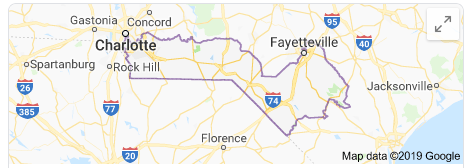
North Carolina’s 9th Congressional District

May 30, 2019 — The JMC Analytics survey research firm released the first special general election poll for North Carolina’s 9th District, and some may consider the results surprising.

According to JMC (May 21-24; 350 NC-9 registered voters), Republican state Sen. Dan Bishop (R-Charlotte) has taken a 46-42 percent lead over Democrat Dan McCready, the solar energy businessman who was the 2018 party nominee. Considering the seven-month-long vote fraud controversy that kept the North Carolina Board of Elections from certifying Republican Mark Harris as the general election victor over McCready (the unofficial total gave the GOP nominee a 905-vote edge) many expected the Democrat to open the special election campaign with a discernible advantage.

There is no doubt that McCready has a resource advantage, however, which should play a major role as this contest moves toward a Sept. 10 conclusion. In the pre-primary financial disclosure period report that ended April 24, McCready reported already raising over $2.01 million, with a $1.57 million cash-on-hand figure. In contrast, Sen. Bishop stated $505,000 raised within the same time frame, more than any individual Republican candidate at the time, but the total included a $250,000 personal loan.

Continue reading

NC Poll: Tillis Vulnerable

By Jim Ellis

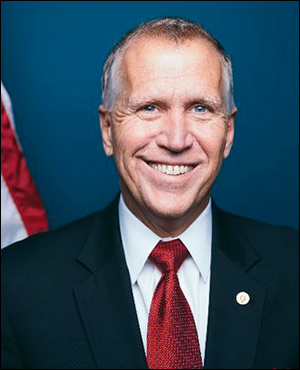
North Carolina Sen. Thom Tillis (R)

May 29, 2019 — One of the key 2020 Senate races lies in North Carolina where first-term Sen. Thom Tillis (R) is seeking his second term and finds himself in a shaky political situation. A new poll suggests he has vulnerability even within the Republican primary.

A WPA Intelligence poll for the Club for Growth PAC (May 19-21; 502 likely North Carolina Republican primary voters) finds Sen. Tillis leading a hypothetical GOP primary against three-term Rep. Mark Walker (R-Greensboro) wealthy businessman Garland Tucker, and accountant Sandy Smith, 40-17-11-2 percent. Though Tillis is below 50 percent, North Carolina election law requires only a 30 percent vote total to win nomination, meaning the senator would be well over the required minimum.

At this point, Tucker and Smith are announced Republican primary opponents, with the former having the potential of becoming a competitive candidate. Several weeks ago, Rep. Walker ruled out running for the Senate, but his latest statements appear to suggest that he is more open to entering the statewide campaign.

Isolating Sen. Tillis and Rep. Walker into a head-to-head contest, which is not realistic from a probable political perspective but is helpful in a polling context, finds Sen. Tillis leading 43-34 percent. But, WPA finds it takes little in the way of persuasion to arrive at a very different result.

According to poll results, when just the following bios are read, the ballot test virtually switches:

Continue reading

The 2020 Democratic Nomination
Will Look Much Different From 2016

By Jim Ellis

May 24, 2019 — As the Democratic presidential field swells to 24 candidates — with the first Democratic presidential forum on tap for late June in Miami, and the first votes being cast in Iowa now just over eight full months away — it’s a good time to review how different this presidential nomination contest will be from the 2016 version.

To review, Hillary Clinton won 34 primaries and caucuses in 2016 as compared to 23 for Sen. Bernie Sanders (I-VT). There are 57 sanctioned delegate voting entities in the Democratic nomination universe. The 57 are comprised of the 50 states, the District of Columbia and the five territories, and a Democrats Abroad category that combines all US citizens living in foreign countries who will still have voting privileges in US elections.

Clinton won 55.2 percent of the 2016 national Democratic popular vote versus Sen. Sanders’ 43.1 percent when combining the totals from all the primaries and caucuses. Though the Sanders Campaign called foul over the Super Delegate voting inflating Clinton’s delegate total, and actually turning six states’ first-ballot roll call from Sanders to Clinton and sending one more state into a tie, Clinton still carried the pledged, or elected delegate, count 2,205 to 1,846, translating to a 54.4 percent margin. When adding the Super Delegate and uncommitted delegate votes, she captured 58.3 percent of the convention total.

Continue reading

Weekly Political Synopsis,
Period Ending May 17, 2019

By Jim Ellis

PRESIDENT
• Gov. Steve Bullock: As has been expected for some time, Montana Gov. Steve Bullock (D) officially announced his presidential effort this week, becoming the 23rd Democratic candidate. Bullock made the argument that he will be an effective national candidate because he’s won two elections in a conservative state and has been able to earn legislative achievements, like Medicaid expansion, in negotiating with Republican leaders.

• Mayor Bill de Blasio: Following Gov. Bullock, New York City Mayor Bill de Blasio released an announcement video at the end of the week making him the 24th Democratic presidential candidate for the 2020 election cycle. His declaration centered around being the candidate for “working families,” and cited the $15 minimum wage, a free pre-K school program, a comprehensive healthcare program that especially covers mental health, and paid sick leave.

• Florida: Former Vice President Joe Biden continues to see strong polling numbers, with the latest data coming from Florida. The Tel Opinion Research organization is reporting its latest results (released May 8; 800 likely Florida Democratic primary voters) that show Biden pulling away from his Democratic opponents on an open-ended ballot test poll. An open-ended ballot test is one where the respondent is not given the candidates’ names. That approach tests for committed strength.
According to Tel Opinion, Biden leads Sen. Bernie Sanders (I-VT), 39-16 percent, with Sens. Elizabeth Warren (D-MA) and Kamala Harris (D-CA) each pulling only five percent support. South Bend (IN) Mayor Pete Buttigieg follows at three percent preference. All of the candidates scored well on the favorability index scale. Biden is viewed positively with an 81:13 percent ratio, where Sen. Sanders’ score is 68:23 percent.

SENATE
• Arizona: Phoenix-based pollster OH Predictive Insights released their latest data from their May 1-2 poll (600 likely Arizona voters) where they queried the respondent universe about the impending Senate race between appointed Sen. Martha McSally (R) and retired astronaut Mark Kelly (D). Though we are more than a year before Arizona’s 2020 late August primary, the chances are strong that the aforementioned will be their respective party standard bearers.
According to the OH poll results, the early race again earns toss-up status. The sample breaks 45-44 percent in Sen. McSally’s favor, which is virtually identical with the firm’s late February poll giving the incumbent a 46-44 percent edge.

Continue reading