Tag Archives: Iowa

House Candidates File in Two Competitive States

By Jim Ellis

Candidate filings have closed in both Nevada and Iowa.

March 23, 2022 — Though both are only four-district congressional states, Iowa and Nevada will both host a large number of highly competitive US House races this year, and now the candidates have filed.

The Senate races in both states are already well defined and will come to a head in the general election. In Iowa, Sen. Chuck Grassley (R) is on the ballot for an eighth term having been first elected in 1980, and it is clear that he will face former US Rep. Abby Finkenauer (D) in the general election.

In Nevada, first-term Sen. Catherine Cortez Masto (D) defends her seat most likely against former Attorney General Adam Laxalt (R), but he must first deflect a credible Republican primary challenge from businessman and disabled Afghan War veteran Sam Brown.

The Hawkeye State House races feature only one safe member, freshman Randy Feenstra (R-Hull/Sioux City). The other three races will again host tight campaigns as they did in 2020, which of course includes Rep. Mariannette Miller-Meeks’ (R-Ottumwa) six-vote victory.

In the new 1st District, Miller-Meeks will again campaign in a district not much different than the 2nd District that she carried by the slimmest of margins in the last election. She won’t again face former state Sen. Rita Hart (D), however. Despite coming agonizingly close to victory in 2020, Hart declined to seek a re-match this year. Democrats only filed one candidate, so state Rep. Christina Bohannan (D-Iowa City) and incumbent Miller-Meeks will compete in a venue that is likely to yield another close finish.

Rep. Ashley Hinson (R-Marion/Cedar Rapids), who knocked off then-Rep. Finkenauer in what was Iowa’s 1st District, finds herself in a slightly more Republican 2nd District. Like in the new 1st CD, the Democrats filed only one candidate. In this seat, the Democrat nominee will be state Sen. Liz Mathis (D-Hiawatha) a former news anchor at the same television station where Hinson also reported the news. The new 2nd rates as R+6 according to the FiveThirtyEight data organization.

In the Des Moines-anchored 3rd CD, Rep. Cindy Axne (D-Des Moines) has won two plurality victories and looks to face another difficult re-election campaign in a seat that rates R+2. State Sen. Zach Nunn (R-Bondurant) looks to be the strongest Republican of the three GOP contenders and is the favorite to win the nomination. This will become a top national Republican conversion opportunity.

Not previously mentioned as a potential candidate against Nevada Rep. Dina Titus (D-Las Vegas) in a new 1st District that is much more Republican, former 4th District Congressman Cresent Hardy (R) filed at the deadline on Friday to officially enter the race.

Rep. Titus has expressed displeasure at the configuration of her new district that FiveThirtyEight calculates went from a current D+22 rating to a D+4 under the new plan. Dave’s Redistricting App finds the average 1st CD Democratic vote at 52.6 percent and the Republican percentage at 42.3 percent. This is considerably better than the seat where Titus averaged 62.1 percent in the five elections conducted during the previous decade.

As many as four other Republicans may qualify for the primary ballot, but Hardy appears to be the most formidable of the contenders. The new 1st District contest, in a CD that encompasses part of Las Vegas before moving south to include the cities of Henderson and Boulder City, will become competitive in the fall but is still an uphill battle for any Republican nominee.

Frequent candidate Danny Tarkanian (R), who last year was elected to the Douglas County Commission after a long string of electoral defeats, is again running for Congress. This will be his fourth quest for the US House in a third different district, on top of two Senate races. Previously, he lost a pair of campaigns in the 3rd CD and one in the 4th District.


Continue reading

The Redistricting Scorecard

By Jim Ellis

In the trifecta of political parties controlling the House, Senate and Executive branches in a state, how many will really benefit from that power in the redistricting process?

Feb. 11, 2022 — There has been quite a bit of redistricting news surfacing during the past few weeks, with many analysts now reversing their earlier predictions about which party is the clear beneficiary from the re-draw process.

Most said early that the Republicans would benefit the most from redistricting and that map drawing alone would be enough to allow the party to reclaim the House majority. We, on the other hand, were showing that the cut would more than likely be about equal even though the GOP has a major advantage in trifecta states, that is, those where one party controls all three legs of the legislative stool, meaning the state Senate, state House, and the governor’s office.

Though the Republicans control 25 states outright from a redistricting perspective compared to the Democrats’ 15, the number of states where each can draw maps to expand their party’s congressional delegation really comes down to seven where Republicans control and a commensurate four for the Democrats.

What balances the process this year is that Republicans appear to have have only one state where they can gain multiple seats — North Carolina — while Democrats can run the table, and have, in two big states, New York and Illinois.

Where both parties suffer in their trifecta states is the number of places where they already control the maximum number of seats, or redistricting power has been transferred to a commission. Either one party already has all the seats in a state like the Democrats do in Massachusetts and the Republicans have in Arkansas, for example, or the state has only one at-large member.

In one place, West Virginia, even though the Republicans have a legislative trifecta, they will drop a seat post election. Currently, the West Virginia delegation consists of three Republicans, but the state loses a seat in national reapportionment. Therefore, the GOP majority had no choice but to collapse one of their own districts.

Articles are now appearing that suggest it is the Democrats who could end the redistricting process with a net seat advantage rather than the Republicans. This, as it has been from the beginning, is true.

In looking at the states once all 50 have adopted new congressional lines, it projects today that the Republicans would add approximately 13 seats, while the Democrats, with multiple seat additions in Illinois and New York, would gain 11 new members. Seven states remain undecided because their level of political competition is predicted to be intense.

Continue reading

The “Fail Up” Senate Candidates

By Jim Ellis

Nov. 16, 2021 — There is an interesting phenomenon developing in the 2022 US Senate races, and that is the number of currently leading primary nomination candidates who have lost their last race. No less than five current US Senate contenders, all topping the latest polling, were defeated the last time they were on the ballot, some even in political campaigns for offices with less prominence.

In recent election years, we’ve seen a number of candidates lose a race and then attempt to “fail up” in the next campaign year. Most of the time, the same result occurs. The seemingly lone exception to the rule is Georgia Sen. Jon Ossoff (D), who lost a special election for the US House in 2017 only to run for the Senate in 2020 and be elected.

Turning to 2022 and the unusually high number of such “fail up” candidates allows us to see if this pattern can reverse itself, or if the vast majority of these contenders will again find themselves on the short end of the vote totals when their election cycle ends either in the nomination contest or general election.

The 2022 “fail up” Senate candidates are Abby Finkenauer (D) in Iowa, Adam Laxalt (R) from Nevada, Pat McCrory (R) and Cheri Beasley (D) in North Carolina, and Pennsylvania’s Sean Parnell (R). Dr. Al Gross, who lost the 2020 Senate race in Alaska is a possibility to enter the 2022 race in the Last Frontier, but so far has not announced his candidacy.

Finkenauer, a Democrat, is a former state representative and congresswoman from Dubuque, Iowa. She was elected to the House in 2018, only to lose her seat after one term, 50-47 percent, to current US Rep. Ashley Hinson (R-Marion/Cedar Rapids).

Finkenauer is leading in early polling for the Senate Democratic nomination as she and retired Navy admiral and defeated 2020 US Senate candidate Mike Franken battle to challenge venerable Sen. Chuck Grassley (R) who has won seven US Senate elections. Early polling finds Finkenauer trailing by close to 20 points.

Laxalt was elected Nevada’s attorney general in 2014, but with only 46 percent of the vote in a place where his party swept all of the statewide offices in that election year with his being the lowest victory percentage. Laxalt then entered the open 2018 governor’s race but lost to current incumbent Steve Sisolak (D), 49-45 percent. The latest polling (September) finds him trailing Sen. Catherine Cortez Masto (D) by five points in a Mellman Group survey but holding a two-point lead in a study from WPA Intelligence.

North Carolina actually features candidates in both parties leading in nomination polling after losing their last race. McCrory is the former governor who lost his 2016 re-election campaign, even while Donald Trump and seven other Republicans were winning their statewide elections.

Continue reading

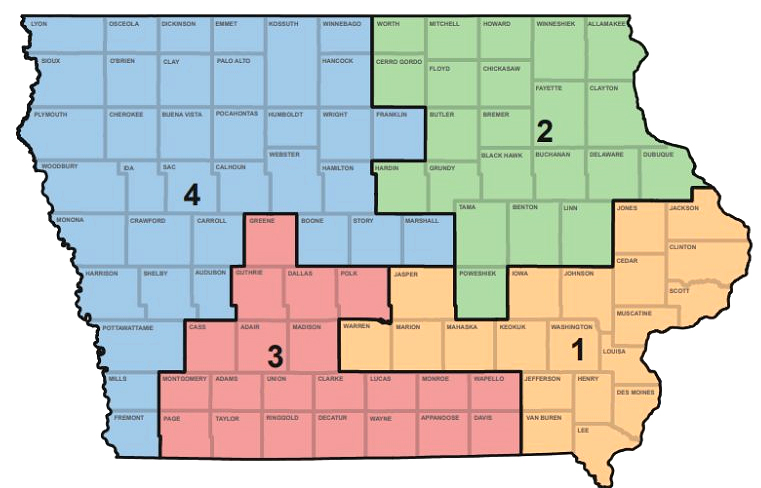
Iowa Map Enacted

By Jim Ellis

Nov. 10, 2021 — Gov. Kim Reynolds (R) signed the new Iowa redistricting map package, legislation that contained the new US House, state Senate, and state House of Representatives maps. The new congressional plan makes what appear to be minor changes to the state’s four districts, while again crafting a new quartet that would have voted in unison for former President Donald Trump. As is the case on the current map, Trump’s district victory margins featured varying percentages.

The Iowa redistricting system is unique. Some believe the state redistricts through a commission, but that is not the case. Rather, a state legislative committee is tasked with drawing the three-map plans and presenting them to the legislature for final approval. The plans must be submitted as a package, and the legislators may only vote up or down on the whole group, as no amendments to any of the maps are allowed.

The committee also employs a formulaic algorithm to create the districts without regard to political proclivities or deference to incumbents. If three map packages are rejected, the legislature then takes full control of the process.

The adopted package is the second plan iteration. The committee staff first put forth a series of maps that failed to make it through the first state Senate committee of jurisdiction. That congressional map was much different than the ultimately enacted plan. In the first draw, freshman Rep. Ashley Hinson (R-Marion/Cedar Rapids) would have been placed in a decidedly Democratic district that would have made her an underdog for re-election in 2022.

It is likely, however, that alone was not the reason for the Senate committee members rejecting the map package. The committee staff created two separate pairings of three incumbent senators apiece, thus dooming the entire package. Once returned, the congressional map plan, using a changed formula, returned to a similar configuration as under the current map.

Continue reading

Q3 FEC Senate Cash Updates

By Jim Ellis

Oct. 22, 2021 — The 3rd Quarter campaign finance summaries and reports are now publicly available at the Federal Election Commission website, and we have the recap for the key competitive Senate races in this Update. As typical for political campaigns since the latter part of the previous decade, the dollar figures are again astronomical.

The amounts are in hundreds of thousands, and COH refers to the candidates’ total cash-on-hand figures since the 2022 election cycle began. The Daily Kos Election website statisticians calculated the 3rd Quarter dollar amounts.

Alaska

CANDIDATE 3rd QTR RAISED (,000) TOTAL COH (,000)
Murkowski $1,062 $3,244
Tshibaka $460 $294

Sen. Lisa Murkowski and former State Administration Director Kelly Tshibaka are the only two candidates who filed disclosure reports. Despite an endorsement from former President Donald Trump, the Tshibaka financial figures are less than expected. With Alaska’s new top four primary system, the early money is rather irrelevant since four candidates, including Sen. Murkowski and Ms. Tshibaka, will advance into the general election.


Arizona

CANDIDATE 3rd QTR RAISED (,000) TOTAL COH (,000)
Kelly $7,217 $13,001
Masters $1,008 $864
Brnovich $559 $515
Lamon $133 $3,606

Sen. Mark Kelly continues to be one of the most prolific fundraisers of all Senate candidates. His huge $13.1 million cash-on-hand figure is topped only by Majority Leader Chuck Schumer’s $31.8 million, and Sens. Raphael Warnock’s (D-GA) $17.2 million and John Thune’s (R-SD) $14.8 million. Candidate Blake Masters is rumored to be benefiting from an outside $10 million Super PAC that billionaire Peter Thiel funds. Candidate Jim Lamon self-funded most of his $3 million-plus cash-on-hand total.


Florida

CANDIDATE 3rd QTR RAISED (,000) TOTAL COH (,000)
Demings $8,351 $5,967
Rubio $5,928 $9,612

Sen. Marco Rubio had a very strong fundraising quarter, but so did his opponent, Rep. Val Demings. Both have large war chests, but each has already spent millions to achieve these totals. Both candidates will advance into a competitive and expensive general election campaign in the Sunshine State.


Georgia

CANDIDATE 3rd QTR RAISED (,000) TOTAL COH (,000)
Warnock $9,432 $17,217
Walker $3,764 $2,477
Black $564 $928

Sen. Raphael Warnock raised more money in the quarter than any Senate candidate and already has a huge war chest. Herschel Walker’s first fundraising quarter as a candidate, and a partial one at that, has to be considered highly successful, but his resources pale in comparison to the incumbent’s dollar raising machine.


Iowa

CANDIDATE 3rd QTR RAISED (,000) TOTAL COH (,000)
Finkenauer $1,019 $598
Grassley $814 $3,064

Sen. Chuck Grassley announced his intention to seek re-election just a week before the third-period fundraising cycle ended. While he didn’t raise as much as his present chief opponent during the third quarter, former US Rep. Abby Finkenauer, his resource total is substantially better than hers and sets him in strong position to launch a massive fundraising effort.


Continue reading

Sen. Grassley to Seek Re-Election

By Jim Ellis

Iowa’s seven-term US Sen. Chuck Grassley (R)

Sept. 28, 2021 — Saying he “ … has a lot more to do for Iowa,” seven-term Sen. Chuck Grassley (R) on Friday announced that he will run for an eighth term next year. Recently, the senator said he would make his decision about launching a 2022 campaign on or before Nov. 1.

Sen. Grassley was one of three Republican incumbents who had not declared their re-election intentions. Sens. Ron Johnson (R-WI) and John Thune (R-SD) both say they will announce their decisions later in the fall. All 14 in-cycle Democrats are on an active re-election track.

Sen. Grassley is already the longest-serving Iowa US senator, originally elected on the same night when Ronald Reagan won the presidency in 1980. He has been an elected official since winning his first term in the state House of Representatives back in 1958. Should he win the coming election and complete his next term, he will have served 70 consecutive years as a public official, counting his time in the state legislature, US House and Senate.

It appears the senator is in strong political shape for the coming campaign. At this point, he faces only state Sen. Jim Carlin (R-Sioux City) in the Republican primary.

When he entered the race, it was speculated that Carlin was attempting to get a head start on an open Republican primary in anticipation that the 88-year-old senator would announce his retirement. He indicated that he planned to stay in the race regardless of Sen. Grassley’s intentions, but now that the incumbent’s campaign is official we will see if Carlin continues in his long shot statewide effort.

The leading Democrat is former Congresswoman Abby Finkenauer. She served two terms in the state House of Representatives, and then defeated incumbent US Rep. Rod Blum (R) in the 2018 election. She would subsequently lose her first re-election bid to current Congresswoman Ashley Hinson (R-Marion/Cedar Rapids). Now, like so many others who have recently lost elections, Finkenauer is attempting to run for a higher office.

Continue reading

Census by District

By Jim Ellis

Aug. 17, 2021 — We can now see exactly where each congressional district in the country stands in terms of population. The Census Bureau delivered the state redistricting data last week, and the Daily Kos Elections site data team segmented the numbers into individual congressional districts.

Below is a chart of the 38 states that have more than two districts, isolating the CDs that are the most over and under populated. The “High” column depicts the district that is the most over-populated in the state, while the “Low” is the one requiring the most new residents. The “+/-” column shows how many districts in the particular state are over and under populated.

The most robust district is that of Texas freshman Rep. Troy Nehls (R-Richmond). His southwest Houston seat houses just under one million people, at an exact count of 972,309. The least populated seat is West Virginia’s 3rd District (Rep. Carol Miller-R): 326,267 people under quota. With all of the Mountain State seats seriously down, it is clear as to why West Virginia lost a seat in reapportionment.

There are only two states, Colorado and Oregon, where all of the current districts are over-populated. Both entities gain one seat in reapportionment. On the other end of the spectrum, Michigan and Pennsylvania saw all districts falling below their new population quota, and in Illinois, 17 of their current 18 do as well. All three states are losing a district.

It is not surprising that California lost a seat for the first time in history. A total of 35 of their current 53 seats require more population versus 18 that must shed residents. New York barely lost a seat, by just 89 people statewide, which is surprising when seeing 23 of their current 27 districts requiring additional population.

The states are now converting their new data into their redistricting software systems. After that, most will hold hearings for public input prior to district construction beginning.

STATE DIST INCUMBENT HIGH LOW +/-
Alabama 5 Mo Brooks (R) 43,348 4, 3
7 Terri Swell (D) -53,143
Arizona 5 Andy Biggs (R) 86,414 3, 6
2 Ann Kirkpatrick (D) -50,133
Arkansas 3 Steve Womack (R) 86,266 2, 2
4 Bruce Westerman (R) -66,283
California 45 Katie Porter (D) 53,645 18, 35
-1 40 Lucille Roybal-Allard (D) -70,139
Colorado 4 Ken Buck (R) 148,823 7, 0
+1 3 Lauren Boebert (R) 36,543
Connecticut 4 Jim Himes (D) 25,627 2, 3
2 Joe Courtney (D) -21,288
Florida 9 Darren Soto (D) 186,381 21, 6
+1 13 Charlie Crist (D) -41,756
Georgia 7 Carolyn Bourdeaux (D) 94,304 8, 6
2 Sanford Bishop (D) -92,108
Illinois 7 Danny Davis (D) 10,986 1, 17
-1 17 Cheri Bustos (D) -79,907
Indiana 5 Victoria Spartz (R) 50,921 5, 4
8 Larry Bucshon (R) -38,579
Iowa 3 Cindy Axne (D) 61,382 1, 3
4 Randy Feenstra (R) -31,730
Kansas 3 Sharice Davids (D) 57,816 1, 3
1 Tracey Mann (R) -33,697
Kentucky 6 Andy Barr (R) 33,300 4, 2
5 Hal Rogers (R) -57,592
Louisiana 6 Garret Graves (R) 40,173 3, 3
4 Mike Johnson (R) -47,947
Maryland 4 Anthony Brown (D) 26,772 6, 2
7 Kweisi Mfume (D) -68,401
Massachusetts 7 Ayanna Pressley (D) 18,714 4, 5
1 Richard Neal (D) -50,635
Michigan 11 Haley Stevens (D) -17,368 0, 14
-1 5 Dan Kildee (D) -104,476
Minnesota 3 Dean Phillips (D) 24,586 5, 3
7 Michelle Fischbach (D) -39,978
Mississippi 4 Steven Palazzo (R) 37,196 3, 1
2 Bennie Thompson (D) -65,829
Missouri 3 Blaine Luetkemeyer (R) 35,121 6, 2
1 Cori Bush (D) -54,618
Nebraska 2 Don Bacon (R) 47,170 2, 1
3 Adrian Smith (R) -53,152
Nevada 3 Susie Lee (D) 79,374 2, 2
1 Dina Titus (D) -73,332
New Jerseyy 8 Albio Sires (D) 47,314 5, 7
2 Jeff Van Drew (R) -41,606
New Mexico 2 Yvette Harrell (R) 8,181 2, 1
1 Melanie Stansbury (D) -11,264
New York 12 Carolyn Maloney (D) 34,717 4, 23
-1 23 Tom Reed (R) -83,462
North Carolina 2 Deborah Ross (D) 165,703 12, 1
+1 1 G.K. Butterfield (D) -6,238
Ohio 3 Joyce Beatty (D) 23,119 2, 14
-1 6 Bill Johnson (R) -99,512
Oklahoma 1 Kevin Hern (R) 36,806 3, 2
2 Markwayne Mullin (R) -69,793
Oregon 1 Suzanne Bonamici (D) 157,843 5, 0
+1 4 Peter DeFazio (D) 117,399
Pennsylvania 10 Scott Perry (R) -5,379 0, 18
-1 15 Glenn Thompson (R) -90,540
South Carolina 1 Nancy Mace (R) 87,689 3, 4
6 Jim Clyburn (D) -84,741
Tennessee 4 Scott DesJarlais (R) 62,976 5, 4
9 Steve Cohen (D) -77,122
Texas 22 Troy Nehls (R) 205,322 28, 8
+2 13 Ronny Jackson (R) -59,517
Utah 4 Burgess Owens (R) 65,265 1, 3
3 John Curtis (R) -31,190
Virginia 10 Jennifer Wexton (D) 100,750 6, 5
9 Morgan Griffith (R) -87,917
Washington 7 Pramila Jayapal (D) 28,862 6, 4
6 Derek Kilmer (D) -33,730
West Virginia 2 Alex Mooney (R) -275,777 0, 3
-1 3 Carol Miller (R) -326,627
Wisconsin 2 Mark Pocan (D) 52,678 2, 6
4 Gwen Moore (D) -41,320