Tag Archives: former president Donald Trump

Projected GOP Presidential Debate Qualifiers; New Senate Candidate in Ohio; Q2 Senate Financials Reported; A Strong CA-9 Candidate Emerges; Indiana Open Gov. Race News

By Jim Ellis — Wednesday, July 19, 2023

President

Debate: Projected Qualifiers — USA Today is projecting that six GOP presidential contenders will qualify for the Aug. 23 debate to be aired on FOX News, while another half-dozen may miss the cut. The candidates meeting the polling and donor requirements are, as expected, former President Donald Trump and Florida Gov. Ron DeSantis. The others are ex-UN Ambassador Nikki Haley, businessman Vivek Ramaswamy, Sen. Tim Scott, and former New Jersey Gov. Chris Christie.

Those on the cusp of failing to meet the participation requirements are former Vice President Mike Pence, ex-Congressman Will Hurd, Gov. Doug Burgum (R-ND), ex-Arkansas Gov. Asa Hutchinson, Miami Mayor Francis Suarez, and commentator Larry Elder.

Senate

Ohio: Sec of State Announces for Senate — As has been long expected, a third major Republican has joined the US Senate primary hoping to advance into the general election to oppose incumbent Sen. Sherrod Brown (D). Frank LaRose was first elected as Ohio’s Secretary of State in 2018 after serving two terms in the Ohio state Senate from the Akron area. He averaged 55 percent of the vote in his two victorious statewide campaigns.

LaRose is the only one of the three GOP candidates – the others being state Sen. Matt Dolan (R-Chagrin Falls) and businessman Bernie Moreno – who has won a statewide race. Sen. Dolan ran for the US Senate in 2022 but lost the Republican primary. Moreno was also in that Senate race but withdrew before voting began seeing no reasonable victory path.

While LaRose is the only statewide official in the race, he begins well behind in the money race. Sen. Dolan has already invested $4 million into his campaign. Moreno reports raising $2.26 million in the 2nd Quarter.

The general election will be difficult since Sen. Brown is a three-term incumbent. The state, however, is significantly more Republican than when the senator last ran in 2018. The ’24 contest is becoming a must-win for the GOP if the party is to capture the Senate majority in the coming election.

Senate Finance: Q2 Dollar Numbers Reported — The 2nd Quarter fundraising numbers have been released, and the 58 reporting Senate candidates in the 34 races attracted a cumulative $91.7 million and have more than $228 million in their campaign accounts. This does not count any money that Super PACs have raised or plan to spend to affect the outcome of the 2024 US Senate electoral contests.

Rep. Colin Allred (D-Dallas) was technically first in funds raised with $8.63 million, but $2.5 million of that total was transferred from his House committee. Rep. Allred’s potential general election opponent, Sen. Ted Cruz (R), ranked sixth overall but first among Republicans. He attracted $3.35 million in financial support.

California Rep. Adam Schiff (D-Burbank) was the net Q2 fundraising leader, bringing in $8.17 million without any transfers from his House account. He also led the all-important cash-on-hand category with a whopping $29.8 million ready to spend on his Senate campaign. The total amounts raised during this early campaign phase suggest that we can expect another hotly contested campaign season next year.

House

CA-9: Republicans Gain Strong Candidate — Stockton Mayor Kevin Lincoln, a Republican elected in a heavily Democratic city, is reportedly preparing an announcement for Thursday indicating he will forego running for a second term in his present position in order to challenge Rep. Josh Harder (D-Turlock) for the US House seat. Rep. Harder was severely redistricted in the 2021 redraw, but still managed to record a 55-45 percent victory over San Joaquin County Supervisor Tom Patti (R). The congressman had a huge 6:1 advantage in resources, which became a key factor in his re-election victory.

The CA-9 district could be one to watch nationally. Republicans must defeat several sitting Democratic incumbents if they are to hold their small House majority and this northern California seat, that the FiveThirtyEight data organization rates as D+8, could be on the cusp of becoming a top-tier conversion target.

Governor

Indiana: Newcomer May Enter Open Gov Race — Indiana Secretary of Commerce Brad Chambers (R) announced he will be resigning his position and it is anticipated that he will quickly declare his gubernatorial candidacy.

Though starting well behind the open race’s two front runners for the Republican nomination and the general election, US Sen. Mike Braun and Lt. Gov. Suzanne Crouch, Chambers, who has the financial ability to self-fund his campaign, may soon become the fourth credible candidate in the field. Venture capitalist Eric Doden also has the ability to attract enough resources to propel his candidacy. Incumbent Gov. Eric Holcomb (R) is ineligible to seek a third term. Sen. Braun is foregoing a second term in the Senate to enter the gubernatorial campaign.
Can DeSantis Overtake Trump?

By Jim Ellis — Tuesday, July 18, 2023

President

Former President Donald Trump; Florida Gov. Ron
Desantis (R)

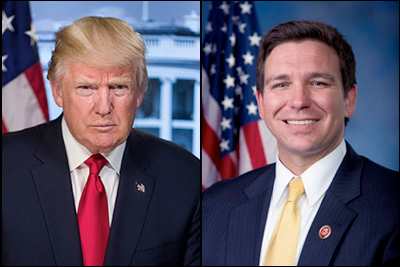
Polling: DeSantis vs. Trump — A series of flash polls taken in June and early July within 13 states provides us a glimpse into the path Florida Gov. Ron DeSantis has ahead of him if he is to wrest the Republican presidential nomination away from former President Donald Trump. In summary, the deficit may be too large to overcome.

National polls have for weeks shown Trump holding huge leads over his GOP opponents, but these national surveys are virtually meaningless since the race will be determined in the state-by-state count. The winner must secure 1,234 pledged delegate votes from the 56 voting entities to clinch the party nomination.

The recent polling from the 13 states yields a combined 944 delegates, or 38.3 percent of the total Republican universe. The tallies come from 11 different pollsters during the period beginning June 5 and ending July 6.

Cumulatively, Trump would command a combined 47.4 percent support from these places, slightly less than he is showing nationally. Gov. DeSantis is so far recording 21.2 percent, and no other candidate even reaches five percent support. Therefore, the Florida governor must more than double his support base if he is to surpass Trump’s advantage.

Included in these 13 states are eight places where voters will cast their ballots on Super Tuesday, March 5, or before. The eight states are, in voting order: Iowa, New Hampshire, Nevada, South Carolina, California, North Carolina, Tennessee, and Texas. Of the pre-Super Tuesday states, only Michigan is not included.

In the early states, Trump’s margin, according to the latest available polling data, is actually an even larger 55-22 percent over Gov. DeSantis, with 23 percent choosing one of the seven minor candidates. Therefore, the Trump lead in the critical momentum building early states is larger than in the at-large universe, thus making DeSantis’s task even more difficult.

In addition to the eight early states mentioned above, the remaining tested domains, again in voting order, are Florida, Ohio, Wisconsin, Pennsylvania, and Montana. Of the 13, DeSantis’ strongest state is Wisconsin, where the Marquette University Law School survey, a frequent Badger State pollster, finds the Florida governor trailing Trump by just one percentage point.

The state will the largest chasm between the two men is Tennessee, where the Targoz Market Research survey finds a Trump margin of 61-12 percent. Perhaps most troubling to Gov. DeSantis is his most recent showing in his own home state of Florida. The latest Florida Atlantic University study that concluded on July 1 reveals a 50-30 percent margin in Trump’s favor.

This poll, however, may be an anomaly because no other data has shown such a large disparity. Since the beginning of May, one other research study finds Trump ahead by eight percentage points, while two more see a virtually even split between Trump and DeSantis. Still, for Trump to be doing this well in Gov. DeSantis’ home state is telling as to the strength of the former President’s national advantage.

While serious campaigning is just now getting underway, much can change between the present circumstances and the eventual outcome. With Iowa now moving their precinct caucuses from an original date of Feb. 5 to Jan. 15, the nomination campaign season grows even shorter.

For Gov. DeSantis, or any of the minor candidates to make a serious run at former President Trump, the activity pace will have to significantly quicken, and their momentum will need an abrupt about face.

Rep. Raskin Won’t Run for Senate; Retired Navy Captain Running for Senate in Virginia; House Race Updates; New Mexico Supreme Court Allows Gerrymandering Case

By Jim Ellis — Tuesday, July 11, 2023

Senate

Rep. Jamie Raskin (D-Takoma Park)

Maryland: Rep. Raskin Won’t Run for Senate — Saying, “if these were normal times, I’m pretty sure I would run for the Senate,” Rep. Jamie Raskin (D-Takoma Park) said he will not enter the race to succeed retiring Maryland Sen. Ben Cardin (D). The congressman, as he has in the past, continued to thank the medical personnel who helped him through six rounds of five-day chemotherapy treatments that appears to have eradicated his cancer. Raskin further said he can best way he can “make a difference in American politics,” is to seek re-election to the US House. He will be a prohibitive favorite to win a fifth term next year.

Virginia: Ex-Congressional Candidate Announces for Senate — Retired Navy Capt. Hung Cao (R), who held Rep. Jennifer Weston (D-Leesburg) to a 53-47 percent re-election win in a district that the FiveThirtyEight data organization rates as D+8 and the Dave’s Redistricting App partisan lean projects a 55.2D – 43.0R Democratic advantage, will now attempt to challenge Sen. Tim Kaine (D).

Cao faces eight announced opponents in the Republican primary but will likely be favored to win the party nomination. He will be a clear underdog against Sen. Kaine, but Cao will give the Republicans a credible nominee and potentially a candidate who can forge bridges into the state’s substantial Asian community. The demographic now accounts for 8.2 percent of the statewide population, but almost 16 percent in the Northern Virginia region, where Republicans don’t fare well.

House

CA-34: Rep. Gomez Rival Returns for Third Race — Largely because there is no inter-party political drama in California’s 34th Congressional District located wholly within Los Angeles County that contains a large portion of downtown LA, the two close races between Rep. Jimmy Gomez (D-Los Angeles) and former prosecutor David Kim (D) have generated little publicity. In 2020, Rep. Gomez defeated Kim, 53-47 percent in the first of their two double-Democratic general elections. In 2022, the congressman’s margin dropped to 51-49 percent. On Friday, Kim announced that he will return for a third run.

The FiveThirtyEight data organization rates CA-34 as D+63, and President Joe Biden defeated former President Donald Trump here, 81-17 percent. The district is almost 88 percent minority. The Hispanic segment accounts for 61.6 percent of the population, while Asians comprise 20.4 percent. Expect this race to again be close and Kim must be considered a significant challenger candidate.

New Mexico: State Supreme Court Allows Republican Lawsuit to Proceed — The New Mexico Supreme Court ruled unanimously at the end of last week that the Republicans’ political gerrymandering lawsuit can move forward against the state. Reflecting upon the US Supreme Court’s recent ruling on the North Carolina judicial role in redistricting, the state high court is in much stronger position to review the 2021 congressional and state legislative maps as political gerrymanders. For example, the congressional plan eliminated the state’s lone Republican seat in the current draw.

Whether the map will be invalidated is yet to be determined, but the high court agreed that the case has merit to continue.

PA-7: New Challenger Emerging — In the past two elections in the Allentown-Bethlehem-Easton 7th District of Pennsylvania, Rep. Susan Wild (D-Allentown) has won two 51-49 percent victories over former Lehigh County Commissioner and businesswoman Lisa Scheller (R). On Friday, a new candidate, Pennsylvania Convention Center director and DeSales University trustee Maria Montero (R), filed a congressional campaign committee with the Federal Election Commission.

While Scheller is not expected to return for a third run, Montero is likely to have Republican primary competition. Technology firm owner and 2022 congressional candidate Kevin Dellicker, who held Scheller to only a 51-49 percent GOP primary victory, is expected to again surface as a candidate. State Rep. Ryan MacKenzie (R-Macungie) is another potential participant.

The 7th District general election should again be highly competitive. The FiveThirtyEight data organization rates the seat as R+4, but Dave’s Redistricting App calculates the partisan lean in the Democrats’ favor, 50.4D – 47.4R.

UT-2: Two File Special Election Petition Signatures — After the Utah 2nd District Republican endorsing convention chose congressional legal counsel Celeste Maloy to replace her boss, Rep. Chris Stewart (R-Farmington), most contenders from the large field ended their Sept. 5 special primary election campaigns.

Two, however, are moving forward. Former state Rep. Becky Edwards and ex-Republican National Committeeman Bruce Hough were the only two who submitted petition signatures in an attempt to qualify for the special primary ballot. It remains to be seen if there are 7,000 valid 2nd District registered voter signatures from each of their submissions.

Assuming the pair qualifies, the three candidates will comprise the primary election field. The winner will advance to a Nov. 21 election against the unopposed Democratic candidate, state Sen. Kathleen Riebe (D-Cottonwood Heights), and any Independent or third party contender who can also qualify for the ballot. Rep. Stewart has announced he will leave office on Sept. 15.

An Unusual DeSantis Trend;
A Returning MD-6 Candidate;
A Big Lead for Dem Candidate in Oregon; Trouble in UT-2

By Jim Ellis — Friday, June 30, 2023

President

Wisconsin Poll: DeSantis Pulls Within One of Trump — A new Marquette University Law School regular Wisconsin poll finds an unusual trend developing. In this survey (June 8-13; 913 registered Wisconsin voters; 419 self-identified Republicans; live interview), Florida Gov. Ron DeSantis has pulled to within one point of former President Donald Trump, 31-30 percent in terms of first choice preference, a margin not seen in any other state with the exception of the governor’s home domain. Former Vice President Mike Pence and South Carolina Sen. Tim Scott are third and fourth with six and five percent support.

In a general election pairing with President Joe Biden, Gov. DeSantis pulls to within the polling margin of error, trailing 47-45 percent. Ex-President Trump fares considerably worse. Biden would lead this match-up by a substantial 52-43 percent margin. It remains to be seen if the closeness of this poll is an anomaly, or the beginning of a new trend.

House

Maryland Ex-Delegate Neil Parrott

MD-6: Ex-Delegate Parrott to Return — Former state Delegate Neil Parrott (R), who twice lost to Rep. David Trone (D-Potomac), announced earlier in the week that he will return for a third congressional run. Rep. Trone has already declared for the state’s open Senate race, meaning the politically marginal western Maryland 6th Congressional District is also open. Post-redistricting, the 6th became more competitive, so Parrott’s 55-45 percent loss to Rep. Trone was an under-performance.

In 2024, however, the former congressional nominee will face at least four other Republicans, including a fellow ex-Delegate, Brenda Thiam. Five Democrats have announced for the seat, including two sitting Montgomery County state Delegates, Joe Vogel and Lesley Lopez. In the general election, this seat could evolve into a toss-up race.

OR-5: 2022 Nominee Posting Big Dem Primary Lead — Freshman Oregon Republican Rep. Lori Chavez-DeRemer (R-Happy Valley) scored one of the biggest upset victories of the 2022 election cycle when she defeated Democratic nominee Jamie McLeod-Skinner (D) to capture the 5th District seat with a 51-49 percent margin. McLeod-Skinner had unseated then-US Rep. Kurt Schrader in the May Democratic primary.

In a politically marginal district that the FiveThirtyEight organization rates D+2, three credible individuals have already declared their candidacies, state Rep. Janelle Bynum (D-Happy Valley), Oregon Metro Council President Lynn Peterson, and former congressional aide Kevin Easton. McLeod-Skinner confirms she is “seriously considering” running again, and now is releasing an early June poll that posts her to a big lead in a hypothetical Democratic primary among the four early contenders.

According to the GBAO Strategies’ poll (May 30-June 1; 400 likely Democratic OR-5 primary voters), McLeod-Skinner would lead Bynum, Peterson, and Easton, 50-9-5-4 percent. No numbers were released for how any of these Democratic candidates would pair with Rep. Chavez-DeRemer. In any event, we can expect another close general election race here in 2024.

UT-2: Trouble Brewing — A story is running in the Salt Lake Tribune newspaper that special Republican Party convention winner Celeste Maloy, legal counsel to resigning Rep. Chris Stewart (R-Farmington), may not have met the legal requirements to become a candidate. During her time in Rep. Stewart’s DC office, she did not vote in Utah, thus was placed on the inactive voter list. She re-registered in Utah after the special election candidate filing deadline. During her time living in Virginia, she registered to vote and cast ballots in Old Dominion elections.

Republican Party officials say there is no requirement to be a qualified voter to compete in the special election, but state law appears to say something quite different. Some of the Republican candidates who failed to win the recent party convention may file a lawsuit to overturn the results.

At this point, it appears that two candidates, former state Rep. Becky Edwards and ex-Republican National Committeeman Bruce Hough, may meet the petition signature requirement to enter the special election primary that is scheduled for Sept. 5. The special general is calendared for Nov. 21. Rep. Stewart will resign his seat on Sept. 15.

Trump, Biden Ahead by Wide Margins in New Poll; Navy SEAL Declares in Montana; Redistricting News from Alabama, North Carolina

New Hampshire GOP presidential poll results / WMUR TV graphic

By Jim Ellis — Thursday, June 29, 2023

President

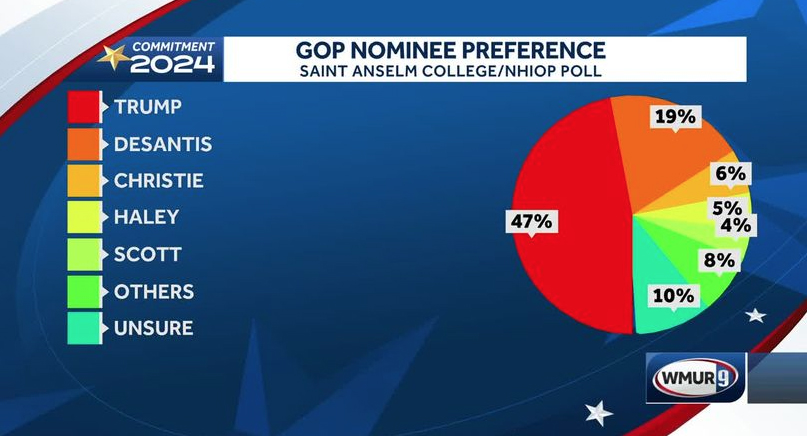
New Hampshire Poll: St. Anselm College Releases Regular Poll — The New Hampshire Institute of Politics of St. Anselm College published their latest regular survey of Granite State voters (June 21-23; 1,065 registered New Hampshire voters; live interview) and sees former President Donald Trump gaining strength in the Republican primary while principal challenger Gov. Ron DeSantis is losing support. The partisan primary numbers find Trump leading Florida Gov. DeSantis, 47-19 percent with no other candidate exceeding six percent support.

On the Democratic side, President Joe Biden dominates Robert F. Kennedy Jr. and author Marianne Williamson, 69-9-8 percent. These numbers exceed how the president is performing nationally. Since the state is unlikely to agree to moving their primary to comply with the new Democratic National Committee calendar, these numbers suggest that Biden could win a write-in campaign against his two intra-party challengers even if he doesn’t enter the official Democratic primary.

In hypothetical general election pairings, President Biden would lead both former President Trump and Gov. DeSantis with the same 49-40 percent spread. This data suggests there is less chance that New Hampshire will become a major general election Republican conversion target.

Senate

Montana: Retired Navy SEAL Declares Candidacy with NRSC Endorsement — Retired Navy SEAL and aerospace company CEO Tim Sheehy (R) announced his US Senate candidacy Tuesday. Immediately, the National Republican Senatorial Committee, with its chairman being Montana’s junior Sen. Steve Daines, endorsed Sheehy’s candidacy. The Montana Senate race is expected to be one of the hottest campaigns in the country as Republicans attempt to deny incumbent Sen. Jon Tester (D) a fourth term.

Rep. Matt Rosendale (R-Glendive), who is also expected to join the race, responded with a Tweet saying, “congratulations to Mitch McConnell and the party bosses on getting their chosen candidate. Now Washington has two candidates – Tim Sheehy and Jon Tester – who will protect the DC cartel.” Early polling shows Rep. Rosendale beginning the race with a substantial lead, so we can expect both a hot general election campaign, and an equally tough Republican nomination contest next year in Big Sky Country.

House

Alabama: Governor Calls Special Redistricting Session — To comply with the US Supreme Court ruling on the Alabama racial gerrymandering case that went against the state, Gov. Kay Ivey (R) said that she will call a special redistricting session for the purposes of drawing a new map to comply with the decision. The legislature will report on July 17 to begin the process.

Since Alabama is a Super Tuesday state and is holding its regular primary on March 5, time is short to draw a new map and obtain the necessary judicial approvals. The ruling and new map is expected to give the Democrats an extra seat in the Alabama US House delegation that currently stands at 6R-1D.

SCOTUS: North Carolina Case Ruling — In an unsurprising 6-3 ruling, the US Supreme Court ruled against the state of North Carolina on the subject of redistricting. Legal analyst Derek Muller of the Election Law Blog describes the crux of the state’s argument as saying, “the state constitution or state judiciary cannot constrain the state legislature exercising power under the Elections Clause.” Predictably, the justices ruled that the judiciary does have the authority to involve itself in redistricting decisions but underscored that the Supreme Court has the power to restrain lower courts from taking too much power away from the legislative bodies.

Largely because the North Carolina state Supreme Court has already reconsidered its previous partisan gerrymandering decision, the high court confined itself to the judicial power question.

Scott Tops Haley in South Carolina;
A GOP Battle in Florida; Steny Hoyer Challenged; LDP Endorses Wilson

By Jim Ellis — Wednesday, June 28, 2023

President

(R-SC)

South Carolina: Sen. Scott Again Tops Ex-Gov. Haley — The American Greatness political organization, loosely affiliated with former President Donald Trump, conducted a survey of the critically important South Carolina Republican primary (National Research, Inc.; June 19-21; 500 likely South Carolina Republican primary voters) and again finds Sen. Tim Scott (R-SC), who the recent NBC national poll now detects moving into third place on the Republican primary ballot test, topping former South Carolina Gov. Nikki Haley.

Former President Donald Trump maintains a substantial lead with 41 percent support. Florida Gov. Ron DeSantis is second with 18 percent. Sen. Scott and ex-Gov. Haley follow with 10 and eight percent, respectively, before their home state electorate. No one else even reaches the four percent benchmark. The South Carolina Republican primary is scheduled for Feb. 24, the fourth state to vote on the GOP calendar.

House

FL-16: Rep. Buchanan to Face DeSantis Appointee — Private school superintendent Eddie Speir (R), who Gov. DeSantis appointed to a board that oversees New College, a public liberal arts college in Sarasota, Florida, announced that he will challenge veteran Rep. Vern Buchanan (R-Sarasota) in next year’s GOP primary. After Rep. Buchanan lost his bid to become House Ways & Means Committee chairman, there were rumors floating that he would resign his seat. Therefore, Buchanan remains a retirement prospect. The FiveThirtyEight data organization rates FL-16 as R+13, while Dave’s Redistricting App calculates a 55.2R – 42.7D partisan lean.

MD-5: Democratic Challenger for Rep. Hoyer — On the heels of former House Majority Leader Steny Hoyer (D-Mechanicsville) hinting he will seek re-election to a 23rd term in 2024, a credible Democratic primary challenger appears on the scene. Prince Georges County Environmental Director Andrea Crooms announced her candidacy Monday, becoming the candidate with the most potential of attracting support. It is highly doubtful, however, that she can unseat Hoyer, who has represented the southern Maryland region since winning a special congressional election in 1981.

It is clear the Democratic primary will be the significant election. With a FiveThirtyEight data organization score of D+28, and a Dave’s Redistricting App partisan lean calculation of 60.9D – 36.4R, the GOP has little chance of making a serious run here in the general election.

Governor

Louisiana: Democratic Party Officially Endorses — With the open Bayou State governor’s race beginning to attract attention, the Louisiana Democratic Party has already gone on record with endorsement support for the leading party contender long before candidate filing closes on Aug. 10, 2023. The LDP now officially endorses former Secretary of Transportation Shawn Wilson, joining outgoing Gov. John Bel Edwards (D) who also publicly supports Wilson as his successor. Gov. Edwards is ineligible to seek a third term under Louisiana election law.

The Louisiana system features an all-party jungle primary on Oct. 14 of this year. If no candidate receives majority support, a runoff between the top two finishers will be held on Nov. 18. The leading Republicans are attorney general and former Congressman Jeff Landry and state Treasurer John Schroder. With eight candidates already actively running, the chances of moving to a runoff are extremely high.

Poll Shows Biden Holding Strong; Hoyer Says Don’t Write My Obit;
Texas Rep. Carter Draws Opponent;
UT-2 Special Election Moves Forward

By Jim Ellis — Tuesday, Jan. 27, 2023

President

NBC News Poll: Trump Strong for Nomination; Trails Biden — Hart Research (D) and Public Opinion Strategies (R) collaborated on a national survey for NBC News (June 16-20; 1,000 US registered voters; 500 likely Republican primary voters; live interview) and found former President Donald Trump, despite his federal indictments, increasing his lead over Florida Gov. Ron DeSantis and the others. According to this data, Trump secures 51 percent in the national poll, well ahead of Gov. DeSantis who records 22 percent support. Former Vice President Mike Pence receives seven percent, and no other candidate even reaches the five percent plateau.

In the general election, however, President Joe Biden would lead former President Trump by four percentage points in the national popular vote, while Gov. DeSantis draws even with the president. A whopping 74 percent believe the country is on the wrong track. President Biden’s job approval was recorded at 43:53 percent favorable to unfavorable.

House

Former House Majority Leader Steny Hoyer (D-Mechanicsville)

MD-5: No Retirement in Sight — Former House Majority Leader Steny Hoyer (D-Mechanicsville), who after winning a special congressional election in 1981 would spend 26 years in top House leadership positions, indicated to the audience of a local Democratic organization event to “not write any obituaries,” as reported on the Daily Kos Elections site. At 84 years old and out of leadership for the first time since 1989, Rep. Hoyer appeared to be a candidate for retirement. Instead, it looks like he will be on the ballot in 2024 seeking a 23rd term.

TX-31: Rep. Carter Faces Primary — Army veteran and former Bell County Republican Party chairman Mark Latimer, who claims 11-term Rep. John Carter (R-Round Rock) is “not ready for the fight ahead,” announced that he will enter the March 2024 Republican congressional primary. Carter, first elected in 2002, faced a primary from two Republicans in 2022 and was renominated with 71 percent of the vote. He was unopposed in the general election.

Over his 11 congressional elections, he’s had only one close call. In 2018, Army veteran Mary Jennings Hegar (D) held him to a 51-48 percent re-election victory. The 31st District contains two-thirds of Rep. Carter’s home county of Williamson, half of Bell County, and all of Bosque, Burnet, Coryell, and Hamilton Counties in central Texas. Prior to his service in Congress, Rep. Carter was a Williamson County district judge for 20 years.

UT-2: Republicans Hold Special District Convention — Utah’s 2nd District Special Republican endorsing convention met in the small, but centrally located town of Delta on Saturday to choose one candidate to advance into the special primary election scheduled for Sept. 5 to replace resigning Rep. Chris Stewart (R-Farmington).

After five rounds of balloting, Rep. Stewart’s congressional legal counsel, Celeste Maloy, scored a 52-48 percent victory over former state House Speaker Greg Hughes. Others may still qualify for the primary ballot but must obtain 7,000 valid 2nd District Republican registered voter signatures by July 5. At least two of the candidates, former state Rep. Becky Edwards and ex-Republican National Committeeman Bruce Hough, are pursuing the signature option.

If no other candidate qualifies for the ballot, Maloy will officially become the party nominee, and be rated as a heavy favorite to win the Nov. 21 special general election in a district that the FiveThirtyEight data organization rates as R+23, and Dave’s Redistricting App calculates the partisan lean at 60.1R – 34.2D.

New Battleground Polling

By Jim Ellis — Monday, June 26, 2023

President

Campaign 2024: States Decide — It is already pretty clear that four states could decide the 2024 presidential election. With the electorate locked in most places either for the Democratic or Republican candidate, voters in Arizona, Georgia, Pennsylvania, and Wisconsin could be the ultimate deciders in Campaign 2024.

Public Opinion Strategies, polling for the DeSantis presidential campaign, released their latest survey results from three of the four key swing domains, Arizona, Georgia, and Pennsylvania.

In each instance the results find Florida Gov. Ron DeSantis leading President Joe Biden, while former President Donald Trump trails the incumbent.

The methodology in each of the three states featured interviews with 500 likely general election voters during the June 17-19 period.

In Arizona, President Biden would lead former President Trump, 45-43 percent. When Gov. DeSantis was tested as the Republican nominee, the race shifted considerably. He would lead the president by six percentage points, 47-41 percent, meaning a net swing of eight points when compared to Trump’s standing.

A similar pattern occurred in Georgia, but not quite as dramatic. The Biden-Trump pairing favored the president, 47-45 percent. Replacing Trump with DeSantis yields a swing toward the Republicans. The Biden-DeSantis match-up favors the Florida governor by a 49-45 percent spread, or a net swing of five percentage points.

The same outcome appears in Pennsylvania. Biden would lead Trump, 48-45 percent, but loses to DeSantis by the same 48-45 percent spread, a net swing of six percentage points.

To win the presidency, the Republicans need to covert states worth a total of 35 electoral votes. These particular polls show the GOP, with DeSantis leading the ticket, as having enough to defeat President Biden, since carrying Arizona (11 electoral votes), Georgia (16), and Pennsylvania (19) would yield the GOP a 46 electoral vote gain, meaning 281 national electoral votes or 11 more than needed to clinch victory.

Continue reading

Primary Maneuverings; Tiffany Pegged in Wisconsin; UT-2 Special Election Debates; Sununu Retiring?

By Jim Ellis — Wednesday, June 21, 2023

President

South Carolina: Republicans Opt for Later Primary — South Carolina moving to first position is the focal point of the Democrats’ new presidential pre-Super Tuesday primary calendar, but some of the affected states are not in agreement. Georgia, for example, voted not to adopt the Democratic National Committee recommendation and New Hampshire is sure to follow suit. Michigan has agreed, and both parties will vote on Feb. 27.

Over the weekend, the South Carolina Republican Party convention delegates voted to hold the state’s Republican primary on Feb. 24. Democrats have already chosen Feb. 3. Therefore, it is likely the state will hold two primaries, one for each party. Holding separate primary days in this state has previously happened. Both Palmetto State parties want South Carolina to continue having a premier primary, so the state is likely to make scheduling accommodations for each political entity.

Senate

Wisconsin: GOP Convention Favors Rep. Tiffany — The Wisconsin Republican Party convention conducted straw polls of those who attended over the weekend, and though it was no surprise that former President Donald Trump out-polled Florida Gov. Ron DeSantis (53-34 percent), much of the attention fell to the US Senate contest. Since Rep. Mike Gallagher (R-Green Bay) announced last week that he would not run for the Senate, the party is in need of a strong challenger to oppose two-term incumbent Tammy Baldwin (D) next year.

A strong plurality of party delegates are now looking to Rep. Tom Tiffany (R-Minocqua), who is indicating he has some interest in the statewide race. A total of 35 percent of the delegates voted for Rep. Tiffany as their first choice to oppose Sen. Baldwin. Former Milwaukee County Sheriff David Clarke was second with 19 percent, with businessman and former statewide candidate Kevin Nicholson, ex-state Sen. Roger Roth, and businessmen Eric Hovde and Scott Mayer following with 16, 11, 8 and 1 percent, respectively. None from this group are official candidates.

House

UT-2: Special Convention, Debates Scheduled — The Utah Republican Party has scheduled the special 2nd District GOP live nominating convention for this coming Saturday, June 24 in the city of Delta, which is in the geographical center of the sprawling CD that stretches from the city of Farmington, through the western Salt Lake City suburbs and then all the way to the Arizona border. Democrats are meeting in a virtual convention on June 28.

The 2nd District Republican delegates will vote among the 13 filed Republicans to send one into the special Sept. 5 primary as the official party endorsed candidate. Democrats have three candidates including the favorite for the nomination, state Sen. Kathleen Riebe (D-Cottonwood Heights). The delegates will continue the voting process until one candidate receives majority support. This individual will automatically be placed on the primary ballot. Other candidates wishing to contest the nomination will be required to file 7,000 valid registered voter petition signatures from the party for which they are attempting to qualify.

Republican debates have also been scheduled for the special election. The northern Utah forum was held Tuesday, with the southern district event on Thursday. Rep. Chris Stewart (R-Farmington), for family reasons, is resigning his seat on Sept. 15. The special general election will be held on Nov. 21. Republicans are favored to hold the UT-2 seat which the FiveThirtyEight data organization rates as R+23.

Governor

New Hampshire: Gov. Sununu Leaning Toward Retirement — In a radio interview Monday, four-term Gov. Chris Sununu (R) said, “I don’t think I’m going to run again,” but indicated he would make a firm decision this summer.

Gov. Sununu is only the second four-term governor in state history; no one has served five terms. New Hampshire, along with neighboring Vermont are the only two states that have two-year gubernatorial terms. Already, Manchester Mayor Joyce Craig and Executive Councilor Cinde Warmington have indicated they will compete for the Democratic nomination. In an open situation, the New Hampshire state house would be a prime Democratic conversion target.

Sen. Scott Shows Movement; Biden vs. GOP Candidates; Tight Race in Michigan; Alabama Redistricting

By Jim Ellis — Tuesday, June 20, 2023

President

South Carolina Sen. Tim Scott (R)

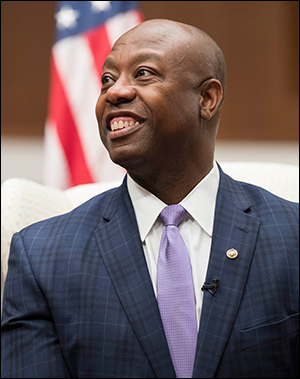
Sen. Tim Scott: Showing Movement — Last week we saw New Hampshire polls found Sen. Tim Scott (R-SC) moving into either third place on the GOP ballot test question, or tying for that same position. Now, we see a new national poll showing similar upward mobility for the South Carolina senator.

YouGov America, polling for the University of Massachusetts (May 31-June 8; 1,133 US adults; online), finds former President Donald Trump again leading among national Republicans with a 56 percent preference figure while Florida Gov. Ron DeSantis trails with 26 percent support. Sen. Scott, though posting only four percent, moves past the other second tier candidates for third place.

The general election pairings also show him highly competitive with President Joe Biden. While Biden leads former President Donald Trump 43-40 percent in the national popular vote question and posts a 41-37 percent margin against Gov. DeSantis, Sen. Scott falls into the same realm. Despite not being well known nationally, he actually polls the best against the president, trailing only 37-35 percent.

Michigan Poll: Highly Competitive Results — The new EPIC-MRA Michigan poll (June 8-14; 60 likely Michigan voters; live interview) again reveals a familiar pattern. That is, President Biden’s job approval rating is extremely low, yet he pulls even in the ballot test with both former President Trump and Florida Gov. Ron DeSantis. The polling sample tilts slightly Republican because the black vote is under-represented by three points when compared to the US Census Michigan population figures.

While President Biden’s job approval ratio is a terrible 29:69 percent favorable to unfavorable (nine percent excellent; 20 percent pretty good; 25 percent just fair; 44 percent poor), he still pulls even with Trump in the Michigan ballot test at 44 percent apiece. When paired with Gov. DeSantis, the president trails by one point, 45-44 percent.

The EPIC poll obviously suggests that Michigan will be a battleground state in the presidential race, but most analysts are projecting it will remain in the Democratic column when the votes are ultimately counted.

Senate

Michigan: Poll Shows Tight Race — The aforementioned EPIC-MRA Michigan poll (see Michigan president above) also tested the impending open Wolverine State US Senate race. The pollsters pitted Rep. Elissa Slotkin (D-Lansing), the early favorite for the Democratic nomination, and retired Detroit Police Chief James Craig, potentially the most well known Republican. The ballot test revealed a tighter contest than expected with Rep. Slotkin holding only a 40-39 percent edge over retired Chief Craig. Both figures contain eight percent in the “lean” category for both Rep. Slotkin and Craig.

The Michigan race will likely move closer to the Democratic column as the year-long campaign evolves. There is a slight Republican skew in this polling sample as blacks are slightly under-represented. Both Rep. Slotkin and Craig are unknown to the majority of the respondent universe indicating that each will have to spend money to increase name identification. The seat is open because four-term incumbent Sen. Debbie Stabenow (D) is retiring.

House

Alabama Redistricting: Court Determines Re-Mapping Calendar — After last week’s US Supreme Court’s ruling that invalidated the Alabama congressional map, the federal three judge panel assuming jurisdiction has sent the map back to the state legislature to begin the re-drawing process. SCOTUS agreed with the plaintiffs in the case that a second majority minority district can be drawn in the state. The current map yields a 6R-1D split.

The court is giving the legislature until July 21 to produce a new map for judicial review. If the legislature cannot complete the plan within that time frame, the court may step in and order a special master to manage the map drawing process.

SCOTUS will also rule on the North Carolina partisan gerrymandering and judicial power lawsuit before the end of June. That ruling could have an effect upon the Alabama case as it relates to judicial control over the redistricting process. Therefore, the situation could again change once the North Carolina ruling is made public.