Tag Archives: Alabama

Slotkin Posts Larger Lead in Senate Campaign; Alabama Redistricting Map Passes; Matos Challenged in Rhode Island; Maloy Challenged in Utah

By Jim Ellis — Tuesday, July 25, 2023

Senate

Michigan Rep. Elissa Slotkin (D-Lansing)

Michigan: Slotkin Posts Larger Lead — Mitchell Research conducted a new poll of the Michigan electorate (July 11-13; 639 likely Michigan voters; SMS text) and finds Rep. Elissa Slotkin (D-Lansing) recording a 44-38 percent lead over former Rep. Mike Rogers (R) and an even larger 41-28 percent advantage over ex-US Rep. Peter Meijer (R). Both are potential Senate candidates. The accuracy level of this poll could be questioned, however. The sample number of 639 is low for a purely electronic poll, and the all-text questionnaire did not accept any respondent who failed to answer all of the survey’s 22 questions.

House

Alabama: New House Redistricting Map Passes Legislature — On Friday, the Alabama legislature passed a new congressional map as directed, but the controversy appears far from over. The US Supreme Court decision that there could be another minority seat drawn on the Alabama map was addressed in the special session that Gov. Kay Ivey (R) called to comply with the SCOTUS ruling.

Assuming the governor signs the new legislation creating the map, the Democratic plaintiffs have already said they will object to the new plan. The initial challenge to this new map will return to the three judge panel who originally declared the Alabama map unconstitutional.

It will be up to the three Republican judges to determine if this plan meets the guidelines that the SCOTUS ruling outlined. We can expect detailed and possibly contentious arguments to occur when attorneys from both sides again appear before the judicial panel. The Alabama primary is being held concurrently with Super Tuesday, March 5, 2024, so expect the new lawsuit to be quickly filed.

RI-1: Matos’ Signatures Challenged — As last week closed, controversy arose in the special election to replace resigned Rhode Island Congressman David Cicilline (D). Lt. Gov. Sabina Matos, who polling suggests has opened a large lead over the field of 21 other Democrats, now may face a challenge over whether her required 750 petition signatures are all from legally registered voters.

Matos’ campaign spokesperson said they will review the signatures to ensure that she has met the legal requirement. If the challenge proves valid and Matos is disqualified, the race becomes wide open. The Democratic primary, the winning of which is tantamount to claiming the seat, is scheduled for Sept. 5.

UT-2: Lawsuit Filed Challenging Maloy’s Legitimacy — One of the special election Republican candidates who lost the Utah Republican Party’s 2nd District endorsing convention and did not file petition signatures to continue his candidacy, has now filed a lawsuit challenging the officially endorsed candidate, Celeste Maloy who is resigning Rep. Chris Stewart’s (R-Farmington) legal counsel.

Two weeks ago, objection to Maloy’s voter registration status arose since she last cast a ballot in Utah during the 2018 election. She moved to the Washington, DC area to work for Rep. Stewart, thus explaining her absence from the state. Lt. Gov. Deidre Henderson (R), who is the state’s chief elections officer, approved her petition, thus allowing her candidacy. Now, however, former candidate Quin Denning (R) is filing an official legal challenge to her status. He is claiming that Maloy reactivated her Utah voter registration at her sister’s house three days after filing her candidacy documents.

Former state Rep. Becky Edwards and ex-Republican National Committee chairman Bruce Hough have qualified via petition for the Sept. 5 special primary election. The Democrats have nominated state Sen. Kathleen Riebe (D-Cottonwood Heights). Rep. Stewart is scheduled to resign on Sept. 15.

Trump, Biden Ahead by Wide Margins in New Poll; Navy SEAL Declares in Montana; Redistricting News from Alabama, North Carolina

New Hampshire GOP presidential poll results / WMUR TV graphic

By Jim Ellis — Thursday, June 29, 2023

President

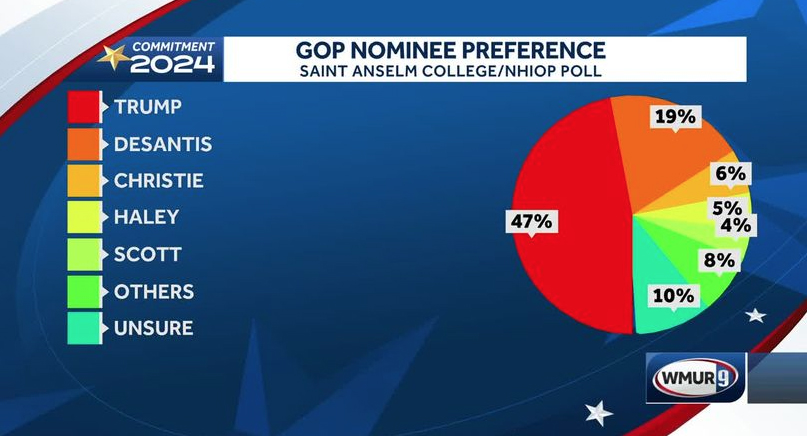
New Hampshire Poll: St. Anselm College Releases Regular Poll — The New Hampshire Institute of Politics of St. Anselm College published their latest regular survey of Granite State voters (June 21-23; 1,065 registered New Hampshire voters; live interview) and sees former President Donald Trump gaining strength in the Republican primary while principal challenger Gov. Ron DeSantis is losing support. The partisan primary numbers find Trump leading Florida Gov. DeSantis, 47-19 percent with no other candidate exceeding six percent support.

On the Democratic side, President Joe Biden dominates Robert F. Kennedy Jr. and author Marianne Williamson, 69-9-8 percent. These numbers exceed how the president is performing nationally. Since the state is unlikely to agree to moving their primary to comply with the new Democratic National Committee calendar, these numbers suggest that Biden could win a write-in campaign against his two intra-party challengers even if he doesn’t enter the official Democratic primary.

In hypothetical general election pairings, President Biden would lead both former President Trump and Gov. DeSantis with the same 49-40 percent spread. This data suggests there is less chance that New Hampshire will become a major general election Republican conversion target.

Senate

Montana: Retired Navy SEAL Declares Candidacy with NRSC Endorsement — Retired Navy SEAL and aerospace company CEO Tim Sheehy (R) announced his US Senate candidacy Tuesday. Immediately, the National Republican Senatorial Committee, with its chairman being Montana’s junior Sen. Steve Daines, endorsed Sheehy’s candidacy. The Montana Senate race is expected to be one of the hottest campaigns in the country as Republicans attempt to deny incumbent Sen. Jon Tester (D) a fourth term.

Rep. Matt Rosendale (R-Glendive), who is also expected to join the race, responded with a Tweet saying, “congratulations to Mitch McConnell and the party bosses on getting their chosen candidate. Now Washington has two candidates – Tim Sheehy and Jon Tester – who will protect the DC cartel.” Early polling shows Rep. Rosendale beginning the race with a substantial lead, so we can expect both a hot general election campaign, and an equally tough Republican nomination contest next year in Big Sky Country.

House

Alabama: Governor Calls Special Redistricting Session — To comply with the US Supreme Court ruling on the Alabama racial gerrymandering case that went against the state, Gov. Kay Ivey (R) said that she will call a special redistricting session for the purposes of drawing a new map to comply with the decision. The legislature will report on July 17 to begin the process.

Since Alabama is a Super Tuesday state and is holding its regular primary on March 5, time is short to draw a new map and obtain the necessary judicial approvals. The ruling and new map is expected to give the Democrats an extra seat in the Alabama US House delegation that currently stands at 6R-1D.

SCOTUS: North Carolina Case Ruling — In an unsurprising 6-3 ruling, the US Supreme Court ruled against the state of North Carolina on the subject of redistricting. Legal analyst Derek Muller of the Election Law Blog describes the crux of the state’s argument as saying, “the state constitution or state judiciary cannot constrain the state legislature exercising power under the Elections Clause.” Predictably, the justices ruled that the judiciary does have the authority to involve itself in redistricting decisions but underscored that the Supreme Court has the power to restrain lower courts from taking too much power away from the legislative bodies.

Largely because the North Carolina state Supreme Court has already reconsidered its previous partisan gerrymandering decision, the high court confined itself to the judicial power question.

Sen. Scott Shows Movement; Biden vs. GOP Candidates; Tight Race in Michigan; Alabama Redistricting

By Jim Ellis — Tuesday, June 20, 2023

President

South Carolina Sen. Tim Scott (R)

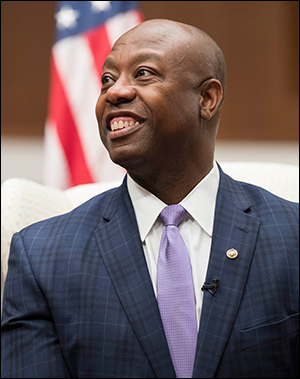
Sen. Tim Scott: Showing Movement — Last week we saw New Hampshire polls found Sen. Tim Scott (R-SC) moving into either third place on the GOP ballot test question, or tying for that same position. Now, we see a new national poll showing similar upward mobility for the South Carolina senator.

YouGov America, polling for the University of Massachusetts (May 31-June 8; 1,133 US adults; online), finds former President Donald Trump again leading among national Republicans with a 56 percent preference figure while Florida Gov. Ron DeSantis trails with 26 percent support. Sen. Scott, though posting only four percent, moves past the other second tier candidates for third place.

The general election pairings also show him highly competitive with President Joe Biden. While Biden leads former President Donald Trump 43-40 percent in the national popular vote question and posts a 41-37 percent margin against Gov. DeSantis, Sen. Scott falls into the same realm. Despite not being well known nationally, he actually polls the best against the president, trailing only 37-35 percent.

Michigan Poll: Highly Competitive Results — The new EPIC-MRA Michigan poll (June 8-14; 60 likely Michigan voters; live interview) again reveals a familiar pattern. That is, President Biden’s job approval rating is extremely low, yet he pulls even in the ballot test with both former President Trump and Florida Gov. Ron DeSantis. The polling sample tilts slightly Republican because the black vote is under-represented by three points when compared to the US Census Michigan population figures.

While President Biden’s job approval ratio is a terrible 29:69 percent favorable to unfavorable (nine percent excellent; 20 percent pretty good; 25 percent just fair; 44 percent poor), he still pulls even with Trump in the Michigan ballot test at 44 percent apiece. When paired with Gov. DeSantis, the president trails by one point, 45-44 percent.

The EPIC poll obviously suggests that Michigan will be a battleground state in the presidential race, but most analysts are projecting it will remain in the Democratic column when the votes are ultimately counted.

Senate

Michigan: Poll Shows Tight Race — The aforementioned EPIC-MRA Michigan poll (see Michigan president above) also tested the impending open Wolverine State US Senate race. The pollsters pitted Rep. Elissa Slotkin (D-Lansing), the early favorite for the Democratic nomination, and retired Detroit Police Chief James Craig, potentially the most well known Republican. The ballot test revealed a tighter contest than expected with Rep. Slotkin holding only a 40-39 percent edge over retired Chief Craig. Both figures contain eight percent in the “lean” category for both Rep. Slotkin and Craig.

The Michigan race will likely move closer to the Democratic column as the year-long campaign evolves. There is a slight Republican skew in this polling sample as blacks are slightly under-represented. Both Rep. Slotkin and Craig are unknown to the majority of the respondent universe indicating that each will have to spend money to increase name identification. The seat is open because four-term incumbent Sen. Debbie Stabenow (D) is retiring.

House

Alabama Redistricting: Court Determines Re-Mapping Calendar — After last week’s US Supreme Court’s ruling that invalidated the Alabama congressional map, the federal three judge panel assuming jurisdiction has sent the map back to the state legislature to begin the re-drawing process. SCOTUS agreed with the plaintiffs in the case that a second majority minority district can be drawn in the state. The current map yields a 6R-1D split.

The court is giving the legislature until July 21 to produce a new map for judicial review. If the legislature cannot complete the plan within that time frame, the court may step in and order a special master to manage the map drawing process.

SCOTUS will also rule on the North Carolina partisan gerrymandering and judicial power lawsuit before the end of June. That ruling could have an effect upon the Alabama case as it relates to judicial control over the redistricting process. Therefore, the situation could again change once the North Carolina ruling is made public.

Polls Show Republican Presidential Race Getting Tighter; A Twist in Wisconsin; SCOTUS Rules on Alabama Redistricting; Special Election in UT-2

By Jim Ellis — Monday, June 12, 2023

President

Former President Donald Trump still up, but down in polling.

State Polls: Republican Race Getting Tighter — Two very recent Republican presidential state polls were released late last week, one from Wisconsin and the other in Utah. While the Wisconsin spread is typical of what we are seeing in other places, the Utah poll has closed to within one percentage point.

Public Policy Polling (June 5-6; 507 likely Wisconsin voters) sees former President Donald Trump leading the Wisconsin GOP primary but with well less than majority support. The ballot test gives the former president a 41-25 percent lead over Florida Gov. Ron DeSantis. Ex-Vice President Mike Pence is next with eight percent support, and no one else breaks five percent. In an isolation question featuring Trump and DeSantis, the former pPresident leads this only 43-39 percent.

The Utah numbers are much closer. In this Dan Jones & Associates poll for the Utah Republican Party (May 22-June 1; 421 registered Utah Republican voters), Trump’s advantage is only 27-26 percent over Gov. DeSantis.

Former Rep. Liz Cheney, not even a candidate, places third with seven percent, and no other candidate breaks the five percent mark. However, this poll’s long sampling period and small respondent universe, along with the introduction of Cheney into the mix, casts an accuracy shadow over this poll.

Senate

Wisconsin: Polling Leader Emerges; Not the GOP’s Top Choice — The Wisconsin Public Policy Polling survey (see President section above) also tested the state’s US Senate race featuring two-term incumbent Tammy Baldwin (D).

The Republican primary ballot test suggests that former Milwaukee County Sheriff David Clarke would lead a prospective group of GOP candidates with 40 percent preference. Placing second is Rep. Mike Gallagher (R-Green Bay) with 20 percent, followed by Rep. Tom Tiffany (R-Minocqua) at 10 percent. Clarke is not an official candidate, and viewed as someone who would be unlikely to win the general election. So far, Rep. Gallagher has not made a discernible move to enter the Senate race. Rep. Tiffany is testing the waters.

The Wisconsin race could become competitive, but Sen. Baldwin would begin any general election as the favorite to win in November.

House

Redistricting: SCOTUS Rules on Alabama — The US Supreme Court, on a 5-4 decision with Chief Justice John Roberts and Associate Justice Brett Kavanaugh joining the majority, ruled in favor of the plaintiffs in the Alabama racial gerrymandering case. Therefore, the Alabama map will be redrawn to reflect a second minority district from the state’s seven seats. Louisiana will likely have to be redrawn as well.

Possible redraws could occur in several other southern states. The ruling is clearly a win for the Democrats and gives them even better odds of re-capturing the House majority in the 2024 election.

UT-2: Special Election Set — Since Utah Rep. Chris Stewart (R-Farmington) submitted an irrevocable letter of resignation for Sept. 15 to Gov. Spencer Cox (R), that action has allowed the state’s chief executive to set at least the special primary election even before the congressman officially leaves office.

Under Utah law, the governor must schedule the special congressional election concurrent with another election. The municipal elections were scheduled for Aug. 15 and Nov. 7, but Gov. Cox is preparing to send the legislature a measure to change those dates to Sept. 5 and Nov. 21 and add the special congressional election to that ballot. These dates meet the federal electoral notice requirements.

The legislature is expected to comply. If they do not, the 2nd District seat could remain vacant for more than a year awaiting the regular primary schedule.

In this instance, the seat will be filled while Rep. Stewart remains in office, which is similar to the Oklahoma law that allows a resigning elected official to serve until a replacement is selected.

2022 Midterm Turnout Trends

Click on the graph above or here to see story and full-size image on BALLOTPEDIA

By Jim Ellis — Wednesday, Jan. 18, 2023

Elections

A Look at the Midterm Numbers — Particularly in low turnout elections, the voter participation figure tends to be definitive as to which party commands the final result. Now that election statistics are final for the 2022 election, we can better analyze the voting patterns and compare them to past trends.

2018 proved to be the highest turnout midterm election in history. In that year, more than 114 million people cast their ballots. The 2022 midterm is now second highest even though voter turnout dropped seven percent from four years previous. In November, just under 106 million total votes were recorded. 

According to the Ballotpedia data organization in their state-by-state turnout recap, 50.33 percent of the eligible voting population participated in 2018 and a commensurate 46.76 percentage is recorded for 2022. By contrast, Ballotpedia finds that 66.8 percent of the eligible voting population participated in the 2020 presidential election. Based upon their calculations, 2020 saw the highest eligible voter turnout in the 21st century.

The Ballotpedia data tells us that the 2022 election’s top five turnout states were Oregon (61.51 percent of the state’s eligible voter figure), Maine (61.46 percent), Minnesota (61.01 percent), Wisconsin (60.1 percent), and Michigan (59.31 percent). 

Conversely, the lowest five turnout states were Tennessee (31.34 percent of the state’s eligible voter figure), Mississippi (32.89 percent), West Virginia (35.66 percent), Alabama (37.74 percent), and Oklahoma (40.11 percent). 

Three of the top turnout states saw a much higher ratio of registered voters casting their ballots when compared to the eligible figures. Maine’s registered voter turnout soared to 75.3 percent, Wisconsin recorded 75.1 percent, and Minnesota reached 69.4 percent. Michigan was one of just 11 states where 2022 turnout exceeded that of 2018.

Except for Tennessee and Alabama, the lowest turnout states also produced substantial increases in registered voter turnout when compared to their eligible voter number. Oklahoma rose to a 50.23 percent participation rate from the registered voter population; Mississippi 44.3 percent; and West Virginia 40.8 percent. Even among registered voters, the Tennessee and Alabama totals failed to reach the 40 percent plateau.

Continue reading

McCarthy’s Win Even Closer

By Jim Ellis — Jan. 9, 2023

House

Colorado Rep. Lauren Boebert (R-Silt)

Speaker: A Dive Into the Numbers — The internal US House voting process that elected California’s Kevin McCarthy as Speaker Friday night on the 15th roll call was arguably even closer than the final 216-212-6 tally suggested. 

The two closest congressional elections, those of Reps. Lauren Boebert (R-CO) and John Duarte (R-CA), both would have affected the Speaker race outcome had the pair not won their tight November electoral contests. 

Though Boebert supported other members on the first 13 roll calls, her “present” vote on the last two helped make the difference in McCarthy’s marathon campaign for the Speakership. Rep. Boebert won her western Colorado re-election campaign with only a 546-vote margin. Duarte was victorious with a similar 564 vote spread in central California. Combined, the aggregate 1,110 vote victories ultimately provided what McCarthy needed to finally reach majority support.

In all, 25 November US House races were decided by less than 10,000 votes apiece. Of those, Republicans won 15 and Democrats 10. In 15 of these 25 elections, we saw the winning candidate flip the district from the previous party’s representation to his or her own. 

It is likely that most, if not all, of these 25 closest 2022 contests will become targeted races in the 2024 election cycle. Throughout the long election cycle, we will be paying particular attention to the 10 districts where the electorate voted opposite of the prognosticators’ pre-election calculation.

The FiveThirtyEight data organization, for example, rated all 435 House districts using past election trends, voter registration, and other statistics to formulate a point spread favoring a nominee of one party or the other.

The following 10 members over-performed their party’s projection and won a close contest in a seat that was expected to favor the opposite party’s nominee:

  • Rep. Marie Gluesenkamp Perez (D-WA-3; R+11)
  • Rep. David Valadao (R-CA; D+10)
  • Rep. Anthony D’Esposito (R-NY; D+10)
  • Rep. John Duarte (R-CA-13; D+7)
  • Rep. Mike Lawler (R-NY-17; D+7)
  • Rep. Susan Wild (D-PA; R+4)
  • Rep. Yadira Caraveo (D-CO-8; R+3)
  • Rep. Wiley Nickel (D-NC; R+3)
  • Rep. Lori Chavez-DeRemer (R-OR; D+3)
  • Rep. Brandon Williams (R-NY; D+2)

Redistricting may very well be back on the table for the 2024 congressional cycle, however. Irrespective of the US Supreme Court deciding the Alabama racial gerrymandering and the North Carolina partisan gerrymandering and legal jurisdiction cases before the end of June, we can expect redraws occurring in certain states.

The legislatures will likely redraw interim court-mandated maps in New York, North Carolina, and Ohio. Based upon a recent federal three-judge court ruling, South Carolina has been ordered to produce a new congressional map by March 31. The impending SCOTUS rulings could force Alabama, Illinois, Louisiana, and North Carolina (if not already done so by the time the high court rules) to change their maps.

The redraws would potentially help Republicans in Illinois and North Carolina, and Democrats in Alabama, Louisiana, New York, and South Carolina. The Ohio situation is unclear, at least for now.

With impending map changes coming in the aforementioned states, and possibly several more depending upon just how far-reaching the future SCOTUS decisions prove, we could again see a large number of seats falling into the competitive realm. This, in addition to the aforementioned 25 close likely targets from the previous election cycle. 

Those members are listed in their entirety below:

Sen. Warnock Wins Re-Election; Florida Sen. Scott to Seek Re-Election; Nebraska Gov. Ricketts to Apply for Senate Appointment; SCOTUS Hears Redistricting Case Today

Georgia Sen. Raphael Warnock (D) wins re-election. | Facebook photo

By Jim Ellis — Wednesday, Dec. 7, 2022

Senate

Georgia: Sen. Warnock Wins Re-Election — As predicted, Georgia Sen. Raphael Warnock (D) defeated GOP former professional football player Herschel Walker (R) last night in the Senate runoff, but the approximate 51-49 percent contest split was much closer than many prognosticators expected. The Warnock win gives the Democrats a 51-49 majority in the Senate, a net gain of one seat from the present 50-50 makeup. The outright majority will give the party at least one more vote than the Republicans on every Senate committee, and make it easier for the leadership to confirm administration appointments, including federal judges.

Turnout is one of the bigger stories, as the projected 3.6 million people voting in the runoff election is actually 200,000-plus individuals greater than those voting in the regular Senate contest back on Nov. 8. It is unprecedented for a runoff to draw more voters than a regular election, but such has apparently happened in this Peach State election.

Yesterday’s secondary election was necessitated under Georgia election law because neither Warnock nor Walker received majority support in November. Unlike in most states, an absolute majority is required to win a Georgia general election.

Sen. Warnock has now secured a full six-years in the Senate after winning the 2020 special election to fill the balance of then-Sen. Johnny Isakson’s (R) final term. Sen. Isakson resigned at the end of 2019 due to health reasons and then later passed away. Gov. Brian Kemp (R) then appointed businesswoman Kelly Loeffler (R) to fill the post until the 2020 special election of which Rev. Warnock won in that cycle’s subsequent runoff.

Florida: Sen. Rick Scott (R) to Seek Re-Election — Quelling political speculation that he would run for president in 2024, Sen. Rick Scott (R-FL) early this week made clear his intentions for the next election. Saying in a response to a question from radio host and national commentator Hugh Hewitt, Sen. Scott said, “I have no plans to run for president and I have a 100 percent plan to run for the US Senate [in 2024]. I’m running for re-election for senator from the great state of Florida.”

Speculation is also surfacing that outgoing US Rep. Stephanie Murphy (D-Winter Park) may challenge Sen. Scott. In a response to a reporter’s inquiry, Rep. Murphy didn’t close the door on such an option and pointed out that Florida is still not as “red” as the electorate voted in the 2022 election. Of the 11 Republican in-cycle seats for 2024, the Florida campaign could be the most competitive, but even here Sen. Scott must be rated a heavy early favorite for re-election.

Nebraska: Gov. Ricketts Will Apply for Senate Appointment — Nebraska junior Sen. Ben Sasse (R) has now set Jan. 8, 2023, as the date he will officially resign his elected position in order to become president of the University of Florida. Governor-elect Jim Pillen (R), who will appoint a replacement for Sen. Sasse, has asked individuals who want to be considered for the Senate appointment to apply before Dec. 23. One person who confirmed he will apply is outgoing Gov. Pete Ricketts (R).

In the open Republican gubernatorial primary back in May, Gov. Ricketts became actively involved and endorsed Pillen, a University of Nebraska Regent, over eight other Republican candidates including Trump endorsed businessman and rancher Charles Herbster. Pillen would win the Republican primary with four percentage-point margin and claimed the general election with just under 60 percent of the vote.

Though others will apply for the soon-to-be vacant Senate position, Gov. Ricketts is viewed as the clear favorite for the early January appointment. The new senator then will stand for election in 2024 to fill the unexpired portion of Sen. Sasse’s final term. The seat is next in-cycle for a full six-year term in 2026.

States

North Carolina: SCOTUS Hears Redistricting Case Today — The North Carolina partisan gerrymandering case that contains challenges to judicial authority over the redistricting process is before the US Supreme Court later today. North Carolina is challenging, among other points in the lawsuit, whether judges have the power to invalidate redistricting maps, since the US Constitution specifically gives re-mapping power to the state legislatures. While it is doubtful that the judicial panel will rule against judicial power, the legitimacy of the redistricting commissions that several states have adopted could be in question.

Along with the previously heard Alabama racial gerrymandering case, the Supreme Court is apparently prepared to issue landmark rulings on Voting Rights Act interpretation for the first time in decades. The rulings should end the inconsistent interpretations we have seen coming from various state judicial systems. Rulings on both the Alabama and North Carolina cases will be issued before the end of next June.

NY Overreach = GOP Majority

CNN’s New York state redistricting map (more coverage on CNN)

By Jim Ellis — Nov. 22, 2022

House

New York State: Redistricting — There is an argument to be made that the New York Democratic redistricting brain trust helped create the new Republican US House majority. With their over-reach on the original map that the legislature and governor enacted, the end result became so egregious that even the Democratic lower and upper courts rejected the congressional map as a pure partisan gerrymander.

The original enacted plan would have yielded a 22D-4R partisan split in the NY congressional delegation of 26 members, thus costing the Republicans four of the eight Empire State seats they control in the current Congress.

Once the votes were cast on Nov. 8 in the districts that the judges’ special master drew to replace the legislature’s plan, the end result saw Republicans not losing four seats but rather gaining three in relation to the current map and seven when compared to the Democrats’ original draw.

Therefore, instead of the intended 22D-4R plan, the New York delegation now headed to Washington is comprised of 15 Democrats and 11 Republicans. With a small Republican majority of what ultimately may be 220-222 seats once the outstanding California and Alaska races are finally projected, the NY swing is arguably the difference in determining which party controls the House.

The Democrats’ map would have reduced the Republicans to just one seat on Long Island, taken the lone district they have in New York City, turned the GOP’s Syracuse seat strongly Democratic, and collapsed the southwestern Upstate seat of resigned Rep. Tom Reed (R) as the lost district in national reapportionment.

You will remember that New York lost a congressional seat by just 89 people when the Census Bureau announced each state’s congressional district compilation under the national reapportionment formula.

After striking down the legislature’s map and replacing it with their own special master’s plan, the court in effect restored much of New York to its historic congressional district pattern.

Under the legislature’s plan, Long Island’s 1st District (Rep. Lee Zeldin) was drawn from the far eastern part of Suffolk County all the way into Queens. This led to stashing a preponderance of the region’s Republican voters in Rep. Andrew Garbarino’s (R-Sayville) South Shore 2nd District. The concept then allowed the map architects to make Districts 3 and 4, both open in 2022 with Reps. Tom Suozzi (D-Glen Cove) running unsuccessfully for governor and Kathleen Rice (D-Garden City) retiring, safely Democratic. The court undid this design.

Now, the 1st District returns to a Suffolk County anchored seat, a CD that Republican Nick LaLota, a former local official and Navy veteran, won to succeed Rep. Zeldin. Rep. Garbarino is back but with a less Republican South Shore seat, which then created a marginal North Shore District 3 seat that Republican George Santos won 54-46 percent in a domain that the FiveThirtyEight data organization rates D+4.

The biggest surprise in New York, and perhaps the country, came in Rep. Rice’s open 4th CD, where Republican Anthony D’Esposito defeated heavily favored Democrat Laura Gillen, 52-48 percent, in a district that actually became more Democratic under the court map at D+10.

The other Republican gains came in the Hudson Valley, where state Assemblyman Mike Lawler (R-South Salem) upset Democratic Congressional Campaign Committee (DCCC) chairman Sean Patrick Maloney (D-Cold Spring) in a D+7 District 17, and Dutchess County Executive Marc Molinaro (R) rebounded from a special congressional election loss in August to claim a 51-49 percent win in a new 19th District rated as R+1.

In the 18th District, state Assemblyman Colin Schmitt (R) came within a percentage point of sweeping the Hudson Valley seats for the GOP, but Rep. Pat Ryan (D-Gardiner) held onto the 18th CD seat after he had won the 19th District special election three months earlier.

The Republican victory string ended with tech executive Brandon Williams (R) defeating former intelligence officer Francis Conole (D) by a percentage point to hold the open Syracuse seat, and former New York Republican Party Nick Langworthy easily won the new 23rd District from which Rep. Reed resigned and Rep. Joe Sempolinski (R-Canisteo) is serving as a caretaker.

The New York 2022 election cycle illustrates just how important map drawing and judicial decisions are in determining US House elections. The New York courts, for example, created a much more competitive political playing field, which certainly led to different results than we would have seen under the legislature’s partisan draw.

Considering that the US Supreme Court is likely to make landmark Voting Rights Act rulings on the Alabama and North Carolina cases before June ends next year, we will likely see new redistricting maps being drawn in several states, and New York could be one of those places. Any newly constructed map would take effect in the 2024 election. A major Supreme Court decision will add yet another dimension to what already promises to be another hot House campaign cycle coming in the new term.

House Updates – Including Gerrymandering: AL, CO, NM, NJ & NY

By Jim Ellis — Thursday, Oct. 6, 2022

House

Alabama redistricting map

Redistricting: Supreme Court Hears Alabama Case — In one of the first cases on the US Supreme Court’s new term docket, oral arguments were heard for the Alabama racial gerrymandering redistricting case, which could result in a landmark ruling relating to future interpretation of the Voting Rights Act.

The state of Alabama is arguing its reasons for keeping the state’s congressional map, which features one strong majority minority district. The US government is arguing that a second minority seat can be drawn. The presentations consumed more time than usual for Supreme Court oral arguments, and now it is up to the nine justices to craft a definitive ruling, which will be released sometime before June next year.

In November, the high court will hear oral arguments on the North Carolina redistricting case, which will lead to a definitive ruling pertaining to judicial power over the constitutional authority of state legislatures.

CO-3: Rep. Boebert’s Slight Lead — Despite representing a relatively safely Republican western slope 3rd Congressional District, Colorado Rep. Lauren Boebert (R-Silt) looks to have a competitive race on her hands as we begin the campaign cycle’s final weeks. Colorado-based Keating Research conducted a poll for the Adam Frisch (D) campaign (Sept. 28-Oct. 2; 500 likely CO-3 voters; live interview & text). The ballot test results found Rep. Boebert’s lead shrinking to 47-45 percent, down from Keating’s 49-42 percent spread detected in its July survey.

Expect to see countering numbers from either the Boebert campaign or the National Republican Congressional Committee to soon be released.

NM-2: Gerrymandered District Yields Dem a Slight Edge — The Global Strategy Group, polling for the Gabe Vasquez (D) campaign, tested the NM-2 electorate to determine the state of the race featuring freshman Rep. Yvette Herrell (R-Alamogordo) and Vasquez, a Las Cruces City councilman. The GSG survey (Sept. 20-26; 500 likely NM-2 voters; live interview) sees Vasquez pulling ahead of Rep. Herrell, 45-43 percent.

The result is not particularly surprising in that the Democratic legislature and governor crafted the new 2nd CD to flip. Before redistricting, the FiveThirtyEight data organization rated the seat, R+14. Post-redistricting, we see a D+4 categorization. This district will still yield a close finish, and voter turnout will tell the ultimate tale.

NJ-7: Rep. Malinowski Internal Poll Shows Dead Heat — The Greenberg Quinlan Rosner Research organization conducted a congressional poll for two-term Rep. Tom Malinowski (D-Rocky Hill), who is again in a tight battle with former state Senate Minority Leader Tom Kean Jr. (R). In 2020, Kean held Rep. Malinowski to a 51-49 percent re-election win in a district that was more Democratic than the new 7th. The GQR survey (Sept. 20-26; 500 likely NJ-7 general election voters) sees both candidates now attracting 48 percent of the vote. The Democratic pollster, however, also detects a partisan generic party label split of 50-45 percent favoring the Republicans. NJ-7 is a key Republican conversion opportunity seat.

NY-22: Republican Breaks Ahead — The Syracuse-anchored 22nd District is open in the 2022 election cycle because Rep. John Katko (R-Syracuse), one of the 10 House Republicans who voted to impeach former President Trump, is not seeking a fifth term. Ironically, the court-drawn map actually makes this district two points more Republican than the seat the Rep. Katko consistently won.

Siena College conducted an independent poll for the Spectrum News Service (Sept. 25-28; 453 likely NY-22 general election voters) and sees Republican technology company executive Brandon Williams jumping out to a five point, 45-40 percent, advantage over former intelligence agency analyst Francis Conole (D).

With the respondents believing the country is on the wrong track by a 25:63 percent margin, it is not particularly surprising to also see Gov. Kathy Hochul (D) falling behind Rep. Lee Zeldin (R-Shirley/East Long Island) in this Upstate District. NY-22 is a must-win for the GOP in November.

Britt Wins Alabama Runoff; Al Gross Exits Alaska Race; Tough Night For Trump in Peach State

By Jim Ellis — June 22, 2022

Senate

Katie Britt won the Republican US Senate nomination in Alabama.

Alabama: Britt Wins Runoff — As the post-primary polling unanimously foretold, Katie Britt, the former president and CEO of the Business Council of Alabama organization and ex-chief of staff to retiring Sen. Richard Shelby (R), won the Republican US Senate nomination with a landslide 63-37 percent margin over Alabama US Rep. Mo Brooks (R-Huntsville) in last night’s runoff election.

Britt’s victory was complete in that she carried 66 of Alabama’s 67 counties en route to claiming the party nomination, and a veritable ticket to the US Senate. She now faces pastor Will Boyd, who won the Democratic nomination outright on May 24 in what will prove to be a perfunctory general election in this safely Republican state.

House

AL-5: Dale Strong Headed to DC — Madison County Commission chairman Dale Strong (R) defeated former Deputy Army Secretary Casey Wardynski with just over 63 percent of the Republican runoff vote. Like Britt, Strong has punched his ticket to Washington with last night’s victory.

The FiveThirtyEight data organization rates AL-5 as R+32, leaving little doubt that Strong is now the prohibitive favorite to defeat Democratic nominee Kathy Warner-Stanton who won her party’s nomination outright in the regular primary contest.

AK-AL: Al Gross Exits Race — Yesterday, surgeon Al Gross, who was the 2020 Democratic US Senate nominee against Sen. Dan Sullivan (R) but running as an Independent in the US House special election, decided to end his campaign. Dr. Gross had qualified for the four-candidate runoff with his third-place finish in the special primary on June 11. He simply said he had “great hope for Alaska” in his departing statement but did not offer a particular reason for making the decision to prematurely end his campaign.

It appears the fifth place finisher, Republican Tara Sweeney a former Deputy Assistant Secretary in the US Department of Interior will move into the fourth position, but even officials at the Board of Elections could not confidently confirm that such is the procedure.

Former governor and 2008 vice presidential nominee Sarah Palin qualified in first position, followed consecutively by businessman Nick Begich III (R), Dr. Gross, and former state Rep. Mary Peltola (D).  In his statement, Dr. Gross endorsed both Peltola and Sweeney saying “they are two outstanding Native women who will serve our state well.” The special general election is Aug. 16.
 
Georgia: Trump has Another Tough Night in Peach State — Georgia proved another tough night for former President Donald Trump, as his two key candidates in House runoff races, Jake Evans in the newly reformed open District 6 and Vernon Jones in the open 10th CD, both went down in landslide proportions. These results, added to Trump candidates David Perdue and Rep. Hice losing the governor and Secretary of State’s races respectively in the May 24 primary, suggests that the Peach State will likely prove to be Trump’s poorest endorsement state.

Dr. Rich McCormick, a retired Navy physician who was the 7th District GOP nominee in 2020, scored a 67 percent win over Evans. In District 10, businessman Mike Collins, a trucking company owner and son of the late former Congressman Mac Collins, recorded almost 75 percent of the runoff vote.

Virginia: Two Congressional Primaries Decided — As predicted, state Sen. Jen Kiggans (R-Virginia Beach), a US Navy veteran and nurse practitioner, topped a field of four Republican candidates with a convincing 56 percent of the vote. She will now oppose Rep. Elaine Luria (D-Norfolk) in what promises to be one of the most hotly contested GOP challenger races in the country.

Moving to northern Virginia, Rep. Abigail Spanberger’s (D-Glen Allen) politically marginal 7th CD produced a general election Republican challenger last night. Prince William County supervisor and former law enforcement officer Yesli Vega defeated five GOP opponents on her way to a tight 29-24-20 percent victory spread. The Spanberger-Vega general election will be hard fought. While the congresswoman has a slight advantage in partisan voting history, the potential turnout pattern suggests that this seat is still very much in play for a potential GOP upset.