Tag Archives: Alabama

The Roy Moore Polling

By Jim Ellis

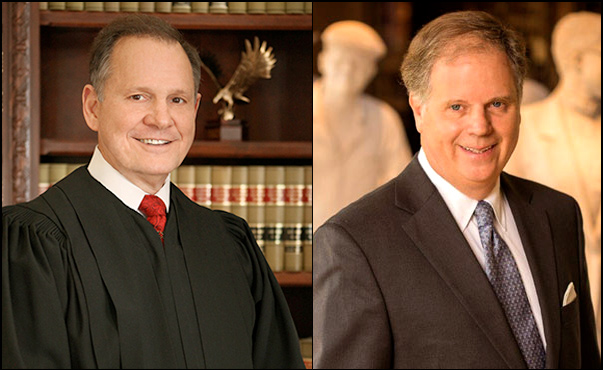
Left: Former state Supreme Court Chief Justice Roy Moore (R) | Right: Ex-US Attorney Doug Jones (D)

Left: Former state Supreme Court Chief Justice Roy Moore (R) | Right: Ex-US Attorney Doug Jones (D)

Nov. 16, 2017 — Last evening’s political news featured heavy coverage of a new National Republican Senatorial Committee poll that produced bad news for Alabama GOP special Senate nominee Roy Moore, but not enough information was released to determine the reliability aspect. In fact, the NRSC didn’t even release the name of the polling company with which they contracted to conduct the survey.

This is significant because their finding that Democrat Doug Jones is leading Judge Moore, 51-39 percent, is clearly out of line with every other poll taken in the corresponding time frame. It is also interesting that they would even release such a poll considering the Republican candidate is doing so badly. It does, however, justify their previous position of cutting the Moore Campaign from additional funding because of the sexual impropriety allegations against the candidate that has dominated recent news coverage.

Below are the post-scandal publicly reported surveys as complied by the Ballotpedia website:

• National Republican Senatorial Committee (Nov. 12-13)
No pollster credited
Jones 51%; Moore 39%
500 Sample

• Fox10 (Mobile) (Nov. 13)
News Strategy Research
Moore 49%; Jones 43%
3,000 Sample (Automated)

• Emerson College Polling Society (Nov. 9-11)
Moore 55%; Jones 45%
600 Polling Sample

• JMC Analytics & Polling (Nov. 9-11)
Jones 46%; Moore 42%
575 Sample

• Decision Desk HQ (Nov. 9)
Moore 46%; Jones 46%
515 Sample

As we can see, the NRSC poll returns the most inconsistent results in comparison to the other available data during the same time frame; the period just after the Moore sexual scandal broke.

Additionally, because the NRSC did not release the name of their pollster or the survey methodology, not enough information exists to determine if their data are skewed in any particular manner.

The lack of available information does not necessarily mean that the Senatorial Committee’s results are inaccurate. It is curious, however, that the other results — and, all have larger sample sizes than the reported NRSC calling universe — finds much different ballot test margins.

Interestingly, the Fox10 poll from a local Mobile television affiliate, which is the latest released survey prior to the NRSC study, and the Emerson College Polling Society find the complete opposite result and their methodologies utilize much larger sample sizes within the studied polling grouping. The Fox10 3,000-person sampling universe clearly suggests that the questionnaire responses were obtained through an automated device, but such does not necessarily mean this poll is less accurate than the live operator polls.

The Alabama race continues to deteriorate, and it is becoming more evident that Jones is now in a strong position to win. But, despite all the negative news coverage, this phantom NRSC poll is the only one that shows him trailing badly.

The other survey to find him dropping behind, from JMC Analytics, featured a sampling universe where 56 percent of the respondents are female, a potential skew in Jones’ favor since this subset broke his way, 46-40 percent. In comparison, men favored the Democrat only 46-45 percent in the JMC crosstabs. Therefore, with a sample where the Democratic-leaning female sector was over-sampled by approximately five percentage points, correcting this skew likely brings the Jones’ 46-42 percent ballot test result back into a tied range.

The NRSC results and partial poll release is intriguing to say the least. Hopefully, we will see more substantiation of their data later today.

A New Nominee; Another Retirement

By Jim Ellis

Pennsylvania Rep. Tim Murphy (R-Pittsburgh)

Pennsylvania Rep. Tim Murphy (R-Pittsburgh)

Nov. 15, 2017 — Though almost all of the weekend political media coverage focused on the Alabama Senate campaign and the sexual impropriety allegations against former state Supreme Court Chief Justice Roy Moore (R), over 800 miles from the heart of Dixie another group of Republicans was choosing a nominee to fill a US House vacancy.

In late October, yet another sex scandal-tainted political figure, Pennsylvania Rep. Tim Murphy (R-Pittsburgh), succumbed to the pressure against him and announced that he would resign from the House. Quickly, Gov. Tom Wolf (D) called the special election to fill the new vacancy for March 13. Each 18th District political party organization then had the responsibility of meeting in convention to choose their respective congressional nominee.

On Saturday, 215 Republican conferees from the CD’s four counties decided among three candidates, all members of the Pennsylvania legislature. An additional state representative, Jason Ortitay (R-Bridgeville), originally announced that he, too, would stand for nomination but decided the morning of the convention to withdraw.

Continue reading

The Alabama Debacle

By Jim Ellis

Judge Roy Moore, the Republican nominee in a special Senate election in Alabama.

Judge Roy Moore, the Republican nominee in a special Senate election in Alabama.

Nov. 14, 2017 — Senate Republicans have a major advantage in the current election cycle, but may be on the precipice of giving it away.

Looking at the 2018 Senate map, Republicans have only to defend eight of the 33 in-cycle seats. Considering that six of the eight are the safe Republican states of Mississippi, Nebraska, Tennessee, Texas, Utah, and Wyoming and the Democrats need a net gain of three conversion seats to claim the majority, it appears unattainable even if the latter party converts legitimate targets in politically marginal Nevada and now open Arizona.

But the mathematics change if Democrats score an unlikely upset in the Alabama special election on Dec. 12, and the latest unfolding events there suggest that such an outcome is far more likely to happen.

As we know, Republican Senate nominee Roy Moore, the twice removed former state Supreme Court Chief Justice, has been accused of sexual impropriety with at least one teenage girl when he was 32 years old in 1979. Washington, DC Republicans, who appear to be taking the Washington Post story and the woman’s allegations at face value, are urging Moore to remove himself from the race. Alabama Republicans are still standing firm for Moore, refusing to accept the story without proof. For his part, Judge Moore denies the incident happened.

Three polls have already surfaced telling us that Moore has suffered a major hit. Earlier surveys found him leading in low double-digits, but Opinion Savvy, Gravis Marketing, and JMC Analytics & Polling immediately went into the field to test the Alabama electorate’s reaction.

Opinion Savvy (Nov. 10; 515 likely Alabama special election voters) conducted their survey just hours after the Moore story broke. Their results find that Moore’s lead has evaporated into a 46-46 percent tie with Democratic nominee Doug Jones, a former US Attorney.

Gravis Marketing launched their poll just as quickly (Nov. 10; 478 likely Alabama voters) and finds a similar ballot test tally: 48-46 percent in Moore’s favor.

JMC Analytics (Nov. 9-11; 575 registered Alabama voters) sees Jones pulling into a 46-42 percent lead (48-44 percent when leaners to both candidates are added), but an over-sampling of female voters could account for the Democratic advantage. Fifty-six percent of the survey respondents were female and they break for Jones, 46-40 percent. Men favor the Democrat 46-45 percent.

Considering these polls were taken immediately as the story was breaking and the questionnaires included an explanation of what was being said about him, the results for Moore are not devastating. For the most part, Republican voters are taking Moore’s side while Democrats believe the accuser. The fact that the division is roughly even suggests that Moore has a chance to rebound if he can effectively tell his story.

While Republican leaders may be calling upon Judge Moore to remove himself from the ticket, realistically and legally, he cannot. Under Alabama election law, the ballot cannot be changed within 76 days of the election. That period began Sept. 28. Now comes talk that Gov. Kay Ivey (R) could be approached to postpone the election, or call a special session of the legislature to pass a new emergency election statute. The governor says she is not inclined to even think about such an option.

Additionally, some absentee packets containing Moore’s name have already mailed, thus making it logistically difficult, if not illegal, to inject a new ballot into the campaign. Therefore, the outlook is virtually certain that the election will proceed as scheduled on Dec. 12.

Another idea suggests that the Senate refuse to seat Moore if he wins the election. Should all Democrats vote against Moore, only three Republicans would need to break ranks to keep the seat in abeyance. Presumably, the state could then call a new election, but there would be nothing preventing Moore from running again. Should that be the case, Gov. Ivey then could appoint another interim senator or even keep Sen. Luther Strange (R) in the position. Also, a new election would allow him to run again, too.

For their part, Democrats are remaining publicly quiet. They are likely doing so for two reasons. First, they are adopting the old axiom, “if one’s political opponents are in process of destroying themselves don’t stop them.” Second, they may soon be faced with another vote to eject a senator. Should New Jersey Democratic Sen. Bob Menendez be found guilty in his corruption trial, there will likely be a move to expel him. Democrats would find themselves in a bind if they make a public spectacle of denying entry to Moore, and then quickly pivot to do the opposite in order to save Menendez.

The Roy Moore saga is far from over but at the outset, the situation appears perilous for Republicans. Since losing this seat would endanger their majority standing in 2018, the stakes for how the majority leadership chooses to handle the Alabama situation becomes even more challenging.

Moore Under Attack; Goodlatte #34

Judge Roy Moore, the Republican nominee in a special Senate election in Alabama.

Judge Roy Moore, the Republican nominee in a special Senate election in Alabama.

By Jim Ellis

Nov. 13, 2017 — Controversy is erupting in the Alabama special US Senate election as we begin to enter the last month of campaigning before the Dec. 12 vote.

The Washington Post broke a story late last week (above) that accuses former state Supreme Court Chief Justice Roy Moore (R) of engaging in sexual contact with a 14-year old girl 38 years ago. At the time, Judge Moore would have been 32 years of age. The judge vehemently denies the charges and strikes back against the Post saying the story is politically motivated. Republican officials in Alabama are generally still supportive of Moore. Washington Republicans, who made public statements, expressed the opinion that Moore should step away from the race if the allegations are true.

In actuality, there is no legal way to remove Moore’s name from the ballot even if there is Republican unanimity to do so. Ballots are printed, some absentee packets have already been mailed to voters, and the law specifically states that a change of nominees cannot be made once the campaign moves within 76 days of the election. For this contest, the point-of-no-return date occurred on Sept. 28.

Suggestions range from running defeated Sen. Luther Strange as a write-in candidate, calling the state legislature into special session to pass emergency legislation to change the election law, or simply refusing to seat Moore should he win the Dec. 12 election. If they choose the latter route, another special election would have to be called and scheduled, and the cycle begins anew.

For his part, Moore is already launching fundraising appeals lashing out at his accusers and begging for resource help in order to fight back. He shows no indication that he will relinquish his position as the US Senate nominee.

More will clearly come of this story during the coming week.

VA-6

Continuing what looks to be a series of House incumbent retirements, veteran 13-term Virginia Rep. Bob Goodlatte (R-Roanoke), chairman of the House Judiciary Committee, announced that he, too, will depart when the current Congress adjourns. The timing coincides with his allotted chairmanship tenure also coming to an end.

Goodlatte becomes the 34th regular cycle member not to seek re-election next year, and the 24th Republican. This total does not include the PA-18 vacancy (former Rep. Tim Murphy, R-Pittsburgh) that will be filled on March 13. The latest vacant seat was filled earlier this week when Utah Rep-Elect John Curtis (R-Provo) was elected to replace resigned Congressman Jason Chaffetz (R-Alpine/Sandy).

Though the open GOP list now reaches 24 seats, 17 of them are safely or likely Republican. Only two are in the toss-up category (FL-27, Rep. Ileana Ros-Lehtinen, R-Miami; NJ-2, Rep. Frank LoBiondo, R-Ventnor City), and another five are rated as lean Republican.

Virginia’s 6th District is safely in the GOP column. Goodlatte averaged 77.6 percent of the vote over his 13 congressional elections. The district hugs the West Virginia border and runs north to south along Interstate 81 from Strasburg through Harrisonburg, Staunton, and Lexington, continuing south all the way to Roanoke, with a jut westward to annex the Lynchburg region. President Trump carried the 6th, 60-35 percent, while Mitt Romney outpaced President Barack Obama here, 60-40percent.

The Emerging Senate Cycle

By Jim Ellis

Tennessee state flag

Tennessee state flag

Oct. 25, 2017 — Though we still have more than two full months remaining in calendar year 2017, the 2018 US Senate field is beginning to take clear shape. With 34 statewide contests to be decided, including the Alabama special election that will conclude Dec. 12, no fewer than 10 campaigns are basically set. Action is occurring in an additional 13 states suggesting that some sort of primary or general election competition will soon come to the forefront. Eleven incumbents seeking re-election are rated as “safe” at the present time.

Former Tennessee US Rep. Stephen Fincher (R-Crockett County) announced Monday that he would join the open US Senate Republican primary battle, attempting to succeed retiring Sen. Bob Corker (R). This race already appears to be evolving into a possible two-way primary between ex-Rep. Fincher and current 7th District veteran incumbent Marsha Blackburn (R-Brentwood).

Andy Ogles, the former Tennessee director for Americans for Prosperity, remains in the race after launching what is now a moot primary challenge to Sen. Corker but it is unclear how strong he will be now that several conservative organizations are already beginning to coalesce behind Rep. Blackburn.

The only other bit of Volunteer State intrigue centers around Democratic former Gov. Phil Bredesen and whether he will enter the statewide contest. Originally, Bredesen took himself out of consideration, but now agrees to consider becoming a candidate. He says a decision will be forthcoming in a matter of weeks. Without Bredesen, the Democrats would likely concede the seat to the eventual Republican nominee since other strong potential candidates, specifically US Rep. Jim Cooper (D-Nashville) and Nashville Mayor Megan Barry, have already said they will not run.

Continue reading

Fox Poll: Moore Tied – Dubious

By Jim Ellis

Left: Former state Supreme Court Chief Justice Roy Moore (R) Right: Ex-US Attorney Doug Jones (D)

Left: Former state Supreme Court Chief Justice Roy Moore (R) Right: Ex-US Attorney Doug Jones (D)

Oct. 20, 2017 — A new Fox Poll (Oct. 14-16; 801 registered Alabama voters) just released earlier this week finds former state Supreme Court Chief Justice Roy Moore (R) and ex-US Attorney Doug Jones (D) tied at 42 percent in the special Alabama Senate race to be decided Dec. 12, but such a result begs further analysis.

Though the sample size appears sound from a numerical perspective, its composition causes one to doubt the final result. The actual segment cell sizes are not revealed in the analysis section, but it appears they are not wholly reflective of the Alabama electorate. Those with the greatest error factors: non-whites (+/-7 percent), liberals (+/-7 percent), moderates (+/-7 percent), and independents (+/-8.5 percent) all are strong cells for Jones. The error factors for other segments: whites (+/-4 percent), conservatives (+/-4.5 percent), and gun owners (+/-4.5 percent) are all much lower than the other tested subgroups and each of those favor Judge Moore.

While the overall error rating within the entire sample of registered voters is only listed at +/-3.5 percent, all 18 of the subgroups have corresponding rates that are much higher. This is not particularly unusual since the subgroups, by definition, are smaller than the overall sample, but the considerably larger error factor among Jones’ best groups provides us clues that the poll is skewed in the Democratic nominee’s favor.

Earlier, the Cygnal polling firm released its statewide poll (Oct. 2-5; 497 likely Alabama special election voters) finding Moore leading 49-41 percent, a survey we analyzed last week, and the ex-Judge does particularly well among those identified as most likely to vote. By contrast, the Fox sample is only of registered voters and did not screen for voting propensity. Not isolating voting likelihood is another polling factor that favors Jones’ standing.

Continue reading

The Latest Alabama Data

By Jim Ellis

Left: Former state Supreme Court Chief Justice Roy Moore (R) Right: Ex-US Attorney Doug Jones (D)

Left: Former state Supreme Court Chief Justice Roy Moore (R) Right: Ex-US Attorney Doug Jones (D)

Oct. 16, 2017 — The Cygnal polling firm just released the latest survey for the special Alabama Senate race (Oct. 2-5; 497 likely Alabama special election voters), and it yields a spread between the two major political party nominees that is beyond the margin of polling error. But, these results come with a qualification: the last Cygnal poll for this race, before the Aug. 15 primary election and prior to the September run-off, badly missed the final outcome.

According to this small sample poll, former state Supreme Court Chief Justice Roy Moore (R) leads ex-US Attorney Doug Jones (D), 49-41 percent. Some of the more interesting segmentation includes a significant gender gap. Men prefer Moore 53-38 percent, while women give Jones a one-point edge, 46-45 percent. Jones also leads with voters 49 years of age and younger (a five percentage point advantage), but Judge Moore has a 12-point margin among those 50 and older. This latter spread is a more important advantage for Moore because the oldest age group has the highest propensity to vote in low participation elections.

This latest Cygnal poll is the first the organization has conducted in Alabama since before the special primary. They did not go into the field during the Sept. 26 run-off cycle.

In late July (20-21st), just under four weeks from the Aug. 15 primary, the firm released data that appears to badly miss the mark, but a closer analysis shows they correctly projected the strength of two of the top three candidates.

Continue reading

Bannon: How Much a Factor?

Steve Bannon (Photo by Gage Skidmore)

Steve Bannon (Photo by Gage Skidmore)

By Jim Ellis

Oct. 5, 2017 — Several articles have appeared in the past few days contemplating former presidential advisor Steve Bannon’s perceived political strength, most specifically regarding his actions involving recruiting Republican primary challengers against Senate Majority Leader Mitch McConnell’s (R-KY) loyalists.

While Bannon appears in good stead vis-à-vis financial backers — with the billionaire Mercer family serving as his monetary base — those running the McConnell-aligned outside political operation downplay just how strong the insurgents might be opposite 2018 Senate GOP incumbents standing for re-election.

Valid points resonate with both sides. Buoyed by Alabama former state Supreme Court Chief Justice Roy Moore’s victory over appointed Sen. Luther Strange in last week’s special Republican run-off election, the Bannon forces, who heaped attack ads on the interim incumbent, were naturally taking a great deal of credit for the victory. And, without doubt, anyone thinking of challenging a sitting senator is greatly encouraged after seeing the Alabama outcome.

Continue reading

First Alabama Poll

By Jim Ellis

Oct. 4, 2017 — The Opinion Savvy research firm went into the field to test the Alabama electorate immediately after last week’s special Republican run-off election, and found the winner of that special primary election, former state Supreme Court Chief Justice Roy Moore, holding only a tenuous lead over his Democrat opponent, ex-US Attorney Doug Jones.

Left: Former state Supreme Court Chief Justice Roy Moore (R) Left: Ex-US Attorney Doug Jones (D)

Left: Former state Supreme Court Chief Justice Roy Moore (R)
Right: Ex-US Attorney Doug Jones (D)

The survey results, which other pollsters will probably soon confirm, should lead to the Democratic leadership launching a major offensive campaign here with the long shot goal of stealing the Republican stronghold seat. They have the resources but are hamstrung in this cycle because few offensive Senate opportunities exist; hence, they must make a serious play for this seat that would not normally be in play.

The Opinion Savvy poll (Sept. 27-28; 590 registered Alabama voters; 514 “definite” Dec. 12 special general election voters; 76 “considering” whether they will vote) finds Judge Moore leading Jones, 50-45 percent. Among the definite voters, Moore’s margin expands slightly to 51-44 percent. Within the lesser-motivated voting group, the Republican’s edge slides to just one point, 46-45 percent.

As we saw during the Republican run-off, a huge split – with diametrically opposite totals – exists between self-described evangelicals and non-evangelicals. Considering that the Census Bureau classifies 49 percent of the entire state population as evangelical, and 55.6 percent of this polling universe, this demographic segment was obviously a crucial block in determining the outcome of the Republican run-off and will have an equally large say in the upcoming special general.

Continue reading

The Primary Fallout

By Jim Ellis

Sept. 29, 2017 — Former Alabama State Supreme Court Chief Justice Roy Moore’s victory in Tuesday’s special Senate run-off election has created a media narrative suggesting that statewide GOP primary challenges will soon be sweeping the political scene, but such simply won’t happen.

While Judge Moore’s win may give legs to one adjacent budding Senate primary challenge, the number isn’t going expand due to the 2018 electoral set-up. That is, few Republicans, eight to be exact, are in-cycle for the coming election and the two most vulnerable situations already feature incumbents engaged with primary opponents.

Additionally, the Moore-Sen. Luther Strange contest had unique characteristics that made a primary victory over this particular incumbent more likely, if not probable. Strange, then Alabama’s attorney general, receiving the vacancy appointment in “swamp-like” fashion from a governor trying to avoid impeachment, and using the Senate appointment process to game the system so that he could later choose the person who would continue the legal investigation of himself, cast Strange in a negative light from his very first day in Washington.

Furthermore, the new senator attracted only 32 percent in his first election, meaning that two-thirds of his own party’s Aug. 15 primary voters turned away from him at their first opportunity, was a clear signal that Strange’s appointment was met with widespread dissatisfaction and that the former AG wouldn’t last long in his new job.

Continue reading