Category Archives: Presidential campaign

Trump Skipping Second Debate; Impact of Romney’s Move; Tragic News for Virginia Rep. Wexton; Tight District Race in NM-2; Houston Mayoral Runoff Schedule Set

By Jim Ellis — Friday, Sept. 22, 2023

President

A view of the Ronald Reagan Library

Donald Trump: Skipping Second Debate — Former President Donald Trump said this week that he will not join the other Republican candidates at the Sept. 27 debate forum at the Ronald Reagan Library in southern California. Instead, he will be making a speech about the striking United Auto Workers union to lay the groundwork for potential support in the general election.

As he continues to hold a big lead over the entire GOP candidate field, Trump would stand to gain little by participating in the next forum. Due to more stringent debate requirements, the Republican National Committee expects to have fewer candidates earning a debate podium, with North Dakota Gov. Doug Burgum and ex-Arkansas Gov. Asa Hutchinson unlikely to qualify.

Senate

Utah: Two Make Moves to Join Open Race — Sen. Mitt Romney’s (R) announcement that he will not seek re-election has led to a pair of Republicans readying to enter the race. Roosevelt Mayor Rod “JR” Bird Jr. just announced his candidacy, joining Riverton Mayor Trent Staggs in the active field. State House Speaker Brad Wilson (R-Kaysville) said he will resign his position in mid-November and has scheduled a “special announcement” for Sept. 27. We can expect a large Republican field to form.

House

VA-7: ’22 Cong Candidate will Return — Iraq War veteran and attorney Derrick Anderson (R), who ran for the 7th District seat in the last election but failed to win the Republican primary, announced that he will return in 2024. Four other Republicans have already declared their candidacies for the politically marginal seat.

Rep. Abigail Spanberger (D-Glen Allen) is reportedly looking at a 2025 run for governor, and if she ultimately moves in that direction, she would not seek re-election to the House in 2024. Therefore, this race will move up the competitive scale. The FiveThirtyEight data organization rates the VA-7 seat as D+2. The Daily Kos Elections statisticians rank the 7th as the 14th most vulnerable seat in the 213-member Democratic conference.

Rep. Jennifer Wexton (D-Leesburg)

VA-10: Health Problems Will Keep Rep. Wexton From Seeking Re-Election — Three-term Virginia US Rep. Jennifer Wexton (D-Leesburg) announced that she will not run for a fourth term next year due to a catastrophic health diagnosis.

“I’ve always believed that honesty is the most important value in public service, so I want to be honest with you now – this new diagnosis is a tough one. There is no ‘getting better’ with PSP (Progressive Supranuclear Palsy).” The Mayo Clinic says that “Progressive Supranuclear Palsy is an uncommon brain disorder that causes serious problems with walking, balance and eye movements, and later with swallowing. … [It] worsens over time and can lead to life-threatening complications, such as pneumonia and swallowing problems. There’s no cure for [it], so treatment focuses on managing the signs and symptoms.”

Virginia’s 10th Congressional District is anchored in Loudoun County and contains Fauquier and Rappahannock counties along with parts of Prince William and Fairfax counties. The cities of Manassas and Manassas Park are also included.

The FiveThirtyEight data organization rates the seat D+8, while Dave’s Redistricting App calculates the partisan lean at 55.2D – 43.0R. President Joe Biden carried this district with a substantial 58.3 – 40.2 percent margin. We can expect a competitive open campaign to develop here, but the eventual Democratic nominee will have a clear advantage in the general election.

NM-2: Tight District Race — One of the closest 2022 campaigns occurred in southern New Mexico where then-Las Cruces City Councilman Gabe Vasquez (D) defeated freshman Rep. Yvette Herrell (R) by a scant 50.3 – 49.6% victory margin in a gerrymandered district designed to elect a Democrat. Survey USA was just in the field testing the 2024 re-match campaign. Again, the polling results suggest a toss-up finish.

The S-USA study (Sept. 6-12; 541 likely NM-2 voters; live interview & online) sees Herrell clutching to a slight onepoint edge over Rep. Vasquez, 46-45%. If the Republicans are to hold their slim House majority, they must win tight districts such as this one to neutralize the Democrats’ apparent advantage on the second round of redistricting.

Cities

Houston: Runoff Schedule Set — Gov. Greg Abbott (R) indicated that he would select Dec. 9 as the runoff election date for any contest that is not decided in the coming Nov. 7th election.

Under Texas law, a runoff is not officially scheduled until it is certain that one would be required. The open Houston mayoral contest largely between current US Rep. Sheila Jackson Lee (D-Houston) and state Sen. John Whitmire (D-Houston) is likely the premier electoral contest, which will require a secondary vote. The Abbott comments give the candidates a better idea as to what time they will have regarding post-election campaign planning.

Harvard Poll: Some Surprises

By Jim Ellis — Thursday, Sept. 21, 2023

Polling

President Joe Biden / Photo by Gage Skidmore

National Survey: Surprises in Key Areas — Harvard University’s Center for American Political Studies recently completed an exhaustive national poll (conducted by The Harris Poll (D) and the HarrisX (R) firm; Sept. 12-14; 2,103 registered US voters; online) and while most of the responses were consistent with what we have seen from other pollsters, some of the questions produced unexpected results.

Responses about the direction of the country and economy and how President Joe Biden is performing on key issues are highly consistent with other findings. The voting public believes by an approximate 2:1 majority that the country and economy are on the wrong track, and President Biden is rated negatively on all key issue areas.

There is a small surprise on the political party approval question. Though the responses are within the polling margin of error, this is the first survey in a long while that produces slightly better numbers for the Republican Party (45:55 percent favorable versus unfavorable) than the Democratic Party (44:56 percent), though both continue to register upside-down numbers.

The Harvard pollsters tested 24 well-known individuals and found a respondent sample that views the overwhelming majority of these public figures in a negative light.

The 24 individuals included all 2024 presidential candidates from both parties with the addition of Vice President Kamala Harris, US Senate Majority Leader Chuck Schumer (D-NY), Minority Leader Mitch McConnell (R-KY), US House Speaker Kevin McCarthy (R-CA), Sens. Bernie Sanders (I-VT), Ted Cruz (R-TX), Josh Hawley (R-MO), Joe Manchin (D-WV), US Rep. Alexandria Ocasio-Cortez (D-NY), Gov. Gavin Newsom (D-CA), former Secretary of State Hillary Clinton, and Elon Musk.

Within this group, only a quarter of the men and women (6 of the 24) registered positively. Surprisingly, Robert F. Kennedy Jr. was the most favorably viewed (+15 percent), followed by former UN Ambassador Nikki Haley and businessman Vivek Ramaswamy (both at +6 percent), Sen. Tim Scott (R-SC) and Elon Musk (both at +5 percent), and Sen. Sanders (+3 percent).

The most negatively perceived were Sen. McConnell (-30 percent), ex-New Jersey Gov. Chris Christie (-20 percent), and former Vice President Mike Pence (-15 percent). President Biden scored a -12 percent, and ex-President Donald Trump fared a bit better at -6 percent.

Perhaps the biggest surprise were Vice President Harris’ ratings. While she scored -4 percent on the favorability index, her rankings in head-to-head pairings with the top Republican presidential candidates generally positive. While the survey showed that she would lose to Trump by six percentage points and tie former Vice President Pence, she leads the others.

Opposite Haley, Harris would lead by a single point. She tops Ramaswamy by two. Her best performance was against Sen. Scott (+7 percent), and Florida Gov. Ron DeSantis (+8 percent). She would also lead Kennedy 45-19 percent for the Democratic nomination if President Biden were to decide not to run.

Conversely, President Biden would trail Trump (-4 percent), Haley (-4 percent), and Sen. Scott (-2 percent). He would lead Pence (+6 percent), DeSantis (+4 percent), and Ramaswamy (+2 percent).

Legal Issues — The Harvard pollsters also queried the sample about the leading presidential candidates’ legal situations.

Regarding whether the sampling universe believes the new Biden impeachment inquiry and ex-President Trump’s prosecutions are legitimate or politically motivated, the respondents break exactly 50/50 on both questions. A majority, however (53-47 percent), support the impeachment inquiry.

There is a different view of the Hunter Biden situation and what the group believes about President Biden’s potential involvement. By a 60-40 percent majority, the respondents say that President Biden had “direct and detailed knowledge about his son’s business dealings.” The same 60/40 break was found when the pollsters asked if “Joe Biden has made false or misleading statements about his son’s business dealings, and what he knew about them.” A 57-43 percent break believes that “Joe Biden was helping his son Hunter get influence-peddling contracts.”

While there is polarization in Congress regarding the nation’s public policy, surprisingly the respondent universe answered the most important issue questions in a rather bipartisan manner.

Republicans (47 percent), Independents (41 percent), and Democrats (31 percent) all identified inflation and prices as the most important issue. Democrats (24 percent) and Independents (16 percent) tabbed climate change as second-most important; for Republicans, it was immigration (19 percent). All three groups reported crime as third-most important (Republicans 15 percent; Democrats 14 percent; Independents 13 percent).

We can count on seeing almost daily polling for the next few months from a multitude of survey research entities. Few, however, will be as extensive and detailed as this Harvard University study.

Utah Sen. Mitt Romney to Retire; Local Wisconsin Republican Announces for Senate; Michigan Secretary of State Slates Trump; OH-13 House News

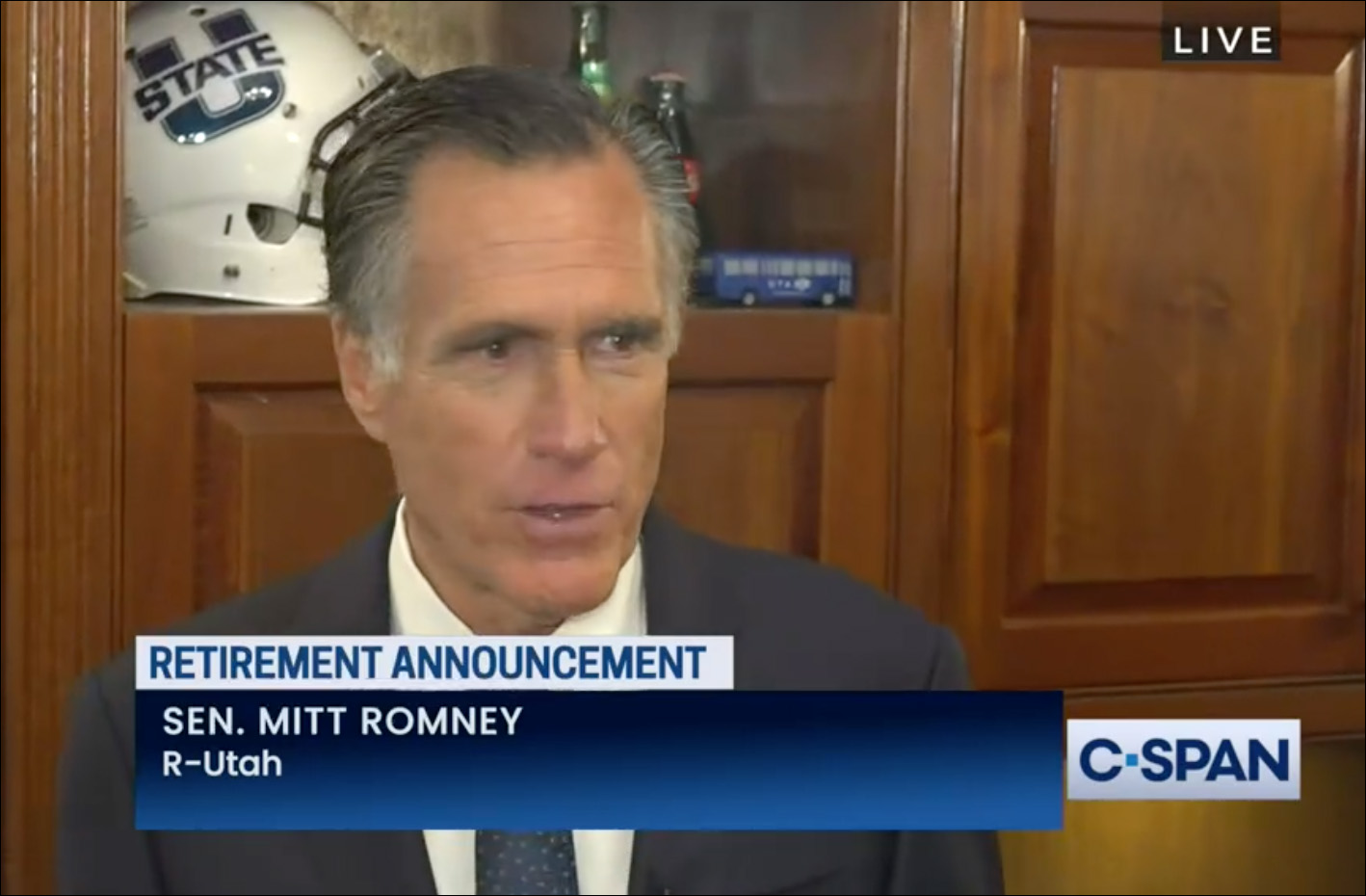
Utah Sen. Mitt Romney announces he will not run for re-election: C-SPAN

By Jim Ellis — Thursday, Sept. 14, 2023

Senate

Utah: Sen. Mitt Romney to Retire — “It is time for a new generation of leaders,” Utah Sen. Mitt Romney (R) said yesterday. “I would be in my mid-eighties if I were to serve another full term.” With that, the Beehive State senator announced that he will not seek a second term next year.

Romney becomes the sixth senator — four Democrats and now two Republicans — to retire when their respective terms end in January of 2025. While Sens. Debbie Stabenow (D-MI), Dianne Feinstein (D-CA), Tom Carper (D-DE), and Ben Cardin (D-MD), are all retiring from politics, Indiana’s Mike Braun (R) is running for governor instead of seeking re-election.

Had he sought another term, Sen. Romney would have faced an active Republican primary challenge. Since he would not likely have fared well at the conservative-dominated Republican nominating convention, it is probable that he would have been forced to access the ballot via the petition signature route. Now, we will see a highly competitive GOP primary battle to succeed Romney in what will be an open-seat campaign.

Wisconsin: Local Republican Steps Forward — Trempealeau County Supervisor Stacey Klein (R) announced yesterday that she will enter next year’s statewide US Senate campaign with the hope of unseating two-term incumbent Sen. Tammy Baldwin (D). This race has been very slow to develop, and Klein now becomes the most politically accomplished individual in the Republican primary.

This, despite her western Wisconsin county serving as home to less than 30,000 individuals. Unless a more senior opponent soon announces, Sen. Baldwin could coast to a third term in what should be a very competitive political environment come November.

President

Michigan: Dem Secretary of State Slates Trump — Michigan Secretary of State Jocelyn Benson (D) yesterday announced that she will award former President Donald Trump a ballot position on the Michigan primary ballot, unless a court decision directs otherwise. Benson stated that “… the courts, and not secretaries of state, should decide if the US Constitution disqualifies Trump.” The Michigan primary is scheduled for Feb. 27, 2024. Presumably, she will also slate Trump in the general election, again barring a court ruling, should the former president win the Republican presidential nomination. Michigan is a critical swing state, so ensuring a ballot position here is a must for the Trump campaign.

House

OH-13: Ex-GOP Chair Won’t Run for House — Jane Timken, the former Ohio Republican Party chair who was a 2022 US Senate candidate, announced yesterday that she will not enter next year’s Republican primary in Ohio’s Akron anchored 13th District. GOP candidates will be vying for the opportunity to challenge freshman Rep. Emilia Sykes (D-Akron).

Announced Republican candidates are Hudson City Councilman Chris Banweg and 2022 congressional candidate Greg Wheeler. Republican leaders are reportedly attempting to recruit former state senator and ex-Rep. Kevin Coughlin.

The 13th will likely feature a competitive general election. The FiveThirtyEight data organization rates the seat R+2. Dave’s Redistricting App, however, casts the partisan lean in the Democrats’ favor, 50.7D – 47.0R. President Joe Biden carried the district over former President Trump, 50.7 – 48.0 percent.

Sen. Cassidy Considers No Labels Party; Newsom Clarifies Potential Appointment; Another Challenger to Sen. Cruz Emerges; NM-3, NY-4 News

By Jim Ellis — Wednesday, Sept. 13, 2023

President

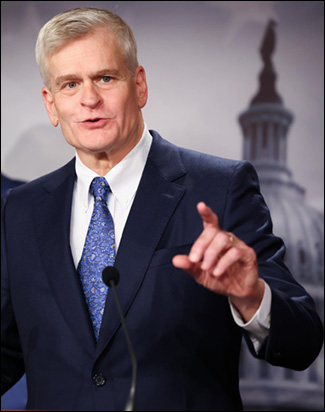
Sen. Bill Cassidy (R-LA)

No Labels Party: Sen. Cassidy Says He’ll Talk — From Sunday’s NBC interview, Sen. Bill Cassidy (R-LA) admitted that he would “talk” to the No Labels Party leaders if they approached him about becoming their presidential nominee. Sen. Cassidy also explained it would depend upon who the major parties nominate, but he intimated if we are going to see a Biden-Trump re-match he would be more inclined to run as a third-party candidate.

Sen. Cassidy is the type of candidate the No Labels Party would like to recruit. It is clear their main goal is to deny former President Donald Trump re-election, so they will be looking for a candidate who has some ability to attract suburban Republican voters away from Trump. The No Labels Party will decide who to nominate, if anyone, at their national conclave scheduled for April 14-15, 2024.

Senate

California: Gov. Newsom Clarifies Potential Appointment — Some Democrats are still urging Sen. Dianne Feinstein (D), who is suffering from failing health, to resign her seat so that Gov. Gavin Newsom (D) can appoint a more able individual. Gov. Newsom now says that he will only appoint someone who will serve as a caretaker if the vacancy were to occur.

The governor said it would be unfair to give an advantage to any of the candidates currently running for the Senate if he were to appoint one of the contenders. Early rumors suggested he was leaning towards appointing US congresswoman and 2024 Senate candidate Barbara Lee (D-Oakland). She hails from Newsom’s northern California political base, but his latest statement suggests he would now go in a different direction.

Texas: Another Cruz Challenger Emerges — Back in May when Texas Rep. Colin Allred (D-Dallas) announced his Senate campaign it looked as if the Democratic leadership had the candidate they wanted to challenge Sen. Ted Cruz (R). Two months later, state Sen. Roland Gutierrez (D-San Antonio) announced his candidacy, and then resigned Nueces County District Attorney Mark Gonzalez followed. Another candidate has now joined them — Dallas state Rep. Carl Sherman Sr. (D), a former local mayor and pastor.

While Rep. Allred still may top what is now becoming a crowded field, he will undoubtedly be forced to drain his campaign treasury just to win the nomination; he had raised over $6 million before the June 30 campaign finance quarterly report. Sen. Cruz will then be able to build an uncontested campaign treasury, and force all four Democratic candidates far to the left on key issues such as the Biden energy policy and the Texas-Mexico border.

House

NM-3: Ex-State Rep to Challenge Rep. Leger Fernandez — Former state Rep. Sharon Clahchischilliage (R), a member of the Navajo Nation who served three terms in the legislature before being defeated for re-election in 2018, announced that she will challenge two-term Rep. Teresa Leger Fernandez (D-Santa Fe) next year. The FiveThirtyEight data organization rates New Mexico’s 3rd District as D+5, meaning we could see a competitive general election develop. In 2022, Rep. Leger Fernandez was re-elected with 58 percent of the vote, but against a Republican candidate who spent only $301,000 on her campaign.

NY-4: Democrat Withdraws — Sarah Hughes (D), who was a member of the 2002 US Olympic figure skating team and had formed a congressional exploratory committee earlier in the year to challenge Rep. Anthony D’Esposito (R-Island Park), announced Monday that she will not pursue her candidacy. The top Democrats appear to be state Sen. Kevin Thomas (D-Nassau) and ex-Hempstead town supervisor and 2022 nominee Laura Gillen (D). In the face of such competition, Hughes’ chances of winning the Democratic primary were poor; hence, the decision to end her political quest.

New York’s 4th District, at D+10 according to the FiveThirtyEight data organization, is likely to become the Democrats’ top conversion opportunity in the country.

Five Republicans Lead Biden; Pelosi to Return; Hudson Announces in MI-3; Cox Draws GOP Challenge in Utah

By Jim Ellis — Tuesday, Sept. 12, 2023

President

Republican presidential candidate Nikki Haley / Photo by Gage Skidmore

CNN Poll: Five Republicans Lead Biden — The new CNN national poll (conducted by the SSRS research company, CNN’s regular polling firm; Aug. 25-31; 1,503 US adults; live interview & text) found no fewer than five of the announced Republican presidential candidates holding small leads over President Joe Biden in general election ballot tests.

Former UN Ambassador Nikki Haley fared best, scoring a six-point advantage over the president. Two-point leaders included former Vice President Mike Pence, Sen. Tim Scott (R-SC), and ex-New Jersey Gov. Chris Christie. Former President Donald Trump held a one-point edge, while Florida Gov. Ron DeSantis tied Biden. The only Republican contender to fall behind Biden, and by only one point, is businessman Vivek Ramaswamy.

This poll, consistent with many other findings, again sees the Republicans doing better in a sample comprised of adults as opposed to registered or likely voters. This suggests the GOP is doing better than Democrats with non-voters, meaning the party will have to find a way to identify, register, and turn these habitual non-voters into participants.

House

CA-11: Rep. Pelosi to Return — Though many expected 83-year-old former House Speaker Nancy Pelosi (D-San Francisco) to retire, she instead announced a re-election bid for a 20th term in Congress late last week. In her statement, Rep. Pelosi said, “our country needs America to show the world that our flag is still there, with liberty and justice for ALL. That is why I am running for reelection — and respectfully ask for your vote.” She will easily be renominated and re-elected next year.

MI-3: Ex-Judicial Candidate Announces for Congress — Attorney and Michigan Supreme Court judicial candidate Paul Hudson (R), who finished fourth in a field of five 2022 candidates, announced for Congress at the end of last week. He hopes to oppose freshman Rep. Hillary Scholten (D-Grand Rapids) in a district the FiveThirtyEight data organization rates as D+3.

Last November, Scholten defeated Republican John Gibbs, 55-42 percent, after he upset one-term Rep. Peter Meijer (R) in the GOP primary. The Michigan Independent Citizens Redistricting Commission transformed what was a safe Republican 3rd District that originally elected Meijer to one that favors the Democrats.

Hudson is the third announced Republican candidate but is clearly the most credible. Should he prevail in the Aug. 6, 2024, GOP primary, assessments will be made as to whether he will become a top-tier challenger candidate. MI-3, however, is the type of politically marginal district that the GOP must win in 2024 in order to protect and enhance the party’s slim majority.

Governor

Utah: Gov. Cox Draws GOP Challenge — State Rep. Phil Lyman (R-Blanding), who hails from San Juan County in the far southeastern corner of the Beehive State, which includes the “Four Corners” where Utah, Arizona, Colorado, and New Mexico meet, announced he will challenge Republican Gov. Spencer Cox in next year’s Republican convention and potentially the state primary.

Lyman, a land rights radical, received a pardon from former President Trump after the government arrested him for his protest activities. Gov. Cox may not be particularly popular with the Republican base, so Lyman may have a chance to assemble a significant support coalition at the state convention.

The 14th Amendment Controversy

Former President Donald Trump / Photo by Gage Skidmore

By Jim Ellis — Thursday, Sept. 7, 2023

President

Trump: Insurrection or Rebellion? — There is a great deal of discussion mounting about whether a key provision of the 14th Amendment to the US Constitution will disqualify former President Donald Trump from the 2024 presidential election ballot.

Recently, two US senators, Tim Kaine (D-VA) and Mike Lee (R-UT), assumed opposite debate positions. The phrase “have engaged in insurrection or rebellion” is at the crux of the argument. Sen. Kaine believes Trump engaged in insurrection with regard to his actions surrounding the January 6th Capitol incursion and should be disqualified from running for office. Many legal scholars agree.

Conversely, Sen. Lee objects, citing that the US Senate found then-President Trump not guilty of insurrection in the second impeachment vote. Therefore, he says, the “rebellion or insurrection” phrase does not apply. Many legal scholars agree.

Sen. Kaine, during a CNN interview, argued that “the language (of the amendment) is specific: If you give aid and comfort to those who engage in an insurrection against the Constitution of the United States — it doesn’t say against the United States, it says against the Constitution. In my view, the attack on the Capitol that day was designed for a particular purpose … and that was to disrupt the peaceful transfer of power as is laid out in the Constitution.”

In an interview with Utah’s Deseret News, Sen. Lee indicated he agrees with the arguments put forth from University of California at Berkeley professor John Yoo and others who published a paper pertaining to this subject.

Professor Yoo and the others penned in part, “if it were clear that Trump engaged in insurrection, the Justice Department should have acted on the January 6 Committee’s referral for prosecution on that charge. Special Counsel Jack Smith should have indicted him for insurrection or seditious conspiracy, which remain federal crimes. If it were obvious that Trump had committed insurrection, Congress should have convicted him in the two weeks between January 6 and Inauguration Day. Instead, the House impeached Trump for indictment to insurrection but the Senate acquitted him.”

Obviously, there are strong opinions on both sides of this argument and, as Sen. Kaine said, the courts, and most likely the US Supreme Court, will ultimately have to make a ruling.

The larger question, however, that no one is yet addressing, is when all of this will happen. If, for example, Trump is convicted in the Washington, DC trial regarding his January 6th actions, the 14th Amendment move to disqualify him could be triggered. Should this scenario unfold, perhaps the most important point would be whether the timing is before or after the Republican National Convention now scheduled for July 15-18, 2024.

If Trump’s name is stricken from the ballot, and that will likely become a state by state issue, then the Republicans will have to nominate a new candidate, assuming that Trump has accumulated enough delegates to clinch the nomination. Currently, the latter observation appears highly likely.

If the disqualification move comes before the RNC meets, the delegates could then nominate a new candidate in an open convention. After Trump becomes the official party nominee, then a whole new set of circumstances will occur, most of which will be subject to conjecture.

Will the vice presidential nominee automatically assume the top ballot positions? Would the RNC instead be called into a special convention to nominate another candidate? Would every state recognize the RNC action, regardless of the course the national political party chooses?

Should the 14th Amendment scenario not be solved before the convention convenes, it is probable the delegates would pass binding resolutions to cover a succession protocol in case what currently exists in the party bylaws is not wholly clear or does not fully apply to the current situation. In any event, political and legal chaos would undoubtedly ensue.

Consider the situation already coming to the forefront in Arizona. Democratic Secretary of State Adrian Fontes says his state’s Supreme Court has already answered the 14th Amendment issue. Fontes says, though he disagrees with the court’s ruling, that the Arizona Supreme Court has dictated Congress would have to specifically designate that Trump, or any other candidate, is to be disqualified from the ballot as it relates to the 14th Amendment insurrection or rebellion language. Otherwise, the candidate in question would be placed on the Arizona ballot.

It is very likely we will see other states invoking some exception or quirk in their own election law that would either place Trump on their ballot or disqualify him. Therefore, the 2024 election participants would then be forced to traverse another set of controversial circumstances that will clearly affect the outcome of the still unfolding campaign.

Trump Way Up in Georgia

Donald Trump continues to defy American political logic as is evidenced in a new Atlanta Journal-Constitution primary poll. (Go to AJC story)

By Jim Ellis — Thursday, Aug. 31, 2023

President

Trump: Georgia Numbers Jump — Former President Donald Trump continues to defy American political logic as is evidenced in a new Atlanta Journal-Constitution primary poll of the Georgia Republican electorate.

Once again we see polling evidence of Trump gaining support after being indicted. This particular study first went into the field one day after the former president and his associates were officially accused of breaking Georgia election law.

The University of Georgia’s School of Public and International Affairs regularly conducts the research studies for the AJC. According to their just-released survey (Aug. 16-23; 807 likely and probable Republican primary voters; live interview), Trump captures 57 percent of the Republican primary respondents’ support.

Florida Gov. Ron DeSantis is a distant second at 15 percent and no other contender even reaches the five percent support threshold.

Since pollsters began testing the Georgia 2024 Republican presidential race, this current AJC poll reveals Trump’s strongest standing within the Peach State electorate. At the end of March, for example, WPA Intelligence detected a one-point DeSantis lead over Trump at 37-36 percent.

It is the crosstabs, however, that tell an even more interesting story. While Trump largely lost the 2020 presidential race because too many female suburban voters who supported him in 2016 turned toward Joe Biden four years later, this poll surprisingly projects his standing among female respondents who plan to vote in the Georgia Republican primary at 57.9 percent, an even stronger number than their male counterparts at 54.5 percent.

In fact, of the seven categories and 23 segments within the AJC respondent sample, Trump leads in all categories and fails to claim the top spot in just one segment. The seven categories are gender, race, age, education level, ideology, income, and partisan persuasion. The 23 segments are response cells within those categories.

A small number of Democrats (number undisclosed) responded that they intended to vote in the Republican presidential primary. Not surprisingly, this is the group in which Trump fails to lead.

Former UN Ambassador Nikki Haley is the favorite among the small number of Democrats who plan to cast their ballot in the GOP primary. In this category, Haley scores 26.1 percent support with New Jersey former Gov. Chris Christie posting 21.7 percent support. Conversely, Trump attracts only 4.3 percent among Democratic Republican primary voters.

He does rather surprisingly lead among those who identify as liberals at 30.0 percent and who say they will vote in the Republican primary. Trump holds a 12.5 point edge over Haley within this segment, and a 17.5 point advantage over Christie.

Trump’s strongest segment is found with those making between $25,000 – $49,999 annually. Here, the former president captures a whopping 76.0 percent support factor.

Though leading among the wealthiest in the sampling pool ($150,000+ annual income level), many of whom are Trump’s own peers, he records his weakest showing within a favorable cell. Within this group, the former president scores only a 30 percent support figure, though still better than any of his opponents.

The final question on the AJC poll relates to the indictment charges and just how seriously the respondents view the accusations. Here, again, we see the female respondent cell performing more in Trump’s favor than the men. A total of 46.5 percent of the female respondents believe the charges are very serious or somewhat serious. Among male respondents, that figure is a larger 52.3 percent.

Minorities break in the opposite manner, which is another surprise from this survey. Only 40 percent of minorities believe the charges are very or somewhat serious, while 48.5 percent believe they are not too serious, or not serious at all.

This poll confirms that Trump continues to enjoy strong support within the Republican primary base, which alone may be enough for him to win the presidential nomination. It is undeniably significant that these favorable partisan numbers are coming from Georgia, the state of his most recent indictment and the most important swing state overall in the general election.

Francis Suarez: Drops Presidential Bid — Miami Mayor Francis Suarez (R), who was unable to jump-start a long-shot presidential campaign, culminating with not qualifying for the first presidential debate, announced that he is officially ending his national bid. The move came with little in the way of surprise since, for the most part, he was not even registering in national polls.