Category Archives: Governor

Ohio’s Red Leap

By Jim Ellis

Jan. 30, 2018 — Thought of as one of the key swing states in American politics since the turn of the century, President Trump’s stronger than expected eight-point Buckeye State victory in the 2016 presidential race proved eye-opening. But, was his performance trend setting or an anomaly?

A new Fallon Group survey for the state’s 1984 Society group finds the upcoming open governor’s race is exceeding the Trump marker, at least in the early going. Such totals indicate that the presidential outcome could be signaling a more Republican-oriented direction beginning to form in the state, but a closer look may point to the Trump numbers as affirming a political trend rather than creating one.

Left - Mike Dewine (R) | Right - Richard Cordray (D)

Left – Mike Dewine (R) | Right – Richard Cordray (D)

According to the Fallon Group data (Jan. 16-19: 801 likely Ohio general election voters; 286 Ohio Republican likely primary voters, 248 Ohio likely Democratic primary voters), attorney general and former US senator, Mike DeWine (R), would lead recently resigned Federal Consumer Protection Bureau director and ex-Ohio attorney general Richard Cordray (D) by a whopping 48-29 percent margin. The polling demographics appear to correctly model the state, thus providing reliability support. In the polling sample, Anglo voters account for 77.4 percent of the respondents, as compared to 79.5 percent of the state population. African Americans are 14.2 percent of the polling universe, and 12.8 percent of the actual Ohio population. Hispanics register 2.2 percent of the respondent group, against a 3.7 percent state population figure. Therefore, the respondent universe is consistent with at least the overall Ohio population complexion. Additionally, the polling universe is comprised of 51.9 percent females, versus a 51.0 percent actual make-up.

The Republican leadership approval ratings are mixed. The respondents believe, by a margin of 54:25 percent, that Ohio is generally on the right track. Outgoing Gov. John Kasich’s (R) job performance is rated highly: a 57:29 percent favorability ratio. President Trump, on the other hand, is upside-down at 43:52 percent positive to negative.

Continue reading

Kansas’ New Race

Kansas Gov. Sam Brownback (R) | Facebook

Kansas Gov. Sam Brownback (R) | Facebook

By Jim Ellis

Jan. 26, 2018 — Two events occurred two days ago that drastically changed the Kansas gubernatorial race.

First, Kansas Gov. Sam Brownback (R) won confirmation as President Trump’s ambassador-at large for International Religious Freedom and will soon be resigning as Kansas’ chief executive to accept his new position. Gov. Brownback barely passed muster in the Senate, a body in which he served 14 years before being elected governor in 2010. Vice President Mike Pence was called into the Senate chamber to break the 49-49 confirmation deadlock.

The move means that Lt. Gov. Jeff Colyer (R), already a candidate for the state’s top post, will be ascending to the governorship by the end of this week. Colyer will become the fourth Republican lieutenant governor who will be running for governor as an unelected incumbent. Govs. Kay Ivey (R-Alabama), Kim Reynolds (R-Iowa), and Henry McMaster (R-South Carolina) are the other three who became governor last year when the individual elected in 2014 either left under an ethical cloud (Alabama) or accepted a Trump Administration appointment (Iowa; South Carolina; and now Kansas).

Second, Republicans also received good news over a development that could decimate the Democrat’s opportunity of running a viable general election campaign. Wealthy Independent Greg Orman, who challenged Sen. Pat Roberts (R) in 2014 and actually became the de facto Democratic nominee (he lost 53-42 percent), officially announced he will enter the governor’s campaign and as a non-affiliated candidate.

Continue reading

Looking at the Governors’ Races

2018-gubernatorial-elections

By Jim Ellis

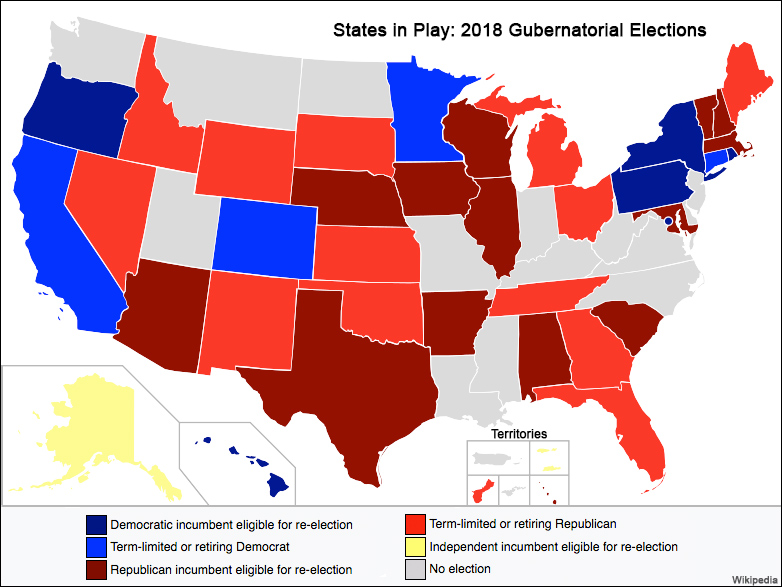
Jan. 25, 2018 — Earlier this month, we set the stage for the Senate and House campaigns. Today, we look at another important election platform, that of the nation’s governors. Though these races will elect people who will obviously determine future individual state policy, most of the 2018 gubernatorial winners will carry redistricting veto power in 2021. Therefore, these elections also carry national implications.

Of the 36 governors’ campaigns, 17 will be open races mostly due to state term limit laws. While the Democrats must protect the preponderance of US Senate seats this year, the opposite situation exists in the governors’ races. Here, Republicans must defend 26 state houses, 13 of which are open seats.

Of the 13 GOP incumbents seeking re-election, three are actually running for governor for the first time. Govs. Kay Ivey (R-Alabama), Kim Reynolds (R-Iowa), and Henry McMaster (R-South Carolina) were all lieutenant governors who ascended to their current position because the person elected in 2014 is no longer in office.

Alabama’s Gov. Robert Bentley (R) was forced to resign as part of a plea bargain arrangement over campaign finance violations. The other two state chief executives, Terry Branstad (IA) and Nikki Haley (SC), accepted positions in the Trump Administration. At this point in the election cycle, all three unelected governors are favored to win a full term.

Continue reading

Rep. Barton to Retire;
Major Ohio Moves

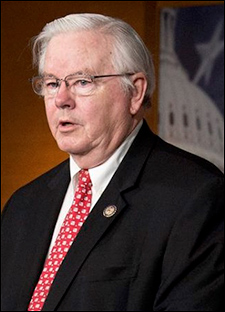
Texas Rep. Joe Barton (R-Ennis)  | Facebook

Texas Rep. Joe Barton (R-Ennis) | Facebook

By Jim Ellis

Dec. 4, 2017 — Veteran Texas Rep. Joe Barton (R-Ennis), a former Energy & Commerce Committee chairman, has apparently taken the advice he was reportedly receiving from many local Republican leaders and activists advising him not to seek re-election. Barton, recently coming under attack when his nude picture taken during a previous consensual sexual relationship surfaced on Twitter, announced late last week through social media that he will end his 34-year congressional career when the current Congress adjourns.

Barton had already filed to run in 2018, but will now withdraw his paperwork prior to Texas’ Dec. 11 candidate filing deadline. We expect to see several Republicans come forward to run in what will be the first open 6th District contest since 1984. Immediately, Tarrant County Tax Assessor Ron Wright announced that he would enter the newly open Republican primary.

The 6th District performs as a safe Republican seat beginning in the Arlington area of Tarrant County, which is the population anchor, before continuing southeast to annex Ellis and Navarro Counties. President Trump carried the 6th, 54-42 percent, down a bit from Mitt Romney’s 2012 performance of 58-41 percent against President Obama.

Continue reading

Election Day: Before vs. After

By Jim Ellis

Nov. 10, 2017 — Voters went to the polls in three places Tuesday to elect two governors, state legislators, and a new member of Congress. Multiple local elections, including mayoral contests in 59 of the nation’s largest cities, with New York, Minneapolis, Seattle, and Charlotte among them, also were on the various ballots.

Much was written and discussed about the Virginia gubernatorial election leading into Election Day, clearly the most important contest from a political perspective. It appeared clear that the campaign between Lt. Gov. Ralph Northam (D) and former Republican National Committee chairman Ed Gillespie was a tight one. That proved not to be the case with Northam’s nine-point win.

Polling suggested that either candidate could win. Most surveys showed either a dead heat or Northam maintaining a small lead. Research for the last Virginia gubernatorial race, that in 2013 when Gov. Terry McAuliffe (D) was elected, badly under-estimated Republican strength. Therefore, should the same methodologies be present in this latest data, Gillespie’s chances of victory may be better than the raw numbers indicate. That line of thinking was dashed by the results.

Continue reading

Dems Score Big; Curtis Wins in Utah;
VA House: 12 Votes to a Win

By Jim Ellis

Lt. Gov. Ralph Northam (D) is also a pediatric neurosurgeon

Virginia governor-elect Ralph Northam (D) is also a pediatric neurosurgeon

Nov. 8, 2017 — Democrats came roaring back, particularly in the Virginia elections last night, as Lt. Gov. Ralph Northam (D) easily outpaced former Republican National Committee chairman Ed Gillespie to win the open Virginia governorship, keeping the position in the Democratic column. Northam scored a 54-45 percent win over Gillespie in a race that most pollsters projected to be much closer.

It appeared that Gillespie had momentum at the end of the past week, but last day polling again found Northam beginning to pull away. Those surveys correctly detected the final trend, as did the Quinnipiac University polls and Christopher Newport University’s final study, all considered outliers because the big margins extrapolated for Northam were outside the polling realm for the other dozen-plus polls released during the closing two-week period. In the end, the actual victory margin was nearer to the previously rejected polls.

Curiously, Gillespie ran behind the two other Republicans on the statewide ticket. All in a losing effort, lieutenant governor candidate Jill Vogel (R) pulled almost 50,000 more votes than the gubernatorial nominee, while attorney general nominee John Adams attracted just under 38,000 more. This could possibly be attributed to left over bad feelings generated from the close Republican primary election that saw Gillespie barely defeat Prince William County Board chairman and immigration policy activist Corey Stewart. Many Stewart voters stated that they would not support Gillespie in the general election, and it may well be that many of them followed through on their “promise.”

‘Many [Corey] Stewart voters stated that they would not support Gillespie in the general election, and it may well be that many of them followed through on their “promise.” ‘

Turning to New Jersey, the pollsters, who uniformly produced consistent data on this race throughout the general election cycle, proved correct. Former US Ambassador to Germany and Wall Street executive Phil Murphy (D), as expected, recorded a 55-43 percent win over Lt. Gov. Kim Guadagno (R). Murphy converts the governor’s mansion for the Democrats after eight years of having Republican Chris Christie.

Continue reading

A Virtual Tie in Virginia


Lt. Gov. Ralph Northam (D) — latest campaign ad


https://youtu.be/Fg3Gac44cl4
Ed Gillespie (R) – latest campaign ad


By Jim Ellis

Nov. 7, 2017 — On the dawn of today’s Virginia governor’s race, significant movement is apparent in the final pre-election polls.

At the end of last week, we previously reported that Lt. Gov. Ralph Northam (D) had a lead of 3.7 percentage points when mean averaging seven realm polls conducted between Oct. 15-28. The latest six studies, all commissioned during the Oct. 29-Nov. 2 period, show Republican Ed Gillespie closing the gap even further, reducing Northam’s lead to a miniscule 1.0 percent.

At least one of the latest half-dozen comes from a pollster with a poor reliability record. Here, Roanoke University (Oct. 29-Nov. 2; 781 likely Virginia voters) finds the two candidates tied at 47 percent, which actually appears in line with the other published polls. Usually, the Roanoke data proves to be an outlier.

The survey giving Northam his best showing comes from Gravis Marketing (Oct. 30-Nov. 3; 1,143 registered Virginia voters via Interactive Voice Response system) where the lieutenant governor posts a 48-43 percent edge, consistent with results from data released last week. Gravis, not screening for likely voters, however, could explain why their results show a bigger spread than the others. The newest poll, from the New York Times/Siena University (Oct. 29-Nov. 2; 785 likely Virginia voters), finds Northam carrying a three-point edge, 43-40 percent, but with a larger undecided factor than the other studies.

Continue reading