Category Archives: Governor

Hickenlooper & Inslee:
Former Governor & Governor
Join Democratic Presidential Fray

By Jim Ellis

Left: Former Colorado Gov. John Hickenlooper (Photo, Moritz Hager) Right: Washington Gov. Jay Inslee

March 6, 2019 — Former Colorado Gov. John Hickenlooper joined the Democratic presidential field over the weekend, following Washington Gov. Jay Inslee who jumped in last Friday. The pair became the 12th and 13th official Democratic presidential candidates, and the first governor and former governor to join the campaign.

But what are the paths to actual nomination for each man? Neither has high national name identification and both are from states moderate in size: Washington has 107 total Democratic National Convention delegates, and Colorado 80. This places them as the 14th and 17th largest states among the 57 voting entities that will comprise the Democratic delegate pool.

It’s hard to see a viable way to the nomination for Gov. Inslee. Without a strong geographical base or high name ID, the two-term Pacific Northwest governor is attempting to carve a niche for himself as the climate change candidate, but that is a space already heavily populated. Sen. Bernie Sanders in particular stresses the climate change issues as part of his portfolio, as do most of the other candidates at least to a degree.

It’s possible Inslee also doesn’t see much of a path for himself, which explains why he answered so vociferously that he is not ruling out running for a third term in his present position when asked during his announcement event. With almost two-thirds of the bound delegate votes likely being decided on or before March 17, 2020, Inslee will have plenty of time to pivot back into a governor’s race because the Washington candidate filing deadline doesn’t elapse until May of that year.

Continue reading

Reflecting on the 2018 Numbers

By Jim Ellis

Jan. 24, 2019 — Now that all but one of the 470 House and Senate races from the election cycle just ended are final and recorded, it is time to better understand what the results portend.
As we know, the Democrats had a good election overall, and most particularly in the US House where they converted a net 40 seats — possibly 41 if NC-9 turns their way when the new election is finally scheduled — but Republicans did expand their majority in the Senate, thus largely disqualifying 2018 as an official wave election. Overall, there are 93 freshman House members and nine new senators when counting appointed Sen. Martha McSally (R-AZ).

Democrats came very near wave proportions, however – the Ballotpedia organization studied past wave elections and found that a swing of 48 House seats is necessary to constitute such a designation. While the effects from the 2018 election will certainly have long term reverberations, much more time is required to determine if the results are providing the foundation for transformational policy changes or are merely a blip that could just as quickly swing back to the Republicans.

What we do know is that women made significant gains in federal representation. In the Senate, the body now features a net three more female members (gaining Kyrsten Sinema and appointed Sen. McSally, both from Arizona, along with new Sens. Jacky Rosen (NV), and Marsha Blackburn (TN), but losing North Dakota’s Heidi Heitkamp), meaning that 25 women are now incumbent senators.

Continue reading

Kentucky Gubernatorial Race
Challengers Emerging

By Jim Ellis

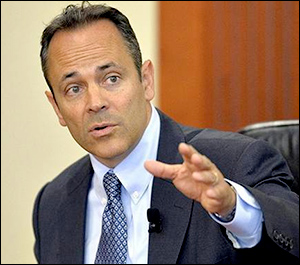
Unpopular Kentucky Gov. Matt Bevin (R)

Jan. 9, 2019 — Blue Grass State politics are beginning to boil, all centered around the 2019 governor’s race. With the candidate filing deadline fast approaching on Jan. 29 for the May 21 statewide primary, several individuals are announcing that they will challenge unpopular Gov. Matt Bevin (R), including a Republican state legislator who is expected to make his formal declaration today.

Though the governor has said he intends to seek a second term, and did so again a week before Christmas, the fact that he has yet to file a 2019 campaign committee has fueled speculation that he may decide to retire. Bevin was elected in 2015 with a relatively substantial 52.5 – 43.8 percent victory over then-Attorney General Jack Conway (D) after upsetting then-agriculture commissioner and now US congressman, James Comer (R-Tompkinsville), by just 83 votes in a May Republican primary that drew almost 215,000 voters.

Bevin’s popularity ratings, however, have largely been upside-down throughout his tenure in office. According to the Morning Consult quarterly national gubernatorial approval rankings that were released just before the November elections in mid-October, Gov. Bevin ranked 46th on the nationwide list, with a 30:55 percent positive to negative ratio.

None of those finishing below the Kentucky governor on that particular scale in October remains in office. The least popular, according to the survey, Oklahoma Gov. Mary Fallin (R), was ineligible to seek a third term last November. Republican Kevin Stitt replaced her. Connecticut Gov. Dan Malloy (D) did not seek a third term and Democrat Ned Lamont held the office. Illinois Gov. Bruce Rauner (R) was defeated for re-election, and Alaska Independent Gov. Bill Walker withdrew before the election because his political situation was hopeless.

Continue reading

Florida Ends; Others Called

By Jim Ellis

Nov. 20, 2018 — In a final result where the candidates were divided by less than two votes per precinct statewide, Gov. Rick Scott (R) defeated Sen. Bill Nelson (D) in the hotly contested Florida Senate race that proved a Herculean battle both before and after the election.

With the original vote falling within a half-percent margin, a mandatory machine recount commenced. Since it produced a separation of less than one-quarter percent between the two candidates, a mandatory hand recount began of the “under and “over votes”, i.e., those ballots where a voter either didn’t make their selection clear or appears to have marked more than one contender in the same contest.

Yesterday, when the afternoon hand count deadline produced a 10,033 vote margin for Gov. Scott, Sen. Nelson conceded the race and ended the seven lawsuits that had been filed by various parties contesting pools of votes and the post-election counting process.

The senator now completes a political career in which he served in elective office for 42 of the past 46 years as a state representative, US congressman, state insurance commissioner, and US senator. Counting his combined time in the House and Senate, Nelson will have served 30 years as a federal lawmaker when he leaves office in January.

Continue reading

Florida Still Has Tight Satewide
Campaigns In Recount Mode

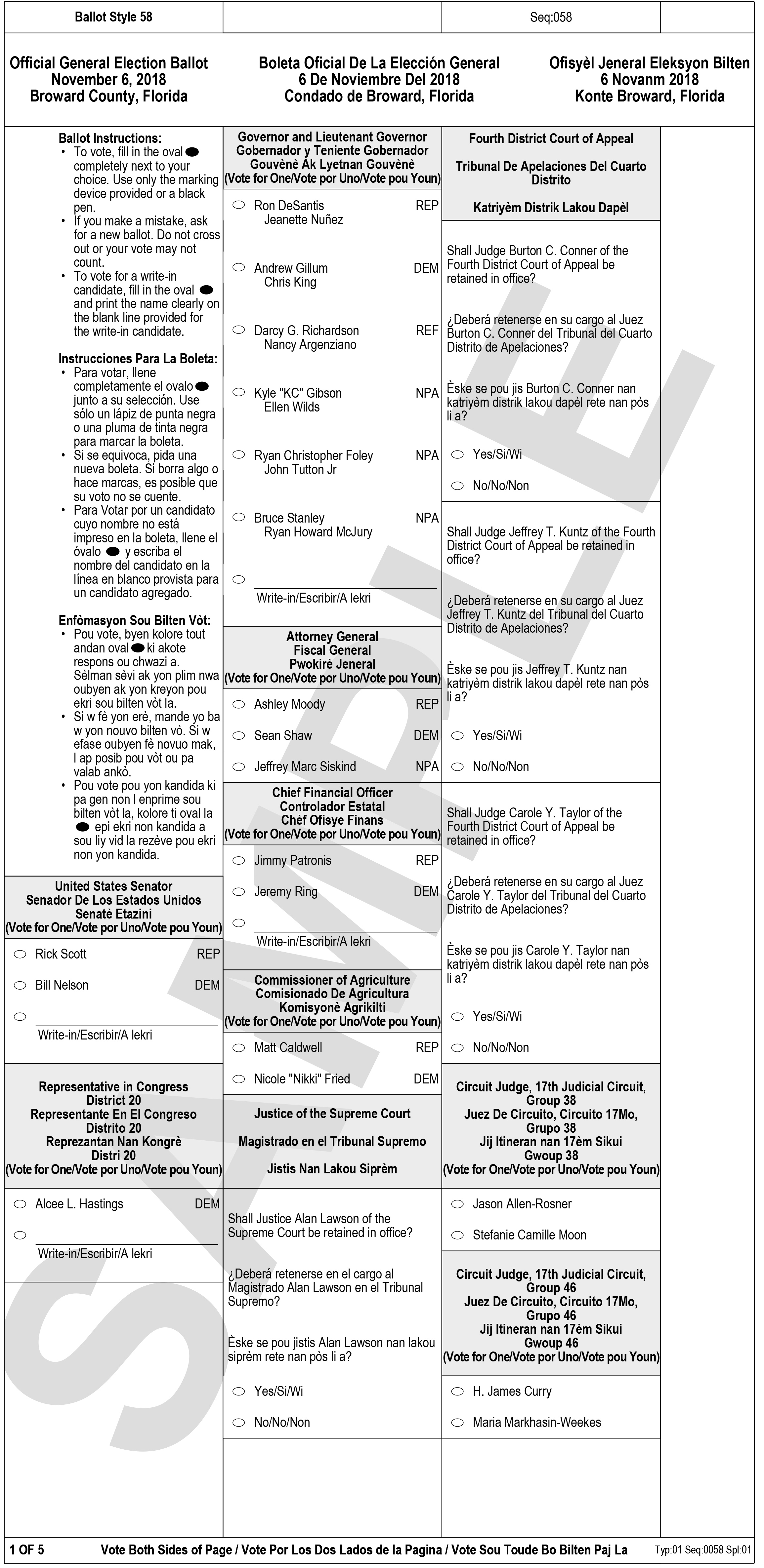
BROWARD COUNTY SAMPLE BALLOT – Click on this image to see the full-size ballot, or go to the jump page or scroll down to see it embedded in this post at a larger size.


By Jim Ellis

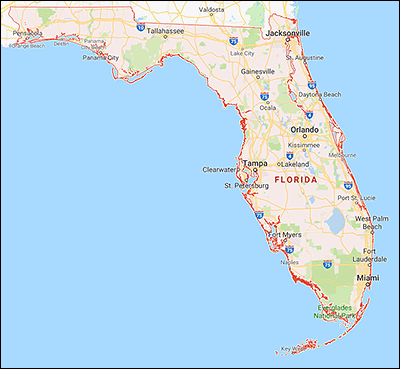
Nov. 19, 2018 — The state of Florida again has tight statewide campaigns in recount mode, reminiscent of the 2000 presidential campaign that saw George W. Bush winning the state by 537 votes that propelled him into the presidency. In that year, the recount and legal challenge process consumed 32 days.

In this election, the US Senate, governor, and agriculture commissioner races are all languishing with results that have yet to be finalized. Last Thursday, the 3 pm deadline for a statewide machine recount passed, and 66 of the state’s 67 counties successfully submitted new totals.

Palm Beach County was the lone electoral entity that was unable to complete the machine recount. Due to antiquated machines that broke down during the process, the county must redo all three statewide races and a state House contest that is fully contained within their jurisdiction.

There are more than 600,000 votes in the county, and all must be run again individually for each of the four races consecutively. Palm Beach is the only county in Florida using machines that cannot count multiple races simultaneously. Therefore, the recount will likely drag on here until late Sunday afternoon before new totals are released.

Here’s a snapshot of where things stand before that count comes through: After the machine counts, and including the Palm Beach original numbers that the county elections supervisor re-submitted because she had no updated information, Gov. Rick Scott (R) leads Sen. Bill Nelson (D) now by 12,603 votes, an increase of 47 votes after the machine recount in the 66 counties that successfully completed their verification process.

Continue reading

Sinema Wins in Arizona; A Florida Update

By Jim Ellis

Rep. Kyrsten Sinema (D-Phoenix)

Nov. 14, 2018 — Rep. Kyrsten Sinema (D-Phoenix) was projected as the winner of the open Arizona Senate race Monday afternoon as the 460,000-plus post-election vote count continued laboriously forward.

With Sinema racking up a 130,000-plus vote margin from Maricopa and Pima counties, it was too much for Rep. Martha McSally (R-Tucson) to overcome in the remainder of the state where the she had been able to build a 64,000-vote advantage.

Though McSally conceded this Senate seat, it is possible that she could still end up serving there soon. Appointed Sen. Jon Kyl (R) has said he planned to remain just through the end of this congressional year. Should he resign early next year, McSally — since she will be exiting the House at the end of the current term — would have to be considered a prime appointment prospect to serve until the next general election. Gov. Doug Ducey (R) appointed Kyl on an interim basis when Sen. John McCain (R) passed away earlier in the year.

Should this happen, McSally, as the appointed incumbent, would be able to run again in 2020. Since Sen. McCain was re-elected in 2016, the seat must come before the voters in a 2020 special election with the winner serving the balance of the term. The 2020 victor would then be able to seek the full six-year term in 2022.

Should McSally be appointed, it could conceivably mean that she would run for the Senate in three consecutive election cycles. Just completing her unsuccessful 2018 campaign, and assuming she would run in the 2020 special election, the seat would again be contested in 2022, at which point she could finally run for the six-year term. But, all of this is pure speculation at this very early juncture.

The Sinema victory means the Democrats converted the two most vulnerable Republican seats: Arizona as well as Nevada, where Rep. Jacky Rosen (D) unseated GOP Sen. Dean Heller. Grabbing those two seats was absolutely necessary if the Dems were going to challenge for the majority. That didn’t play out, however, as the Democrats dropped at least three of their own seats (and possibly a fourth if Gov. Rick Scott’s (R) miniscule lead holds in Florida). That means the GOP will net gain at least one seat in the Senate and possibly two despite the loss of both key defense seats.

Turning to Florida, the three close statewide races: senator, governor, and agriculture commissioner, will all go to official recounts. Under Florida election law, election totals separated by less than one-half a percentage point are subject to an automatic recount. Republicans lead two of the three races, obviously all with very small margins.

Gov. Rick Scott’s (R) lead over Sen. Bill Nelson (D) was 12,562 votes at the time the recount was ordered. This from a total vote more that 8.183 million ballots cast. Former Rep. Ron DeSantis (R) sees a slightly larger lead over Tallahassee Mayor Andrew Gillum (D), some 33,684 votes. But, the closest of all is the ag commissioner campaign with Democrat Nikki Fried having a statewide edge over Republican Matt Caldwell of just 5,326 votes.

The 67 counties have until Thursday at 3 pm to complete their machine recount. Under Florida law, if the machine recounts drop any race below one-quarter of a percent between the two candidates, then a hand recount will begin.

The Broward County controversy will continue. Over 24,000 ballots did not record votes in the Senate race, which Democrats claim is either the result of a faulty ballot design or that marked ballots were not being properly read in the machines. I must point out that none of the other 66 counties in the state of Florida are reporting such a problem.

We can expect this process to drag on for a long period of time, and will undoubtedly see a multitude of lawsuits being filed from each side.

Election Day Recounts and Lawsuits

By Jim Ellis

Nov. 9, 2018 — Political overtime action is occurring in three states as very close elections for US Senate and governor still appear to be a long way from concluding.

In Florida, Gov. Rick Scott’s (R) lead over Sen. Bill Nelson (D) has dwindled to just over 15,000 votes as more and more mail ballots are counted. Now further controversy has arisen in Broward County, which is reminiscent of the 2000 presidential election that required 32 days and a US Supreme Court ruling to decide.

In this current instance, people are calling into question why there were 24,000-plus fewer votes cast in the US Senate race, which led the Florida ticket, than the other contests on the Broward County ballot. Democrats are suggesting the ballot design that placed the office on the lower left side is the a primary reason for the large drop-off and argue that the counting machines are not detecting marks made on individual ballots. Broward County election officials say they can only count what the machine reads.

Gov. Scott held a news availability last night to accuse the Democrats of attempting to “steal the election.” He is suing elections supervisors in Broward and Palm Beach County over their failure to meet certain legal deadlines in ballot counting and reporting and, in his capacity as governor, is ordering the Florida Department of Law Enforcement to investigate the situation.

The vote count change is also affecting the governor and commissioner of agriculture elections as well as the US Senate contest. All three have dropped within the half-percentage point margin that automatically triggers a recount. It is likely that all three contests will be recounted once a final vote is determined. Therefore, we can expect weeks of legal and administrative wrangling before these highly important elections are decided.

In Arizona, similar controversy is arising. With more than 450,000 ballots remaining to count in the US Senate race, local Republican county officers from Maricopa, Apache, Navajo, and Yuma counties are suing election officials in Maricopa, Pima, and Coconino counties over their process of “curing” absentee or mail ballots where the envelope signature appears different than what is on file. In such an instance, the election officials attempt to contact the individual to verify that he or she did cast the ballot.

Continue reading