Category Archives: Governor

A New Republican Governor

By Jim Ellis

Aug. 7, 2017 — West Virginia Gov. Jim Justice made national news the other night at President Trump’s rally in Huntington, WV, when the Democratic state chief executive took the stage to announce that he is switching to the Republican Party.

When addressing the Trump rally, Justice said, “like it or not, but the Democrats walked away from me … West Virginia, I can’t help you anymore by being a Democratic governor.”

The move now gives Republicans control of the entire West Virginia governmental apparatus, owning both houses of the state legislature and the governor’s office. Factoring Justice’s party change, the GOP holds the West Virginia chief executive post for the first time since Gov. Arch Moore (R) was defeated for re-election in 1988. There are now 26 states where Republicans control the legislature and governor’s office, including Nebraska where the legislature only has one ostensibly non-partisan legislative chamber but is clearly overwhelmingly Republican. In contrast, Democrats have full power in only five states.

The development means the Democrats drop to holding just 15 governors, an all-time low number for the party. Republicans, on the other hand, reach their historical apex with 34 governors as party members. The 50th governor, Bill Walker of Alaska, is an Independent.

Continue reading

Another Tennessee Open

https://youtu.be/uxCuaxf0K4M

By Jim Ellis

Aug. 4, 2017 — For the second time this week, a Volunteer State Republican seat came open for the succeeding election. Following Rep. Jimmy Duncan’s (R-Knoxville) retirement announcement in the state’s 2nd District, House Budget Committee chair Diane Black (R-Gallatin) declared her candidacy for governor, thus opening her 6th District for the 2018 campaign.

In an announcement video (see above) that left no doubt she will be campaigning as a strong conservative, Rep. Black attempted to neutralize what may be her most glaring negative … that she is a member of the US House. In her one minute, 46-second video announcement, the congresswoman emphasizes the work she’s done for Tennessee and makes clear that she will use intense rhetoric to convey her positions, such as opposing “the weak-kneed people in her own party.” Professing to be like most Tennesseans, Rep. Black says she is among the majority who “do things the right way, no matter what Hollywood or Washington thinks about it.”

Rep. Black joins an open Republican governor’s field that includes state House Speaker Beth Harwell, state Sen. Mae Beavers, former state Economic Development Commissioner Randy Boyd, business owners Bill Lee and Kay White, and entertainer Mark “Coonrippy” Brown. Former Nashville Mayor Karl Dean and state House Minority Leader Craig Fitzhugh, so far, comprise the Democratic contingent. Gov. Bill Haslam (R) is ineligible to seek a third term.

Continue reading

Ohio Poll; Tennessee Retirement

By Jim Ellis

Aug. 3, 2017
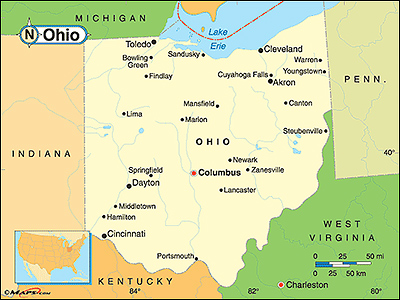
— We now have our first major political poll for the important open Ohio governor’s race, a contest that features several current and former prominent office holders from both parties.

The Tarrance Group surveyed the Ohio Republican electorate (July 24-26; 800 likely Ohio GOP voters) for the American Freedom Builders conservative organization, testing next year’s Republican gubernatorial primary that includes three sitting statewide elected officials and a member of Congress.

According to the Tarrance results, attorney general and former US Sen. Mike DeWine leads the field both in support (42 percent) and name identification (96 percent). He enjoys a wide margin over Secretary of State Jon Husted who polls 18 percent, Lt. Gov. Mary Taylor (11 percent), with US Rep. Jim Renacci (R-Wadsworth) now taking just five percent.

Name familiarity at this point has a great deal to do with ballot test standing. Husted’s name is recognized by 67 percent of the respondents, and Lt. Gov. Taylor just 44 percent, while Rep. Renacci is unknown to 71 percent of the statewide voters.

Continue reading

One In, One Out

By Jim Ellis

July 13, 2017 — Two major announcements occurred during the last few days resulted in one individual becoming an official statewide candidate and another withdrawing from a campaign that had already begun.

West Virginia Senate

As had been expected for some time, two-term West Virginia Attorney General Patrick Morrisey (R) announced his campaign for the United States Senate. He will face two-term Rep. Evan Jenkins (R-Huntington) in the Republican primary, with the winner drawing a difficult political match with Sen. Joe Manchin (D).

With average win percentages of 62 percent over two elections as governor (2004, ’08) in addition to a pair of Senate campaigns (2010 special election; 2012), Sen. Manchin appears to be in strong shape as he approaches his 2018 re-election. But, there are some cracks in his armor, hence the presence of two strong GOP opponents.

Though Sen. Manchin has attempted to cross the partisan line in his public relationship with President Trump and the Republican leadership on several issues, it is still a net negative for the senator to campaign on the same political landscape that proved to be the former’s second strongest state (69 percent).

Continue reading

Big Governor News

By Jim Ellis

July 12, 2017 — A major announcement was made in a western state governor’s race Monday, with an additional one from an adjacent domain coming later today. Both affect corresponding US House seats.

New Mexico Governor; NM-2

Rep. Steve Pearce (R-Hobbs) announced that he will enter the open New Mexico governor’s race next year, saying to the Albuquerque Journal that he’s “concerned about an exodus of young people leaving New Mexico,” going to other places for a more favorable job market. Pearce said his campaign will emphasize improving education, spurring economic growth, and reducing crime and poverty.

This will be the second time Pearce has left his House seat to pursue a statewide contest. In 2008, when serving his third term in Congress, he decided to challenge then-Rep. Heather Wilson (R-Albuquerque) for the US Senate nomination, and successfully upset her in the Republican primary. He would then go onto lose the general election to then-Rep. Tom Udall (D-Santa Fe), 61-39 percent, in the Obama landslide year.

Continue reading

New Virginia Polling

By Jim Ellis

June 26, 2017 — Despite the vast majority of survey research firms again failing to predict the correct outcome for a recent political campaign — this time the GA-6 special election — we do have new data to analyze for the Virginia governor’s race.

While it is too early to tell whether the pollsters are correctly projecting the turnout model and whether they are using the proper formula to pull a representative sample, it is still worthwhile to look at all the published polls in order to establish a moving trend.

As was reported immediately after the Virginia primary concluded, Harper Polling went into the field the day after Lt. Gov. Ralph Northam (D) and former Republican National Committee chairman Ed Gillespie won their respective party nominations for governor. According to their results (June 14-16; 500 registered Virginia voters), both Northam and Gillespie were tied at 46 percent. The conclusion was even a bit better for Gillespie because within the eight percent group who reported themselves as undecided, 19 percent indicated a preference for the Republican, while seven percent said they were leaning toward Northam, the new Democratic candidate.

Continue reading

Gillespie Digging Out

By Jim Ellis

June 19, 2017 — As has been discussed since the Virginia gubernatorial primary votes were counted last Tuesday, the election’s end result was much different for both parties than expected even though the favored candidates won. For Republican nominee Ed Gillespie, the primary vote distribution could have only been worse if he had lost.

At week’s end, GOP second-place finisher Corey Stewart announced that he would not challenge the vote totals –- it is unlikely that a recount would have produced enough to overcome his 4,320 statewide vote deficit -– but he stopped short of formally endorsing the new party nominee; though Stewart did indicate that he would vote for Gillespie.

The breadth of his former opponent’s comments indicates that Gillespie has quite a gap to fill in order to attract the Stewart vote base for the general election. These are people Gillespie must have if he is to seriously compete with Lt. Gov. Ralph Northam, who won the Democratic gubernatorial nomination in surprisingly easy fashion.

“The real question is, will [Gillespie] support my supporters? Unless he stands up and takes clear positions on defending our heritage and our history, supporting the president, cracking down on illegal immigration, those who supported me are not going to go with him. This isn’t old-style politics anymore. I just can’t tell 155,000 folks to go ahead and vote for Ed despite the fact that he’s not a fighter,” Stewart said in a post-election Washington Post interview.

https://youtu.be/PPTL9m33SpA

Gillespie had hoped to be in the opposite position that he now faces. Forecasts suggested he would easily win the party nomination, while it appeared that the Democrats were in the closer contest. Possibly the best case Gillespie scenario was seeing a close Northam win after strongly securing his own nomination. Since the lieutenant governor moved far to the left to counter the Bernie Sanders/Elizabeth Warren-supported Tom Perriello, Gillespie wanted maneuvering room to move closer to the center while Northam was trapped on the far left perch of his party.

Continue reading

Virginia Opposite Than Predicted

By Jim Ellis

June 14, 2017 — The Virginia governor primaries actually produced the expected winners for both sides last night, but the margins and the candidates’ points of geographical strength turned the pre-election predictions upside down.

Going into yesterday’s vote, Lt. Gov. Ralph Northam was generally favored to prevail in a close Democratic contest over former US Rep. Tom Perriello (D-Charlottesville). The tangible result, however, provided Northam a substantial 56-44 percent win, a performance that saw him easily carrying the areas where Perriello had to make major inroads if the latter was to construct a winning statewide bid.

Specifically, vote-rich northern Virginia, where Perriello was making a strong campaign effort and went as far left as possible in an attempt to attract the region’s Democratic primary voters, failed to come through for him. Northam took the city of Alexandria, and Arlington and Fairfax Counties with percentages of 61, 62, and 60 percent, respectively, far above his projected vote performance.

Continue reading

Virginia Primary Today

By Jim Ellis

June 13, 2017 — The Virginia governor’s campaign is becoming a national race in relation to prognosticating political trends, and we will be able to glean some partial answers this evening.

Initially, the eventual Virginia general election winner earns the redistricting veto pen for the 2021 redraw, and becomes the first newly elected governor to have such authority. All other states where redistricting is handled through the normal legislative process will elect their commensurate governors in 2018, 2019, and/or 2020.

Second, the Commonwealth’s Democratic primary race has evolved into an early microcosm of what Democrats may be experiencing throughout the country this year and next, and quite possibly beyond.

The split between the party’s more extreme Bernie Sanders/Elizabeth Warren faction and the traditional liberal Hillary Clinton segment is portrayed in the Tom Perriello/Ralph Northam gubernatorial primary. Though former US Rep. Perriello is wrapping himself in the Sanders/Warren mantra, going so far as having them star in his ads along with film clips of President Obama extolling his virtue when he was a member of the House, Perriello’s initiative has driven Lt. Gov. Northam to adopt more leftward ideological positions, as well.

Continue reading

Unelecteds and Opens

By Jim Ellis

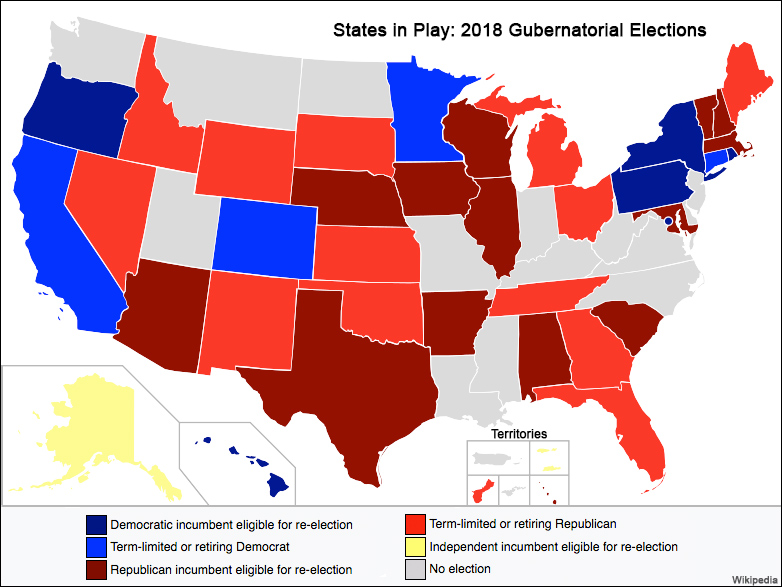
June 12, 2017 — It was always known that a large number of 2017-18 cycle governors’ races would be open contests, but finding several unelected incumbents running to hold their new positions is an unforeseen nuance.

In three states, and possibly soon a fourth, governors have been appointed to Trump administration positions or forced from office, thus allowing the lieutenant governor to move into the state’s top position.

South Carolina’s Nikki Haley, now UN Ambassador; Terry Branstad of Iowa becoming US Ambassador to China and Alabama Gov. Robert Bentley being forced from office for misappropriation of state funds have made Henry McMaster (SC), Kim Reynolds (IA), and Kay Ivey (AL) overnight governors. While on paper and in practice this is a big advantage for the former lieutenant governors in running for the state’s top position, none of them have easy campaign roads, and not even for their respective party nominations.

Last week’s announcement from Kansas Secretary of State Kris Kobach (R) that he will enter his state’s open gubernatorial contest next year may soon lead to him battling a new incumbent if on-again, off-again Washington, DC appointment rumors eventually prove true.

Speculation has abounded that President Trump will tap Gov. Sam Brownback (R-KS) for an open United Nations position, or another associated with foreign policy. Though such talk has been a subject of discussion since February and he has yet to be appointed, it is unclear if such will ever happen. Should it, however, then Secretary Kobach, oil businessman Wink Hartman, and ex-state Rep. Ed O’Malley will have to face a new sitting Republican governor, Jeff Colyer, the current lieutenant governor.

Continue reading