
By Jim Ellis
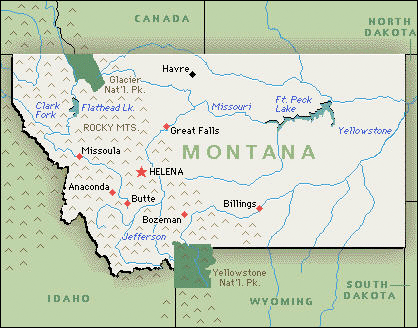
Montana
Montana holds its major statewide races in the presidential election year as opposed to the mid-term. In the state’s seven major statewide offices, Republicans currently enjoy a 5-2 edge, though Democrats hold the governorship and a US Senate office. In the 2012 election, however, the outcome was completely reversed as Democrats took five of the same seven positions.
With this background, a just-released research survey from Public Policy Polling (March 12-13; 903 registered Montana voters) tested a newly formed US Senate race between first-term Sen. Steve Daines (R) and Gov. Steve Bullock (D), along with the open at-large congressional contest. Both parties have contested primaries for the House, but state auditor and former US Senate nominee Matt Rosendale (R) and former state representative and 2018 congressional nominee Kathleen Williams (D) appear to be the favorites to win their respective party nominations.
The state is also hosting an open governor’s race, but the PPP poll did not test that campaign. The progressive left group End Citizens United sponsored the Public Policy Polling survey, and they sampled a universe that contained 37 percent self-identified Republicans, 32 percent Democrats, and 31 percent who describe themselves as Independents. It’s difficult to compare this sampling universe with the actual state electorate because Montana does not have party registration and the state features an open primary system.
That being said, the ballot test finds Sen. Daines and Gov. Bullock locked in a 47-47 percent tie, with an almost identical conclusion for a hypothetical pairing between Rosendale and Williams (45-45 percent).
 March 19, 2020 — The COVID-19 virus is causing obvious problems worldwide, and it’s changing the United States’ electoral system. Several states all with primaries on or before June 23 have already moved their date or are discussing such an option.
 March 12, 2020 — We have now seen US Senate primaries occur in five states with another six completing the filing process. In 15 instances, we already have either the general election pairings officially or unofficially set, though the Massachusetts Democratic primary on Sept. 1 is effectively the only determinative election.