
By Jim Ellis — Friday, August 28, 2026
Senate
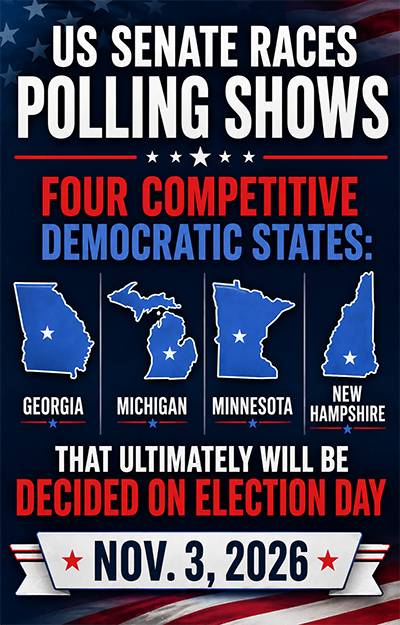 Fox News is reporting that 12 US Senate races are competitive enough for Democrats to potentially win the majority. As part of the story, American Majority CEO Ned Ryun – son of former Republican Congressman Jim Ryun – argues that Republicans are “whistling by the graveyard” regarding the coming Senate elections.
Fox may be highlighting such narratives to motivate the Republican base, but a network that brands itself as “fair and balanced” should also weigh factors that place the GOP’s outlook in a more measured perspective.
To begin with, of the 12 races cited, Democrats already control four. Even if they win all of these, they would not reduce the Republican advantage. For Democrats to claim Senate control, they must flip four Republican‑held seats.
The four competitive Democratic states are Georgia, Michigan, Minnesota, and New Hampshire.
Michigan is likely the most important Senate race in terms of signaling which party may ultimately secure the majority. If former Congressman and 2024 Senate nominee Mike Rogers (R) wins, Democrats would need to convert five Republican seats rather than four, since retiring Sen. Gary Peters (D) currently holds the Wolverine State seat.
Realistically, a Rogers victory is a strong possibility. Across six polling aggregator sites, Democratic nominee Abdul El‑Sayed averages just 45.7 percent support. While El‑Sayed still leads in several polls, the persistent polling error of the Trump era – underestimating Republican vote share – suggests that this low Democratic average is a troubling sign for the Democrat’s campaign regardless of Rogers’ numbers.
Fox rates New Hampshire as lean Democratic. Yet the University of New Hampshire’s Granite State Poll (Aug. 20–24; 1,878 likely voters; online) finds former Sen. John E. Sununu (R) leading Rep. Chris Pappas (D-Manchester) 45-43 percent.
Additionally, not factored into Fox’s assessment is the Sununu family’s electoral history: former Gov. John Sununu, former Gov. Chris Sununu, and John E. Sununu have collectively won 11 New Hampshire elections over 44 years, losing only once.
Furthermore, the same UNH poll shows Gov. Kelly Ayotte (R) ahead of her Democratic opponent by 10 points. These indicators fail to suggest a favorable New Hampshire Democratic climate.
Fox also labels the open Minnesota race as likely Democratic, yet polling shows Republican nominee Michele Tafoya, the former national sportscaster, consistently within the polling margin of error. She has gained traction by attacking fraud uncovered in Minnesota’s administration of certain federal transfer‑payment programs.
Moreover, even though Minnesota is a reliably Democratic state, it is arguable that Lt. Gov. Peggy Flanagan, positioned on the far left, was the weaker of the two candidates who could have won the Democratic nomination.
Georgia is rated lean Democratic, which is accurate today. Given that all Georgia Senate races in 2020 and 2022 advanced to runoffs means this contest may tighten as Election Day approaches, however. Sen. Jon Ossoff (D) defends his seat against Republican Congressman Mike Collins.
Turning to Republican seats, Fox rates the Kansas seat of Sen. Roger Marshall (R) as only lean Republican, despite the fact that the Jayhawk State has not elected a Democrat to the US Senate since 1932. Sen. Marshall holds at least $5 million cash‑on‑hand, more than double his opponent, and Democrats failed to recruit their strongest prospect, Rep. Sharice Davids.
Fox calls Iowa a toss‑up, even though Republicans have Rep. Ashley Hinson as their nominee. Hinson is a strong media-savvy campaigner, has raised $4 million more than her opponent, and leads 45-41 percent in the latest independent Suffolk University poll (Aug. 20-23; 500 likely voters; live interview). She is also in a better position than retiring Sen. Joni Ernst (R) was at a comparable point in both of her successful campaigns.
Nebraska, rated only lean Republican, appears to be a replay of 2024. Independent Dan Osborn unified Democrats behind him two years ago, cleared the field, and raised millions – yet still lost by six points. He is attempting the same strategy now, but Sen. Pete Ricketts (R), who has averaged 59 percent in his three statewide races and has more than $200 million in personal resources, is in a stronger position than Sen. Deb Fischer was in 2024.
In Ohio, appointed Sen. Jon Husted (R) is running even or slightly behind former Sen. Sherrod Brown (D), similar to current Sen. Bernie Moreno’s position two years ago. It is important to remember that Sherrod Brown lost his last election by over three percentage points even though he gained 296,000 votes when compared to his last victory in 2018 while spending over $100 million.
Ohio has shifted so consistently to the right in the Trump era that Democrats no longer include it in their “Blue Wall” as they originally did when discussing presidential prospects.
Turning to Maine, Democrats were forced to replace Senate nominee Graham Platner – who set a record for votes in a Democratic primary – with a candidate who placed third in the 2026 Governor’s primary.
While Democrats appear to be running even or slightly ahead of Sen. Susan Collins (R) today, history matters: in 2020, Collins’ opponents spent $62 million in a state of just 1.3 million people, and their candidate led in every public poll. Sen. Collins ultimately won by 8.5 points, securing her fifth statewide victory.
Texas Republicans clearly have a flawed nominee in Attorney General Ken Paxton, but he has won three statewide general elections and three major statewide primaries, including defeating four‑term Sen. John Cornyn by 28 points in this year’s runoff.
Republicans also consistently under‑poll in Texas. President Trump led by seven percentage points in 2024 polling but won by 13. Sen. Ted Cruz led Democrat Colin Allred by approximately four points in polling two years ago but won by eight percentage points – against an opponent far less liberal than current nominee James Talarico.
Alaska Sen. Dan Sullivan (R) posted a weak jungle primary showing last week, but former Rep. Mary Peltola (D) lost her 2024 race despite placing first in that year’s qualifying election, and Sullivan’s campaign will now swing into full action. Polling so far has accurately portrayed Peltola as leading the race, but an ultimate Sullivan victory is still within reach.
The open North Carolina race is Democrats’ best opportunity to flip a Republican seat. Former two-term Governor and four-term Attorney General Roy Cooper (D) is a clear favorite over former Republican National Committee chairman Michael Whatley and that projection likely won’t change.
Considering that polling in the Trump era has consistently under‑estimated Republican candidates and Democrats often appear stronger early, the 2026 cycle remains far from delivering a new Democratic Senate majority, even if some Republicans are, as Ryun suggests, “whistling by the graveyard.”