Tag Archives: Jim Ellis

The Healthcare Attacks

By Jim Ellis

Sept. 27, 2018 — Now that the economy is rolling, surveys are beginning to show that jobs and taxes are lesser campaign issues.

Some state and district polls indicate that the economy is dropping from the most important issue commonly cited all the way down to number three. Depending on the district or state location, immigration moves into the second slot, while healthcare now becomes the top concern. Most research consistently finds these three issues, in some order, as the most important set of topics that could move voters in an election, however.

Therefore, it is not surprising to see the two major party congressional arms attacking their opponents about healthcare, but from very different perspectives. The method of attack is becoming prevalent in virtually all of the top campaigns.

Democratic Congressional Campaign Committee (DCCC) ad attacking Rep. Peter Roskam (R-IL) in a suburban Chicago race

Democrats, usually using the DCCC as their message delivery entity, though the House Majority PAC, which is the Democrats’ main outside organization commonly involved in congressional races, is also a major part of the attack portfolio, hits Republican incumbents for voting to end coverage for pre-existing conditions.
Continue reading

The Democrats’ Path

By Jim Ellis

Sept. 25, 2018 — Most of the contemporary political talk surrounds the Democrats’ ability to gain the US House majority, but is there a viable path for a power shift in the Senate? Their road to a new Senate majority is much rockier than for the House, but at least a mathematical chance of that becoming reality does exist.

senate 2018 midterm election competitionLast week we reviewed the status of the 17 states that see legitimate competition for the in-cycle Senate seats. Now, looking at the latest Fox News Senate ratings, we can draw some conclusions about the Democrats’ victory chances.

It is important to remember that the minority Dems must defend 26 of the 35 in-cycle Senate races in the current election cycle. Thus, the party’s least complicated path is to run the table of their current 26 seats, and then take two of the five GOP states where they are fielding credible opposition candidates. Doing so would give the Dems a 51-49 majority.

But, this is easier said than done. According to Fox, and virtually all other media prognosticators, one of the Democratic seats, North Dakota, is already leaning to the Republicans, while three more (Florida, Indiana, and Missouri) reside in the “Toss-up” column.

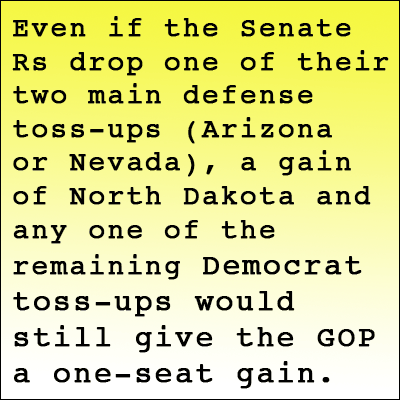
Of the nine seats the Republicans need to defend, three reside in the Toss-up category (Arizona, Nevada, and Tennessee), while one is classified as a Lean Republican (Texas), and the remaining five (Nebraska, the two Mississippi seats, Utah, and Wyoming) are rated as Likely Republican. (Fox does not use a “safe” designation. The best a candidate of either party can achieve from a Fox News political rating is “likely.”)

Continue reading

Nevada’s Polling Contradiction

By Jim Ellis

Sept. 19, 2018 — A new survey was just released covering the two Nevada statewide campaigns, and the results are curious.

Gravis Marketing tested the Silver State electorate (Sept. 11-12; 700 likely Nevada voters) and finds consistency with other polling in one race but projects a major change in the other.

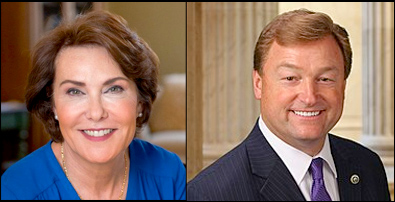
Nevada Senate candidate, Rep. Jacky Rosen (D) and Sen. Dean Heller (R)

Nevada Senate candidate, Rep. Jacky Rosen (D), and Sen. Dean Heller (R)

According to Gravis, Rep. Jacky Rosen (D-Henderson) holds a 47-45 percent lead over Sen. Dean Heller (R) in the US Senate campaign. Such a conclusion is well within the range of other published data.

Just as Gravis was beginning their survey process, Suffolk University was ending theirs (Sept. 5-10; 500 likely Nevada voters), and they saw Rep. Rosen holding a similarly close 42-41 percent edge. Suffolk also surveyed in late July (July 24-29; 500 likely Nevada voters) and found Sen. Heller clinging to a one-point 41-40 percent lead. All of these consistent findings suggest the Senate race has been, and continues to be, a pure toss-up.

But the same Gravis polling sample produced a radically different conclusion for the open governor’s race. All other previous data found Clark County Commissioner Steve Sisolak (D) and Attorney General Adam Laxalt (R) locked in a close battle. The same two previous polls cited above for the Senate race, Suffolk University’s Sept. 5-10 survey and their July 24-29 study, actually found Sisolak ahead only 37-35 percent in the former, while Laxalt actually led 42-41 percent in the earlier poll.

Continue reading

Health Care Politics

By Jim Ellis

Sept. 18, 2018 — In virtually every poll, health care is mentioned in the top three of the most important issues across the country. Therefore, ad themes attacking the problem from both ends of the political spectrum are now regularly appearing in every competitive congressional campaign.

The Democrats are zeroing in on Republican incumbents, in particular, on the pre-existing condition issue claiming that the GOP is trying to eliminate insurance coverage for those having previous health problems. The Dems support this argument by pointing to the Affordable Care Act repeal vote.

(Dr. Kim Shrier ad)

Republicans are now mounting an offensive against the pitch that many Democrats are promoting when they call for expanding Medicare coverage for everyone as the solution to the nation’s health insurance problem.

Both the campaigns themselves and various independent expenditure groups are attacking from both angles, and four ads presented below are typical examples of what we are seeing across the nation.

Washington Democrat Kim Shrier is running for the Seattle area district from which Rep. Dave Reichert (R-Auburn) is retiring. She is a pediatrician, so naturally healthcare is a key theme for her campaign. Dr. Shrier is opposing Republican former state senator and statewide nominee Dino Rossi in what is clearly a toss-up campaign.

Rossi and Dr. Shrier topped a field of 12 candidates in the Washington jungle primary held on Aug. 7. The Republican, by far the most well-known candidate of the group, placed first with 43.1 percent of the vote. Dr. Shrier nipped fellow Democrat Jason Rittereiser, 18.7 – 18.1 percent to advance into the general election. But, in the aggregate, Democrats earned slightly more votes than Republicans in the district-wide primary vote 50.2 – 47.2 percent.

One of Dr. Shrier’s healthcare campaign ads is included above as a good example of how Democrats are attacking Republicans, particularly over the pre-existing condition issue. Kansas Rep. Kevin Yoder (R-Overland Park) goes on the attack against his opponent, former White House fellow (Obama Administration) and professional Mixed Martial Arts boxer Sharice Davids (D), over her promoting “Medicare for all” and claims that such will lead to the elimination of private health insurance.

Continue reading

The Polling Machine

By Jim Ellis

Sept. 17, 2018 — In news that got pushed aside because of all of last week’s primaries, the Siena College Research Institute entered into a polling partnership with the New York Times to survey what the news organization spokespeople indicate will be nearly 100 US House campaigns. The Times’ statement also says more people will be “talked to (in sampling groups) than ever before.”

sienna-college-research-institute-jim-ellis-insightThe other interesting twist is that the results will be published in real time, meaning readers can see the responses as they are being recorded. The full sample is targeted to be in the 500 range per congressional district, a very healthy size. But readers should be cautioned about trying to project a pattern before the individual respondent universe is fully developed.

Siena College has been the featured New York Times pollster for several election cycles, concentrating on New York races. They regularly poll the state to test a governor’s approval rating, and how the electorate rates certain state-related and federal issues, along with conducting candidate ballot tests.

The 538 political analytics organization, which rates national, regional, and local pollsters, among other research, awards Siena an A grade in both the 2016 and 2018 election cycles, saying they have called 82 percent of the races correctly from 66 political surveys (60 in the 2016 election cycle, and six this year).

Siena records an average polling error rate of 4.9 percent, and concentrates on the live phoner method that includes conducting some respondent interviews on cell phones. The 538 organization records a Siena bias factor toward the Democrats of just 0.1 percent, which ties for one of the lowest in the polling universe and behind only Iowa’s Selzer & Company and Fairleigh Dickinson University, which scored a perfect 0.0 percent bias factor rating.

Continue reading

Rhode Island Results

By Jim Ellis

RHODE-ISLANDSept. 13, 2018 — The Ocean State conducted the final primary before the general election yesterday, and Gov. Gina Raimondo was successfully re-nominated in the Democratic primary. But her victory margin wasn’t particularly impressive.

Now, all states with the exception of Louisiana have held their federal nomination elections. Because the Bayou State leaders desire a system that allows candidates to win an office in one election – by obtaining majority support – such a procedure is only legally possible when that one election is scheduled concurrently with the regular general vote. For those who fail to achieve majority support, the top two finishers, regardless of political party affiliation, advance into a Dec. 8 run-off to determine the final outcome.

In Rhode Island, Gov. Raimondo scored a 57-33 percent re-nomination victory percentage against former Secretary of State Matt Brown, with a turnout basis of just over 116,000 Democratic primary voters. Minor candidate Spencer Dickinson captured the remaining nine percent of the vote. The fact that almost 43 percent of Democratic voters chose a candidate other than their sitting governor is obviously not a good sign for her as Gov. Raimondo now embarks upon a general election campaign.

But her positive spin is that Cranston Mayor Allan Fung, was also the party nominee in 2014, win the Republican primary again last night. His victory percentage last night was virtually the same as the governor’s — about 56.5 percent — but from a small Republican voter base of just under 33,000 individuals. State House Minority Leader Patricia Morgan, who was running to ung’s right, took 40 percent of the GOP vote.

Continue reading

Delaware Primary Results

By Jim Ellis

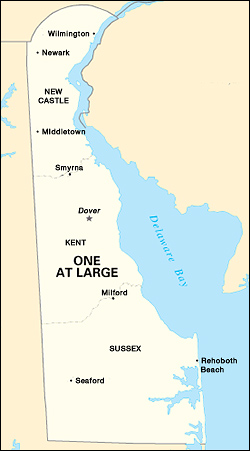
DelawareSept. 7, 2018 — The First State voters chose their nominees last night, the 47th state to do so in the current election cycle. The nominating election was basically a non-event despite media reports attempting to hype the challenger’s chances. Sen. Tom Carper (D) scored almost a 2:1 victory over socialist Democrat Kerri Harris. Sen. Carper, running for a fourth term, posted a 65-35 percent win from a turnout of just over 83,000 Democratic voters.

The three-term incumbent will now face the GOP winner from last night, Sussex County Councilman Rob Arlett who thrashed two minor GOP candidates with 67 percent of the vote. The general election is not competitive and Sen. Carper will easily win a fourth term in November.

In the House race, freshman Rep. Lisa Blunt Rochester (D-Wilmington) was unopposed for re-nomination. In the Republican primary, floral contractor Scott Walker scored a 53-47 percent win over teacher and actor Lee Murphy. As in the Senate race, this House campaign will be non-competitive and Congresswoman Rochester will easily win a second term on Nov. 6.

MA-3: A Sleeper?

Massachusetts congressional districts

Massachusetts congressional districts


By Jim Ellis

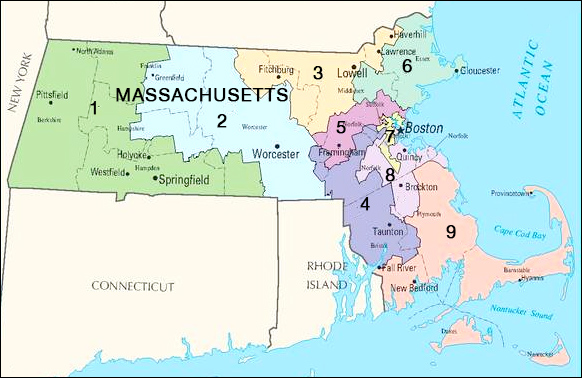
Aug. 27, 2018 — One of the few interesting remaining primaries in this 2018 election cycle is the open northern Massachusetts congressional race a week from tomorrow featuring 10 Democratic candidates all attempting to succeed retiring Rep. Niki Tsongas (D-Lowell).

A new University of Massachusetts at Lowell and Boston Globe survey of the impending MA-3 Democratic primary (Aug. 14-21; 849 MA-3 registered voters, 553 MA-3 likely Democratic primary voters) finds ex-Boston mayoral chief of staff Dan Koh forging into the lead, but with only a 19-13-13 percent edge over former ambassador to Denmark, Rufus Gifford, and state Sen. Barbara L’Italien (D-Andover) as the state’s Sept. 4 partisan primary draws near.

But other candidates could possibly make a run, too. Business consultant Lori Trahan posts eight percent in the poll, and while state Rep. Juana Matias (D-Lawrence) has just six percent, she is dominant within the district’s Hispanic community. In such a crowded campaign with a low voter turnout, any candidate with a major support base must be taken seriously. The other five candidates each register four percent and below.

But there could be more to this campaign than the winner of a crowded primary going on to easily take the general election in what should be a safe seat for the dominant party in the district, in this case the Democrats.

Continue reading

Dead Heats in New Nevada Senate Poll

By Jim Ellis

Nevada Senate candidate, Rep. Jacky Rosen (D) and Sen. Dean Heller (R)

Nevada Senate candidates: Rep. Jacky Rosen (D) and Sen. Dean Heller (R)

Aug. 2, 2018 — A new Suffolk University survey (July 24-29; 500 likely Nevada voters) returns numbers that again show Sen. Dean Heller (R) and Rep. Jacky Rosen (D-Henderson) falling within the margin of polling error with neither candidate attracting majority support.

According to Suffolk, Sen. Heller leads Rep. Rosen by a bare 41-40 percent margin, meaning the two are virtually tied. This is the first poll since mid-April that projects the senator to any kind of an advantage, but even the four surveys in between, all of which favored Rep. Rosen, showed margin spreads in the realm of two to six points. Of the eight polls publicized for this race during the entire election cycle, in only one, the April Survey Monkey study, did either candidate ever reach the 50 percent mark (Rosen, 50-44 percent; Survey Monkey; April 2-23; 1,332 Nevada registered voters in the Survey Monkey pool).

Suffolk also tested the state’s open governor’s race, and found an equally tight contest. Here, Republican Attorney General Adam Laxalt posts a 42-41 percent tally over Democratic Clark County Commissioner Steve Sisolak. In the one previously released post-primary general election poll, from Gravis Marketing (June 23-26; 630 likely Nevada general election voters), an almost identical result was projected: Laxalt leading 43-41 percent.

The Nevada Senate race is one of the most important in the nation this year, and one of two main Democratic conversion targets (the open race in Arizona is the other). Winning this race is the only gateway to the Democrats potentially gaining the Senate majority, thus we can expect to see major political action in this state for the remaining prime campaign months.

Continue reading

Previewing Tennessee Thursday

By Jim Ellis

Tennessee state flag

Tennessee state flag

July 26, 2018 — Next Thursday, Volunteer State voters head to the polls in the only place that holds its statewide primary on a day other than a Tuesday or Saturday. The Aug. 2 Tennessee political card features some intense races, including an open US Senate and governor’s race, along with three open-seat House races in addition to one significant incumbent challenge.

Though the Senate race is open and will be hard fought through November, the primary is set for both parties so we won’t see the usual uptick in activity here next week. Former two-term Gov. Phil Bredesen has the Democratic nomination sewn up, as does US Rep. Marsha Blackburn (R-Brentwood) on the Republican side.

In the open governor’s race, US Rep. Diane Black (R-Gallatin) and businessman Randy Boyd appear to be the two front-runners, and the two are zeroing in on each other. Boyd, and fellow candidate Bill Lee, are both being hit over making past contributions to Democratic candidates. Rep. Black, running as the most conservative candidate, is taking flack for her role in an unpopular Congress. Former Nashville Mayor Karl Deen and state House Minority Leader Craig Fitzhugh (D-Ripley), emphasizing his “Tennessee Always” slogan, are the top Democratic candidates. But, the real battle to replace term-limited Gov. Bill Haslam (R) lies in Thursday’s Republican primary.

Though many names will appear on the ballot in Tennessee’s nine congressional races, only a few candidates are legitimately competitive.

Reps. Phil Roe (R-Johnson City), Chuck Fleischmann (R-Chattanooga), Scott DesJarlais (R-South Pittsburg), and Steve Cohen (D-Memphis) all have primary opponents, but none appear particularly strong. In the case of Reps. Fleischmann and DesJarlais, both face an easy primary run for the first time in their congressional careers.

Continue reading