Tag Archives: Fox News

New Hillary Polls: Bogus, and Not So Good

July 17, 2015 — This week, two polling organizations released new data about presumed Democratic nominee Hillary Clinton. One provides results that should be discarded; another brings forth more methodologically sound data, which rings warning bells for her in six key swing states.

Earlier in the week Suffolk University released a small-sample poll showing Donald Trump leading the Republican field. As we noted in a previous column, those results were highly unreliable because only 349 likely Republican primary voters were questioned from across the country, and Trump’s “lead” consisted of exactly 60 people saying they would vote for him.

On Tuesday, Monmouth University publicized similarly flawed results, but this time regarding the Democratic nomination contest. Here, the pollsters and media are trying to indicate that Clinton’s support is dropping among Democrats based upon a survey that interviewed, during the July 9-12 period, only 357 people nationally who say they plan to vote in a Democratic primary or caucus. Even within this small group she topped 51 percent, while her closest opponent, Vermont Sen. Bernie Sanders, attracted only 17 percent support. Vice President Joe Biden, who is not a presidential candidate but may soon become one, notched 13 percent.
Continue reading >

LaHood Scores in Illinois;
The Fox News Dubious Debate Plan

July 9, 2015 — As expected, Illinois state Sen. Darin LaHood (R) cruised to an easy special election primary victory Tuesday in the vacant Peoria-anchored congressional district. Rep. Aaron Schock’s (R) March resignation created the vacancy, which is the only unrepresented seat in the entire US House.

LaHood, whose father, Ray LaHood, represented the seat for 14 years before becoming President Obama’s Transportation Secretary, topped 69 percent of the vote against two weak GOP opponents who spent less than $50,000 combined on their campaigns. Democrats officially nominated educator Rob Mellon, an Army Reserve officer who lost his party’s congressional primary in 2014.

LaHood will easily defeat Mellon, but must wait until Sept. 10 for the next vote in what is an unusually long special election cycle. His eventual victory will bring the House party division back to 247R-188D, the spread generated on Election Night 2014.
Continue reading >

The Debate Game

May 27, 2015 — With yet another Republican ready to announce his presidential campaign tomorrow, last week’s declaration from two media sources saying they are going to limit the number of televised debate participants to 10 will soon ignite a firestorm of protest. It is probable that the question surrounding who is and is not invited to participate will probably create more intense political fireworks than the formal debates themselves.

It’s clear that Fox News and CNN want to have manageable television programs, hence the arbitrary limits placed upon who can attend. The fact that they want to base their exclusion on inexact national polls, using a mathematical formula that no pollster would deem legitimate (averaging diverse surveys), in order to produce an imaginary top 10 will certainly lead to extensive discussion and dissent, and possibly even legal challenges.

Former New York Gov. George Pataki is set to become the next official presidential candidate, and he would likely be one of the people excluded from the televised debates, assuming his effort does not catch fire between now and summer. Pataki is a three-term governor of New York, one of only three Republicans to hold this position since the early 1920s. The other two are Nelson Rockefeller, who would later become vice president, and Thomas E. Dewey, winner of the 1948 Republican presidential nomination but loser to President Harry Truman (D) in what was one of the more memorable campaigns of the 20th Century.
Continue reading >

Fox Poll Blitz: Alaska, Ark., Colo., Kan. & Ky.

Fox News, which contracts with both a Democratic and Republican pollster to provide joint data relating to key political races, released a series of surveys yesterday, each providing good news for Republicans. The results may skew slightly Republican because in certain instances they exceed other similarly published survey suggests.

The two firms, neither particularly well known nor quoted in national polling circles, are Anderson Robbins Research (D) and the Shaw Polling Company (R). The two combined to produce polls in five different states during the Oct. 4-7 period. In each place, the sampling universe numbered somewhere between 702 and 739 likely voters. In all but Kentucky, both the Senate and governors’ races were tested. Blue Grass State voters won’t choose a new governor until next year. As identified in the headline, the other four polled states were Alaska, Arkansas, Colorado and Kansas.

Alaska

Here, the Fox poll gave former Attorney General Dan Sullivan (R) a 44-40 percent lead over Sen. Mark Begich (D), which could well be accurate. Sullivan and Begich have Continue reading >

Pollster Projects Romney Win in Fla., N.C., & Va.

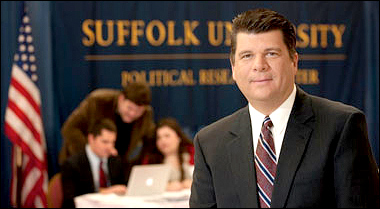
Suffolk University’s David Paleologos

On Bill O’Reilly’s Fox News program, “The O’Reilly Factor,” Suffolk University polling director David Paleologos rather surprisingly announced that his institution would no longer conduct presidential surveys in the core swing states of Florida, North Carolina and Virginia. He says that Republican challenger Mitt Romney will carry the trio, representing a combined 57 Electoral Votes. If true, this would have a stunning effect on the national election.

Paleologos has several reasons supporting his decision to project the three states, all of which voted for President Obama in 2008. First, he says, in Florida, 12 candidates are on the ballot. When questioning the respondents who say they are supporting someone other than Obama or Romney, the overwhelming majority cited the Republican nominee as their second choice. He reasons that most people pledging for a minor candidate will move to one of the two major party contenders when they actually cast their ballots instead of wasting their vote on someone who cannot win.

Paleologos also cited the absentee ballot request forms in Florida as another fundamental reason that Romney will win the Sunshine State. He argues that of those people officially requesting ballots, 43.4 percent are registered Republicans versus 39 percent who identify as Democrats. Of those already returning their voting envelope, 45.5 percent are Republican as compared to 38 percent Democratic. In North Carolina, 52 percent of the absentee ballot requests are from Republicans with just 27 percent coming from Democrats. He is less specific about his reasoning for including Virginia in this group of states.

Though some of the support points for Suffolk’s decision are sound, it is way too early, and the margins too close, to begin projecting such states for either candidate. Just look at the major swings occurring within the last two weeks, yielding trends that no one predicted. Much will continue to happen in the next month to determine the actual winner. Suffolk’s polling withdrawal decision is quite premature.

Doing the Delegate Math: Exactly Who’s Right?

In tracking the delegate count for the Republican presidential nomination, it is clear that no “official” tabulation exists. In fact, virtually all major media organizations and political websites have different totals for Mitt Romney, Rick Santorum, Newt Gingrich and Ron Paul, and with wide divergence.

Below are the latest published delegate counts from key media and political outlets. Notice that only ABC News and the New York Times agree, which probably means they are using the same source.

   • ABC News: Romney 105; Santorum 71; Gingrich 29; Paul 18

   • CBS News: Romney 111; Santorum 44; Gingrich 30; Paul 15

   • CNN: Romney 127; Gingrich 38; Santorum 37; Paul 27

   • Fox News: Romney 107; Santorum 45; Gingrich 32; Paul 9

   • The Green Papers: Romney 107; Santorum 43; Gingrich 43; Paul 35

   • NBC News: Romney 84; Gingrich 29; Santorum 14; Paul 11

   • New York Times: Romney 105; Santorum 71; Gingrich 29; Paul 18

   • Real Clear Politics: Romney 99; Santorum 47; Gingrich 32; Paul 20

To recap, the eight entities don’t even show a consistent order of candidates – CNN and NBC have Gingrich in second place and the others project Santorum in the runner-up position. Romney ranges from a low of 84 pledged delegates (NBC) to a high of 127 (CNN). Santorum’s spread is from 14 (NBC) to 71 (ABC/NYT). Former Speaker Gingrich appears to be most consistent, tallying in a range from 29 (ABC/NYT) to 43 (The Green Papers). Finally, Rep. Paul runs the gamut from 9 (Fox) to 35 (The Green Papers).

Why the differences? First, even some states where voters have already participated – Iowa, Nevada, Missouri, Maine, Colorado and Minnesota – won’t actually apportion their delegates until convention events later in the year. Some of the aforementioned trackers are estimating what these states will eventually do based upon the public votes already cast.

Secondly, the media and political sources either are, or are not, projecting unpledged delegate votes. Many of the unpledged delegates themselves aren’t even chosen yet.

Third, at least two states’ delegations, Florida and Arizona, will likely be challenged at the Republican National Committee Convention. Both are apportioning their delegates under a winner-take-all option in defiance of RNC rules. Only states that vote after Super Tuesday (March 6) are entitled to use the winner-take-all format. Therefore, the Florida count (50 delegates for Romney) could change. The same with Arizona (29 delegates), which votes Feb. 28.

Considering that no official delegate count actually exists, it clearly means we will continue to see a very fluid situation that could lead to a surprising conclusion. Keep in mind, regardless of the apportioned delegate count’s accuracy, or lack of it, only 11 percent of the 2,286 delegates have been assigned. The mathematics continue to show that this race is still very much undecided.

A Polling Trifecta

An interesting set of three presidential polls was just released: a national survey testing the Republican candidates, which reveals a new leader and a surprise mover, and two key state general election studies that show President Obama barely clinging to a lead in two places that he carried comfortably back in 2008.

Fox News, contracting with both Democratic and Republican polling firms, which seem to have conducted a more methodologically sound survey than others emanating from the network in the recent past, shows former Massachusetts Gov. Mitt Romney recapturing the lead over Texas Gov. Rick Perry. The big mover, however, was retired businessman Herman Cain, who catapulted himself into a strong third position.

The pollsters, Anderson Robbins (D) and Shaw & Company (R), went into the field during the Sept. 25-27 period and questioned 925 registered voters. The error factor is plus or minus 3 percentage points 95 percent of the time. Of the group, 363 individuals are Republican primary voters. The results show that Gov. Perry took a hit from his poor debate performance before the Presidency 5 straw poll in Florida, and his lackluster showing at the event itself. Though Romney only gained one percentage point from the last Fox News poll, he secures first place with just 23 percent of the vote. Perry is next with 19 percent, dropping a full 10 points when compared with the Fox Aug. 29-31 survey. Cain captures a solid 17 percent, making him now a close third nationally, at least according to this particular poll. Former House Speaker Newt Gingrich is the other significant mover. He grew from 3 percent to 11 percent during the interval between the two Fox polls.

These results are not particularly surprising. Perry has taken a media beating since the Presidency 5 debate and straw poll, so it was expected that he would fall to a diminished position in the ensuing national polls. Though Romney is leading, he continues to record stagnant numbers and still cannot break out of the low 20s. Considering he is the best known of all the Republican candidates, a standing of this level should not be seen as particularly encouraging.

The Cain numbers are interesting, and reflect that he’s receiving more positive exposure before a public that is clearly looking for a new option, but this result could also be short-lived. Next month’s polling data will show if Mr. Cain has staying power or if his current standing is simply an anomaly.

Turning to the two large-sample Quinnipiac University general election polls taken in Ohio (Sept. 20-26; 1,301 registered Ohio voters) and Pennsylvania (Sept. 21-26; 1,370 registered Pennsylvania voters), it appears that Gov. Perry is not the only candidate who is seeing his fortunes decline. Mr. Obama, who scored a 51-47 percent victory in the Buckeye State and a 54-44 percent triumph in neighboring Pennsylvania three years ago, fares considerably worse today against both Romney and Perry.

In Ohio, the President can manage only a 44-42 percent edge over Romney and a similar 44-41 percent advantage when matched up against Perry. Mr. Obama’s Ohio standing is reflective of his poor job approval rating, according to these Q-Poll results. By a margin of 42:53 percent, the Buckeye State respondents disapprove of the job he is doing in the White House. Potentially an even worse ratio from his perspective, only 43 percent of those surveyed believe the President deserves re-election, while a majority 51 percent say he does not.

The Pennsylvania numbers are strikingly similar to those found in Ohio. There, the President maintains an almost identical 45-43 percent spread against Mr. Romney, but does slightly better when matched with Perry, leading him 46-40 percent. Perhaps most surprising of all, Mr. Obama can only manage a three-point, 45-42 percent margin against defeated Pennsylvania Sen. Rick Santorum, who lost his seat in 2006 by more than 17 percentage points.

As in Ohio, Mr. Obama’s job approval numbers in this critical political state are poor. The Pennsylvania respondents, by a margin of 43:54 percent, disapprove of his performance as President. And, his re-elect score is also similar to that found in Ohio. Among Keystone State voters, 44 percent say he deserves another term in office, while, again, a majority 51 percent of those sampled say he does not.

With all of the major candidates now seemingly on a bit of a downward spiral, the election of 2012 can be counted upon to be highly unpredictable as it moves forward.