Tag Archives: California

COVID & Redistricting

By Jim Ellis

April 29, 2020 — The deadline for the Census Bureau to release the new population data is March 31, 2021, but with the entire process being delayed due to COVID-19 precautions, the ability to meet the requirement is becoming more difficult by the day. Already, the Bureau has been delayed in dispatching their door-to-door teams necessary in obtaining the responses from people who did not return their mail tabulation form.
The Trump Administration is reportedly suggesting that the March 31 deadline be postponed to sometime in the summer of 2021. If this happens, we will see a series of redistricting problems ignited in the states. First, the political leaders in New Jersey and Virginia, places that have 2021 elections and need their new state legislative lines in place well before that date, would find themselves in a difficult position.

Initially, the two states would certainly have to postpone their primary elections because both nominate their general election candidates in June. Beyond that, it is possible they would have to even postpone their general elections into 2020 or run in the obsolete boundaries that were drawn back in 2011. In either case, we could expect lawsuits being launched from whichever party loses a particular electoral contest.

Other states would be affected, too. Many have legal deadlines in place mandating that the new redistricting maps for state legislature and the US House delegation be adopted before the legislative sessions ends. Most states recess before mid-summer, which would mean special sessions being called if the legislature is to act.

The problem intensifies in the states that are either gaining or losing congressional districts in reapportionment. Currently, it appears that seven states will add seats to their delegations (the best projections suggest that Texas will gain three, Florida two, and Arizona, Colorado, Montana, North Carolina, and Oregon one apiece), while 10 will lose single districts (Alabama, California [for the first time in history], Illinois, Michigan, Minnesota, New York, Ohio, Pennsylvania, Rhode Island, and West Virginia).

The aforementioned apportionment is based upon calculations released publicly and not, of course, using the actual numbers. Therefore, we could see some differences between these projections and what the formulas actually produce when the Census Bureau finally can produce the updated real figures.

Continue reading

House Opens – Toss-Up/Leans

By Jim Ellis

April 15, 2020 — The open-seat count has increased to 43, with 31 coming from the minority Republican column. The number of competitive opens, however, at this point in the cycle is likely just nine, as 34 of the incumbent-less seats fall into either the Safe/Likely Democratic (12) column or Safe/Likely Republican (22) category. Today, we look at the competitive open seats.

Toss-Up

• CA-25: The vacant Palmdale/Simi Valley seat heads to a special election on May 12 in north Los Angeles County. State Assemblywoman Christy Smith (D-Newhall) and Republican retired Navy fighter pilot Mike Garcia (R) advanced from the special primary into the stand-alone mail-in special general. Regardless of the outcome on May 12, these two candidates will advance into the November general election to determine who will represent the politically marginal district in the next Congress.
   The special election has moved from “Lean Democratic” into the “Toss-up” category as a result of recent polling that projects Garcia owning a small lead and because of the partisan turnout numbers in the regular primary. The latter statistic actually found more Republicans voting than Democrats.

• GA-7: In 2018, this Atlanta suburban seat featured the closest raw vote margin in the nation, as incumbent Rep. Rob Woodall (R-Lawrenceville) defeated state legislative staff member Carolyn Bourdeaux by just 419 votes. This year, with Rep. Woodall retiring, Bourdeaux returns but must top five other Democratic candidates including a state senator, state representative, and former Fulton County commission chairman. Therefore, the May 19 Democratic primary, now moved to June 9, will be competitive and the possibility of advancing to an Aug. 11 runoff election certainly exists.
   Republicans may be more likely to move into a runoff than the Democrats, however. Seven candidates are in the field, only one of who is an elected official. More on this race as it develops, but we will probably see tight elections in both primaries and almost assuredly in the general election.

Lean Democratic

• IA-2: In a 2020 open-seat election in this southeastern Iowa congressional district, the Republican challenge is at least as difficult as opposing seven-term incumbent David Loebsack (D-Iowa City), who is now retiring. Democrats have already coalesced around ex-state senator Rita Hart (D-Wheatland), a soybean farmer and former educator from Clinton County.
   In 2018, Hart was the Democratic nominee for lieutenant governor on the ticket that businessman Fred Hubbell lost in a close race to Gov. Kim Reynolds (R). It is an unusual situation when an incumbent party must defend an open seat and winds up with an unopposed candidate in the primary, but that is what has occurred here.
Continue reading

Reviewing the House Vacancies

By Jim Ellis

April 2, 2020 — With the COVID-19 virus playing havoc with virtually every aspect of American life, including elections, how are the House vacant seats being affected?
North Carolina Rep. Mark Meadows (R-Skyland/Buncombe County) resigned from Congress Monday night to become White House Chief of Staff, which brings the total number of vacancies to a half-dozen. Special elections are scheduled in four of those, with three to be decided on or before May 12.

Originally, the special elections in Maryland and New York were supposed to be the first to go to the voters, but the COVID-19 precautions changed the date of the New York election and the voting system in Maryland. Former Rep. Kweisi Mfume, who easily won the crowded Democratic primary on Feb. 7, will win the special general on April 28 but the process now becomes all-mail. The Republican nominee is event planner Ken Klacik, but this Baltimore city district and surrounding area will easily remain in Democratic hands. We can expect Mfume to break 75 percent of the vote.

The former congressman was elected to five terms in the House beginning with the 1986 election. He resigned to become president and CEO of the NAACP in 1996. Mfume served in that position until running unsuccessfully for the Senate in 2006, losing the Democratic primary to then-congressman, Ben Cardin. Then-state Delegate Elijah Cummings replaced Mfume in the House at that time and served until his death in October. Now, ironically, Mfume returns to replace the late Rep. Cummings.

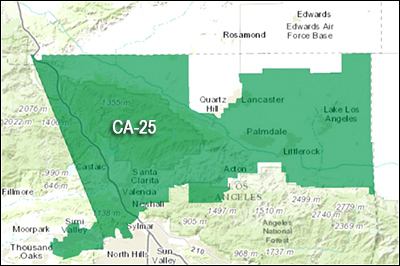
California’s 25th District, which begins in the state’s Simi Valley and stretches to the Palmdale area, potentially features the hottest of the current special elections. Rep. Katie Hill (D) resigned the seat because of a sexual scandal leading to a multi-candidate concurrent special and regular election.

Democratic state Assemblywoman Christy Smith topped the field on March 3, and she advances to the special election runoff on May 12 with Iraq War fighter pilot Mike Garcia (R). The latter individual placed ahead of, and eliminated, former US Rep. Steve Knight (R) who was attempting a political comeback after losing to Hill in 2018. Polling is projecting a tight finish. Regardless of what happens on May 12, both Smith and Garcia are advancing to the regular general election to battle for the full term beginning in 2021. The May 12 winner is immediately sworn into the House and serves the remaining part of the current congressional session.

Continue reading

CA-25: Pondering Questions

By Jim Ellis

California Congressional District 25

March 24, 2020 — Political observers are asking many questions about the special election in California’s 25th Congressional District, the seat that former Rep. Katie Hill (D) resigned late last year, particularly after seeing a new ballot test poll enter the public domain.

In the special California primary held on March 3, a dozen candidates, six Democrats and six Republicans, battled one another either to secure majority support or one of two runoff positions for the May 12 runoff vote. Under California election law, if a candidate attracts majority support, the individual would be elected outright to serve the balance of the current term. If not, the top two finishers, regardless of political party affiliation, advance to a runoff election. It is the latter scenario that occurred here.

In addition to the special election, a second vote was held on March 3 for the regular succeeding term. In this contest, 13 candidates were on the ballot, the 12 aforementioned contenders along with Independent Otis Lee Cooper.

Not surprisingly, the two individuals finishing first in the special election also qualified for the general election. They are: freshman state Assemblywoman Christy Smith (D-Newhall) and defense contractor and Iraq War veteran Mike Garcia (R). The election totals in the two contests are somewhat different, however.

The final totals are still not tabulated. According to the Secretary of State’s office, 313,739 ballots statewide remain uncounted with virtually no progress being made last week. In the 25th District, approximately 5,500 votes await counting in order to be added to the published totals. The final tabulation will not change the first- and second-place finisher status, however.

Interestingly, despite the special and regular vote being held at the same time and on the same ballot, almost 4,000 more people voted in the special election than in the regular primary. Percentage-wise, approximately 39 percent of the district’s registered voters cast a ballot in the special while 38 percent did so for the regular primary. Statewide, the turnout measured just under 45 percent of the registered voters for the regular primary that included a contested Super Tuesday presidential vote.

Continue reading

The Primary Analysis

By Jim Ellis

March 19, 2020 — The COVID-19 virus is causing obvious problems worldwide, and it’s changing the United States’ electoral system. Several states all with primaries on or before June 23 have already moved their date or are discussing such an option.
First, a total of six states already have held primary events and three general election cards are set. On March 3, full state nominating elections were held in Alabama, Arkansas, California, North Carolina, and Texas. Illinois followed suit on March 17. Ohio was also supposed to also vote on March 17 but halted their election at the last minute and moved to June 2. Four of the six early voting states hold runoffs, and three will host some significant secondary nominating elections.

With a 30-percent runoff law, North Carolina only has one congressional finalist election, the open 11th District Republican battle between former Haywood County Republican Party chair Lynda Bennett and investor Madison Cawthorn. Texas has a 50 percent runoff law, and the state will feature a Democratic runoff in the Senate race along with five Democratic congressional runoffs and seven on the Republican side. Though Arkansas requires 50 percent to win a party nomination outright, no federal runoff elections are necessary. Therefore, we have full sets of general election nominees for all regular 2020 races in Arkansas, California, and Illinois.

News came from Alabama yesterday when Gov. Kay Ivey (R) announced that the state is transferring the March 31 runoff all the way to July 14. The significantly longer cycle will potentially change outcomes, the Senate race in particular.

As you will remember, former US Attorney General and ex-Alabama senator Jeff Sessions finished second in the March 3 primary, one point behind retired Auburn University head football coach Tommy Tuberville. Until yesterday, the two were heading for deciding the nomination at the end of the month. All polling was suggesting a Tuberville victory. Now, with almost four full months until the runoff, this contest has the potential of changing. Sessions will now have adequate time to alter his campaign message and has the opportunity to rebound and capture the nomination. The winner faces Sen. Doug Jones (D) in the general election.

Continue reading

The California Pairings

By Jim Ellis

California Congressional Districts

March 17, 2020 — The laborious California ballot verification and tabulation process continues, and now just two US House races fail to have general election finalists. Democratic Reps. Lucille Roybal-Allard and Maxine Waters don’t yet know the identity of their general election opponent, but neither is in a politically competitive district.

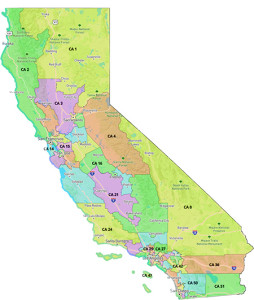
Under the California electoral system, the top two jungle primary vote-getters from the March 3 Super Tuesday election advance into the general regardless of percentage attained and political party affiliation. It appears that 12 of the state’s 53 congressional districts will feature some level of competition. In each of these instances the seat is either open, known to be a national target, or the incumbent garnered less than 50 percent of the vote in the primary election.

The following are the competitive general election pairings, including the special general election in the 25th District that will be held on May 12:


CA-7

Rep. Ami Bera (D) – Incumbent, 4th Term – 49.3%
Buzz Patterson (R) – Retired Air Force Officer – 34.8%
• The 7th District, which contains most of Sacramento County, has turned in some close elections since redistricting created it before the 2012 election. Rep. Ami Bera (D-Sacramento), first elected in that year, had very tight original election results but has seemingly secured the district in his latter campaigns. Though he did not hit the 50 percent mark in the primary, at least at this point, the four-term incumbent should still win comfortably in November. Likely Democratic


CA-8

• Open Seat (Rep. Paul Cook-R elected as San Bernardino County Supervisor)
Jay Obernolte (R) – State Assemblyman – 35.1% in primary
Chris Bubser (D) – Engineer – 28.7% in primary
• Since county supervisor races in California are non-partisan, retiring Rep. Paul Cook (R-Apple Valley) was able to win his new office on March 3 by securing majority support. In his wake, state Assemblyman Jay Obernolte (R-Hesperia) and engineer Chris Bubser will advance to the November congressional election. The 8th is one of the very few safe Republican districts in the state, and Obernolte is a lock to become the new congressman. Safe Republican


CA-10

Rep. Josh Harder (D) – Incumbent, 1st Term – 43.3%
Ted Howze (R) – Former Turlock City Councilman – 34.9%
• Freshman Rep. Josh Harder (D-Turlock/Modesto) unseated veteran Rep. Jeff Denham (R) in 2018. Though he finished well below 50 percent in this primary, Rep. Harder is still a strong favorite for the general election in a district that continues to become more Democratic. Former local elected official Ted Howze (R) raised over $717,000 at the pre-primary filing period, but $325,000 of that total was self-contributed. Likely Democratic


Continue reading

Numbers Rolling in From the
Texas and California Primaries

By Jim Ellis

March 5, 2020 — Tuesday’s elections in Texas and California were subject to slow counting, but at least in the Lone Star State, the numbers are near final.

More than 780,000 votes have currently been received in California but not yet counted. More votes are coming into county offices. To be valid, voters could have postmarked their mail ballots on Election Day and as long as they are received in the county election offices by close of business on March 6, they will be counted. Therefore, an unknown number will be added to the received but uncounted total.

The large total explains why some of the California congressional races remain uncalled even though the vote spreads among the affected candidates is sometimes quite large.

Map of US Congressional districts in Texas

In Texas, US Senate candidate Cristina Tzintzun Ramirez conceded the second Democratic run-off position to state Sen. Royce West (D-Dallas). The two battled for the slot all evening and into yesterday, but the small margin in Sen. West’s favor was definitive enough that Ramirez officially ended her bid. The May 26 statewide run-off election will feature first-place finisher M.J. Hegar, a retired Army helicopter pilot who held veteran Rep. John Carter (R-Georgetown) to a 51-48 percent re-election victory in the 2018 CD-31 campaign that encompasses Williamson and Bell Counties, and now Sen. West. The winner opposes Sen. John Cornyn (R) in November.

The final unofficial Democratic presidential tally finds former vice president Joe Biden scoring 34.5 percent of the vote as compared to 30.0 percent for Sen. Bernie Sanders (I-VT). Though Biden and Sanders were the only candidates to break the 15 percent barrier to qualify for at-large delegates, former New York City mayor Michael Bloomberg and Sen. Elizabeth Warren (D-MA) both obtained the threshold percentage in certain congressional districts, so they, too, earned several delegate votes; both, however, have ended their campaigns, Sen. Warren just this morning. The final unofficial delegate board finds Biden capturing 111 bound Texas first-ballot delegates, Sen. Sanders 102, Bloomberg 10, and Sen. Warren, five.

Just over 2 million people voted in the Democratic presidential primary. President Trump garnered 94 percent of the Republican vote, translating into more than 1.863 million votes. Just under 2 million voters cast ballots in the GOP primary despite there being no real race for president.

Continue reading