Category Archives: Senate

Texas: Cornyn Defeated Soundly;
Other Runoff Results

By Jim Ellis — Wednesday, May 27, 2026

Senate

Texas Sen. John Cornyn (R) suffered a crushing defeat yesterday in the Texas Republican runoff election.

Early vote totals initially suggested a favorable runoff turnout model for the Senator, but that expectation ultimately proved unfounded as Attorney General Ken Paxton convincingly secured the party’s nomination. Paxton, who held a lead beyond the polling margin of error in the campaign’s final weeks, appears poised to finish the runoff with a support figure exceeding 60 percent.

Clearly, Sen. Cornyn’s failure to win renomination stemmed from losing touch with the Republican base and allowing himself to be cast as a centrist incumbent – even though, according to his own messaging, he voted with President Trump 95 percent of the time.

Now Paxton advances to the general election, where he will face state Rep. James Talarico (D-Austin) in a contest that will feature sharp contrasts. The Texas race is expected to be both hard‑fought and expensive, with Democrats focusing their attacks on Paxton’s character and Republicans targeting Talarico’s more extreme – and at times unusual – issue positions, particularly those relating to Christianity.

Cornyn is now the second Senate incumbent to lose a renomination bid in the early 2026 cycle, joining Louisiana Sen. Bill Cassidy (R), who was defeated in his May 16th primary while seeking a third term. In total, there are now 13 open US Senate seats among the 35 contests up for election this cycle.

House

Sen. Cornyn was not the only veteran incumbent to fall last night. In the Houston-anchored 18th Congressional District, 11‑term Rep. Al Green (D-Houston), who gained national attention after shaking his walking cane at President Trump during a televised address and being escorted from the House chamber, also lost in a landslide.

Rep. Green was paired in the 18th District under the new redistricting plan with congressional newcomer Christian Menefee (D-Houston). Rep. Menefee had previously won a differently configured version of the 18th District in a November special election to succeed the late Rep. Sylvester Turner (D).

What makes Rep. Menefee’s victory so striking is that he previously represented only 26 percent of the newly drawn 18th District. Despite that limited geographic base, he defeated Rep. Green with a projected 68 percent of the vote. Rep. Menefee now heads into the general election as a heavy favorite and will win comfortably.

A freshman House incumbent also won’t be returning to Congress next year. In Dallas, Rep. Julie Johnson (D-Farmers Branch) lost her renomination bid to former Congressman and 2024 US Senate nominee Colin Allred. After initially announcing plans for another Senate run, Allred unexpectedly reversed course as the filing deadline approached and declared his intention to instead pursue a House comeback.

Allred’s decision to enter the 33rd District Democratic primary – after incumbent Marc Veasey (D) chose not to seek re‑election when his Fort Worth power base was removed from the redrawn district – proved to be a well‑timed move. Yesterday, he defeated Rep. Johnson by a 55-45 percent margin and now will have an easy run in the general election.

Rep. Johnson was elected to the previous 32nd District in 2024. The new redistricting plan shifted the seat into Republican territory, making District 33 her most viable option for re‑election. Rep. Allred, however, had previously represented a much larger share of the newly drawn 33rd than Rep. Johnson, and the absence of a more favorable district left her with no realistic path to continue in Congress, limiting her tenure to a single term.

The 33rd District now becomes an open seat for the general election, marking the 66th open US House seat nationwide and the 13th in Texas.

Another US House incumbent lost his primary, though Rep. Chip Roy (R-Austin) was not seeking re‑election to Congress. Instead, he pursued the open state Attorney General’s office but fell to state Sen. Mayes Middleton (R-Galveston) yesterday, 55-45 percent.

No surprises emerged in the remaining runoffs. Consistent with primary results across the country so far, President Trump’s endorsed candidates again routinely prevailed.

In the newly created Harris County-based 9th Congressional District, investment banker and Army veteran Alexandra “Alex” Mealer, another Trump endorsed candidate, easily won the Republican runoff over state Rep. Briscoe Cain (R–Deer Park), who Gov. Greg Abbott supported. Though votes remain to be counted, Mealer is currently just under 69 percent of the vote.

Moving to the Lubbock anchored 19th CD, as expected, agribusinessman Tom Sell defeated conservative activist Abraham Enriquez, who Gov. Abbott endorsed, by a lopsided 64-36 percent margin. Sell took more than 40 percent of the vote in the primary, so his runoff victory came as no surprise.

In the newly drawn 35th District, which stretches from San Antonio halfway to Corpus Christi, another Trump‑versus‑Abbott proxy contest broke in the President’s favor. Businessman Carlos De La Cruz, the brother of Rep. Monica De La Cruz (R-McAllen), defeated state Rep. John Lujan (R-San Antonio) by nearly a 60-40 percent margin.

For the Democrats, as expected, Bexar County Deputy Sheriff Johnny Garcia won the party’s runoff with more than 62 percent of the vote, defeating therapist Maureen Galindo, who had previously made controversial and bigoted public statements. The general election is likely to be competitive, though the newly drawn district leans at least somewhat in the Republicans’ favor.

Returning to Harris County, in the 38th District that Rep. Wesley Hunt (R-Houston) risked to run for the Senate, the expected outcome materialized. Trump‑endorsed financial advisor Jon Bonck easily won the Republican runoff over businesswoman and pilot Shelly deZevallos, taking 65 percent of the vote.

Bonck had secured roughly 47 percent in the primary, leaving little doubt about the runoff result. The 38th District is safely Republican, positioning Bonck to join the incoming freshman class in Washington early next year.

Texas Runoffs; 17 Decided Today

By Jim Ellis — Tuesday, May 26, 2026

While the highly publicized Texas Republican primary campaign between Sen. John Cornyn and Attorney General Ken Paxton will be settled today, 16 US House runoffs will also be decided, including six major contests.

President Trump may have helped tilt the race in Paxton’s favor, but the early vote turnout model seems to favor Sen. Cornyn.

For US Reps. Nathaniel Moran (R-Whitehouse/Tyler), Lance Gooden (R-Terrell), Lizzie Fletcher (D-Houston), Randy Weber (R-Friendswood/Galveston), Veronica Escobar (D-El Paso), Pete Sessions (R-Waco), Beth Van Duyne (R-Irving), and Greg Casar (D-Austin), along with open seat contenders Frederick Haynes (D-Dallas) and Jace Yarborough (R-Rockwall), today’s results will determine their general election opponents.

All eight incumbents, as well as Pastor Haynes and Yarborough, enter the fall campaign as prohibitive favorites.

Six competitive House runoff results tonight will likely determine the districts’ next US Representative. The half‑dozen include open CD-9, created under the new 2026 redistricting plan; CD‑18, featuring the incumbent pairing between Reps. Al Green and Christian Menefee; and Lubbock‑based District 19, where agribusinessman Tom Sell faces conservative activist Abraham Enriquez.

Turning to the Dallas Metroplex, the CD‑33 runoff features freshman Rep. Julie Johnson (D‑Farmers Branch) facing former Congressman and 2024 US Senate nominee Colin Allred. Farther south along I‑35, the new redistricting‑created 35th District-anchored in San Antonio will also be decided tonight; as will the Houston open seat that Rep. Wesley Hunt (R‑Houston) risked to pursue a Senate bid.

TX-9

The newly created east Harris County-anchored 9th District is designed to elect a Republican, which is why today’s runoff will likely determine the general election winner. The two Republican candidates are investment banker and Army veteran Alexandra “Alex” Mealer, who President Trump endorses, and state Rep. Briscoe Caine (R-Deer Park), who Gov. Greg Abbott supports.

Mealer finished first in the primary with 35.8 percent, ahead of Rep. Cain’s 31.2 percent. The runoff is again expected to be close, particularly given that runoff turnout is typically lower than in the primary. The winner will face Democratic nominee Letty Gutierrez, a lobbyist and former Houston City Council staff member. According to the Dave’s Redistricting App analysis, the new 9th District carries a 51.6R–46.6D partisan lean.

TX-18

The new Houston-anchored, safely Democratic 18th District pairs veteran Rep. Al Green with special election winner Christian Menefee in a Democratic runoff that will determine which of the two members will continue his congressional career. In the primary, Menefee, despite representing only 26 percent of the newly drawn district, edged Rep. Green 46.0 to 44.2 percent. As with all runoffs, the candidate who most effectively turns out his voter base is likely to prevail.

TX-19

Agribusinessman Tom Sell came very close to winning the Republican nomination outright on March 3. He is widely expected to seal the nomination tonight. In the primary, he finished first with 40.4 percent of the vote. Because the margin between second and third place was only 193 votes, it took several weeks to determine that Abraham Enriquez had qualified for the runoff.

The closeness of the primary is of little consequence because Sell is expected to easily win tonight. With a 72.4R – 25.4D partisan lean, he will also enter the general election as the prohibitive favorite.

TX-33

The 33rd District contest is another Democratic runoff featuring candidates with prior electoral success. Freshman Rep. Julie Johnson previously represented the 32nd District, which was converted to a Republican seat during redistricting. She now faces former Rep. Colin Allred, who entered the race after withdrawing from the Senate campaign.

In the primary, Allred finished first with a substantial 44.0 to 33.2 percent margin. He also reported an approximate $400,000 cash-on-hand advantage through the May 6 financial disclosure deadline. Tonight’s winner secures the seat in November. The DRA partisan lean for the newly configured 33rd CD, now fully contained within Dallas County, is 70.9D – 26.7R.

TX-35

Texas’s new 35th CD is another product of the 2026 redistricting plan. The seat covers a large portion of the southeastern San Antonio suburbs and extends roughly halfway toward Corpus Christi. The district’s DRA partisan lean is 50.9R to 46.7D, indicating a Republican advantage but before an electorate that has the potential of becoming competitive in November.

Both parties are locked in runoffs tonight. The Republicans feature state Rep. John Lujan (R-San Antonio) battling businessman Carlos De La Cruz, the brother of Rep. Monica De La Cruz (R-McAllen). This is another race that pits a President Trump-endorsed candidate (De La Cruz) against one who Gov. Abbott supports (Lujan).

On the Democratic side, Bexar County Sheriff’s Deputy Johnny Garcia has support from party leadership as he faces former San Antonio City Council candidate Maureen Galindo, who has reportedly expressed anti‑Semitic views. Outside organizations have been “attacking” Galindo with messages aimed at appealing to and energizing far‑left voters. Democratic officials argue these ads are being funded by Republican‑aligned groups attempting to boost Galindo over Garcia in the primary.

Whoever emerges from both party runoffs tonight will set up an especially interesting general election.

TX-38

As in TX‑19, the outcome of this runoff appears largely pre-determined. Competing in the Republican contest to succeed departing Rep. Wesley Hunt in this safely Republican district (DRA partisan lean: 60.5R to 37.4D) are mortgage broker Jon Bonck and businesswoman Shelly deZevallos. Bonck led the initial primary with a 46.8 to 18.9 percent margin – just about three points short of securing the nomination outright.

Unlike the TX‑32 primary, where the challenger conceded before the runoff, deZevallos pushed this contest into a second round. While the race is still competitive, most indicators point toward a Bonck victory, though deZevallos has had sufficient resources to remain viable. Regardless of tonight’s outcome, the eventual Republican nominee is expected to hold this safely GOP seat in November.

Texas Senate Race: Not So Fast

By Jim Ellis — Thursday, May 21, 2026

Senate

The Texas Senate Republican runoff is Tuesday, and President Trump’s endorsement this week of Attorney General Ken Paxton over Sen. John Cornyn has certainly drawn even more attention to this race. But is it the clinching blow? Several points suggest otherwise.

To recap, Sen. Cornyn placed first in the March 3 primary with a 41-40 percent edge over AG Paxton. The incumbent performed well in the state’s major population centers while Paxton handily carried most of the Texas rural regions with the notable exceptions of the Panhandle and South Texas.

As we have seen recently with the defeats of Louisiana Sen. Bill Cassidy and Kentucky Rep. Thomas Massie, the President has been on a strong political run in helping his endorsed candidates secure victories.

There are several reasons why the Texas situation differs from the previously mentioned campaigns. In both the Cassidy and Massie races, President Trump’s involvement centered on Republican officeholders who had openly opposed him. Trump sought to defeat Sen. Cassidy because of his vote to convict during the 2021 impeachment proceedings.

Rep. Massie, meanwhile, had long been a member who frequently broke with the President’s proposals and was widely viewed as the least loyal House Republican in terms of supporting Trump’s policy agenda.

The Texas situation is different. First, the President is not attacking Cornyn as an enemy; in fact, for a time he appeared inclined to endorse the Senator. This, even though Paxton has been a loyal Trump supporter since the very beginning of the President’s political rise in 2016.

Secondly, both four‑term Sen. Cornyn, previously elected as state Attorney General and to the Texas Supreme Court, and AG Paxton, who has won three statewide general elections and two competitive primaries, are already very well known to Texas Republican primary voters. As a result, the extent to which a last‑minute presidential endorsement can sway or energize voters on Paxton’s behalf is open to question.

Third, it’s possible the President is influenced with the latest polls because the most recent May research studies have produced results suggesting the closing trends were moving away from the incumbent.

Peak Insights (May 2-5; 800 likely Texas Republican runoff voters) found Cornyn and Paxton virtually tied with a 47-46 percent split in the Senator’s favor. The Remington Research Group and the Global Strategy Group, the latter a Democratic pollster, detected a much different result slightly later in the month. The RRG data (May 3-5; 1,810 likely Texas Republican runoff voters) reported Paxton leading 47-36 percent, while GSG (May 6-11; 600 likely Texas Republican runoff voters) saw an even wider 52-40 percent Paxton advantage.

If polls factored into the President’s endorsement, the decision may have been hasty. In the primary, the six surveys conducted closest to Election Day showed Paxton leading by an average of seven percentage points. Yet Cornyn ultimately prevailed by a single point, indicating an eight‑point average polling miss.

Additionally, polling for a runoff is even more challenging than polling for a primary. Turnout in a Texas secondary election is typically one‑third to one‑half lower than in the primary, making accurate measurement even more difficult and the results less certain.

Furthermore, turnout tends to be higher in metro areas than in rural communities, a dynamic that could help Cornyn since he did well in the cities on March 3.

While the state does not have a mass vote‑by‑mail program, it does allow in‑person early voting for roughly a month before Election Day in regular elections and over a five‑day period for runoffs. According to the Target Early Target Smart organization, which tracks early voting, three‑quarters of the 2024 Texas general‑election vote was cast before Election Day.

With early voting ending on Friday, the Trump endorsement may have less impact because a substantial share of ballots are already cast.

The Texas Senate race remains one of the more compelling contests of the 2026 election cycle and will continue to draw significant attention through the general election, regardless of Tuesday’s Republican runoff result.

While the Trump endorsement has proven golden for many Republicans seeking a party nomination, the factors outlined above suggest the outcome on May 26 could be different. Once again, significant political attention will soon be focused on the Lone Star State.

Massie Loses; Major Primary Results

By Jim Ellis — Wednesday, May 20, 2026

Massie Loses; Major Primary Results

Kentucky Congressman Thomas Massie (R)

Rep. Thomas Massie (R-KY), probably the President’s top Republican US House nemesis, lost his primary to Trump-endorsed retired Navy SEAL Ed Gallrein. The vote split was 55-45 percent in Gallrein’s favor and capped a victory week for the President.

Trump’s endorsed candidates defeated two of his Republican targets in Sen. Bill Cassidy (R-LA) and Massie, and the Republicans recorded several redistricting legislative and judicial victories that improves the party’s position of holding their small US House majority.

Alabama

As expected, Sen. Tommy Tuberville (R) and ex-Sen. Doug Jones (D) both easily won their respective gubernatorial primaries last night. The result precludes a rematch of the 2020 US Senate campaign in which Tuberville recorded a 60-40 percent victory.

In the Senate race, also as expected, Rep. Barry Moore (R‑Enterprise) secured the first runoff position while Attorney General Steve Marshall and anti-human trafficking advocate Jared Hudson are locked in a tight battle for the second Republican runoff slot. It may take several days to determine the second place finisher.

For the Democrats, attorney Everett Wess and businessman Dakarai Larriett will advance to the second round. The Alabama Senate runoff elections are scheduled for June 16.

All US House incumbents were easily renominated and will become prohibitive favorites in the general election.

Georgia

With Gov. Brian Kemp term‑limited, both parties held open contests to choose their 2026 gubernatorial nominees. In the Republican primary, Lt. Gov. Burt Jones and businessman Rick Jackson secured the two runoff positions and will advance to the June 16 second round.

On the Democratic side, former Atlanta Mayor Keisha Lance Bottoms won the party nomination outright, attracting 56 percent against six opponents. She now advances directly into the general election.

In the Senate race, first‑term incumbent Jon Ossoff (D) has raised more money than any other US candidate and was unopposed in the Democratic primary.

On the Republican side, Rep. Mike Collins (R‑Jackson) and former University of Tennessee head football coach Derek Dooley qualified for the runoff. Dooley edged Rep. Buddy Carter (R-Pooler/Savannah) in a surprise finish. The two Republicans will now battle in the June 16 runoff election for the right to oppose Sen. Ossoff in November.

Turning to the Georgia House races, Jim Kingston, son of former Rep. Jack Kingston (R), claimed the open 1st District Republican nomination outright with a 52 percent victory over five candidates. The primary victory virtually assures Kingston of election in November.

In open District 10, state Rep. Houston Gaines (R-Athens) was an easy Republican primary winner, capturing 67 percent against two opponents. He is now a lock to succeed Rep. Collins in November.

The race to replace retiring 11th District Rep. Barry Loudermilk (R-Cassville) will go to a runoff. Surgeon and former congressional candidate John Cowan and Loudermilk chief of staff Rob Adkerson will advance to the second round. Finishing third in an upset result is Public Service Commissioner Tricia Pridemore who was favored as a runoff participant. The June 16 Republican runoff winner will claim the seat in November.

In solidly Democratic District 13, state Rep. Jasmine Clark (D‑Lilburn) won her party nomination outright with a 56 percent of the vote against five opponents. She is not a candidate in the special election to directly replace the late Rep. David Scott (D-Atlanta) but will take the seat in the next Congress with a general election victory. The special election is scheduled for July 28. The winner will serve only to the end of the current Congress before yielding to Clark.

Idaho

Sen. Jim Risch (R) recorded a 64 percent victory over three Republican primary opponents on his way to winning a fourth term. Realtor David Roth won the Democratic primary but will be a definitive underdog to Sen. Risch in November.

Reps. Russ Fulcher (R-Meridian) and Mike Simpson (R-Idaho Falls) were easy winners in their respective Republican primaries.

Gov. Brad Little (R), seeking a third term, topped eight minor Republican challengers with 60 percent of the vote and is not expected to encounter significant resistance heading into the November election against Terri Pickens, the 2022 Democratic Lieutenant Governor nominee.

Kentucky

In addition to the Massie defeat, Rep. Andy Barr (R‑Lexington) easily secured the Republican Senate nomination with a solid 60 percent victory over former Attorney General and 2023 gubernatorial nominee Daniel Cameron and nine others.

For the Democrats, former Louisville state Rep. Charles Booker defeated 2020 Senate nominee Amy McGrath with a 47-36 percent victory margin despite being outspent. Rep. Barr appears as a prohibitive favorite to win the general election and succeed retiring Sen. Mitch McConnell (R).

In Rep. Barr’s open 6th District, former state Senator and 2019 Lieutenant Governor nominee Ralph Alverado, who left the state to become Tennessee’s State Health Commissioner before returning, won the Republican nomination with 56 percent over four opponents. He will face Democratic winner Zach Dembo, an attorney and Navy veteran. This general election campaign could turn competitive, though Alvarado begins the campaign as the November favorite.

The four other congressional incumbents seeking renomination all won easily.

Oregon

All Beaver State incumbents seeking renomination were easy winners last night. The Governor’s race will be a rematch from 2022 because state Sen. Christine Drazan (R-Canby) decisively won her GOP primary opposite state Rep. Ed Diehl (R‑Stayton) and 2010 gubernatorial nominee and retired professional basketball player Chris Dudley. Drazan will again square off with Gov. Tina Kotek (D) in the general election.

Pennsylvania

In the Governor’s race, both incumbent Josh Shapiro (D) and state Treasurer Stacy Garrity (R) were unopposed for their party’s nomination. The Governor is favored to win a second term.

The electorates in three competitive Republican House districts chose their Democratic nominees last night, and all three races could prove pivotal in determining control of the chamber in the general election. All Pennsylvania Republican House members were unopposed for renomination.

In the Allentown/Bethlehem‑anchored 7th District, freshman Rep. Ryan MacKenzie (R‑Lower Macungie) is headed for a hard‑fought general election campaign in this politically competitive district. State Firefighters Union president Bob Brooks overcame former federal prosecutor Ryan Crosswell and Northampton County Executive Lamont McClure to secure the Democratic nomination last night. The 7th District general election is expected to draw national attention.

To the north in the Scranton area, freshman Rep. Rob Bresnahan (R‑Dallas Township) is set to face Scranton Mayor Paige Cognetti (D) in the general election. Both candidates were unopposed in their respective primaries. This race is expected to be another highly competitive general‑election contest.

In the Harrisburg‑anchored 10th District, Rep. Scott Perry (R‑Dillsburg) will again defend his politically marginal seat. Janelle Stelson, a former news anchor who held Rep. Perry to a 51-49 percent victory two years ago scored a 67 percent victory over Dauphin County Commissioner Justin Douglas meaning the November rematch is set.

Turning to the southeastern sector, as expected, Bucks County Commissioner Bob Harvie won the Democratic primary and will now challenge five-term Rep. Brian Fitzpatrick (D-Levittown) in one of just three districts nationally that voted for Kamala Harris and sent a Republican to the US House.

In the 3rd District, state Rep. Chris Rabb (D-Philadelphia) defeated state Sen. Shariff Street (D-Philadelphia) and surgeon Ala Stanford with 44 percent of the vote. Rabb will succeed retiring Rep. Dwight Evans (D-Philadelphia) in the general election.

Six States Voting Today

By Jim Ellis — Tuesday, May 16, 2026

A half‑dozen states are holding their nominating elections today, and several major races will be decided. Runoffs in the top contests are likely in Alabama and Georgia. Nominations will be settled tonight in Idaho, Kentucky, Oregon, and Pennsylvania.

Below, we highlight the notable races in each state.

Alabama

Sen. Tommy Tuberville is well positioned to secure the Republican gubernatorial nomination tonight, while Rep. Barry Moore (R‑Enterprise) and Attorney General Steve Marshall appear most likely to advance to a Republican Senatorial runoff.

Because of redistricting, only Congressional Districts 3 (Rep. Mike Rogers-R), 4 (Rep. Robert Aderholt-R), and 5 (Rep. Dale Srong-R) hold their primaries today.

The primaries for Disricts 1, Open Seat; 2, Rep. Shomari Figures (D); 6, Rep. Gary Palmer (R); and 7, Rep. Terri Sewell (D); have been postponed to Aug. 11. Districts 3, 4, and 5 saw no boundary changes in the new 2026 map, so there was no reason to delay the primary in those particular domains.

Georgia

Two statewide races will dominate Georgia’s political landscape tonight. With Gov. Brian Kemp term‑limited, both parties are holding open contests to choose their nominees. In the Republican primary, businessman Rick Jackson and Lt. Gov. Burt Jones have consistently placed first and second in most polling.

Should the results track those trends, Secretary of State Brad Raffensperger and Attorney General Chris Carr would be sidelined from advancing. On the Democratic side, the key question is whether former Atlanta Mayor Keisha Lance Bottoms can reach the 50 percent threshold needed to secure the nomination outright.

In the Senate race, first‑term incumbent Jon Ossoff (D) has raised more money than any other U.S. candidate. In the Republican primary, it appears likely that Reps. Mike Collins (R‑Jackson) and Buddy Carter (R‑Pooler/Savannah) will advance ahead of former University of Tennessee head football coach Derek Dooley.

Four open seats in Districts 1, 10, 11, and 13 will likely see party runoffs form in each campaign. Among the notable candidates expected to advance are Jim Kingston (R), son of former longtime Congressman Jack Kingston (R), in District 1; and Public Service Commissioner Tricia Pridemore in District 11.

In District 13, the primary results will determine the general‑election matchups ahead of the July 28 special election to replace the late Rep. David Scott (D‑Atlanta). Two leading contenders, state Sen. Emanuel Jones (D‑Decatur) and state Rep. Jasmine Clark (D‑Lilburn), are opting not to run in the special election.

Idaho

Expect a quiet primary night in Idaho as incumbent Sen. Jim Risch (R) and Reps. Russ Fulcher (R-Meridian) and Mike Simpson (R-Idaho Falls) all appear set for strong general election runs.

Gov. Brad Little (R), seeking a third term, faces eight minor Republican challengers and is not expected to encounter significant resistance heading into November.

Kentucky

The two major Kentucky contests are the open US Senate race and the Republican primary challenge to seven‑term Rep. Thomas Massie (R‑Garrison), a frequent critic of President Trump.

On the Republican side, Rep. Andy Barr (R‑Lexington) appears to have made all the right moves in the closing stretch of the campaign to secure the party’s nomination. If such holds true tonight, he would have the inside track to succeed retiring Sen. Mitch McConnell (R).

For Democrats, the contest is between former state Rep. Charles Booker and 2020 US Senate nominee Amy McGrath. Booker leads in most polling, while McGrath holds the financial advantage.

As President Trump successfully targeted the Indiana state Senators who opposed his redistricting push, as well as Sen. Bill Cassidy (R‑LA), who lost his primary on Saturday, Rep. Massie now becomes his most recent potential political target.

The Congressman’s Republican primary challenger is retired Navy SEAL Ed Gallrein, who holds the President’s endorsement. Polling has been competitive, but Gallrein posted a 51–44 percent advantage, outside the survey’s margin of error, in the most recently released poll (Grayhouse; May 16–17; 435 likely KY‑4 Republican primary voters).

Republican officeholders who have opposed President Trump have generally fared poorly in subsequent elections, so tonight will show whether that pattern continues in Rep. Massie’s case.

Oregon

There is little suspense in today’s Oregon primary. Incumbents seeking re-election appear secure in their respective contests. The most notable race is the Republican gubernatorial primary, where 2022 nominee Christine Drazan is viewed as the favorite over state Rep. Ed Diehl (R‑Stayton) and 2010 nominee and retired professional basketball player Chris Dudley.

Whoever wins the GOP nomination will enter the general election as a clear underdog against Gov. Tina Kotek (D), who is seeking a second term.

Pennsylvania

The electorates in three U.S. House races will select Democratic nominees tonight, and all three could prove pivotal in determining control of the chamber in the general election.

In the Allentown/Bethlehem‑anchored 7th District, freshman Rep. Ryan MacKenzie (R‑Lower Macungie) is headed for a hard‑fought general‑election campaign in this politically competitive district.

Democrats have three strong contenders vying for the nomination tonight: State Firefighters Union president Bob Brooks, former federal prosecutor Ryan Crosswell, and Northampton County Executive Lamont McClure. The 7th District general election is expected to draw national attention.

To the north in the Scranton area, freshman Rep. Rob Bresnahan (R‑Dallas Township) is set to face Scranton Mayor Paige Cognetti (D) in the general election. Both candidates are unopposed in their respective primaries tonight. This race is expected to be another highly competitive general‑election contest.

In the Harrisburg‑anchored 10th District, Rep. Scott Perry (R‑Dillsburg) will again defend his politically marginal seat. His likely opponent is 2024 nominee Janelle Stelson, a former news anchor who held him to a 51–49 percent victory two years ago. Dauphin County Commissioner Justin Douglas is challenging her in the Democratic primary, but Stelson is favored.

Louisiana Sen. Cassidy Loses

By Jim Ellis — Monday, May 18, 2026

Senate

Sen. Bill Cassidy (R-LA) loses challenge to hold US Senate seat.

Louisiana Sen. Bill Cassidy suffered a decisive defeat in Saturday’s Republican primary, even failing to qualify for the runoff election.

Rep. Julia Letlow (R-Start), with President Trump’s public support, finished first with a strong 44.8 percent of the vote against three opponents, falling just over five percentage points short of an outright victory. She will advance to the June 27 runoff against State Treasurer, physician, and former Congressman John Fleming, who outpaced Sen. Cassidy to secure second place. Dr. Fleming finished 3.5 percentage points ahead of the two‑term incumbent, a margin of nearly 14,000 votes.

Letlow carried 53 of Louisiana’s 64 parishes — and potentially 54 once all ballots are tallied. She trails Dr. Fleming by a single vote in Grant Parish. Including Grant, Dr. Fleming won eight parishes, all located within the 4th Congressional District that he represented for eight years. Sen. Cassidy managed to prevail in only three parishes, two in the New Orleans metro area and one in Baton Rouge.

The result marked another impressive primary victory for President Trump. He endorsed Rep. Letlow even before she became a Senate candidate. Sen. Cassidy had been Trump’s top Republican intra‑party target, as he is one of only two GOP Senators on the ballot this year — the other being Susan Collins from Maine — who voted for the 2021 impeachment just days before Trump left office after losing the 2020 election.

Clearly, Sen. Cassidy did not anticipate Trump’s return to the Presidency, which proved a grave political miscalculation. Of course, the Senator will remain in office to serve the final seven months of the current term.

Cassidy was first elected in 2014 and re‑elected in 2020, both under Louisiana’s jungle primary system, in which all candidates appear on the same ballot regardless of party affiliation. He defeated three‑term Sen. Mary Landrieu (D) in the 2014 runoff by a 56-44 percent margin. In 2020, he won re‑election outright in the jungle primary, earning 59.3 percent of the vote against 14 opponents, only one of whom was a Republican.

Many Louisiana political observers believe that unseating Sen. Cassidy was one factor motivating the legislature and Gov. Jeff Landry (R) to change the state’s nomination structure. Analysts have suggested that Cassidy would likely have performed better under the previous jungle primary system, where Democrats and Independents could also participate.

Instead of holding a November jungle primary concurrently with the general election followed by December runoffs for any race in which no candidate reached the 50 percent threshold, the legislature and Governor replaced the system with early closed partisan primaries for federal offices and select Louisiana state contests.

Ironically, because of the ongoing redistricting process, primaries for the US House races were not held on Saturday. Once a new 2026 congressional map is finalized, those campaigns will return to the traditional November/December schedule. As before, any candidate who secures a majority in the November vote will be elected outright.

For the Democrats, Saturday’s overwhelming first‑place finisher was farmer Jamie Davis, who captured 47.4 percent of the vote and topped his two opponents in all 64 parishes. It remains unclear whom he will face in the runoff, as the current second‑place candidate, businessman and Navy veteran Gary Crockett, leads non-profit organization executive Nicolas Albares by only 284 votes with several thousand ballots still uncounted.

In both parties, the first‑place finishers came close enough to the 50 percent mark that Rep. Letlow and Davis enter their respective June 27 runoff elections as virtual prohibitive favorites. Given Louisiana’s strong Republican lean, Rep. Letlow would then become the clear general‑election favorite once the runoffs conclude.

The Cassidy defeat brings the number of open US Senate races in the 2026 cycle to 11 – seven from the Republican side and four from the Democratic column. The next major Senate contest arrives on May 26 in Texas, where Sen. John Cornyn and Attorney General Ken Paxton are competing for the Republican nomination in what is expected to be a very close finish.

Louisiana Senate Primary Tomorrow

By Jim Ellis — Friday, May 15, 2026

Primary

Voting in the hard-fought Louisiana Republican primary among Sen. Bill Cassidy, Rep. Julia Letlow (R-Start), and State Treasurer John Fleming takes place tomorrow, and only two things appear certain. First, the race is headed to a runoff because none of the three candidates has majority support. Second, one contender will be eliminated, but polling has not definitively shown which one.

Ever since President Trump was re-elected, it became clear that he would seek to defeat Sen. Cassidy in Louisiana’s Republican nomination contest. Cassidy was one of two Republican Senators who voted to convict Trump in the 2021 impeachment trial, likely under the assumption that the outgoing president would never return to office.

True to form, Trump is now seeking political retribution. The only other Republican Senator on the 2026 ballot who voted to convict him in the impeachment trial is Maine’s Susan Collins. But because Republicans view her as their only chance of holding that seat, she has thus far avoided presidential opposition.

President Trump endorsed Rep. Letlow even before she officially entered the Senate race. The campaign’s true surprise, however, is State Treasurer and former Congressman Fleming’s strength. He has turned the Senate primary into a genuine three-way contest – a development few observers anticipated.

On the eve of the primary, it remains unclear which of the three candidates will be eliminated tomorrow, and it is entirely possible that Sen. Cassidy could even fail to qualify for the runoff election.

Four polls have been released since April 26 – from Emerson College, BDPC (a Louisiana polling firm), Fabrizio, Lee & Associates, and Quantus Insights. The two challengers have led in at least one of the recent surveys, while the incumbent has failed to place first.

The Emerson College poll (April 24-26; 455 likely Louisiana Republican primary voters; multiple sampling techniques) finds a virtual two-way tie, with Sen. Cassidy trailing outside the survey’s margin of error. The ballot test shows Fleming leading Letlow, 28-27 percent, while Sen. Cassidy attracts only 21 percent support.

The BDPC poll (April 28-30; 600 likely Louisiana Republican primary voters) projects Letlow leading beyond the survey’s margin of error, with Sen. Cassidy and Dr. Fleming tied for second place but well behind. The ballot test favors Letlow, 33-21-21 percent.

The Fabrizio, Lee & Associates study (April 4-5; 600 likely Louisiana Republican primary voters; live interview and text) also finds Rep. Letlow leading, with Sen. Cassidy in second place and Dr. Fleming falling short of runoff qualification. The Fabrizio ballot test posts a 32-26-21 percent split.

The most recent survey, from Quantus Insights (May 6-7; 1,015 likely Louisiana Republican primary voters; online), paints yet another distinctly different picture. Here, Rep. Letlow leads with 42 percent support, the strongest showing for any candidate in the recent polling, though still well below the 50 percent threshold needed to avoid a runoff. Thus, despite Letlow’s sizable advantage, the Quantus numbers still point toward a secondary election.

Dr. Fleming places second with 30 percent support in the Quantus result, while Sen. Cassidy trails badly at just 20 percent among Republican primary voters.

The cumulative results of these polls suggest that Rep. Letlow is likely to qualify for the second round, while it remains a toss-up whether Sen. Cassidy or Dr. Fleming will join her in the runoff. This is a rare situation in which, on the eve of a primary election, it is uncertain whether an incumbent will even advance to the runoff.

One area in which Sen. Cassidy leads is campaign resources. Through the April 26 pre-primary reporting period, he had raised $13.3 million and retained more than $5.5 million for the final stretch before the primary. By comparison, Dr. Fleming raised $11.2 million, including $9.6 million from individuals other than himself, while Rep. Letlow has raised just under $4.4 million.

Since the 2026 election has thus far proved to be turnout rather than persuasion driven, Sen. Cassidy using his financial advantage to deploy his vote base to the maximum degree will greatly improve his chances of securing a runoff position.

With inconsistent polling results over a prolonged period, virtually anything could happen tomorrow. The runoff election is scheduled for June 27.

The Ohio Outlook

To see an interactive view of this 2026 Ohio Congressional Districts map, click on the image above or go to Dave’s Redistricting App.

By Jim Ellis — Thursday, May 7, 2026

Ohio Elections

The Indiana and Ohio primaries were held on Tuesday, and while the Indiana general election appears quiet, we will see plenty of action in the Buckeye State of Ohio.

The Senate and Governor’s races will be hotly contested and expensive. Former Sen. Sherrod Brown (D) returns in a comeback attempt after losing his seat in 2024 to current Sen. Bernie Moreno (R). Now against appointed Sen. Jon Husted (R), we will see a different race.

It is important to remember that former Sen. Brown received 230,000-plus more votes in his 2024 losing effort than he did when he last won in 2018. Yet, he still lost by just under four percentage points, thus showing how far Ohio has moved to the political right.

We can expect this year’s race to be expensive, and it will continue to feature close polling. In the campaign’s final two weeks, if the typical Ohio pattern remains true in 2026, Husted will pull away and win with a comfortable single-digit margin.

The open Governor’s race, featuring Republican businessman and former presidential candidate Vivek Ramaswamy, and Democratic ex-Ohio Health Director Amy Acton will also be very expensive and potentially end in a closer finish than the Senate campaign. Dr. Acton was in charge of the state’s COVID response, so expect her decision to advocate and implement a full shutdown during the pandemic to become a campaign issue.

In the US House campaigns in Ohio, six contests are of note. The most vulnerable seats under the new Ohio congressional map, to which the bipartisan elected officials redistricting commission unanimously agreed, are those of Reps. Marcy Kaptur (D-Toledo) and Greg Landsman (D-Cincinnati).

Former state Rep. Derek Merrin, who won Tuesday’s 9th District Republican primary, was also the nominee in 2024; in that ’24 contest, Merrin came within seven-tenths of a percentage point of unseating Rep. Kaptur, now fourth in US House seniority having been first elected in 1982.

The redistricting map made Democratic Rep. Kaptur’s Toledo-anchored 9th CD even more Republican. Under the new plan, President Trump would have carried the seat by a 55-44 percent margin, a net four points more Republican than the previous district configuration. This race will be a top national GOP conversion opportunity.

The Democratic House Majority PAC has already committed more than $3 million in advertising buys in the Toledo market to help Rep. Kaptur, so we will see another red-hot campaign here unfold over the next few months.

In Cincinnati, Rep. Landsman’s 1st District is also more Republican when compared to the previous Ohio congressional map. Before the changes, Kamala Harris recorded a 53-46 percent victory margin over President Trump. Rep. Landsman scored a re-election win percentage of 55 in 2024 after unseating veteran Rep. Steve Chabot (R) two years earlier with a 53 percent victory total.

Under the new redistricting map, however, the 1st District dramatically changes. Instead of President Trump losing by seven points, he would have carried the new CD-1 with a three-point margin. Therefore, we see a net 10-point swing in Republicans’ favor, which certainly makes the 1st District 2026 campaign a major national target.

Former CIA case officer Eric Conroy became the consensus Republican candidate, and he easily won Tuesday’s Republican primary with 70 percent of the vote against two opponents.

But the Democratic incumbent is no pushover. Rep. Landsman already possesses $2.9 million in his campaign account, and the House Majority PAC has reserved $1.9 million in Cincinnati media time to aid his campaign.

Democrats are also targeting other races that appear as long shots. The House Majority PAC has reserved media airtime (including digital advertising) in the Cleveland market ($1.175 million) largely to target Rep. Max Miller (R-Rocky River) in the new 7th CD. Winning the Democratic nomination on Tuesday night is Brook Park City Councilman Brian Poindexter.

Some of the Cleveland market buy could also be used to support Rep. Emilia Sykes (D-Akron). Her 13th District was thought to be a major target in 2026, but the new map actually made the seat more Democratic. Therefore, the top Republican candidate, former state legislator Kevin Coughlin who held the Congresswoman to a 51-49 percent victory in 2024, dropped out of the race. As a result, Democrat Sykes is in strong position for re-election without much help needed from outside organizations.

The House Majority PAC is also investing heavily in the Dayton and Columbus markets.

In the 10th District, the Democrats are targeting veteran Rep. Mike Turner (R-Dayton). A $2.8 million media reservation in the Dayton market suggests their efforts are serious. The new Democratic nominee is nurse and Air Force veteran Kristina Knickerbocker, who defeated five Democratic opponents with one-third of the primary vote.

It remains to be seen if Knickerbocker can mount a serious challenge, but the HMP’s big monetary commitment suggests that they will make OH-10 a top national priority.

Finally, in what is clearly a long-shot effort, the House Majority PAC has reserved $1.8 million in Columbus media time to challenge Rep. Mike Carey (R-Columbus). His 15th District seat is a mid-50s Republican domain, which makes unseating a GOP incumbent very difficult.

The new Democratic nominee, defeating the 2024 challenger on Tuesday, is college professor Don Leonard. Party leaders believe he would be a stronger candidate than former state Rep. Adam Miller who lost to Carey 56-44 percent in the last election.

Though the media time is reserved, the buyer can make changes and cancellations (with a financial penalty) before the actual payment comes due. Therefore, if these challenges do not materialize to a satisfactory degree, the House Majority PAC leaders can transfer the money to fund other races.

Expect the Ohio electorate to play a major role in determining which party will control the House in the next Congress.

The Unmentioned

By Jim Ellis — Friday, April 24, 2026

Senate

In every election cycle, a previously overlooked Senate race surprises the political world by becoming highly competitive. In 2024, such a campaign occurred in Nebraska where Independent Dan Osborn became a major challenger to Sen. Deb Fischer (R).

While the Osborn campaign fizzled in the end and Sen. Fischer was re-elected with a six-point margin, the Independent, with Democratic Party support, managed to turn a race that appeared unopposed into a top challenger effort.

Right now, it appears there are three under-the-radar Senate races that could develop, two of which are in the primary cycle.

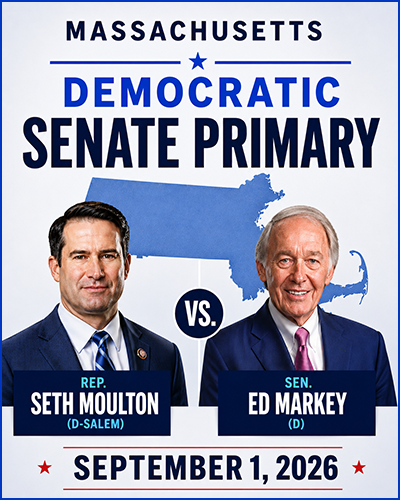
In Massachusetts, six-term Rep. Seth Moulton (D-Salem) is challenging Sen. Ed Markey (D) in the state’s Sept. 1 Democratic primary. While originally thought that Rep. Moulton was making a strange move — considering Sen. Markey had in 2020 defeated a member of the Kennedy family (then-Rep. Joseph P. Kennedy, III) in the latter’s home state, within their own party, and posted a full 10 percentage point margin — another primary challenge seemed a fool’s errand.

Yet, new polling and fundraising data suggests that the Congressman may become a serious challenger. He is one of more than a dozen Democratic younger office holders or activists challenging an elderly incumbent (Sen. Markey will be 80 years old at the time of the election), and willing to make age a campaign issue.

According to the new Federal Election Commission reports, Rep. Moulton surprisingly outraised the incumbent, $1.051 million to $811,000 during Q1 2026. For the campaign, Moulton also leads Markey in cash-on-hand, $3.3 million to $2.5 million.

Polling, while still favoring the incumbent, suggests the race could close. According to the recently released Suffolk University poll (April 9-13; 500 likely Massachusetts Democratic primary voters; live interview) Sen. Markey holds a 47-30 percent lead. While he clearly posts an advantage beyond the polling margin of error, producing a ballot test where an incumbent is under 50 percent within his own party certainly suggests underlying vulnerability.

The Massachusetts primary campaign still has a long cycle, but the early development suggests we will see some meaningful action.

If there is a developing Republican sleeper Senate race, it may be in Minnesota. The GOP has a media savvy candidate in former national sports broadcaster Michele Tafoya, who for more than a decade was the sideline reporter for NBC Sunday Night Football. Prior to joining NBC Sports, she was a game reporter for ESPN. Originally from Minnesota, Tafoya began her broadcasting career in the Land of 10,000 Lakes, so she has been a well-known figure in the state for decades.

After announcing her candidacy in late January, Tafoya has raised over $2 million for her Senate campaign. She is already the consensus Republican candidate and the two top Democrats, Lt. Gov. Peggy Flanagan and Rep. Angie Craig (D-Prior Lake), are likely headed for a contentious primary that won’t be decided until Aug. 11.

The Flanagan-Craig race is likely to reach a boiling point at the Democratic endorsing convention. Flanagan is favored to win the endorsement, and typically Minnesota candidates do not force a primary after the state party delegates choose their candidate. In this race, however, it is likely that we will see a Democratic primary no matter who wins the official party endorsement. Therefore, the hotly contested primary will allow Tafoya to prepare for the general election and pool her expanding money through the beginning of August.

Only one poll of potential general election pairings has been released and that came in February, soon after Tafoya’s formal announcement. Emerson College publicized their survey (Feb. 6-8; 1,000 likely Minnesota voters; multiple sampling techniques) and found Tafoya trailing Lt. Gov. Flanagan and Rep. Craig by seven and six points, respectively, with neither Democrat reaching 50 percent support.

With great unrest in the state considering the ICE controversy and the Minnesota federal grant fraud investigation that will become a top issue in November, and with Sen. Amy Klobuchar (D) running for Governor in what will be a quiet race since the Republicans have little chance, the seeds may be sown for a legitimate general election campaign despite the state’s reliable Democratic voting history.

Six years ago, South Carolina GOP Sen. Lindsey Graham faced a major challenge and saw approximately $145 million spent against him, but he still recorded a 10-percentage point general election victory.

This year, his fight is likely in the Republican primary where businessman Mark Lynch has already put more than $5 million of his own money into the campaign. It is unlikely that this race will develop, but Sen. Graham is taking Lynch seriously. He has already banked $11.6 million for the campaign and is actively advertising throughout the state.

Sen. Graham has issues on his political right, because he has never been a favorite of the MAGA base vote even though he has become an ardent President Trump supporter. Therefore, this is another stealth Senate contest that likely deserves attention in the closing weeks of the primary campaign.

Virginia Redistricting: Yes Vote Wins; Mississippi’s Hyde-Smith’s Tight Race

By Jim Ellis — Wednesday, April 22, 2026

Virginia

Old Dominion voters completed the redistricting referendum voting process yesterday and the “yes” position, as Democratic leaders advocated, scored a victory, but in a closer than expected 51.5 – 48.5 percent margin.

The outcome must be viewed as a Republican leadership strategic misplay. With Democrats dominating the airwaves and using a partisanship strategy, the early spending showed they had an 11:1 advantage.

Republicans countered to an extent, but their effort proved too little, too late. The closeness of the outcome suggests that a better GOP campaign might have delivered a close win.

The referendum result means the state’s congressional map is expected to shift dramatically from the current 6D–5R alignment to a projected 10D–1R configuration. The new map will take effect unless the Virginia Supreme Court, which allowed the referendum to proceed, upholds the lower court ruling that declared the legislature violated its own rules and state electoral procedure in placing the measure on the ballot. Now that the voters have spoken, it becomes even more unlikely that the high court will overturn the referendum that they allowed.

Therefore, we can expect to see Reps. Rob Wittman (R-Montross), Jen Kiggans (R-Virginia Beach), and John McGuire (R-Manakin-Sabot) all become general election underdogs.

The one remaining Republican seat is in southwestern Virginia. It is possible that Reps. Ben Cline (R-Botetourt) and Morgan Griffith (R-Salem) will be paired in a Republican primary. Rep. Cline could also choose to face a Democrat in an adjoining district where he would also be a general election underdog.

Earlier in the year as a result of placing the referendum on the ballot, the Virginia candidate filing deadline was moved to May 26 and the state primary to Aug. 4. Therefore, it remains to be seen what decisions the affected members make regarding where, or if, they will seek re-election.

Mississippi

A newly released April survey from Impact Research suggests that Sen. Cindy Hyde-Smith (R) may be heading into a more competitive re-election environment than expected.

The survey, conducted for the Southern Poverty Law Center Action Fund (April 8-12; 500 likely Mississippi general election voters; live interview & text), sees Sen. Hyde-Smith leading Lowndes County District Attorney Scott Colom, who won the Democratic nomination in March, by a narrow 42-39 percent margin.

Perhaps the most concerning data point for the Senator is her favorability rating. While President Trump scores a personal favorability index of 55:43 within this polling universe, Sen. Hyde-Smith scores a poor 35:55, with a “very unfavorable” data point of 42. Gov. Tate Reeves (R) is also in negative territory with a 43:52 index, but his standing is obviously not as challenging as those reported for the Senator.

The result is surprising since the Senator fared well in the March Republican primary, scoring 81 percent of the GOP vote and obviously winning the nomination outright. In her two general election victories, one a special vote conducted after she was appointed to replace resigned Sen. Thad Cochran (R) in 2018, she averaged a 53.8 victory percentage.

For Democrats to put the Senate majority in play this cycle, they must broaden the competitive map. Should polling like this continue, national Democratic leaders and outside groups who support liberal candidates may begin directing significant resources toward Mississippi.

According to the Q1 Federal Election Commission campaign financial disclosure reports, Colom only has raised $1.6 million and held just under $560,000 in his campaign account, far under the dollar quantity he will need to run an effective statewide campaign.

Conversely, Sen. Hyde-Smith posted just over $5 million raised with a cash-on-hand figure of $2.46 million. Expect these financial numbers for both candidates to grow exponentially.

It is likely that a Republican-aligned poll will soon be released presenting more favorable numbers for Sen. Hyde-Smith. If such polling does not emerge, it may indicate that her internal data aligns with the Impact Research findings.

There is always an unexpected Senate race that comes to the forefront in the general election. We will soon see if Mississippi hosts the 2026 surprise campaign.