Category Archives: Reapportionment

More Redistricting Delays

By Jim Ellis

Jan. 29, 2021 — The Census Bureau announced at mid-week yet another postponement in releasing the national apportionment figures, this time until April 30. Reapportionment should have been completed by Dec. 31, but the Bureau previously announced that March 6 would be the new release date due to COVID-related problems. Now, we see further delays.

Reapportionment is the process of creating a new census data algorithm in order to project the number of congressional seats each state will be awarded for the coming decade. It appears that 10-12 seats could change states, with the northeast and Midwest typically losing districts to southern and western states. This time, however, California, for the first time in history, is reversing their trend and appears headed for the losing list.

Once the apportionment numbers are known and the individual data dispersed, the states can begin the redistricting process. The Census Bureau further stated that individual states won’t be receiving their particular data necessary for redistricting until at least July 30. This will clearly set the redistricting cycle back significantly, which could cause major problems for the coming election cycle.

In the past, the Census Bureau has prioritized the states with early primaries to be first to receive their data. This meant that New Jersey and Virginia initially received their new population numbers ahead of the others because they have odd-numbered year state legislative elections. Texas and Illinois were next to receive since they traditionally schedule their regular primaries in March of the election year.

Knowing that the numbers would not be available for them in 2021, New Jersey and Virginia took preparatory action. Garden State officials placed a referendum on the November ballot asking voters for approval to postpone legislative redistricting until 2023. The measure passed.

The Old Dominion leaders decided they would run their 2021 state Delegate elections on the amended 2011 map but could conceivably call elections again for next year once they receive their updated data and can draw district boundaries. Virginia state senators do not stand for election until 2023, so it is unlikely the redistricting delay will affect those campaigns.

The data distribution and processing delay could place most legislatures in a conundrum. Most will be adjourned when the data is received, so special sessions will have to be called in most cases to complete the process prior to the 2022 candidate filing deadlines. This suggests that the states having redistricting commissions might prove to be in better position to complete the task because they won’t have to deal with legislative politics, priorities, or calendars, all of which result in a lengthy process.

Additionally, since almost every map is challenged in court, we could well see a plethora of lawsuits being filed late in the year that keep the redistricting process tied in figurative knots for months.

The states in the most difficult situations will be those gaining and losing congressional representation. Because the number of districts these particular states will have differ from their current allotments, they do not have the option of reverting to the current map once 2021 apportionment becomes final.

In the case of gainers and losers not having completed maps, we may see at-large races for the House. This would be particularly difficult for the losing states because we may see all members in the affected places having to run at-large for seats in their House delegations.

Unofficially, the gaining states appear to be Texas (3 seats), Florida (2), Arizona, Colorado, Montana, North Carolina, and Oregon. The losers may be New York (possibly 2 seats), Alabama, California, Illinois, Michigan, Minnesota, Ohio, Pennsylvania, Rhode Island, and West Virginia. Reports suggest that the closest developing situation concerns whether Alabama loses a seat or New York drops two.

President Biden’s executive order that mandates non-citizens be counted in the census will certainly affect the final data projections and may be another reason for this latest delay.

The only certainty about 2021 reapportionment and redistricting is the many moving parts in these various states will likely produce surprising political results.


The Losing Regions – Part II

All the best for a great holiday break. The Political Updates will return on Monday, Jan. 4.

A look at how things might play out in key states in the redistricting tug of wars

By Jim Ellis
Dec. 24, 2020 — Continuing our two-part series of examining reapportionment projections for states expected to lose congressional seats, today we look at an additional four states with CDs on the chopping block: Illinois, New York, Ohio, and Pennsylvania.

At this point, it appears a total of ten states are in the losing category. Yesterday, we covered Alabama, California, Michigan, and Minnesota. The remaining two, Rhode Island and West Virginia, are moving to at-large and two district status, respectively, meaning their new maps become obvious.

The new apportionment, originally due at the end of this year but delayed due to COVID, could be released sometime in January.


Illinois

Illinois is a sure loser and one of the few states where the overall population is less (over 158,000 people) according the latest available numbers (July 2019) than registered 10 years ago. Therefore, Illinois is in the rare situation of losing congressional representation not because the population failed to keep pace with the rate of growth, but rather due to the entity actually having fewer people.

This leads to speculation that the state could lose two seats because even in such a scenario the per district population number would be under 800,000 individuals. A two-seat loss would still render the state with a lesser per district total population figure than some of the other states losing one.

All current 18 Illinois CDs need to gain population even under a one-seat loss scenario. Making such calculations we see that the new rudimentary per district population figure would be approximately 745,401 individuals, less than the number projected for most states. Typically, states losing congressional districts feature much higher numbers. This adds to the speculation that the state could drop a second CD.

If the loss is only one, as the current projection formula suggests, the southern part of the state would appear to take the hit. This means that Republicans, while holding only five of the state’s current 18 districts, would likely lose a seat. Aside from Rep. Cheri Bustos’ (D-Moline) 17th District anchored in the Quad Cities region, which has the largest population number to gain, over 79,000 people, the remaining seven of the top eight districts needing a population increase come from the Downstate region.

The figures suggest that combining the five central and southern districts of Reps. Mike Bost (R-Murphysboro), Rodney Davis (R-Taylorville), incoming freshman Mary Miller (R), Adam Kinzinger (R-Channahon), and Darin LaHood (R-Peoria) into four districts would be the most likely scenario unless the Bustos district is collapsed. Considering that the Democrats control the redistricting process, it is probable that the former scenario would be the one adopted.


New York

Like Illinois, New York, while having slightly more people than they did in 2010 (just over 75,000 more according to July 2019 estimated figures), could be on the cusp of losing two seats. Of their current 27 districts, 24 must gain population. Only the seats of Reps. Hakeem Jeffries (D-Brooklyn), Gregory Meeks (D-Queens), and Adriano Espaillat (D-Bronx) are in the position of shedding residents. All others need a population influx even to reach the approximated 748,213 figure that appears be present at this point for a 26-District model.

As in Illinois, a two-seat loss would still keep the per district number at well under 800,000, much less than other states that are projected to lose congressional representation.

Also as in Illinois, the non-urban area looks to need the largest population gain (meaning Upstate, in this case), would contain the area most prone to lose a seat. This means, also as in Illinois, that the party in a small minority, the Republicans, is most likely the one on the chopping block.

Continue reading

The Losing Regions – Part I

By Jim Ellis

Dec. 23, 2020 — With the Census Bureau readying the national apportionment formula to present to the Clerk of the House at some point next month, it is a reasonable time to again look at the states projected to lose congressional districts and begin to determine where a dragging population could cost a region its current representation.

Today, we look at four states projected to lose a district: Alabama, California, Michigan, and Minnesota. Tomorrow, we will examine Illinois, Ohio, Pennsylvania, and New York. Rhode Island and West Virginia are also going to lose seats but because they are two- and three-district states, the new redistricting map becomes obvious, particularly in the former’s case.


Alabama

The Alabama population suggests that it is too small to keep its seventh congressional district, but such makes the remaining six districts very large, likely well over population figures of 800,000 residents apiece. It is an ironic problem for the states losing districts in that the remaining CDs actually become much larger. If Alabama is on the losing end in final reapportionment, the scenario of dropping a district and making the remaining seats much larger will certainly come to pass.

As with all redistricting, those in a corner of a state, i.e., either bordered by another state, body of water, or country are in the best shape because their districts can only expand or contract one or two ways. In Alabama, the 1st and 5th CDs, those of incoming Rep. Jerry Carl (R-Mobile) and Mo Brooks (R-Huntsville) are in the most favorable geographic positions.

The district appearing to lose the most population is Rep. Terri Sewell’s (D-Birmingham) 7th CD, but this is a protected Civil Rights district meaning it must be protected. The seat could need to gain almost 150,000 people according to rudimentary calculations, and the most likely place for the increase comes from Montgomery County at the expense of the 2nd District and possibly the 3rd.

The 2nd District, even when bordered by states on two sides, appears the most vulnerable to collapse. Needing to likely gain over 140,000 individuals before almost certainly losing population to the current 7th District, the collapsing of the 2nd and 3rd Districts into one seat appears to be a potential outcome. This would place incoming freshman Rep. Barry Moore (R-Enterprise) and veteran Congressman Mike Rogers (R-Anniston) in the same district.


California

For the first time in history, California looks to lose congressional representation. In the last census, the state remained constant for the first time. In every previous census apportionment, the Golden State had gained representation. In the 1980 census, for example, California gained seven new congressional districts. Now, it appears they will reduce representation from 53 to 52 seats, but still be the most populous state by a wide stretch.

The region not keeping up with the rate of growth appears to occur in the southern California expanse from Bakersfield through Los Angeles County and portions of Riverside, Orange, and San Bernardino Counties. Such a region covers 18 congressional districts, 16 of which will need to gain population under a rudimentary calculation suggesting that each of the state’s 52 CDs will require approximately 760,000 residents. Of the 18 districts, Democrats represent 15 and Republicans’ three.

Only two of these 18 districts, those of Reps. Brad Sherman (D-Sherman Oaks) and Norma Torres (D-Pomona), are either at or slightly over the approximated population goal.

Continue reading

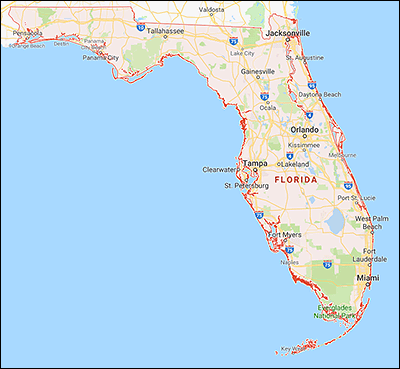
Florida Data

By Jim Ellis

Dec. 18, 2020 — Continuing with our project this week of analyzing statewide data now that official final election results are being published from around the country, today we look at the Sunshine State of Florida, another key redistricting state.

Though having only three-quarters of Texas’ population, the Florida presidential turnout came within only a few hundred to equaling that of the Lone Star State (FL: 11,067,366; TX: 11,315,056).

On the statewide tally, President Trump carried Florida with a 51.2 – 47.5 percent margin over former vice president Joe Biden. The result represents a net 2.2 percentage increase for the president when compared with his 2016 statewide total, while Biden’s performance registered a decline of 0.3 percent from Hillary Clinton’s Sunshine State aggregate vote.

The House performance detected in California and Texas, showing that the average victorious congressional candidate performed better within their particular district than President Trump, was not nearly as pronounced in Florida.

On average, Texas US House Republican candidates ran 2.8 percentage points better than Trump, and the average California GOP House candidate ran 4.2 points ahead of the president’s statewide percentage. In Florida, however, the number was virtually equal to the president’s, with the average House Republican contender running just 0.2 percent above Trump’s statewide total.

Because two of the Republican incumbents, Reps. Neal Dunn (R-Panama City) and Mario Diaz-Balart (R-Miami/Hialeah), ran either without Democratic opposition (Dunn) or totally unopposed (Diaz-Balart) the Florida Secretary of State does not record votes in such a district. Therefore, for purposes of this exercise, a projected result of 65-35 percent for the two congressional districts was added as an estimated total. This percentage spread was extrapolated when comparing the performance of Republican and Democratic congressional candidates in similar Florida districts.

To review, in California, Democratic House incumbent performance fell below their 2018 recorded vote in 33 of 44 districts, while results improved for four of the six Republican incumbents on the ballot. In Texas, vote percentages for 11 of the 16 Republican incumbents seeking re-election improved from 2018, while the Democratic incumbent performance index declined for all 13 who ran for a succeeding term.

Continue reading

Texas Data

By Jim Ellis

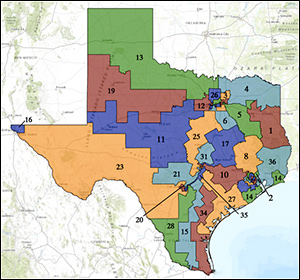
Texas US House Districts

Dec. 17, 2020 — Yesterday, we analyzed the California official 2020 Statement of the Vote and today we turn out attention to voting statistics from the Lone Star State of Texas, a particularly interesting domain for the coming redistricting process. Estimates project that Texas will gain three congressional districts from reapportionment, which should become official at some point in January.

Despite predictions of a “blue wave” hitting Texas and putting the state in play for Joe Biden, Republicans once again swept the competitive races. Though President Trump’s margin did decline from 2016, his 52-46 percent margin was still more than comfortable, especially when considering he was simultaneously losing the nationwide vote.

As was the case in California, down-ballot GOP candidates, as a rule, performed better than President Trump. Sen. John Cornyn (R) was re-elected, and the GOP won 23 congressional races in the state, accounting for almost 11 percent of their party’s national total.

Sen. Cornyn topped 53 percent of the vote in recording a nine-point win over his Democratic opponent, retired Army helicopter pilot M.J. Hegar. In the 23 victorious Republican House races, the winning GOP candidate outpaced President Trump in 19 districts most of which were competitive at least to a degree.

Compared with the Democratic improvement in elections two years ago, the GOP rebounded in 2020. A total of 16 Republican incumbents sought re-election, and 11 of those improved their vote percentages from 2018. Additionally, all five of those falling below their previous benchmark did so by less than one percentage point.

For the Democrats, all 13 of their House incumbents saw a downgrade in their voter support from 2018. Rep. Henry Cuellar (D-Laredo), who fought off a tough Democratic primary challenge in early March, saw the biggest drop for any Texas House incumbent, falling from 84.4 percent in 2018 to a 58.3 percent win in November. The more serious drop, however, was for Rep. Vicente Gonzalez (D-McAllen) who won re-election to a third term from his South Texas district with just 50.5 percent of the vote against an opponent who spent only $404,000. Gonzalez’s victory percentage slipped from 59.7 percent in 2018.

The TX-15 district is largely a Mexican border seat that starts just east San Antonio in the Seguin area and travels south all the way through the city of McAllen in Hidalgo County. The latter entity hosts three-quarters of the 15th District’s population. Republicans, including President Trump, improved their standing throughout the Mexican border area in the 2020 election, which was a principal reason that Democratic gains in the Dallas, Houston, Austin, and San Antonio metropolitan areas were somewhat offset.

Statewide turnout was up a strong 23.7 percent when compared to 2016, enabling the state to exceed 11 million voters (11,315,056) for the first time. The Texas population grew 3.9 percent during that same time interval.

Continue reading

COVID & Redistricting

By Jim Ellis

April 29, 2020 — The deadline for the Census Bureau to release the new population data is March 31, 2021, but with the entire process being delayed due to COVID-19 precautions, the ability to meet the requirement is becoming more difficult by the day. Already, the Bureau has been delayed in dispatching their door-to-door teams necessary in obtaining the responses from people who did not return their mail tabulation form.

The Trump Administration is reportedly suggesting that the March 31 deadline be postponed to sometime in the summer of 2021. If this happens, we will see a series of redistricting problems ignited in the states. First, the political leaders in New Jersey and Virginia, places that have 2021 elections and need their new state legislative lines in place well before that date, would find themselves in a difficult position.

Initially, the two states would certainly have to postpone their primary elections because both nominate their general election candidates in June. Beyond that, it is possible they would have to even postpone their general elections into 2020 or run in the obsolete boundaries that were drawn back in 2011. In either case, we could expect lawsuits being launched from whichever party loses a particular electoral contest.

Other states would be affected, too. Many have legal deadlines in place mandating that the new redistricting maps for state legislature and the US House delegation be adopted before the legislative sessions ends. Most states recess before mid-summer, which would mean special sessions being called if the legislature is to act.

The problem intensifies in the states that are either gaining or losing congressional districts in reapportionment. Currently, it appears that seven states will add seats to their delegations (the best projections suggest that Texas will gain three, Florida two, and Arizona, Colorado, Montana, North Carolina, and Oregon one apiece), while 10 will lose single districts (Alabama, California [for the first time in history], Illinois, Michigan, Minnesota, New York, Ohio, Pennsylvania, Rhode Island, and West Virginia).

The aforementioned apportionment is based upon calculations released publicly and not, of course, using the actual numbers. Therefore, we could see some differences between these projections and what the formulas actually produce when the Census Bureau finally can produce the updated real figures.

Continue reading

New House Census Projections

By Jim Ellis

Jan. 3, 2020 — The Census Bureau just released its new population growth estimates for the 12-month period between July 1, 2018 and July 1, 2019. Their data allows us to assess just which states will likely gain and lose congressional districts in 2020 reapportionment, both in terms of the real numbers just presented and for projecting the final count once the decade’s final-year patterns are calculated and the census is actually conducted.
The national population growth rate was analyzed to be 0.5 percent, down from the peak period of the decade, the July 1, 2014 through July 1, 2015 time segment, when the growth factor reached 0.73 percent. The population patterns of movement to the south and west continue, with the northeast actually seeing a population decrease during the aforementioned reported 12-month period that ended on July 1. The Midwest is not keeping up with the national rate of growth, either, but not losing overall population.

Ten states actually lost population during the reported period, led by West Virginia’s 0.7 percent drop. Alaska declined by 0.5 percent, with New York and Illinois each losing 0.4 percent. Hawaii dropped by 0.3 percent, Connecticut, Louisiana and Mississippi 0.2 percent, and Vermont (0.1 percent). New Jersey is the tenth population reduction state, but it lost only 3,835 people from a population of more than 8.9 million individuals for a 0.0004 percent decrease.

The fastest growing states at this point in the decade are Idaho (2.1 percent since July 1, 2010), Nevada, Arizona, and Utah (all at 1.7 percent increase during the same period), Texas and South Carolina (1.3 percent), Washington and Colorado (1.2 percent), Florida (1.1 percent), and North Carolina (1.0 percent).

Continue reading

A Pennsylvania Gerrymander or Not?

By Jim Ellis

Feb. 4, 2019 — As more final voting data becomes available about the 2018 electoral patterns, new local analysis articles are being distributed that allow us to better understand why the results unfolded as they did.

Emily Previti published a piece for Pennsylvania’s Keystone Crossroads media site at the end of last week that details just how the congressional outcome might have changed if the state Supreme Court had not altered the Pennsylvania federal map.

The Pennsylvania high court ruled about a year before the last election that the 2011 redistricting legislative package was a political gerrymander in relation to the state’s constitution. The court then instituted new boundaries for the 2018 and 2020 elections, designed to bridge the gap until the next census, reapportionment, and redistricting processes begin again.

The court majority reasoned that the previous congressional map routinely yielding a 13R-5D congressional result was out of sync with a statewide electorate that usually favors Democrats, among other reasons. Yet, according to the Previti article, such may not have been the case.

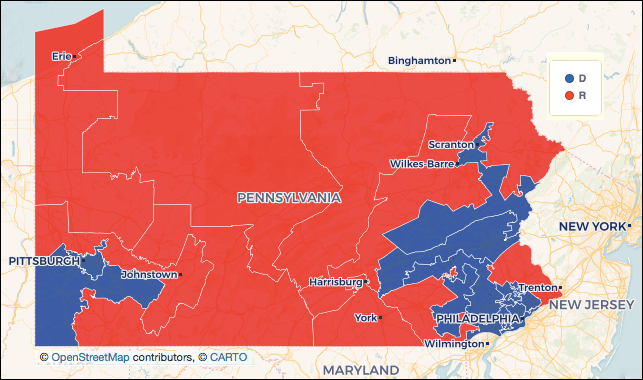
Click on above map to see full story and interactive map at the Keystone Crossroads media site.

After overlaying the new court-imposed 18-district congressional map (above) that returned a 9R-9D result from the previous 12R-6D delegation split (the division changed when Democrat Conor Lamb won an early 2018 special election in a previously Republican 18th CD), Previti concludes that the same 9-9 split we see today may well have occurred even under the previous map.

Continue reading

Projecting Apportionment

By Jim Ellis

Dec. 7, 2018 — New population growth numbers are now available from the Census Bureau, allowing us to gain more clues about how the coming 2020 post-census apportionment might look for the nation’s congressional districts.

Every 10 years, states gain and lose CDs based upon their total population and percentage growth figures. The current US population of 327,774,453 represents a growth rate of 5.96 percent when compared to 2010.

Currently, Idaho is the fastest growing state for 2018, with a gain of 2.15 percent for the current year, the only state to break the two percent barrier for the period. Nevada (1.96 percent), Utah (1.85 percent), Washington (1.69 percent), and Florida (1.56 percent) round out the top five.

The group constituting the bottom half of the top 10 in 2018 growth contains Arizona (1.53 percent), Texas (1.41 percent), Colorado (1.37 percent), Oregon (1.37 percent), and South Carolina (1.28 percent).

On the other hand, eight states, led by Wyoming (-0.97 percent), actually lost population during the year. The others are West Virginia, Illinois, Alaska, Hawaii, Mississippi, Louisiana, and North Dakota.

Continue reading

Gainers and Losers in 2017

By Jim Ellis

Jan. 3, 2018 — The Census Bureau just released their year-end population estimates and we again see a familiar pattern with regard to populace ebbs and flows. People are continuing to relocate south and west, while the Midwest and northeast fail to keep pace.

Eight states in the Great Lakes, northeast, and Midwest are again projected to see their congressional representation reduced, while the south, Pacific Northwest, and Rocky Mountain sectors will likely elect additional House members.

Idaho in Nation's Fastest-Growing State[Source: U.S. Census Bureau]

As always, there are quirks within the population numbers. While Idaho was the fastest growing place with a 2.2 percent increase in total population during this calendar year, the Gem State will again be nowhere close to gaining a third seat for its congressional delegation. Nevada, which added a fourth district in the 2010 reapportionment, is the second-fastest growing state with a 2.0 percent increase, but it doesn’t appear the trends will be sufficient for them to gain a fifth seat in the 2020 distribution. It is very difficult for the small states to gain or lose districts, as the Idaho and Nevada numbers demonstrate.

Though Idaho had the fastest growth rate, Texas saw the greatest raw number resident increase. From the beginning of 2017, the Lone Star State population grew by just under 400,000 people. Florida was second with more than 327,000 new individuals now living there, while California saw their populace grow by more than 240,000 people. Washington, North Carolina, Georgia, and Arizona all had increases between 125,000 and 107,000 people, respectively.

Continue reading