Category Archives: Primary

Ohio Entering Home Stretch

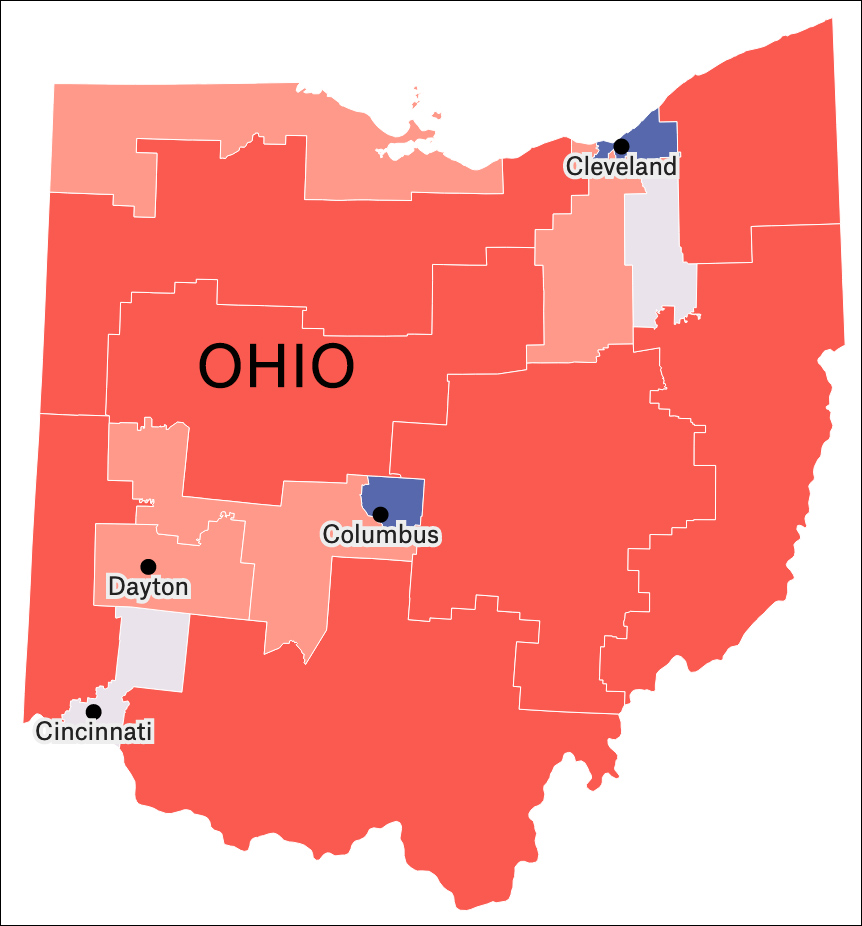
Ohio redistricting map in question (click on map above or here to go to FiveThirtyEight’s interactive map)

By Jim Ellis

April 18, 2022 — We’re on the threshold of entering the final two weeks before the Ohio primary on May 3, and the candidates for all offices are swinging into high gear just as the state Supreme Court rejected another set of redistricting maps.

The state House of Representatives and Senate primaries having been postponed, because the legislature and state Supreme Court cannot find common ground pertaining to the new district lines; no new primary date has been set. Late last week, for the fourth time, the judicial body rejected the legislature’s draw for their own political boundaries in both chambers. Since the Ohio Constitution does not give the courts the authority to draw maps, all the justices can do is return the plans to the legislature and order them to begin yet again.

News is occurring in the races that are headed toward nominations. The new Remington Research Group US Senate GOP primary survey (April 11-12; 884 likely Ohio Republican primary voters, interactive voice response system) finds former state treasurer, Josh Mandel, forging back into the lead and state Sen. Matt Dolan (R-Chagrin Falls), a minority owner of the Cleveland Guardians MLB franchise, moving into contention.

The statewide GOP primary ballot test finds Mandel leading the pack with 23 percent as compared to businessman Mike Gibbons’ 17 percent, Sen. Dolan’s 15 percent, former Ohio Republican Party chair Jane Timken posting 12 percent, and author J.D. Vance trailing at 10 percent.

Reports suggest that an endorsement coming for Vance from former President Donald Trump is imminent. If so, the polling standings will change. Remington posed a second ballot test question to the current respondent pool asking how they would vote if knowing Trump had endorsed Vance. While Mandel would still lead, his edge shrinks to 19 percent; Gibbons, Dolan, and Vance would bunch together at 15 percent; and Timken drops to 11 percent.

If the reports of Trump endorsing Vance prove true, the Remington poll suggests that such a move would likely change the race’s flow. The Trump involvement in such a manner appears to make a close contest even closer.

The Remington survey is the tenth poll taken of the Republican Senate primary since the beginning of February. Gibbons has led in six of them and Mandel three, with one showing a three-way tie among the two aforementioned men and Vance. The fact that all five of the key candidates, at one time or another, have been within shouting distance of the lead suggests that any one of them could catch a flyer at the end and propel themselves into a nomination victory with a small plurality.

On the Democratic side, US Rep. Tim Ryan (D-Warren/Youngstown) appears to be cruising toward an easy nomination victory against former Consumer Financial Protection Bureau official and 2020 failed congressional candidate Morgan Harper.
Continue reading

Budd Laps McCrory in N.C.

By Jim Ellis

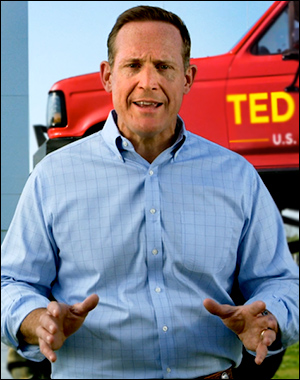
North Carolina Rep. Ted Budd (R-Advance)

April 14, 2022 — Just a month ago, some analysts and activists were questioning North Carolina Rep. Ted Budd’s (R-Advance) US Senate campaign even to the point where speculation was building that former President Donald Trump was about to pull his endorsement.

The tables have rapidly turned.

The fifth consecutive statewide survey was published Tuesday showing Budd leading former Gov. Pat McCrory as the two begin the final month of campaigning prior to the May 17 Republican primary.

Survey USA published their latest study (April 6-10; 593 likely North Carolina Republican primary voters, online) projecting Rep. Budd to a 33-23-7-2 percent advantage over McCrory, former US Rep. Mark Walker and author Marjorie Eastman. Since March 22, four other pollsters have published similar numbers. The McCrory camp has yet to counter with different figures.

Vitale & Associates was the first since early January to find Budd leading the race, a 32-29 percent margin over the former governor according to their March 22-23 survey of 504 North Carolina Republican primary likely voters.

The margin started gelling for the Budd campaign this month when three successive surveys gave the congressman double-digit leads. Cygnal, Emerson College, and WPA Intelligence — all published just before the new Survey USA study — staked Rep. Budd to leads of 11, 16, and 13 percentage points, respectively, in their polls conducted between April 1-5.

The turnaround is not particularly surprising. In relation to the Trump endorsement, early polling consistently showed the political horse race changing when the respondents were informed that the former president supported Budd. Though trailing McCrory in the initial ballot test, the fact that the two candidates flipped just on the knowledge of Trump’s endorsement was an early indicator that the former governor and fourteen-year Charlotte mayor held underlying political weaknesses.

The other clue suggesting McCrory could potentially collapse was the fact that 35 percent was his high-water mark in any of the 12 surveys results released since Jan. 5 and he only averaged 27.7 percent in those dozen polls. This, for a former governor before his own political party.

Continue reading

Iowa Senate: Finkenauer Disqualified

By Jim Ellis

Former US Rep. Abby Finkenauer (D)

April 13, 2022 — An Iowa district judge rejected former US Rep. Abby Finkenauer’s (D) signature petitions late Sunday night, thus disqualifying her from the Democratic primary ballot. It appeared that she was the party’s early front runner to challenge Sen. Chuck Grassley (R) in the general election.

Under Iowa law, a statewide candidate must submit 3,500 valid registered voter signatures to obtain ballot position. A side requirement is that at least 100 signatures must come from a minimum of 19 individual counties, and it is here where Finkenauer came up short. While filing more than 5,000 signatures statewide, the qualification came down to two of her 19 counties where all but the bare minimum number were rejected outright.

The State Objection Panel, comprised of two Democratic statewide officials and one Republican, had approved the petitions, but Polk County District Judge Scott Beattie said the body was wrong for ignoring the full legal requirements. Three signatures from the two counties in question lacked the date of signature, which is a clear requirement under the Iowa procedure. Republicans then filed their legal challenge arguing that the Objection Panel did not fully adhere to the law.

Judge Beattie agreed, and wrote that though the “court takes no joy in this conclusion,” he had no choice but to enforce the letter of the law.

Finkenauer immediately claimed the judicial ruling was partisan in nature because Judge Beattie is a Republican. She said his decision is a “massive gift to Washington Republicans,” according to the Des Moines Register newspaper.

She then launched an appeal to the state Supreme Court. The Secretary of State, however, has said he has to see a ruling overturning the decision, if such is to be rendered, before April 15 in order to satisfy the national MOVE Act requirements, which mandates notice of an election at least 45 days prior for overseas and military voters. The Iowa primary is June 7. Therefore, if the Court proceeds with their review, it will have to act within the next couple of days.

It is not yet known what amount Finkenauer raised during the year’s 1st quarter, but she had already obtained more than $1.9 million in contributions prior to 2021 ending. Of that, she reported more than $723,000 in the bank at the Dec. 31 reporting deadline.

Continue reading

Ohio Numbers Crunched

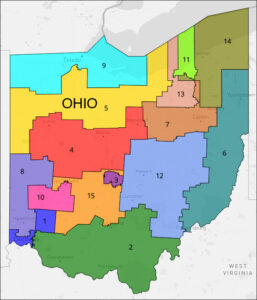
Ohio 2022 Congressional Redistricting map. Click on image to go to FiveThirtyEight’s fully interactive map.

By Jim Ellis

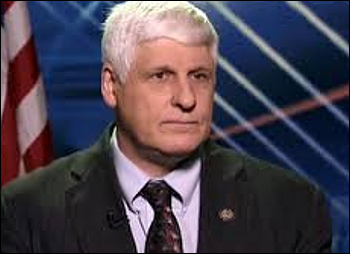
April 11, 2022 — When Ohio Rep. Bob Gibbs (R-Lakeville) announced the suspension of his re-election campaign on Wednesday, it brought some national attention to what has become a Buckeye State redistricting debacle.

Gibbs called out the Ohio State Supreme Court for allowing the replacement congressional district map to languish in political limbo after they rejected the first iteration for excessive political gerrymandering. Though congressional candidate filing was delayed until March 4 from the original Feb. 2 deadline in association with the state’s May 3 primary, the court still took no action toward finalizing a new map. Therefore, candidates were forced to file for districts that may or may not change before election day.

When the Ohio state high court finally informed the Democrat plaintiffs who were challenging the map that the decision regarding the first map constituted the final ruling, the complaint process had to rewind, beginning with a new lawsuit. Now filed, it is apparent that first judicial action on the new challenge is still months away. Therefore, the replacement map appears set for the 2022 elections, at least through the nomination process.

That finally being the case, we can now look at what is becoming a relatively competitive map for the upcoming general election.

Ohio loses a seat, therefore a new congressional map must be in place for the 2022 elections, otherwise all 15 US House contests would be decided on a statewide basis.

The state will now feature two open seats, Gibbs’ 7th CD and the newly configured open 13th District that Rep. Tim Ryan (D-Warren/Youngstown) is vacating to run for US Senate. Two new House members, Reps. Shontel Brown (D-Warrensville Heights/Cleveland) and Mike Carey (R-Columbus), who were both elected in November 2021 special elections, will stand for full terms this year.

Of the 13 incumbents seeking re-election, two, Reps. Steve Chabot (R-Cincinnati) and Marcy Kaptur (D-Toledo) — the latter being the fourth longest-serving member of the House who was first elected in 1982 — find themselves in toss-up general election situations.

In Rep. Chabot’s 1st District, which covers much of greater Cincinnati, the FiveThirtyEight data organization rates the seat as a D+3. Dave’s Redistricting App largely agrees, finding the average Democratic vote over a historical set of races registering 49.91 percent as opposed to 47.93 percent for Republicans. Already, the general election is largely set with Rep. Chabot seeking re-election and the Democrats having a consensus candidate is Cincinnati City Councilman Greg Landsman.

Rep. Kaptur sees the Cleveland portion of her district redacted, meaning her Toledo-anchored seat now features an even mix between Democrats and Republicans. The FiveThirtyEight group rates Kaptur’s new 9th CD at R+6, but Dave’s Redistricting App sees this seat differently. According to the party averages over the course of past political contests, the Democratic vote is 48.77 percent, as compared to a virtually even percentage for Republicans, 48.63.

Rep. Kaptur has no Democratic primary opposition, but four Republicans have filed, two of whom would be significant general election contenders. They are state Sen. Theresa Gavarone (R-Bowling Green) and state Rep. Craig Riedel (R-Defiance). It is likely that one of these two will advance into the general election and make the OH-9 general election campaign one of the most hotly contested in the nation.

Continue reading

Ohio Rep. Bob Gibbs Suspends Campaign for Re-election

By Jim Ellis

Ohio Rep. Bob Gibbs (R-Lakeville) to retire.

April 8, 2022 — Expressing frustration with the Ohio courts and constituent complexion of his new district, six-term Buckeye State Rep. Bob Gibbs (R-Lakeville) on Wednesday surprisingly became the 22nd Republican US House member who has decided not to seek re-election.

This retirement announcement is different from all the others — 31 Democrats have also made public their decision to leave the House at the end of the current session — because Gibbs had filed for re-election and Ohio early voting has already begun.

Lashing out at the state Supreme Court that has delayed for weeks in providing 2022 candidates a clear direction with regard to the redistricting maps, Gibbs said in his retirement announcement statement, “It is irresponsible to effectively confirm the congressional map for this election cycle seven days before voting begins, especially in the Seventh Congressional District, where almost 90 percent of the electorate is new and nearly two-thirds is an area primarily from another district, foreign to any expectations or connection to the current Seventh District.”

Rep. Gibbs has a valid point about the state Supreme Court. After rejecting the original congressional map under partisan gerrymandering reasoning, the legislature returned a second map, and the court did not render a decision, even after again rejecting the alternative version maps for the state House and Senate. Therefore, the congressional incumbents and candidates have been languishing for weeks not knowing precisely the location of the new district lines, and long past the candidate filing deadline that occurred on March 4.

The court justices then informed the Democratic plaintiffs regarding their lawsuit challenging the congressional lines, after waiting for several weeks with no action, that the original decision on the first map constituted their final ruling, thus the plaintiffs would have to file a new lawsuit for them to consider further arguments to the second plan. The Democratic plaintiffs did file again, but even preliminary action of any kind is reportedly now months away. Hence, the second map is, at least for now, in place for the 2022 election cycle.

The court and legislature were also in a battle over whether the high court even has jurisdiction to order new maps. Under the Ohio Constitution, the courts do not have authority to draw new redistricting maps. They may only remand any rejected map back to the legislature. Thus, the continuing saga of 2022 Ohio redistricting.

Considering Gibbs’ late withdrawal, Secretary of State Frank LaRose (R) immediately announced that the congressman’s name cannot be removed from the ballot, and any vote cast for him would now not be counted. The move puts former Trump White House aide and Marine Corps veteran Max Miller in the favorite’s position for the Republican primary.

Continue reading

Redistricting News – Ohio; Florida

By Jim Ellis

March 31, 2022 — Two long awaited key redistricting situations became clearer Tuesday, as the important electoral states of Ohio and Florida took action. While the Ohio congressional plan may finally be set for this election, the Sunshine State map, while still not close to finalization, is trending toward resolution.

Ohio

Click on map or here to go to: Interactive Ohio Congressional Redistricting map.

The state of Ohio has had the rockiest redistricting path this year, as the legislature and state Supreme Court have been passing and rejecting congressional and state legislative district maps since early in the year.

Last week, the high court, from which people were waiting for a new decision over the congressional map before them for several weeks, surprised the Democratic plaintiffs by informing them that they would have to file a new lawsuit. The justices explained that they had already issued a final ruling on the first map, hence the process would have to begin again with this second installment.

It now appears that the legislature-passed congressional map currently before the court will be used for the 2022 election. The briefing schedule was set for the new lawsuit, but the submission deadline is two months beyond the state’s May 3 primary. Therefore, the new congressional map looks to remain in place for 2022.

The new map would create a swing open 13th District south and east of Cleveland that would likely have been where Rep. Tim Ryan (D-Warren/Youngstown) would have run for re-election had he stayed in the House. On this map, the other member not seeking re-election, Rep. Anthony Gonzalez (R-Rocky River), would have been paired with GOP Rep. Bob Gibbs (R-Lakeville) in a new strongly Republican 7th District that encompasses the western Cleveland suburbs.

The two incumbents in the most competitive situations are Reps. Steve Chabot (R-Cincinnati) and Marcy Kaptur (D-Toledo) who both will face electorates favoring Democrats.

The lawsuit against the congressional map could well move forward during the latter part of this year, but any changes resulting from related legal action would likely mean a new draw for the 2024 election. After a string of favorable congressional map court rulings for Democrats, the lack of further judicial action in Ohio looks to benefit the Republicans, at least for the short term.

Continue reading

House Candidates File in Two Competitive States

By Jim Ellis

Candidate filings have closed in both Nevada and Iowa.

March 23, 2022 — Though both are only four-district congressional states, Iowa and Nevada will both host a large number of highly competitive US House races this year, and now the candidates have filed.

The Senate races in both states are already well defined and will come to a head in the general election. In Iowa, Sen. Chuck Grassley (R) is on the ballot for an eighth term having been first elected in 1980, and it is clear that he will face former US Rep. Abby Finkenauer (D) in the general election.

In Nevada, first-term Sen. Catherine Cortez Masto (D) defends her seat most likely against former Attorney General Adam Laxalt (R), but he must first deflect a credible Republican primary challenge from businessman and disabled Afghan War veteran Sam Brown.

The Hawkeye State House races feature only one safe member, freshman Randy Feenstra (R-Hull/Sioux City). The other three races will again host tight campaigns as they did in 2020, which of course includes Rep. Mariannette Miller-Meeks’ (R-Ottumwa) six-vote victory.

In the new 1st District, Miller-Meeks will again campaign in a district not much different than the 2nd District that she carried by the slimmest of margins in the last election. She won’t again face former state Sen. Rita Hart (D), however. Despite coming agonizingly close to victory in 2020, Hart declined to seek a re-match this year. Democrats only filed one candidate, so state Rep. Christina Bohannan (D-Iowa City) and incumbent Miller-Meeks will compete in a venue that is likely to yield another close finish.

Rep. Ashley Hinson (R-Marion/Cedar Rapids), who knocked off then-Rep. Finkenauer in what was Iowa’s 1st District, finds herself in a slightly more Republican 2nd District. Like in the new 1st CD, the Democrats filed only one candidate. In this seat, the Democrat nominee will be state Sen. Liz Mathis (D-Hiawatha) a former news anchor at the same television station where Hinson also reported the news. The new 2nd rates as R+6 according to the FiveThirtyEight data organization.

In the Des Moines-anchored 3rd CD, Rep. Cindy Axne (D-Des Moines) has won two plurality victories and looks to face another difficult re-election campaign in a seat that rates R+2. State Sen. Zach Nunn (R-Bondurant) looks to be the strongest Republican of the three GOP contenders and is the favorite to win the nomination. This will become a top national Republican conversion opportunity.

Not previously mentioned as a potential candidate against Nevada Rep. Dina Titus (D-Las Vegas) in a new 1st District that is much more Republican, former 4th District Congressman Cresent Hardy (R) filed at the deadline on Friday to officially enter the race.

Rep. Titus has expressed displeasure at the configuration of her new district that FiveThirtyEight calculates went from a current D+22 rating to a D+4 under the new plan. Dave’s Redistricting App finds the average 1st CD Democratic vote at 52.6 percent and the Republican percentage at 42.3 percent. This is considerably better than the seat where Titus averaged 62.1 percent in the five elections conducted during the previous decade.

As many as four other Republicans may qualify for the primary ballot, but Hardy appears to be the most formidable of the contenders. The new 1st District contest, in a CD that encompasses part of Las Vegas before moving south to include the cities of Henderson and Boulder City, will become competitive in the fall but is still an uphill battle for any Republican nominee.

Frequent candidate Danny Tarkanian (R), who last year was elected to the Douglas County Commission after a long string of electoral defeats, is again running for Congress. This will be his fourth quest for the US House in a third different district, on top of two Senate races. Previously, he lost a pair of campaigns in the 3rd CD and one in the 4th District.

Continue reading