Category Archives: NORTH CAROLINA

Electoral College — Left Coast, Right Coast; Republicans Choose Nominee in VA-4; North Carolina Supreme Court Rejects Map

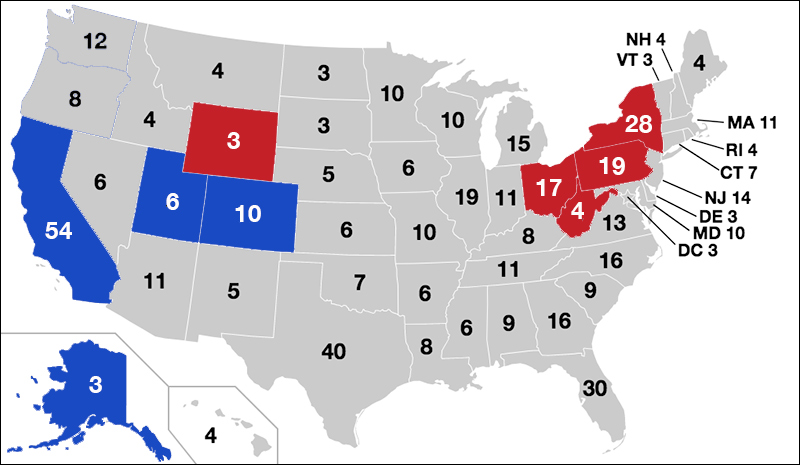
Electoral College Votes Per State, 2022 — blue moving more left, red moving more right


By Jim Ellis — Tuesday, Dec. 20, 2022

President

Electoral College: West Moving Left, East Moving Right — The researchers at the University of Virginia’s Center for Politics have completed a study regarding the country’s ideological shift during the past 20-plus years. Tracking all 50 states’ presidential votes from the 2000-2020 elections, we first see all of the western states now voting Democratic in greater percentages with the exception of Wyoming. The biggest shifts came in Alaska, California, Colorado, and Utah, though two of those four states still regularly produce at least smaller majority or plurality Republican victories.

Conversely, the south and east have trended more Republican with the strongest swings generally occurring in central south with only Maryland, Rhode Island, Vermont, and Virginia becoming more Democratic. Mid-Atlantic states such as New York, Ohio, Pennsylvania, and West Virginia have moved decidedly more Republican, though two of these four continue to regularly deliver clear Democratic majorities. Remaining constant in their voting pattern during this entire 20-year span are Illinois, Maine, Massachusetts, Minnesota, and South Carolina.

House

VA-4: Republicans Choose Special Election Nominee — Republicans re-nominated their 2020 and 2022 candidate in the Saturday, Dec. 17 “firehouse primary” through Ranked Choice Voting. The local 4th District Republican Party leadership did not release the actual results, only to say that pastor and US Navy veteran Leon Benjamin had defeated former Mecklenburg School Board member Dale Sturdifen, and non-profit advocacy organization director Derrick Hollie. Benjamin now advances to the Feb. 21 special general election to replace the late Rep. Donald McEachin (D-Richmond). He will again be a decided underdog in a district that the FiveThirtyEight data organization rates D+30.

The Democratic firehouse primary will be held today. Four candidates filed to run: state Sens. Jennifer McClellan (D-Richmond) and Joseph Morrisey (D-Richmond), former state Delegate Joseph Preston, and businessman Tavorise Marks. While the special election will be held in late February, Gov. Glenn Younkin’s (R) call required the parties to choose nominees by Dec. 23.

In another development, Colette McEachin, the late congressman’s widow, announced her endorsement of Sen. McClellan, joining most of the Virginia Democratic establishment who has already done so.

States

North Carolina: NC Supreme Court Tosses State Senate Map — The North Carolina state Supreme Court, with the 4-3 Democratic majority on the cusp of expiring, rejected the NC Senate map on a partisan vote as a partisan gerrymander. But, the action is likely to be short-lived and adds fuel to the speculation that the new legislature will re-draw all of the state’s redistricting maps after commencement. Doing so may well render moot the partisan gerrymandering case that the US Supreme Court recently heard.

Under North Carolina legislative procedure, the governor has no veto power over redistricting legislation, so whatever the legislature passes will become law. Because of the current court’s farewell action, the state Senate map must be re-configured. Since Republicans gained two seats on the state Supreme Court in the November election and will have a 5-2 majority beginning in January, the likelihood of not only the Senate map being redrawn but also the state House and congressional delegation plans is greater. The latter two maps are court-drawn interim placeholders, which the legislature can replace at any time.

North Carolina Redistricting Again Front and Center: A Deeper Dive

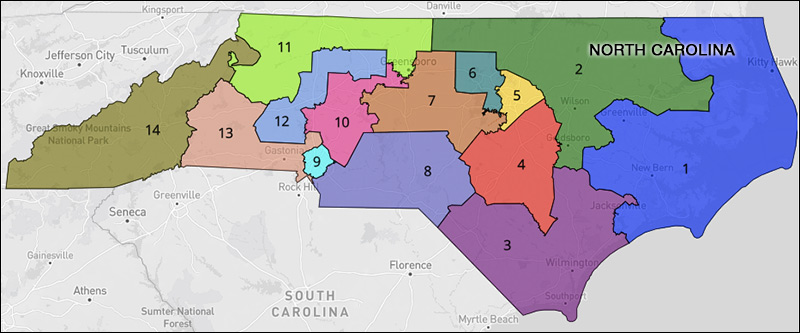
North Carolina Congressional District Plan Court-Ordered in 2022, used for the 2022 election (click on map to go to the state’s interactive map)


By Jim Ellis — Friday, Dec. 9, 2022

Redistricting

North Carolina: Redistricting Under Scrutiny — During the past decade, no state has been forced to draw more redistricting maps than the Tar Heel State of North Carolina. Since the 2010 census, the Republican legislature and the Democratic state Supreme Court have gone back and forth over what is a partisan gerrymander or a legal district.

The North Carolina partisan gerrymandering case was heard before the US Supreme Court on Wednesday, and it is a potential landmark case — but some North Carolina state political sources suggest the arguments may go by the proverbial wayside. The high court will rule before the end of June, but before such a decision is rendered the new North Carolina legislature may draft updated redistricting plans for the US House, state Senate, and state House of Representatives. Since the current set of court maps are only interim plans, the legislature can replace them with permanent draws at any time. 

One of the Republicans’ more important victories in the November election was winning a majority on the North Carolina state Supreme Court. Now, with five Republican justices and two Democrats, many in the legislature believe the time will be right to craft new redistricting maps, plans they believe will this time pass legal muster through a different and more favorable state Supreme Court. 

If this occurs as described, and new maps are enacted – remember, in North Carolina, the governor has no veto power over redistricting legislation – it is possible that the action could render as moot the case before SCOTUS. If so, the issue of whether the Constitution views state legislatures as solely independent when handling redistricting could well go unanswered.

The North Carolina state Supreme Court rejected the Republican legislature’s plan again last year. Under that draw, which the court deemed a partisan gerrymander, the Republicans could have won 10 of the state’s 14 congressional districts. North Carolina was one of the states that earned a new seat in national reapportionment. Therefore, a 10-4 split would have meant a net gain of three Republican seats when compared to the previous court map upon which the 13-member NC congressional delegation had last run.

Instead, under the state Supreme Court’s draw, the new Tar Heel State delegation features seven Democrats and seven Republicans. The map awarded the new 14th District to the Charlotte area as a safe D+11 seat according to the FiveThirtyEight data organization calculation. State Sen. Jeff Jackson (D-Charlotte), who was originally a 2022 candidate for the US Senate, won the new district with an easy 58-42 percent victory.

The other seat to go Democratic was the created open 13th CD, located in the south Raleigh suburbs that stretched to include the Democratic city of Fayetteville. The court balanced the district by adding Republican Johnston County. FiveThirtyEight rated this seat R+3, but Democratic state Sen. Wiley Nickel (D-Raleigh) defeated Republican Bo Hines by a 51.6 – 48.4 percent margin.

The other major affected area that changed between the original Republican map and the state Supreme Court’s draw was the Greensboro-anchored seat of Rep. Kathy Manning (D-Greensboro). Under the Republican plan, this district would have favored a Republican candidate, and Rep. Manning would have had a difficult run for re-election. The Court altered this seat, too, thus giving Rep. Manning an even better district than the one to which she was originally elected — a 6th District seat now rated as D+9.

If the congressional map is in fact re-drawn early in the new state legislative session, we can expect these geographic areas again to be the most affected. If the Republican legislative leaders make a move to finalize permanent redistricting maps, then it might be some time before the issue of independent state legislatures relating to redistricting again comes before the high court. 

Or, if SCOTUS still issues a ruling on the North Carolina case irrespective as to what the legislature does, it could force even further changes in what may again be a new Tar Heel State congressional map.

North Carolina Races – Part II

Click on above image or here to go to FiveThirtyEight interactive redistricting map.


By Jim Ellis

March 9, 2022 — Today’s update is the second part of our look at the new North Carolina political map. In this edition, we examine the state’s 14 new US House districts.

Incumbents who look to be in strong position under the new map and won’t get much of a challenge are the following (the rating figure comes from the FiveThirtyEight statistical organization):

  • Rep. Deborah Ross (D-Raleigh; D+24)
  • Rep. Greg Murphy (R-Greenville; R+29)
  • Rep. Virginia Foxx (R-Banner Elk; R+24)
  • Rep. Kathy Manning (D-Greensboro; D+9)
  • Rep. David Rouzer (R-Wilmington; R+16)
  • Rep. Dan Bishop (R-Union County; R+38)
  • Rep. Patrick McHenry (R-Lake Norman; R+43)
  • Rep. Alma Adams (D-Charlotte; D+25)

The state will feature four open seats in the 2022 election. Rep. G.K. Butterfield (D-Wilson) is retiring after serving what will be nine full terms, leaving his 1st District as an open seat. Rep. Butterfield complained that the original draw makes the seat less favorable for an African-American candidate to win. The new district increases the black population percentage by a point, to just over 41 percent. The total minority population registers almost 50 percent of the new 1st, with a 49.9 percent number.

Four Democrats filed for the seat, and the leading candidates appear to be state Sen. Don Davis (D-Snow Hill) and ex-state senator and 2020 US Senate candidate Erica Smith. Seven Republicans filed including 2020 nominee Sandy Smith, who held Rep. Butterfield to a 54-46 percent re-election victory, and Rocky Mount Mayor Sandy Roberson. FiveThirtyEight rates this seat as D+5, so we can expect the GOP to target this race.

Rep. David Price (D-Chapel Hill) is also retiring. He is completing 17 non-consecutive terms in the House, having lost his seat in the 1994 election after originally coming to the House in the 1986 vote. He returned to Congress in the 1996 election. Eight Democrats are vying for the party nomination and the seat in the May primary.

Since the new 4th is rated D+30, claiming the Democratic nomination is tantamount to winning the general election. The leading candidates appear to be state Sen. Valerie Foushee (D-Carrboro), Durham County Commissioner Nida Allam, and country singer and 2014 congressional nominee Clay Aiken.

Continue reading

North Carolina Races Set – Part I

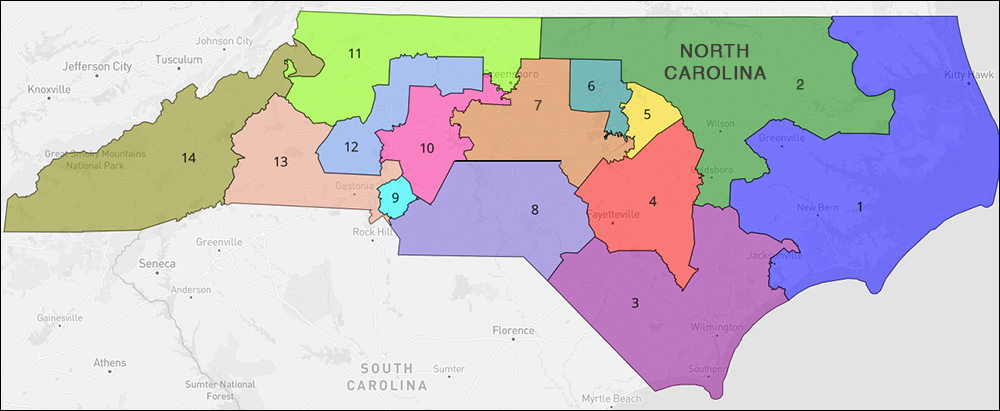
2022 North Carolina Congressional Redistricting Map

By Jim Ellis

March 8, 2022 — The chaotic Tar Heel State political scene quelled on Friday as the postponed candidate filing period finally came to a close. Today we look at the recent North Carolina redistricting past and future, along with an analysis of the open Senate race. Tomorrow, we examine the state’s 14 new US House districts.

The North Carolina state Supreme Court’s approved map will be in place for the 2022 midterm election, and as a result the candidate slate is less competitive than the originally conceived congressional plan would have yielded. While the Democrats won this most recent political battle, the state’s redistricting war, a fight between the legislature and state Supreme Court that has resulted in four different congressional maps being in passed into law and ultimately rejected since 2010, will likely continue.

The Republican legislature controls the redistricting pen because the North Carolina governor, in this case Democrat Roy Cooper, has no veto power over this subject matter. Democrats control the state Supreme Court with a 4-3 partisan majority, but there is at least an even chance that the balance of power will change after the midterm election.

Two of the Democratic judges are on the ballot this year and no Republicans. One of the two, Justice Robin Hudson, is not seeking re-election, so GOP chances of winning at least one of the two races are enhanced. If they succeed, Republicans will hold the court majority after the first of the year.

Since a court map is only an interim plan, the legislature can replace it at any time. Since the state high court did approve the legislature’s latest version of the state House and Senate maps, Republicans stand a strong chance of maintaining their majorities in both houses. Therefore, re-drawing the congressional map in 2023 should the NC Supreme Court have a different complexion could mean that the GOP would be able to enact a stronger plan next year.

Originally, North Carolina arguably looked to be the Republicans’ most important redistricting state in that it was one of just two places where the party could gain multiple congressional seats and the only one where a potential three-seat increase was within the realm of possibility. The outlook for the final 2022 map, however, gives the Democrats an advantage. It now appears more likely that the Dems will gain one or even two seats in the delegation.

The North Carolina judicial decision is a major blow to House Republican national prospects. While the party still has a good chance of re-taking the majority they lost in the 2018 election, the difficulty factor has increased through adverse court decisions here and in several other states.

Continue reading

Democrats Score in Pennsylvania and North Carolina Redistricting

Click on above map or this link to see an interactive Pennsylvania redistricting map on: FiveThirtyEight

By Jim Ellis

Feb. 25, 2022 — Democrats notched major gains as courts in Pennsylvania and North Carolina Wednesday chose maps that will largely favor their party as we move toward the midterm elections in November.

The Pennsylvania State Supreme Court, to no one’s surprise, since they have consistently ruled as a partisan Democratic panel, adopted on a 4-3 vote a new congressional map that will cost sophomore Rep. Fred Keller (R-Middleburg) his current seat, but does give the Republicans a rather surprising chance to convert two seats in the eastern part of the state.

Though Reps. Susan Wild (D-Allentown) and Matt Cartwright (D-Moosic/Scranton) must still be regarded as clear favorites for re-election, they will again find themselves embroiled in highly competitive battles come November.

All other PA incumbents appear in strong shape for re-election. Additionally, the two open Democratic seats in the Pittsburgh area have been restored, both the downtown district from which Rep. Mike Doyle (D-Pittsburgh) is retiring, now numbered 12, and the western Allegheny County 17th CD that Rep. Conor Lamb (D-Pittsburgh) is vacating to run for the Senate.

The current Keller seat, labeled District 12, is a safe Republican district that stretches from just west of Harrisburg in Perry County all the way to the New York border. The population anchor is Lycoming County and the city of Williamsport, home of the Little League World Series. Keller won a 2019 special election after then-Rep. Tom Marino (R) resigned the seat to accept an offer in the private sector.

The new map splits the current 12th District into three seats, and places Rep. Keller’s home in veteran Rep. Glenn “G.T.” Thompson’s (R-Howard) 15th CD. Overlaying the current map over the new plan, Keller sees that 40 percent of his district lies within the confines of Rep. Thompson’s seat; but the congressman announced late Wednesday night that he will instead challenge Rep. Dan Meuser (R-Dallas) in the new 9th District. Approximately 34 percent of Keller’s current district moved to the new 9th with the new map, as compared to Meuser having more than 60 percent carryover territory.

Assuming Keller follows through, this will become the seventh intra-party pairing, and the fourth involving Republicans.

In eastern Pennsylvania, the adopted map attempts to make Rep. Cartwright’s 8th District a bit more Democratic, but it comes at the potential expense of District 7’s Rep. Wild, who won re-election in the last cycle with only a 52-48 percent spread over businesswoman and former Lehigh County Commissioner Lisa Scheller (R). According to the FiveThirtyEight data organization, the new 7th rates as a R+4, which is down from the EVEN rating the seat held under the current map.

On the other hand, Dave’s Redistricting App records the Democratic percentage at 50.1 for the new PA-7 compared to the Republican 47.4. Rep. Cartwright sees his 8th District hold a 49.7 – 47.6 percent split in favor of the Democrats, but the FiveThirtyEight rating is R+8. Even what appears to be a fairly lofty figure to overcome, however, is still a tick down from the R+9 in the current district that Cartwright carried 52-48 percent in 2020.
Continue reading

North Carolina Redistricting II

2022 North Carolina Congressional Redistricting Map (click on image or here to go to interactive map: Dave’s Redistricting App)

By Jim Ellis

Feb. 23 2022 — Both houses of the North Carolina state legislature have now passed a new congressional map to replace the original version that the state Supreme Court previously rejected.

The new plan now undergoes judicial review as early as tomorrow before final enactment. The legislators agreed upon a plan to meet the pre-determined judicial schedule. The districts must be set to meet an impending March 4 candidate filing deadline for the March 8 primary that was initially postponed to May 17. Any further redistricting delays will likely move the primary once more, this time to June 7.

The high court struck the plan because the justices determined the map was a political gerrymander and, on the original map, that Democrats were under-represented.

The previous map would likely have produced 10 Republican victories as opposed to four Democratic wins. The current division in 8R-5D. The state gained a new seat in national reapportionment, thus increasing the Tar Heel state delegation to 14 members.

The proposed map is certainly more competitive. Preliminary analysis suggests that the Republican nominee would be favored in six of the seats and the Democrats four, with an additional four being cast into a highly marginal category.

The legislature also restored the previous numbers to the districts, making statistical comparisons easier to understand. The members receiving what should be favorable districts are: Reps. Deborah Ross (D-Raleigh; District 2), Greg Murphy (R-Greenville; District 3), Virginia Foxx (R-Banner Elk; District 5), Richard Hudson (R-Concord; District 8), Dan Bishop (R-Union County; District 9), Patrick McHenry (R-Lake Norman; District 10), Madison Cawthorn (R-Hendersonville/Asheville; District 11), and Alma Adams (D-Charlotte; District 12).

Democrats would then be favored in open District 1 (Rep. G.K. Butterfield (D-Wilson) retiring) and open District 4 (Rep. David Price (D-Chapel Hill) retiring).

Incumbents relegated to highly competitive seats are Reps. Kathy Manning (D-Greensboro; District 6) and David Rouzer (R-Wilmington; District 7). The Dave’s Redistricting App statistical organization rates the Manning 6th District as a seat having a voting pattern that divides the two parties by less than one percentage point: 49.44 percent for Republicans and 49.18 percent for Democrats. The Rouzer District 7 breaks similarly: 49.39 percent for the Democrats and 49.04 percent for Republicans.

According to the FiveThirtyEight statistical organization that has not yet scored the new plan, the previous Manning 6th District rated as a D+21 and the Rouzer 7th CD, an identical partisan spread of R+21. Therefore, these two districts going to an even rating clearly changes the entire map’s outlook, and obviously so for this pair of incumbents.

Continue reading

The Redistricting Scorecard

By Jim Ellis

In the trifecta of political parties controlling the House, Senate and Executive branches in a state, how many will really benefit from that power in the redistricting process?

Feb. 11, 2022 — There has been quite a bit of redistricting news surfacing during the past few weeks, with many analysts now reversing their earlier predictions about which party is the clear beneficiary from the re-draw process.

Most said early that the Republicans would benefit the most from redistricting and that map drawing alone would be enough to allow the party to reclaim the House majority. We, on the other hand, were showing that the cut would more than likely be about equal even though the GOP has a major advantage in trifecta states, that is, those where one party controls all three legs of the legislative stool, meaning the state Senate, state House, and the governor’s office.

Though the Republicans control 25 states outright from a redistricting perspective compared to the Democrats’ 15, the number of states where each can draw maps to expand their party’s congressional delegation really comes down to seven where Republicans control and a commensurate four for the Democrats.

What balances the process this year is that Republicans appear to have have only one state where they can gain multiple seats — North Carolina — while Democrats can run the table, and have, in two big states, New York and Illinois.

Where both parties suffer in their trifecta states is the number of places where they already control the maximum number of seats, or redistricting power has been transferred to a commission. Either one party already has all the seats in a state like the Democrats do in Massachusetts and the Republicans have in Arkansas, for example, or the state has only one at-large member.

In one place, West Virginia, even though the Republicans have a legislative trifecta, they will drop a seat post election. Currently, the West Virginia delegation consists of three Republicans, but the state loses a seat in national reapportionment. Therefore, the GOP majority had no choice but to collapse one of their own districts.

Articles are now appearing that suggest it is the Democrats who could end the redistricting process with a net seat advantage rather than the Republicans. This, as it has been from the beginning, is true.

In looking at the states once all 50 have adopted new congressional lines, it projects today that the Republicans would add approximately 13 seats, while the Democrats, with multiple seat additions in Illinois and New York, would gain 11 new members. Seven states remain undecided because their level of political competition is predicted to be intense.

Continue reading

Alabama Map Ruling Stayed; Redistricting Update

By Jim Ellis

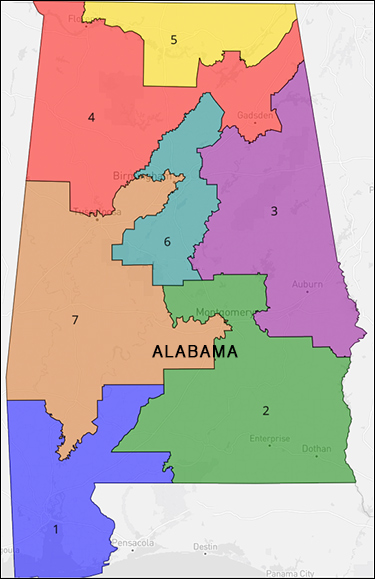
Alabama redistricting map (Click on the map above or go to DavesRedistricting.org to see interactive map)

Feb. 9, 2022 — On a 5-4 vote, the US Supreme Court voted to stay the lower court ruling that invalidated the new Alabama congressional map. A Republican three-judge panel had ruled that a second majority minority district could have been drawn among the state’s seven congressional districts, and thus disqualified the plan on Jan. 23.

Writing a concurring opinion, Justice Brett Kavanaugh stated that the lower court decision was made too close to the 2022 election, meaning that the judicial process would not have proper time to hear the appeal and make an educated ruling prior to the state’s scheduled primary election. The ruling does not mean the appeal was granted, but merely postpones hearing the case to a later date.

Analysts say the stay ensures that the original map will be in place for this year’s election. It does not mean, however, that the map won’t be altered for the 2024 election and beyond.

The new plan is virtually an extension of the current map, which elected six Republicans and one Democrat in the 2020 election. It was a curious original decision, not only because the judges that ruled against the GOP map drawers were appointed by former President Donald Trump (2) and the late President Ronald Reagan (1), but that the same map footprint stood unencumbered for the past 10 years.

The major change made from the current map to the new draw came in the 7th CD, which is the Voting Rights district. The legislature, however, had no choice but to make a substantial change. AL-7 was 53,143 people short of reaching the state’s congressional district population quota of 717,754 individuals.

The previous ruling also postponed the Jan. 28 candidate filing deadline for the Alabama US House candidates. Those running for all other offices have now already filed and been qualified for the respective party primary ballots. The congressional candidates will now file on Feb. 11.

Redistricting Notes

• Summarizing the legal action in other states, the North Carolina map has been disqualified and the legislature will now return to redraw the congressional and state legislative maps. As has been the case throughout the previous decade, the partisan Republican legislature and the partisan Democratic state Supreme Court continue to go back and forth over the issue of partisan gerrymandering.

• The lower court ruling in Michigan rejected the Detroit area Democratic current and former state legislators’ claim that the Michigan Independent Citizens Redistricting Commission members violated the Voting Rights Act in drawing the city of Detroit’s congressional and state legislative maps. Unless an appeal is granted, the new Michigan maps will stand for this year’s elections.

• The Kansas legislature adjourned without voting to override Gov. Laura Kelly’s (D) veto of the state’s congressional map. The hasty adjournment move, however, allows the legislature to reconsider the veto override. Without a successful override vote, the map will go to the courts for a redrawing of the Kansas City metro area.

Continue reading

North Carolina Map Rejected

Rejected 2022 North Carolina Congressional Redistricting map (click on map above or here to go to an interactive map at DavesRedistricting.com)

By Jim Ellis

Feb. 8, 2022 — In what has almost been a decade-long game of gerrymander ping pong, the state Supreme Court on Friday rejected the new North Carolina congressional and state legislative maps, thus repeating their actions from the two previous times the panel’s majority disqualified a Republican legislature’s map.

The vote was 4-3, with all four Democrats voting in favor of declaring the map a partisan gerrymander, consistent with their past action, while the three Republicans voted to uphold the plans.

We are again looking at a relatively quick re-draw situation because the twice-postponed North Carolina primary is now scheduled for June 7. If an agreement cannot be reached, it is possible the candidate filing deadline and statewide primary are again postponed.

The high court’s move was expected, but this is a serious setback to Republicans from a national perspective since North Carolina appears to be the only state where the party can gain multiple seats through redistricting.

It is likely that the inter-party pairing of Reps. Virginia Foxx (R-Banner Elk) and Kathy Manning (D-Greensboro) will be re-drawn when a new congressional version is passed. The Greensboro area has been the major focal point of this and the previous maps, with the partisan Republican legislature and partisan Democratic court continuing to battle over a map that will eventually become the state’s 2022 political playing field.

As drawn, the legislature’s map — under North Carolina law and procedure, the governor, in this case Democrat Roy Cooper, has no veto power over redistricting — would have returned either 10 Republicans and 4 Democrats or possibly has high as 11 Republicans and 3 Democrats. Under the current draw, the Republican advantage is 8-5.

North Carolina gained one seat under national reapportionment, and the last iteration of the state Supreme Court map, ordered before the 2020 election, resulted in the Republicans losing two seats, one in Raleigh and the other in the Greensboro area.

Continue reading

Redistricting Challenges – Part II

By Jim Ellis

Jan. 26, 2022 — Yesterday, we covered the US House members whose districts have changed to the point of having seats where a majority of their new constituencies are unfamiliar. Today, we delve deeper.

To reiterate, a total of 28 states have now completed their redistricting process, and 41 incumbents seeking re-election in these places will be in new seats where a majority of the electorate has not previously seen their names on the congressional ballot.

Interestingly, many of the changes are positive for some of the members in question, because the new constituents are favorable to the incumbent’s party. Others, however, face potentially tough re-nomination or re-election battles, and some will see challenges coming from both Republicans and Democrats.

In 16 specific instances the outlook is seriously negative as nine Democratic members and five Republicans face major challenges toward continuing their congressional careers.

The members in the worst situations are those paired with another incumbent. Illinois Rep. Sean Casten (D-Downers Grove) faces freshman Rep. Marie Newman (D-La Grange). Casten has only a quarter of the new Chicago suburban constituency as compared to Newman’s 42.9 percent carryover factor. Her home base in La Grange, however, is not included in the new 6th District.

Remaining in Illinois, neither paired Republican Reps. Mary Miller (R-Oakland) nor Rodney Davis (R-Taylorville) have large constituencies in the new 15th CD. Rep. Miller has only a 34.7 percent carryover factor from the current 15th but is larger than her opponent’s, Mr. Davis, 30.8 percent figure coming from his 13th CD.

Michigan Rep. Bill Huizenga (R-Holland) has announced that he will run in his state’s new 4th District, meaning a pairing with veteran Rep. Fred Upton (R-St. Joseph). He has only 25.1 percent of his constituents in the new 4th as compared to Upton’s much stronger 68.8 percent carryover factor. Still, Rep. Upton says he is unsure as to whether he will seek re-election to a 19th term.

Staying in Michigan, Rep. Andy Levin (D-Bloomington Township) has decided to enter in a paired battle with Rep. Haley Stevens (D-Rochester Hills). He has only 26.7 percent of his current 9th District constituency in the new 11th CD as compared to Rep. Stevens’ having 46.1 percent coming from her current 11th District. Her home base of Rochester Hills, however, does not carryover, while Rep. Levin’s base in Bloomington Township becomes the anchor population in the new CD.

Continue reading