Category Archives: Election Analysis

Democrat Debate Friction


By Jim Ellis

June 10, 2019 — The Politico publication ran a story late last week detailing building friction between the Democratic National Committee and Montana Gov. Steve Bullock, a late-entering Democratic presidential candidate, over the committee leaders apparently axing the western governor from the first debate forum coming later this month.

The source of controversy is the party leadership contending that Gov. Bullock, who looked to have qualified for the debate under the outlined criteria, now has not. Instead, New York City Mayor Bill de Blasio is in position to capture the 20th and final debate podium for the upcoming June 26-27 candidate forums from Miami.

As we have previously reported, the qualifications the party leaders have placed upon the candidates require them to either build a fundraising organization of 65,000 donors, with a minimum of 200 coming from 20 states, or score one percent support in at least three surveys from eight designated pollsters.

Gov. Bullock appeared to have met the polling requirement. He exceeded the one percent threshold in the ABC/Washington Post survey in January. But, the DNC is now disallowing this particular poll, and the action probably eliminates him from the debate.

Their reasoning is that the ABC/Post poll asked an open-ended presidential ballot test question — that is, where the names of the candidates are not read, but the respondents must voluntarily state a name. This type of question is usually employed to test hard name identification and candidate strength.

Continue reading

Polling vs. Delegates:
“The Game Within the Game”

By Jim Ellis

Texas state senate districts

June 7, 2018 — Quinnipiac University released their latest Texas poll (May 29-June 4; 1,159 registered Texas voters) and it finds former Vice President Joe Biden doing well in opponents’ Beto O’Rourke and Joaquin Castro’s home state.

According to the results, Biden heads the Lone Star State Democratic presidential field and is the only candidate to top President Trump when the president is isolated against each competitive Democrat (Biden over Trump: 48-44 percent).

Arguably, Texas, with its 38 Electoral Votes and the largest cache that a Republican candidate can generally claim, is Trump’s most important state. Losing here would likely mean forfeiting the presidency. There is no mathematical way to compensate for Trump failing to win Texas’ electoral votes and still allow him a path to reach the 270 Electoral Votes to claim a national victory.

In the Democratic primary, scheduled for Super Tuesday, March 3, Biden leads the pack of candidates with 30 percent of the vote, topping ex-Rep. O’Rourke (16 percent), Sen. Bernie Sanders (15 percent), Sen. Elizabeth Warren (11 percent), and the nine others who recorded between one and four percent statewide support.

Sens. Amy Klobuchar (D-MN), Kirsten Gillibrand (D-NY), Michael Bennet (D-CO), Govs. Jay Inslee (D-WA) and Steve Bullock (D-MT), Reps. Tulsi Gabbard (D-HI), Eric Swalwell (D-CA), Seth Moulton (D-MA), and Mayors Bill de Blasio (New York, NY), Wayne Messam (Miramar, FL), failed to reach the one percent plateau.

But, how would such a vote split translate into delegates for the participating candidates? Under Democratic Party rules, each state has both at-large and district delegates. Another group, called PLEO’s, are comprised of state and local Democratic Party leaders along with elected officials.

Continue reading

The Early Primary Cycle

By Jim Ellis

June 6, 2019 — Looking at the 2020 primary calendar, it is obvious that the presidential race is already having an impact upon what is becoming an accelerated congressional campaign schedule in many states.

The analysts for the Daily Kos Elections website released their research posting all of the 2020 state primary dates giving us a better indication of which congressional primaries will be held earlier than their traditional scheduled primary slot.

Several states that have moved to early presidential primary dates have also transferred their entire ballot, meaning the congressional cycle will start earlier than usual for many members and challengers.

Texas and Illinois are typically the first states to hold primary elections, and they are again at the forefront of the congressional calendar. Texas will hold its presidential and congressional nominating elections on March 3, which will become the 2020 Super Tuesday. Illinois, along with Florida and Arizona, will vote on March 17. But, on that date, only Illinois will hold congressional nomination elections.

Next year, however, several other states, will join Texas with a full ballot primary on March 3.

Continue reading

A Counter Poll in NC-9

By Jim Ellis

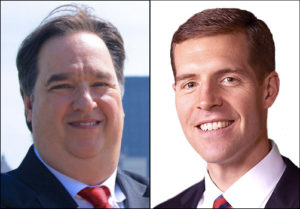
North Carolina Republican state Sen. Dan Bishop (left) | Democrat Dan McCready (right)

June 5, 2019 — The Atlantic Media & Research organization went into the field in North Carolina’s 9th Congressional District and found a different special election leader than last week’s JMC Analytics poll. Atlantic’s conclusion sees Democrat Dan McCready topping state Sen. Dan Bishop 41-39 percent, which is the inverse of JMC’s result.

JMC projected Sen. Bishop leading 46-42 percent in their survey of 350 likely special election voters conducted on May 21-24. Atlantic polled 358 “definite or very likely” special election voters from May 20-23 and continuing through May 28-30. Though the two polls produced separate leaders, their combined data conclusions are similar in that the participants are within the polling margin of error. While the spread yields an eight-point net difference between the two polls, the margin of error contained in each is less than four percent.

But the Atlantic methodology is a bit different. The research firm polled on consecutive weekdays in two separate weeks leaving the Memorial Day weekend period unsampled. The gap leads to a longer than average polling stage, which could mean a less accurate conclusion.

Atlantic Media also reviews its previous poll completed five months ago in December of last year, just after the general election, and compares those results with the most current data set. The numbers are similar in that the partisan ballot tests and the president’s job approval rating varies by only a percentage point or two. And, attempting to discount the final 2018 result that was infected with voter fraud, the Atlantic December post-election poll finds candidate McCready topping Republican Mark Harris by a tight 46-43 percent margin.

Continue reading

The Impeachment Landscape

By Jim Ellis

June 4, 2019 — As we have seen, the impeachment drumbeat is starting to resonate more loudly since former special prosecutor Robert Mueller addressed the media. While it appears any impeachment move the House makes would be dead on arrival in the Senate, could the proponents even pass the measure through the body of origin?

Currently, the House party division stands at 235 Democrats and 198 Republicans after Rep-Elect Fred Keller (R-PA) was sworn into office just last evening. The two vacant seats, both in North Carolina, will be filled on Sept. 10. The impeachment measure, like all other bills, would require a majority, or 217 yes votes, if all members are present and voting assuming a vote is taken before the North Carolina seats are filled.
.
With Rep. Justin Amash (R-MI) possibly being the lone GOP exception, the Republican conference would likely be unified in opposition. That being said, the focus of attention would then come upon the 31 Democrats who represent districts that President Trump carried in 2016, 23 of whom are freshmen. Therefore, adding Amash to the “yes” category, the Democratic leadership could afford to release a maximum of only 19 conference members, meaning 92 percent of the conference would have to hold the impeachment party line.

Of these 23 freshmen, 16 are from traditionally Republican districts whose electorate flipped for the first time in more than a decade. Looking at the 31 as a whole, the group averaged a 52.6 percent win percentage factor in 2018. The 23 freshmen averaged just 51.5 percent, meaning only a few have an established political base.

These statistics suggest that the Democratic leadership might have a difficult time passing impeachment in the House with just their own party members. And, this margin projection doesn’t include some of the more centrist members from other close districts that Hillary Clinton carried with a small margin.

The following is a list of the 31 now Democratic House districts that Mr. Trump carried. They are listed in order of the president’s strength. Those in bold are freshmen members:
Continue reading

Electoral Vote Compact Takes a Hit

By Jim Ellis

June 3, 2019 — Recently, Sen. Elizabeth Warren (D-MA) spoke one of her strongest applause lines on the presidential campaign trail, when she talked about eliminating the Electoral College. And the National Popular Vote Interstate Compact organization had been gaining significant energy when Colorado, Delaware, and New Mexico officially joined its ranks earlier this year. But, that momentum hit a major roadblock yesterday.

The National Popular Vote Interstate Compact, or NPVIC, began soon after the 2000 presidential election when Democratic nominee Al Gore won the popular vote count but fell to George W. Bush in the Electoral College. The result marked the first time since the 1888 election when the popular vote winner failed to win the presidency.

By 2007, Maryland became the first state to officially join the NPVIC. Today, 14 states are Compact members, representing 189 Electoral Votes. The organization’s stated goal is to recruit enough states to equal a majority of 270 EVs that will agree the respective members will deliver its Electors to the national popular vote winner regardless of how their own electorate votes.

However, the Maine House of Representatives, on a 76-66 vote, defeated legislation late last week to add their state to the growing NPVIC organization. And, Nevada Gov. Steve Sisolak (D), in a surprise move to some, vetoed the compact legislation that had reached his desk. Earlier in the Oregon legislative session, the state Senate passed its bill to join the compact and action is awaited in the House before the legislative session’s scheduled end on June 21.

Continue reading

Democrats Up the Debate Ante

By Jim Ellis

May 31, 2019 — The Democratic National Committee just announced the imposition of new requirements for presidential candidates to participate in the series of subsequent debates to begin in mid-September. The first two sessions are scheduled for June 26-27 and July 30-31 in Miami and Detroit, respectively.

The field is close to being set for the initial forums with 20 candidates qualifying according to the Intelligencer publication, the personnel from which have been tracking the debate process since the schedule was first announced.

To earn a podium in the first two debates, the candidates are required to either score one percent support in three of eight designated polls or reach 65,000 donors, of which at least 200 must come from 20 specific states.

The participants will include some of the more obscure candidates including author Marianne Williamson, New York City businessman Andrew Yang, and the two western governors, Jay Inslee of Washington, and Steve Bullock from Montana.

This means that Sen. Michael Bennet (D-CO), Rep. Seth Moulton (D-MA), former Sen. Mike Gravel (D-AK), and Miramar, Fla., Mayor Wayne Messam likely will not be part of the first forum, though time remains for them to still qualify.

Continue reading

NC-9: The First Poll is Surprising

By Jim Ellis

North Carolina’s 9th Congressional District

May 30, 2019 — The JMC Analytics survey research firm released the first special general election poll for North Carolina’s 9th District, and some may consider the results surprising.

According to JMC (May 21-24; 350 NC-9 registered voters), Republican state Sen. Dan Bishop (R-Charlotte) has taken a 46-42 percent lead over Democrat Dan McCready, the solar energy businessman who was the 2018 party nominee. Considering the seven-month-long vote fraud controversy that kept the North Carolina Board of Elections from certifying Republican Mark Harris as the general election victor over McCready (the unofficial total gave the GOP nominee a 905-vote edge) many expected the Democrat to open the special election campaign with a discernible advantage.

There is no doubt that McCready has a resource advantage, however, which should play a major role as this contest moves toward a Sept. 10 conclusion. In the pre-primary financial disclosure period report that ended April 24, McCready reported already raising over $2.01 million, with a $1.57 million cash-on-hand figure. In contrast, Sen. Bishop stated $505,000 raised within the same time frame, more than any individual Republican candidate at the time, but the total included a $250,000 personal loan.

Continue reading

NC Poll: Tillis Vulnerable

By Jim Ellis

North Carolina Sen. Thom Tillis (R)

May 29, 2019 — One of the key 2020 Senate races lies in North Carolina where first-term Sen. Thom Tillis (R) is seeking his second term and finds himself in a shaky political situation. A new poll suggests he has vulnerability even within the Republican primary.

A WPA Intelligence poll for the Club for Growth PAC (May 19-21; 502 likely North Carolina Republican primary voters) finds Sen. Tillis leading a hypothetical GOP primary against three-term Rep. Mark Walker (R-Greensboro) wealthy businessman Garland Tucker, and accountant Sandy Smith, 40-17-11-2 percent. Though Tillis is below 50 percent, North Carolina election law requires only a 30 percent vote total to win nomination, meaning the senator would be well over the required minimum.

At this point, Tucker and Smith are announced Republican primary opponents, with the former having the potential of becoming a competitive candidate. Several weeks ago, Rep. Walker ruled out running for the Senate, but his latest statements appear to suggest that he is more open to entering the statewide campaign.

Isolating Sen. Tillis and Rep. Walker into a head-to-head contest, which is not realistic from a probable political perspective but is helpful in a polling context, finds Sen. Tillis leading 43-34 percent. But, WPA finds it takes little in the way of persuasion to arrive at a very different result.

According to poll results, when just the following bios are read, the ballot test virtually switches:

Continue reading

Trump’s Ballot Politics

President Donald Trump | whitehouse.gov


By Jim Ellis

May 28, 2019 — Earlier this month, the California state Senate approved a bill that would require presidential candidates to release their tax returns in order to qualify for the Golden State ballot. A similar measure was vetoed by then-Gov. Jerry Brown (D) in 2017, but current Gov. Gavin Newsom (D) is expected to sign the measure.

A total of 17 other states also have similar pending legislation, with the strongest chances for enactment coming most probably in New York and Washington.

The move, of course, is targeted at President Trump who will not release his tax returns. But, would denying him ballot placement in states that he won’t carry actually hurt him?

A contrary argument exists to suggest that Trump and the down-ballot Republican candidates in those states might actually receive some tangential benefits from the president not being on the official ballot in places like California and New York, in particular.

First, if Trump didn’t appear on the California, New York, and Washington ballots, it would not change the Electoral College outcome because he won’t carry any of those states. He will likely concede them at the outset and spend no campaign money in any of those locations. Therefore, his ballot placement in these places could arguably be irrelevant.

Continue reading