
Monthly Archives: September 2026

Kansas Now In Play

By Jim Ellis — Thursday, September 3, 2026

Senate
One of the Democratic Party’s 2026 objectives in its bid to regain the Senate majority is to push the maximum number of Republican seats into the competitive realm.

The death of South Carolina Sen. Lindsey Graham has placed that typically safe GOP seat into competitive mode, as have the credible Democratic candidacies that are emerging in Alaska and Iowa.

Party strategists have also taken the unusual step of persuading three Democratic nominees – in Idaho, Nebraska, and South Dakota – to withdraw in favor of coalition aligned Independents, each a former Democrat or clear liberal ideologue, in hopes of consolidating enough support to tighten those races.

The party leaders’ similar quest fell short in Montana, where Democratic nominee Alani Bankhead declined to step aside for former University of Montana president Seth Bodnar, who is running as an Independent.

The latest state to show signs of competitiveness is Kansas. A new Global Strategy Group survey (Aug. 12-16; 800 likely voters) finds Democrat Adam Hamilton holding a narrow 44-43 percent edge over Republican Sen. Roger Marshall. Kansas polling finding a Democrat within striking distance in September is not unusual, however, and recent history suggests caution in interpreting such numbers.

Certainly, this is not the first time in recent memory where we have seen Kansas polling data putting the Democratic nominee on the same footing as their Republican opponent only to see the GOP prevail by about 10 percentage points on election day.

Sen. Marshall himself faced similar polling volatility in 2020. That September, he led in two polls, trailed in two, and was tied in two more. He ultimately won the open Senate race with a 53-42 percent margin.

The pattern was even more pronounced in 2014, when four term incumbent Pat Roberts (R) appeared to be in serious trouble. This campaign started as a three-way contest among Sen. Roberts, the Democratic nominee, and a strong Independent, Greg Orman, who would eventually narrow the race to a choice between he and the incumbent.

In September of that year, Orman led in six of eight polls and the two were tied in a ninth. Roberts nevertheless prevailed by the same 53-42 percent spread as Marshall would six years later.

Therefore, seeing a Kansas Senate race close in the month of September before a regular election is nothing new. It is important to remember, that regardless of polling reports, the last time a Democrat was elected as a Jayhawk State US Senator came in 1932.

Democrats, however, have fared better in gubernatorial contests, winning seven races since 1932, most recently with current two term Gov. Laura Kelly. Kathleen Sebelius also won two terms in 2002 and 2006. Over that same period, Republicans have elected 13 governors.

Hamilton, a Methodist minister, has run a credible campaign and performed well financially. According to Federal Election Commission pre primary filings through July 15, he raised $4.2 million and reported $1.7 million cash on hand. Sen. Marshall raised $6.2 million over the same period and entered the late summer stretch with nearly $5.4 million in his campaign account. A noticeable uptick in spending from the Senator’s campaign will occur in the coming days and weeks.

It is probable that both the Kansas and South Carolina Senate races will soon show a stronger Republican trend and they will likely exit the competitive board as election day approaches. For now, however, each warrants monitoring in case signs of a long shot upset begin to crystallize.
Markey Wins Big; Neal, Lynch Tighter

By Jim Ellis — Tuesday, September 2, 2026

Last night’s Massachusetts primary resulted in each incumbent prevailing, but not all were landslide victories.

Senate

Polling accurately anticipated the outcome of the Bay State’s Senate primary, as veteran incumbent Ed Markey easily defeated Rep. Seth Moulton (D‑Salem) by a 65-35 percent margin. Though not all 351 municipalities had reported by late Tuesday night, returns from roughly 280 communities showed Moulton carrying only nine, with six of them coming within his 6th Congressional District.

Rep. Moulton’s decision to run for the Senate had been questioned by many political observers, since Sen. Markey did not appear vulnerable to a Democratic challenge. He demonstrated that strength six years ago when he defeated then‑Rep. Joseph P. Kennedy III, 55-45 percent, overcoming a member of the Kennedy family in their home state and within their own party.

The six‑term Congressman attempted to frame the race around age and longevity. Sen. Markey is 80 years old and has held elective office continuously since first winning a seat in the Massachusetts House of Representatives back in 1972. In the end, the Moulton attack line failed to gain traction.

Moulton will leave Congress when his term ends in January. Sen. Markey now heads into the general election with a prohibitive advantage over attorney John Deaton, who was unopposed for the Republican nomination.

Governor

Incumbent Gov. Maura Healey was unopposed in yesterday’s Democratic primary, and, as expected, former healthcare company executive Mike Minogue won the Republican nomination, defeating businessman and retired Marine Corps veteran Brian Shortsleeve by a commanding 76-24 percent margin.

Minogue will be a credible Republican contender against Gov. Healey, but his prospects remain weak in a state that is quintessentially Democratic. Turnout underscores the challenge: roughly 275,000 voters participated in the Republican primary, compared with more than 900,000 on the Democratic side. While Gov. Healey enters November as a heavy favorite, Minogue is positioned to offer voters a viable alternative.

House

While several members of Massachusetts’ all‑Democratic US House delegation faced primary challengers, only one race appeared genuinely competitive heading into election day. In the end, a second contest proved unexpectedly close.

The surprise came in the 1st District, where veteran Rep. Richard Neal (D‑Springfield) defeated educator Jeromie Whalen by a narrower‑than‑expected 54-46 percent margin, remarkably tight given the campaign’s extreme spending disparity. Through the pre‑primary reporting period ending Aug. 12, Rep. Neal held a $3 million to $330,000 expenditure advantage.

The challenger did not run as a Democratic Socialist but cast Congressman Neal as an entrenched establishment incumbent and claimed he is “one of the top recipients of corporate money.” This, of course, would be illegal, since direct corporate contributions to candidate committees are not allowed.

Whalen did not distinguish the difference between a corporate contribution and a corporate political action committee comprised of private sector employees voluntarily participating in the political process.

Given the number of incumbent House members in both parties who have lost renomination this year, Rep. Neal’s below‑average margin may reflect a broader frustration among various electorates toward long‑serving federal incumbents.

In the 4th District, three‑term Rep. Jake Auchincloss (D‑Newton) easily dispatched research scientist Jason Poulos, once viewed as a potentially credible challenger. Rep. Auchincloss secured renomination with a 72-28 percent victory.

House Minority Whip Katherine Clark (D‑Revere) also cruised, winning 74 percent of the vote against two opponents. She advances to the November general election as a prohibitive favorite in her 5th District, which carries a 68.3D – 29.7R partisan lean according to the Dave’s Redistricting App statisticians.

In the open 6th District, as polling suggested, former Andover Selectman and ex‑Biden Administration official Dan Koh won the Democratic nomination with a 41-30-12-9 percent result over state Rep. Tram Nguyen (D‑Andover), cryptocurrency executive John Beccia, and former state Rep. Jamie Belsito. Koh previously lost a 2018 3rd District primary to current Rep. Lori Trahan (D‑Westford) by just 145 votes.

Finally, in the Boston‑anchored 8th District, veteran Rep. Stephen Lynch (D‑South Boston) defeated former gubernatorial aide Patrick Roath, 57-43 percent, in a race that fundraising and polling had suggested could be competitive.

Rep. Lynch lost the Boston municipality to Roath but performed strongly in the district’s communities that lie south of the state’s capital city. The Congressman is again a prohibitive favorite in the November general election to secure a 14th term.

Next week, voters in New Hampshire and Rhode Island will choose their nominees, and Delaware will close the 2026 primary season on Sept. 15.

The Democrats’ Independent Ploy

By Jim Ellis — Tuesday, September 1, 2026

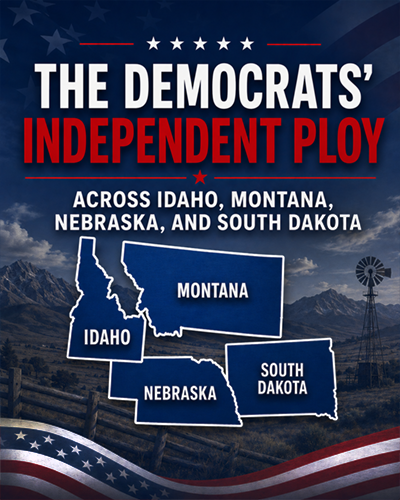
Democrats and their ideological coalition partners are pursuing a coordinated strategy across the Mountain and Midwest states to make otherwise safe Republican Senate seats more competitive. Their chances of unseating GOP incumbents remain low, but recent polling indicates that races in Idaho, Montana, Nebraska, and South Dakota have tightened.

The approach follows the model established in Nebraska’s 2024 Senate race, when Independent Dan Osborn, with the help of the Nebraska Democratic Party, which agreed not to field its own candidate, turned what had appeared to be an easy re‑election path for Sen. Deb Fischer (R) into a serious contest.

Osborn returns this year, this time challenging Sen. Pete Ricketts. Democrats and their ideological allies have now replicated the Nebraska blueprint in Idaho and South Dakota, clearing the field for coalition‑aligned Independent candidates and persuading the Democratic nominees in all three states to withdraw. They attempted the same maneuver in Montana, but Democratic nominee Alani Bankhead refused to step aside.

Idaho

Sen. Jim Risch (R), who previously served a short stint as Idaho’s Governor, two non‑consecutive partial terms as Lieutenant Governor, and 22 years in the state Senate, is seeking a fourth term in the US Senate.

In late July, Democratic nominee David Roth withdrew from the race, clearing a path for Independent Todd Achilles, a former Democratic state legislator, to mount a stronger challenge. The contest is not a direct one‑on‑one matchup, however, as two additional Independent candidates also appear on the ballot.

Highly conflicting August polls emerged within days of each other. Peak Insights (Aug. 11-13; 500 likely Idaho voters) showed Sen. Risch with a commanding 52-18 percent lead over Achilles. By contrast, the Bullfinch Group (Aug. 16-19; 608 likely Idaho voters) reported a dramatically different result, placing Achilles ahead 38-32 percent.

Across its three surveys of the race, the Bullfinch Group has consistently produced much tighter margins than other pollsters. For example, Change Research – a Democratic firm – found Risch in a far stronger position in its late July poll (July 28-30; 1,213 likely Idaho general election voters; online), showing the Senator leading Achilles 45-21 percent.

Sen. Risch remains favored for re‑election, but Mr. Achilles, running without the Democratic Party label, presents a more formidable challenge than a traditional party nominee would in heavily Republican Idaho.

Montana

Democratic Party leaders urged their June 2 primary winner, retired Air Force officer Alani Bankhead, to withdraw from the Montana Senate race in order to give former University of Montana President Seth Bodnar a stronger chance of preventing Republican Kurt Alme from succeeding retiring Sen. Steve Daines (R). Bankhead refused and remains a candidate. Her presence on the ballot creates a four‑way contest that clearly benefits Alme.

Controversy erupted at the candidate filing deadline when Sen. Daines – who had already filed for re‑election – abruptly withdrew as the window was closing, allowing Alme to file with almost no time left for other Republicans to enter the race. In a hypothetical two‑way contest between Alme and Bodnar, the latter polled competitively and made the general election a genuine race.

In the multi‑candidate configuration, Alme leads by a substantial margin but falls short of majority support. Montana recognizes plurality victories, however, so the current ballot structure favors the GOP nominee.

The latest Hart Research poll underscores how Bankhead’s decision to stay in the race reshapes the contest. According to their survey (Aug. 1-4; 800 likely Montana general election voters), Alme leads the four‑way race with 46 percent, Bodnar follows at 30 percent and Bankhead at 15 percent. In a hypothetical head‑to‑head matchup, Hart Research finds Alme and Bodnar tied at 46 percent each.

The FiftyPlusOne polling aggregator similarly shows Alme with an average 45-26-22 percent advantage over Bodnar and Bankhead, respectively.

Nebraska

Independent Dan Osborn returns with official Democratic Party and liberal organization backing after major‑party nominee Cindy Burbank – who initially insisted she would remain in the race even when the Secretary of State questioned her intentions – ultimately withdrew, giving Osborn a clear path. Last month, the Legalize Marijuana Party candidate also exited the contest, leaving Osborn in a direct one‑on‑one matchup with Sen. Pete Ricketts (R).

As in 2024, polling now suggests the Nebraska Senate race is highly competitive. Still, based on historical voting patterns, the eventual outcome as Election Day approaches is likely to favor Sen. Ricketts by more than five percentage points.

Across his three statewide elections – two for Governor and one for the Senate in 2024, when he won the special election to fill the remainder of former Sen. Ben Sasse’s term – Sen. Ricketts has averaged 59 percent of the vote.

South Dakota

The most recent Senate race in which an Independent has become the principal challenger to a Republican incumbent lies in South Dakota, where Democratic nominee Julian Beaudion withdrew in early August. His departure leaves Independent Brian Bengs, a former Democrat, as Sen. Mike Rounds’ (R) chief opponent.

A new survey suggests the race could become competitive, though polls taken immediately after a major candidate withdrawal often give the remaining challenger a temporary boost. The Democratic polling firm Impact Research conducted a live‑interview poll (Aug. 13–17; 500 likely South Dakota general election voters) showing Bengs pulling into a 44-44 percent tie with Sen. Rounds.

It is unlikely that such parity will hold as Election Day approaches, but the result ensures that the South Dakota Senate race will receive more attention than originally expected.