
By Jim Ellis — Wednesday, September 23, 2027
Senate
Senate polling over the past two weeks shows a modest uptick for Democratic candidates, but the question remains whether these numbers will translate into victories.
If recent election cycles are any guide, the answer is likely no. Data from the past three national elections consistently show that pollsters tend to underestimate Republican strength while more accurately projecting the Democratic vote share.
The pattern is clear when examining four key states in the 2020 and 2024 presidential elections. All four feature close Senate races this year.
In Texas, the 2020 polling averages suggested President Trump would win by roughly one point; he carried the state by six. In 2024, the averages pointed to a six-point Trump margin, but he ultimately won by 13.
Iowa largely displayed the same trend. Polling in 2020 projected a Trump win of between 1.3 and 2 points; he won by eight. In 2024, the averages showed a lead of about 4.5 points, yet he prevailed by 13.
Ohio followed suit. In 2020, Trump’s polling margin topped out at one point, but he won by eight. In 2024, the averages suggested a lead of 7.6 to 8.8 points; he finished with an 11-point victory.
Alaska also demonstrated this undercounting pattern. In 2020, Trump was projected to win by 5.6 to 7.7 points; he won by 10. In 2024, the averages showed an 8- to 10-point Trump lead; he won by 13.
Republicans hope this underpolling pattern is again present in this year’s Senate races. If pollsters continue to correctly project Democratic strength, those candidates will likely settle in the high 40s as the campaign progresses through the election prime time weeks. The numbers will shift somewhat as early voting approaches in mid October, but the broader trend is worth watching.
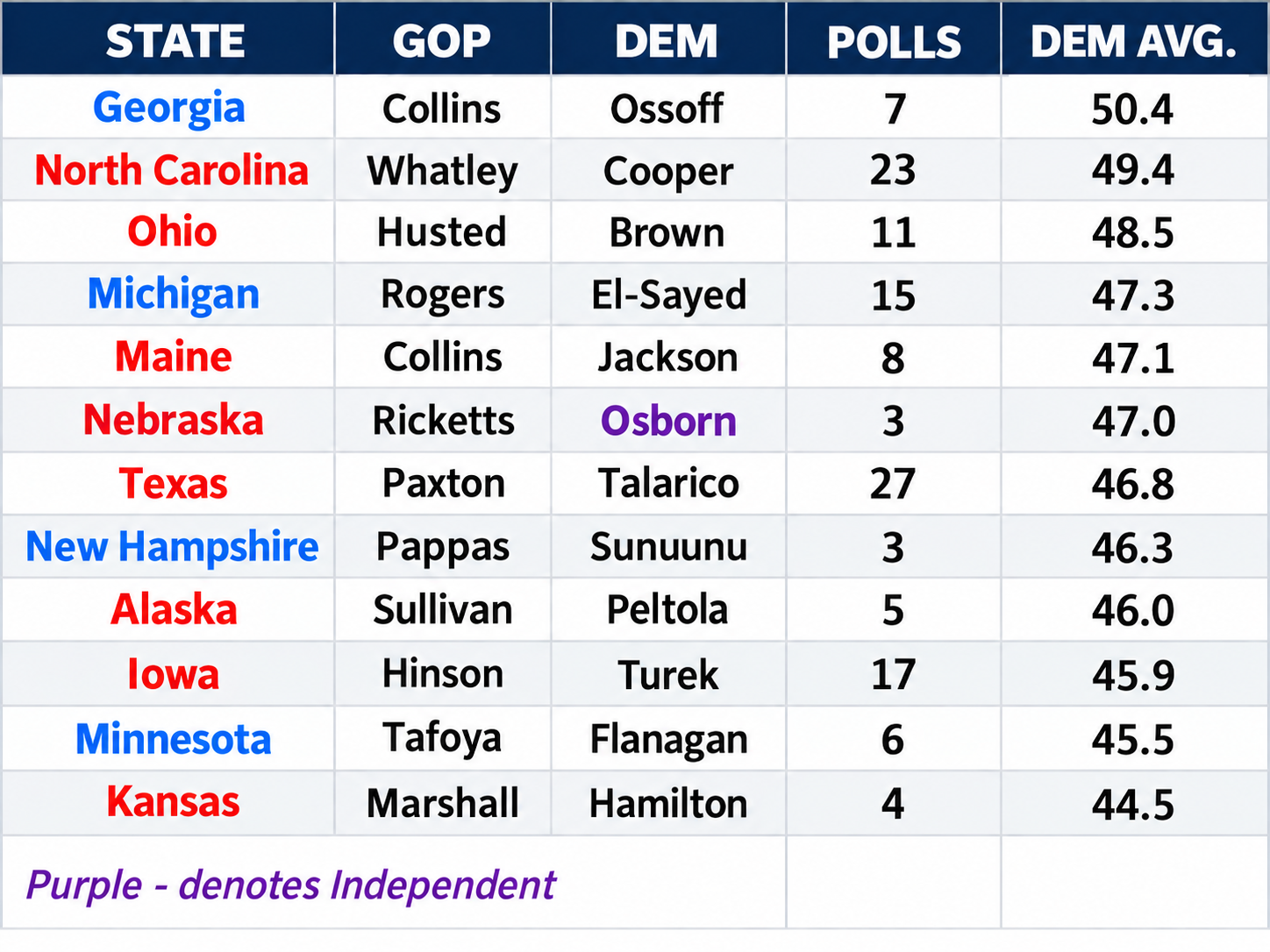
The table at top reflects where the dozen most competitive Senate races stand today. Democrats have two clear leaders – Sen. Jon Ossoff in Georgia and former North Carolina Gov. Roy Cooper. The remaining contests are much tighter.
Two of the biggest surprises in this table are the relatively weak Minnesota numbers for Lt. Gov. Peggy Flanagan and the somewhat unexpectedly competitive Ohio polling for former Sen. Sherrod Brown. While Brown’s numbers mirror the trajectory that preceded Sen. Bernie Moreno’s upset win in 2024, they still leave him positioned for a potential comeback victory this year.
Except for Georgia and North Carolina, the margins in the other races remain close. The Democratic average in the mid-to-high 40s is encouraging for Republicans, yet Democrats being competitive in so many Republican held states is similarly heartening for the challenging party.