
By Jim Ellis — Monday, September 28, 2026
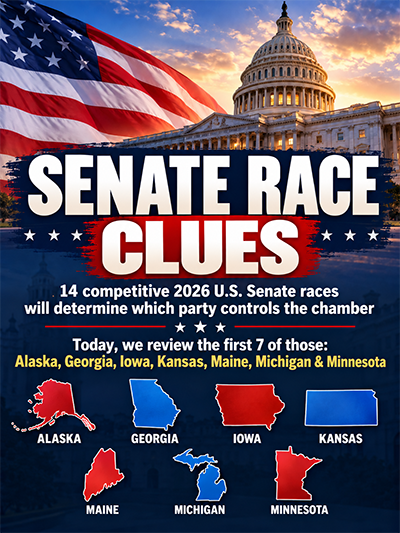 There are 14 competitive US Senate races that will determine which party controls the chamber in the next Congress, but factors beyond polling provide additional insight into how these campaigns may ultimately conclude. Today, we examine the first seven of these 14 contests in alphabetical order. Tomorrow, we will review the remaining seven.
Alaska
Alaska races typically follow a familiar pattern: major‑party candidates poll closely through early October, only for the Republican to pull ahead once voting begins. In the end, the GOP nominee usually wins comfortably. Recent polling again shows a tight contest, with Sen. Dan Sullivan (R) gaining ground on former Rep. Mary Peltola (D). The latest Trafalgar Group survey (Sept. 22-24; 1,079 likely voters; mixed sampling) shows Sullivan edging back into a narrow 47-46 percent lead.
The jungle primary results, however, told a different story. Alaska reports votes by its 40 state House districts rather than counties. On Aug. 18, Sen. Sullivan carried only 13 of the 25 districts that typically vote Republican; but turnout was just 22 percent. This race carries genuine upset potential.
Georgia
Sen. Jon Ossoff (D), seeking a second term that could serve as a springboard for a 2028 presidential bid, has led all candidates nationwide in fundraising throughout the cycle. His opponent, Rep. Mike Collins (R‑Jackson), remains significantly under-funded. The latest Insider Advantage poll (Sept. 22-23; 1,200 likely voters; online & text) again shows Ossoff ahead, this time beyond the margin of error, 50-42 percent. Sen. Ossoff enters the final stretch as a clear favorite.
Iowa
The Hawkeye State also exhibits a familiar polling pattern, particularly since the 2016 election: the two major‑party candidates run close through September, only for the Republican to pull away in the final weeks of October. The historical record suggests we may see the same dynamic again this November. Rep. Ashley Hinson (R‑ Marion/Cedar Rapids) and state Rep. Josh Turek (D‑Council Bluffs) remain locked in a tight contest, with polling leads seesawing between them.
Historically, Rep. Hinson is in a stronger position at this stage than retiring Sen. Joni Ernst (R) was during either of her successful campaigns. In her 2020 re‑election bid, Ernst trailed in multiple late‑September polls by margins ranging from one to 12 points, yet ultimately won by seven. In 2014, across 14 cumulative surveys, Ernst led in six, Democrat Bruce Braley led in six, and two were tied — before she went on to record a 52-44 percent victory.
Though the 2026 campaign remains competitive, the historical pattern and comparative positioning suggest that Rep. Hinson is well‑placed as the race enters its decisive phase.
Kansas
Once again, we are seeing close polling in a Kansas Senate race, but the likely outcome mirrors every Senate contest since 1932: a Republican victory. This marks the third Senate election since 2014 in which September polling has shown a tight race. The numbers in the 2026 contest between Sen. Roger Marshall (R) and pastor Allen Hamilton (D) project a virtual toss‑up, just as the polls did for Sen. Pat Roberts (R) in 2014 and then‑Congressman Marshall in 2020.
The 2026 race certainly merits watching, but history suggests a familiar pattern. In both 2014 and 2020, the Republican nominee pulled away in October to win a comfortable victory after a competitive September. It is likely that Sen. Marshall will again follow the same trajectory in the closing weeks of this campaign and score a convincing victory.
Maine
Being in a tough race is nothing new for Sen. Susan Collins (R); she has won five times in a state that is consistently difficult terrain for Republicans. In 2020, Sen. Collins never led a single general‑election poll, yet ultimately won by 8.5 points despite massive spending against her. This year, her opponent is former state Senate President Troy Jackson (D), who entered the race after Democratic leaders forced their primary winner, oysterman Graham Platner (D), out of the race.
Polling has bounced back and forth between the two candidates, and Republicans have identified vulnerabilities in Jackson’s record that they are working to exploit. The race is unquestionably competitive, but far less intense than the 2020 contest. As a result, Sen. Collins again has a strong chance to defy the Pine Tree State’s political odds.
Michigan
In many ways, the Michigan Senate race is the most important campaign on the political board. If former Congressman and 2024 Senate nominee Mike Rogers (R) wins and flips the state into the Republican column, the Democratic path to a Senate majority becomes immensely more difficult.
Polling has been abundant, and most surveys show Democratic nominee Abdul El‑Sayed — the former director of the Wayne County Health, Human and Veterans Services Department — holding a small lead.
While El‑Sayed generally posts narrow advantages on the ballot test, he has reached 50 percent only twice in 19 post‑primary polls, suggesting his political support ceiling may be in the 48 percent range. In the primary, nine pollsters projected him ahead by an average of 16 points heading into the Aug. 4 election, yet he won by just one percentage point.
Additionally, in the 2024 campaign, Rogers consistently outperformed his polling. Taken together, these factors underscore that the 2026 Michigan race remains wide open.
Minnesota
The Minnesota campaign being virtually tied in polling is a considerable surprise given that the state is the most reliably Democratic political entity in the country. The last time Minnesota voted for a Republican presidential candidate was in 1972 for President Richard Nixon; every other state has supported at least one Republican nominee since. Still, Republicans do occasionally win Minnesota statewide offices.
GOP nominee Michele Tafoya, a former national sportscaster who built her media career in Minnesota, appears to be gaining traction. Polling suggests her attacks on government corruption within various transfer‑payment programs are resonating, particularly her criticism of Gov. Tim Walz’s (D) administration as lax and incompetent. Her opponent, Lt. Gov. Peggy Flanagan (D), has seen the polling gap narrow as Tafoya’s message takes hold.
Whether Tafoya can ultimately cross the finish line as a winner remains uncertain, but the tightening numbers indicate that an upset is clearly possible.