
By Jim Ellis — Thursday, September 24, 2026
Finance
While national Republican organizations hold a sizable cash‑on‑hand advantage over their Democratic counterparts, the GOP is now beginning to spend aggressively — and they have substantial resources to deploy.
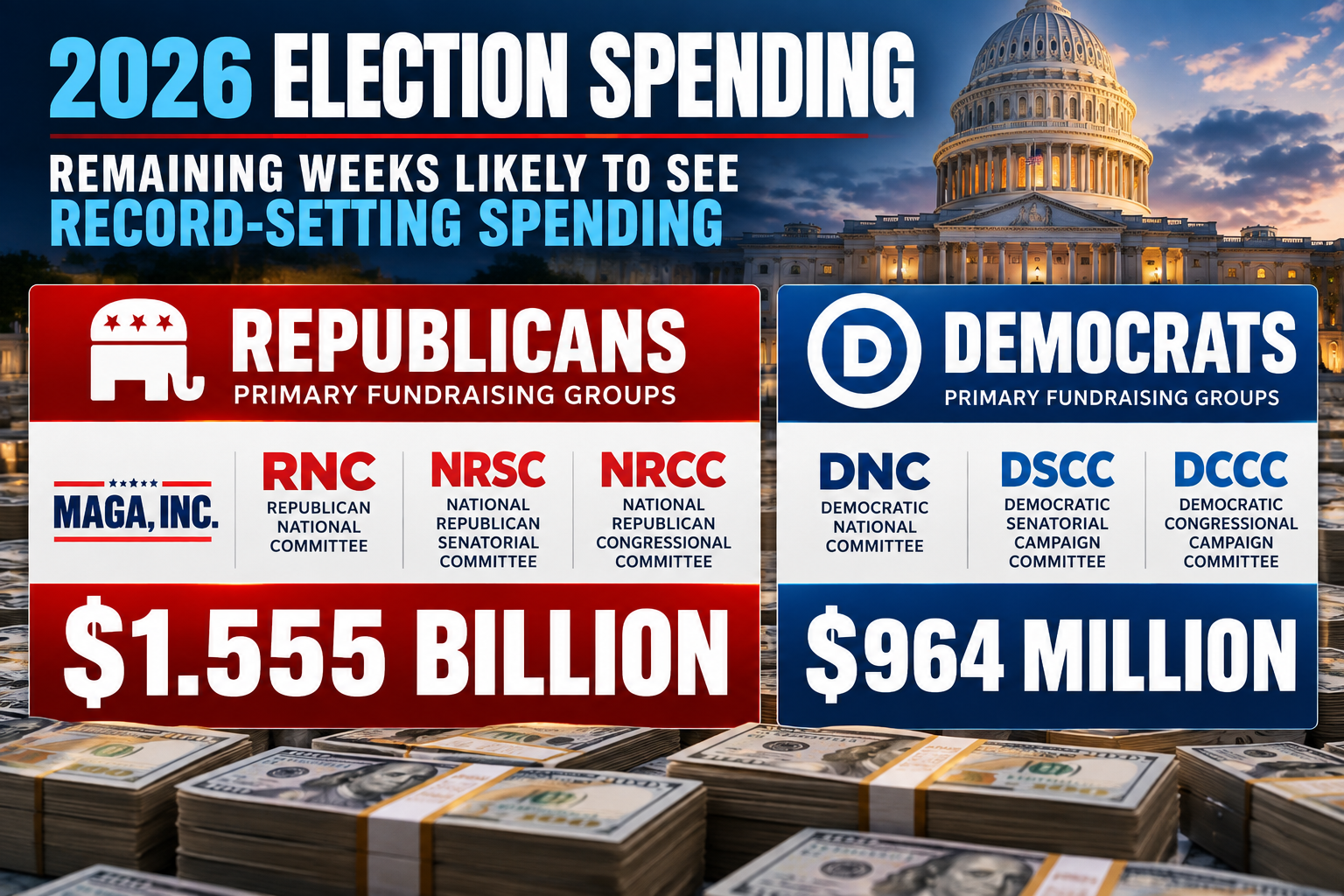
Among the major presidential and party committees, Republicans are led by President Trump’s MAGA, Inc., along with the Republican National Committee (RNC), the National Republican Senatorial Committee (NRSC), and the National Republican Congressional Committee (NRCC). Democrats counter with the Democratic National Committee (DNC), the Democratic Senatorial Campaign Committee (DSCC), and the Democratic Congressional Campaign Committee (DCCC).
Each party also benefits from major outside spending arms aligned with congressional leadership: the Senate Leadership Fund and Congressional Leadership Fund on the Republican side, and the Senate Majority PAC and House Majority PAC for Democrats.
Collectively, these committees have raised more than $2.5 billion in the current election cycle. The largest single entity is President Trump’s MAGA, Inc., which reported an extraordinary $424,389,502 raised through the Aug. 31 monthly filing. The RNC follows with $316,215,037. In aggregate, Republican committees have taken in $1.555 billion for the 2026 cycle, compared to $964 million for the Democratic committees.
Democrats, however, have been the more aggressive early spenders. Across all major party and party‑affiliated committees, Republicans report a combined cash‑on‑hand total of $1.029 billion, while Democrats hold 38 percent of the GOP total: $392 million.
All financial figures come from committee disclosure reports filed on Aug. 31, except those from the Senate Leadership Fund, Congressional Leadership Fund, and Senate Majority PAC, whose next reporting deadline is Sept. 30, with public access beginning Oct. 15.
Another major funding channel for both parties is their online donor platforms, which serve as conduits for small‑dollar contributions to individual campaigns. These entities act as holding companies, transferring funds to campaigns upon receipt. Though campaigns pay significant fees for the service, they benefit from streamlined fundraising without major overhead.
In this arena, Democrats dominate. Despite ActBlue — the party’s flagship online fundraising platform — facing a congressional investigation over potential foreign contributions and other alleged irregularities, and its leaders invoking their Fifth Amendment rights before congressional committees, the organization continues to operate at full speed.
In this cycle, ActBlue has transferred an extraordinary $2.26 billion to Democratic Senate and House candidates. The Republican counterpart, WINRED, has moved more than $748 million to GOP candidates, or 33 percent of Act Blue’s total.
Even with the significant Democratic advantage in online fundraising, the umbrella Republican apparatus still maintains a $564 million overall financial edge. The next question is how the GOP intends to deploy these resources. The first major answers come in Texas and Ohio.
According to AdImpact, the Senate Leadership Fund — through its Texas affiliate — is reserving $100 million in advertising to support Republican Senate nominee Ken Paxton against Democratic state Rep. James Talarico of Austin. The investment is critical for Paxton, whose campaign reported just $1.75 million in cash on hand as of June 30, compared to Talarico’s $21.5 million.
AdImpact also reports that Ohio Sen. Jon Husted’s campaign is positioned to outspend former Democratic Sen. Sherrod Brown by a $90 million to $60.2 million margin in reserved ad time, not including a newly announced $30 million expenditure from the cryptocurrency‑aligned Super PAC Fairshake.
Fairshake spent heavily in 2024 to help defeat Sen. Brown, who, as chairman of the Senate Banking Committee, was one of Washington’s most outspoken cryptocurrency critics.
The remaining weeks of the 2026 election cycle are likely to see record‑setting spending. This cycle has already established a new fundraising benchmark, but it will almost certainly be surpassed, and in short order.
Expect the 2028 presidential cycle to be the most expensive in American campaign history — and the gap between first and second place election cycle spending will not even be close.