
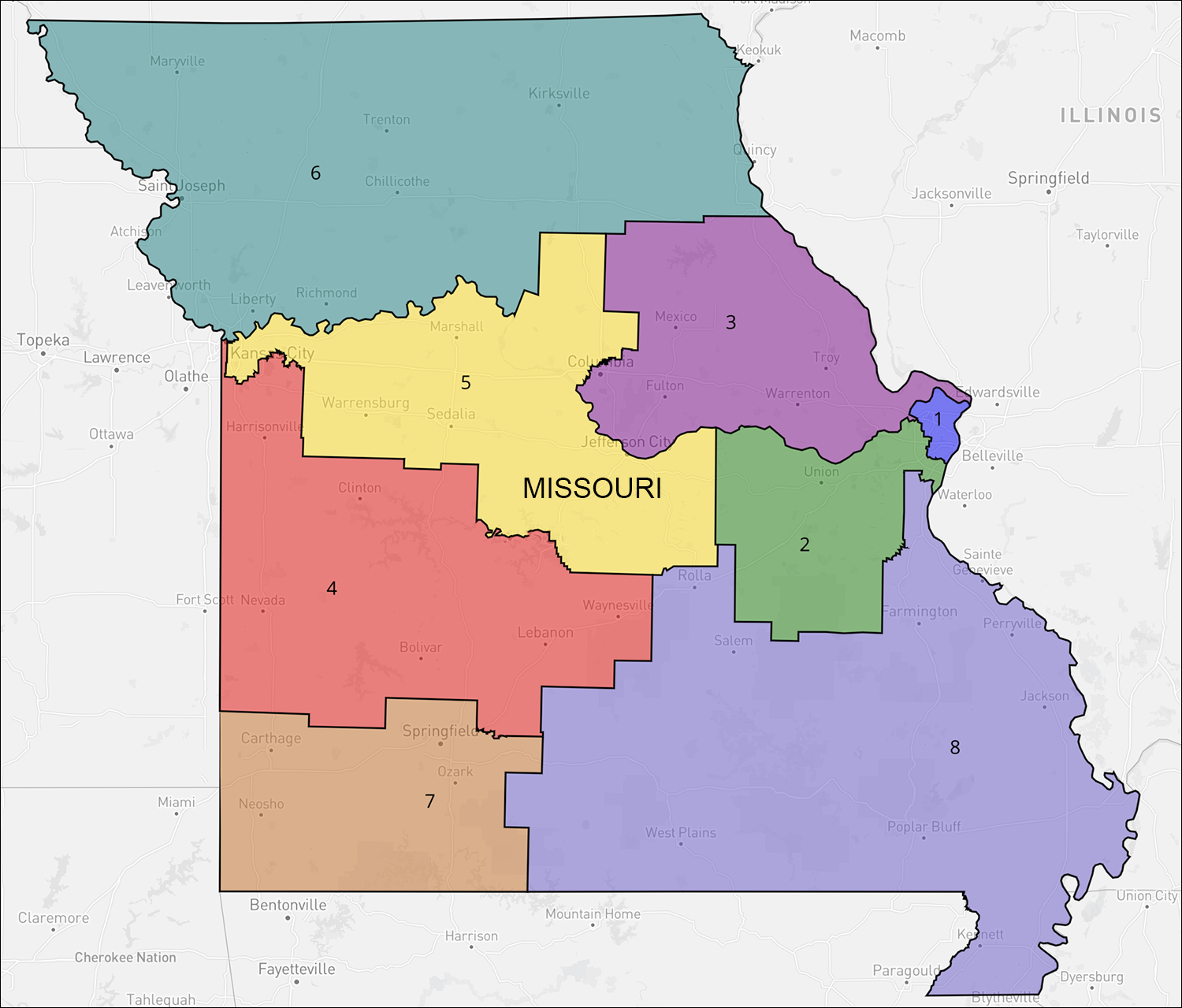
To see an interactive version of this map, go to: Dave’s Redistricting App.
By Jim Ellis — Tuesday, September 8, 2026
Redistricting
Just when it appeared that redistricting litigation had ended for the 2026 election cycle, the Missouri Supreme Court late last week ruled that Secretary of State Denny Hoskins (R) lacked the authority to reject a ballot initiative allowing voters to approve or reject the state’s new congressional map.
According to a comprehensive report from The Down Ballot political blog, Secretary Hoskins had argued that the state constitution “does not authorize” an initiative on congressional redistricting. The court unanimously rejected that position, holding that the Missouri constitution does not prohibit citizens from bringing an initiative on any subject. The justices further ruled that this particular initiative was “legal, sufficient, and timely.”
Missouri Attorney General Catherine Hanaway (R) announced she will immediately appeal the ruling to the US Supreme Court. On Sept. 3, the high court denied an emergency motion from the Michigan‑based organization American for Citizens Voting, which had petitioned the justices to place a proof‑of‑citizenship ballot measure before voters.
As in the Missouri case, the Citizens Voting group had collected well above the required number of signatures to qualify for the ballot, but election officials refused to certify the initiative. The Court offered no explanation for its denial, prompting AG Hanaway to seek a similar ruling on her appeal.
Conversely, if the federal high court takes no action, the newly adopted congressional map – one that would almost certainly have delivered Republicans the Kansas City-anchored seat of Rep. Emanuel Cleaver (D) – is suspended. The Missouri court also reinstated the previous map, under which Rep. Cleaver’s 5th District remains safely Democratic.
What the state court did not address is how to resolve the fact that nominees have already been elected under the now‑disqualified map in the Aug. 4 primary. Missouri will have to account in some manner for the fact that it has congressional nominees in districts that no longer legally exist. The situation is especially difficult because the Missouri ballot certification deadline of Aug. 25 for the Nov. 3 general election has already passed.
It is also unclear who has the authority to decide how replacement nominees should be chosen. Reports suggest “election officials” would determine the new nomination process, but that term is undefined. Would the decision fall to the Secretary of State? The Governor? The Attorney General? Would the legislature be called into special session to enact a remedy? These questions must be resolved before the elections can proceed.
Several electoral options are being discussed. One would be to hold a new primary concurrent with the general election in a jungle format. If no candidate receives a majority, a runoff would be held in early December. Louisiana has adopted this approach because it faces a similar situation.
Another possibility is to conduct partisan primaries on Election Day, followed by a special general election in December. A third option is to rely on state law allowing political parties to appoint nominees when a vacancy occurs.
Yet another suggestion is to assign each nominee to the district number in which they originally ran. While administratively simple, that approach would likely invite litigation because it substitutes an appointed decision for the voters’ and/or parties’ expressed preferences.
Furthermore, the ballot certification process itself poses a major logistical obstacle. Because the certification deadline has already passed, ballot printing is underway. The timeline is further compressed by Missouri’s early‑voting commencement date of Oct. 20.
Additionally, Missouri, like all other states, must comply with the federal Uniformed and Overseas Citizens Absentee Voting Act (UOCAVA), which requires that individuals covered under the act have 45 days official notice before an election. For 2026, affected voters must receive notice beginning Sept. 19.
Once again, a late‑cycle court ruling has placed election administrators in an extremely difficult position as they attempt to meet their legal obligations. What happens next remains uncertain.