
Tag Archives: Virginia

Yesterday’s Odd-Year Election Day

Kentucky Gov. Matt Bevin (L) and Attorney General Andy Beshear

By Jim Ellis

Nov. 6, 2019 — The odd-year Election Day hit yesterday, with voters going to the polls in Kentucky, Mississippi, New Jersey, and Virginia. Governors’ chairs were at stake in Kentucky and Mississippi, while state legislators were on the ballot in all of the aforementioned with the exception of Kentucky.

Bluegrass State Gov. Matt Bevin (R) ran for a second term after a tenure that has seen him dwell at the bottom of the 50-state approval polls for almost his entire time in office. Bevin was a surprise winner in 2015, defeating then-Attorney General Jack Conway (D) who was viewed as the favorite for the entire campaign. Similarly, Gov. Bevin again faced a Democratic Attorney General in this election, Andy Beshear, the son of the man who he replaced in Frankfort, former Gov. Steve Beshear (D).

Polling suggested a close race. Polling was right. As of publish time, the election still was too close to call despite Beshear claiming victory. Bevin would not concede. Fewer than 5,000 votes separate the two candidates, the advantage going to Beshear at the moment.

Bevin lagged behind early in the general election cycle, but returned to parity. The polling pattern was similar in Bevin’s last contest, so he is obviously hoping for a repeat performance. In 2015, Bevin defeated AG Conway by a surprisingly large 52-44 percent spread, a margin that surprised pollsters.

Mississippi featured an interesting gubernatorial campaign between GOP Lt. Gov. Tate Reeves, who attempted to succeed term-limited Gov. Phil Bryant (R), and state Attorney General Jim Hood (D), serving his fourth consecutive term. This race, as in Kentucky, has been close in the polls with Reeves maintaining a small lead. And Reeves is ahead with 53 percent of the vote.

The Mississippi race included a budding controversy that could take shape after the election. Under state law, a gubernatorial candidate must not only win a popular vote majority at the statewide level, he or she must also carry a majority of the 122 state House districts. A federal judge appears ready to strike down the result if the state legislature is forced to decide because no candidate wins both a majority in the statewide vote and in the state House districts.

The entire Virginia House of Delegates and state Senate was on the ballot, and Democrats were confident that they would assume the majority in both houses. Before yesterday, Republicans held a 20-19 edge in the state Senate with one vacancy, and a three-seat margin in the House with one vacancy. The latter majority was literally decided by pulling lots from a hat when the final 2015 Delegate race ended in a tie. The Democrats took back both the House and Senate; it looks like the Democrats will win 21 seats in the state Senate, with the Republicans holding on to 19. In the House, the Democrats are ahead with 53 seats to the Republicans 43 seats with a few races still outstanding.

It was estimated that the redistricting decision since the last election, which mandated the re-drawing of several Delegate districts, would likely give the Democrats an extra boost.

New Jersey voters selected state Assembly members, however the state Senate won’t come before the electorate until 2021. Democrats maintain a huge 54-25 majority with one vacancy, and that could increase. Republican chances of winning a majority in the state Assembly were nil.

Continue reading

Biden Showing Up Strong in North Carolina – But Is It Enough?

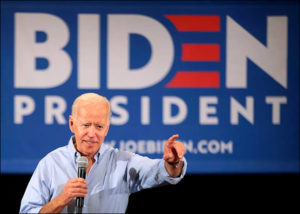
Former vice president and 2020 Democratic presidential candidate, Joe Biden

By Jim Ellis

Oct. 11, 2019 — Raleigh-based Public Policy Polling just released their latest North Carolina survey (Oct. 4-6; 963 likely North Carolina voters, 410 likely North Carolina Democratic primary voters) Wednesday, which projects a two-person race developing in the Tar Heel State as former Vice President Joe Biden leads Sen. Elizabeth Warren (D-MA), 39-22 percent. South Bend Mayor Pete Buttigieg receives nine percent support, while Sen. Bernie Sanders (I-VT) earns only a disappointing six percent. All other candidates fail to break the three percent level.

North Carolina is one of the Super Tuesday states, a state whose electorates will cast ballots on March 3, the largest voting day of the nominating season. On March 3, a total of 14 states and one territory will host primaries or caucuses, seven of which come from the south. It is here where former Biden would have to make his stand, since his southern numbers are the best of any candidate by a wide margin.

The question being posed is whether a sluggish Biden start in the first three voting states, Iowa, New Hampshire, and Nevada, where he could conceivably fail to place first in any, would derail his momentum to the point of lessening his southern advantage.

Making rudimentary delegate calculations from the 19 entities that would vote on or before Super Tuesday, we find that current polling would place the former vice president in the lead on the evening of March 3, but that his delegate edge would certainly not be dominating.

To re-cap, based upon the latest polling from Iowa, New Hampshire, and Nevada, the delegate estimate prior to South Carolina would find the former VP and Sen. Warren tied with 37 delegates apiece, while Sen. Sanders would have 27, meaning a virtual three-way tie despite Biden not winning any of the states outright. If he can stay in the hunt — with neither of his key opponents establishing themselves as a clear leader — the tide turns Biden’s way.

Continue reading

2020 Senate Races: The Latest

By Jim Ellis

Aug. 15, 2019 — New developments are occurring in 2020 Senate races across the country and several are apparently unofficially set for the general election. Below is a recap:

ALABAMA: Two polls have been conducted since both former state Supreme Court Chief Justice Roy Moore and retired Auburn University football head coach Tommy Tuberville joined the Republican race. Each survey showed Tuberville with the lead. The most recent, from the Cygnal research firm (June 22-23), finds Tuberville leading Rep. Bradley Byrne (R-Mobile), 29-21 percent. Judge Moore, the 2017 special election GOP nominee, recorded only 18 percent support among the likely GOP voters. An April 14 Republican run-off is likely after the March 3 primary. The eventual party nominee faces Sen. Doug Jones (D) in the general election.

ARIZONA: While the general election already appears set between appointed Sen. Martha McSally (R) and retired astronaut Mark Kelly (D), the special election schedule is not as clear cut. The 9th Circuit Court of Appeals is considering a lawsuit that challenges the length of McSally’s current appointment. The ultimate ruling could mean an earlier special election. Currently, the special cycle is to run concurrently with the regular 2020 election calendar.

COLORADO: Signs continue pointing to former Gov. John Hickenlooper leaving the Democratic presidential campaign and entering the Colorado Senate race. He looks strong in a Democratic primary – a recent Garin Hart Yang Research poll posts him to a 61-10 percent lead — but he will face a tough general election against incumbent Sen. Cory Gardner (R).

IDAHO: Sen. Jim Risch (R) has announced his re-election campaign for a third term and looks to be a lock for another win.

ILLINOIS: Minority Whip Dick Durbin now has no Democratic primary opposition as state Rep. Anne Stava-Murray (D-Downers Grove) announced several weeks ago that she was ending her Senate campaign. Sen. Durbin is the prohibitive favorite for re-election.

IOWA: The Democratic establishment is coalescing around Des Moines real estate executive Theresa Greenfield. At this point, the general election pairing looks to feature Sen. Joni Ernst (R) and Greenfield.

KANSAS: There is less conjecture that US Secretary of State Mike Pompeo (R) will return to Kansas and run for the open Senate seat and more thought that western Kansas Rep. Roger Marshall (R-Great Bend) will become a candidate. Mr. Marshall already has $1.4 million in his federal campaign account for the 2020 election cycle. He will face a crowded Republican primary but should be favored. Democrats feature a primary between former US Attorney Barry Grissom and ex-one-term Rep. Nancy Boyda.

Continue reading

The Early Delegate Projections

By Jim Ellis

June 25, 2019 — There have been several important state polls recently released that provide us data about where the Democratic presidential candidates stand in relation to popular preference. But that is only half the story.

In order to gauge where the candidates might stand in terms of delegate apportionment, we have taken the available published polls from 16 states and began extrapolating a reasonable delegate projection for each.

For purposes of this exercise, all of the polling data is considered accurate, even though in some instances such a conclusion is a stretch. Additionally, these projections were only based upon the at-large numbers but understand more than half of the delegates come from the state’s chosen districts (usually congressional district, though Texas uses their state Senate seats).

It is reasonable to believe, however, that the district apportionment will, in most cases, be similar to the statewide total. At this point, the at-large ratios are the only data set from which we can begin to draw statistical conclusions.

With that short background, the states and their most recent polling result are listed below along with our unofficial delegate projections listed in chronological order based upon voting schedule:

February 3

Iowa Caucus

(YouGov – May 31-June 12; 587 likely Iowa Democratic primary voters)
• First-Ballot Delegates: 41

Biden 30%
Sanders 22%
Warren 12%
Buttigieg 11%

Delegate Projection:

Biden 15
Sanders 11
Warren   8
Buttigieg   7

Continue reading

The 2020 Democratic Nomination
Will Look Much Different From 2016

By Jim Ellis

May 24, 2019 — As the Democratic presidential field swells to 24 candidates — with the first Democratic presidential forum on tap for late June in Miami, and the first votes being cast in Iowa now just over eight full months away — it’s a good time to review how different this presidential nomination contest will be from the 2016 version.

To review, Hillary Clinton won 34 primaries and caucuses in 2016 as compared to 23 for Sen. Bernie Sanders (I-VT). There are 57 sanctioned delegate voting entities in the Democratic nomination universe. The 57 are comprised of the 50 states, the District of Columbia and the five territories, and a Democrats Abroad category that combines all US citizens living in foreign countries who will still have voting privileges in US elections.

Clinton won 55.2 percent of the 2016 national Democratic popular vote versus Sen. Sanders’ 43.1 percent when combining the totals from all the primaries and caucuses. Though the Sanders Campaign called foul over the Super Delegate voting inflating Clinton’s delegate total, and actually turning six states’ first-ballot roll call from Sanders to Clinton and sending one more state into a tie, Clinton still carried the pledged, or elected delegate, count 2,205 to 1,846, translating to a 54.4 percent margin. When adding the Super Delegate and uncommitted delegate votes, she captured 58.3 percent of the convention total.

Continue reading

McAuliffe Pulls Back From Running

By Jim Ellis

April 22, 2019 — After once indicating that he was preparing to announce a presidential effort, former Virginia governor and ex-Democratic National Committee chairman Terry McAuliffe said that he would not become a national candidate. Rather, he said late last week, he plans to work in Virginia to help Democrats make further political gains in the Old Dominion.

Though McAuliffe continued to keep his name alive as a potential presidential candidate, the preparatory actions surrounding such a move never seemed to be in evidence.

Interestingly, when asked whether he would consider running for governor again in 2021, he didn’t rule out the possibility. Virginia is the only state in the nation that bars a governor from running for two consecutive terms, but it doesn’t prohibit an ex-chief executive from returning after a break in service.

Currently, the number of officially announced presidential contenders is 19, with former Vice President Joe Biden still not confirming his informal candidacy.

Montana Gov. Steve Bullock and US Rep. Seth Moulton (D-MA) are also making visits to early primary states and appear to be readying a respective campaign apparatus.

Sen. Michael Bennet (D-CO) indicated last week that he wants to enter the national campaign, but a prostate cancer diagnosis has derailed any short-term plans he had to join the large field; however, his long-term health prognosis appears strong.

Continue reading

The Early Targets

By Jim Ellis

April 3, 2019 — Continuing our early outlook of the 2020 House situation, we can begin by narrowing the field to those districts where Republicans will be concentrating at least their initial efforts in order to reclaim the majority they lost in November.

After the 2016 election, there were 12 districts that supported President Trump but elected a Democrat to the House. After the 2018 midterm, that number rose to 31. For the Republicans to regain the majority, they will need to convert a net 18 seats back to their column, or 19 if the Democrats score a victory in the NC-9 special election to be held later this year in the Charlotte-Fayetteville metro areas in southern North Carolina.

The other two House special elections, PA-12 (May 21) and NC-3 (Sept. 10), unless huge upsets occur, look to remain within the Republican stable of districts.

Of the 31 Trump/House Democrat seats, 16 of them also voted for Mitt Romney over President Obama in 2012. Furthermore, a dozen within this group elected a Republican Representative until the 2018 election. They are:

  • GA-6 – Rep. Lucy McBath (D) – Defeated Karen Handel (R)
  • IL-14 – Rep. Lauren Underwood (D) – Defeated Randy Hultgren (R)
  • MI-8 – Rep. Elissa Slotkin (D) – Defeated Mike Bishop (R)
  • MI-11 – Rep. Haley Stevens (D) – Replaced David Trott (R)
  • NJ-11 – Rep. Mikie Sherrill (D) – Replaced Rodney Frelinghuysen
  • NM-2 – Rep. Xochitl Torres Small (D) – Replaced Steve Pearce (R)
  • NY-22 – Rep. Anthony Brindisi (D) – Defeated Claudia Tenney (R)
  • OK-5 – Rep. Kendra Horn (D) – Defeated Steve Russell (R)
  • SC-1 – Rep. Joe Cunningham (D) – Replaced Mark Sanford (R)
  • UT-4 – Rep. Ben McAdams (D) – Defeated Mia Love (R)
  • VA-2 – Rep. Elaine Luria (D) – Defeated Scott Taylor (R)
  • VA-7 – Rep. Abigail Spanberger (D) – Defeated Dave Brat (R)

Continue reading