Tag Archives: Vice President Joe Biden

Colorado & Hickenlooper —
Decisions, Decisions

By Jim Ellis

Feb. 27, 2019 — Saying he’s “not cut out to be a senator,” former Colorado Gov. John Hickenlooper (D) said that he will either run for president in 2020 or no office at all. He further stated that, “Senators don’t build teams. Senators sit and debate in small groups … But I’m not sure that’s my — I’m a doer. That’s what gives me joy.”

Former Colorado Gov. John Hickenlooper – not running for Senate (Photo Moritz Hager)

While Hickenlooper is definitive that he won’t enter the Democratic senatorial primary to challenge first-term GOP incumbent Sen. Cory Gardner, he also has made lesser-than-expected moves toward entering the presidential race.

With already a dozen Democrats either officially entering the race or forming exploratory committees, and ex-Vice President Joe Biden set to announce his decision about becoming a candidate in the coming month, Hickenlooper, with low national name identification, may be waiting too long to generate a serious effort. Therefore, the more time that passes, the greater the chances of this ex-two-term governor and Denver mayor not being on the ballot at all in 2020.

The Monday announcement was certainly good news for Sen. Gardner. Possibly in the most vulnerable position of any Republican senator standing for re-election in 2020 – largely because his state has voted decidedly Democratic in the past several elections – the Colorado and national party leadership had hoped to recruit Hickenlooper into the Senate race. Most political observers clearly believe he would be Gardner’s strongest general election challenger.

Right now, mostly minor candidates have announced for the senate in Colorado. The two most prominent Democratic figures are former state House speaker and defeated US Senate and congressional candidate Andrew Romanoff, and ex-state senator and defeated gubernatorial candidate Mike Johnston, who finished third in the 2018 party primary that nominated current governor, Jared Polis.

Continue reading

With Sanders Now a Democratic
Presidential Candidate,
What is His Path to Victory?

By Jim Ellis

Sen. Bernie Sanders (I-D/VT)

Feb. 21, 2019 — Calling Donald Trump “the most dangerous president in modern American history,” Sen. Bernie Sanders (I-D/VT) announced his 2020 presidential campaign through You Tube and email this week.

His further virulent attack on President Trump was softened by his call to unite America under his presidential campaign, with a goal, he stated, of recruiting more than 1 million volunteers to participate in a grassroots message delivery operation.

The rhetoric notwithstanding, where is Sen. Sanders’ path to the Democratic nomination? This will only be the second time in his long career where he has actually entered Democratic Party primaries. Has his political opportunity window closed as many believe to be the case?

Though the senator is now 77 years of age and would be 79 when sworn into office, should he win the presidency next year, he still has strong support within the youngest segment of the American electorate. He also attempts to appeal to racial minorities, union workers, and climate change activists as the core constituencies of a political base that he believes can expand and carry him to the nomination.

But, unlike 2016, when he battled eventual nominee Hillary Clinton one-on-one through all of the primaries and to the Democratic National Convention only to lose 60-40 percent on the first ballot roll call, he does not have the Democratic left all to himself.

Continue reading

Poll: Harris Underwhelms in CA

By Jim Ellis

Declared presidential candidate, Democrat Sen. Kamala Harris of California.

Feb. 19, 2019 — A new Change Research poll was just released of the California Democratic presidential electorate and should former Vice President Joe Biden enter the race, he apparently would fare quite well in Sen. Kamala Harris’ home state.

According to the survey (Feb. 9-11; 948 likely California Democratic presidential primary voters) Biden and Sen. Harris would actually tie at 26 percent apiece. Sen. Bernie Sanders (I-D/VT) closely trails with 20 percent.

Considering the delegate proportionality rules, the two men would score a handsome number of committed delegates in Sen. Harris’ own backyard if this poll happens to correctly predict what could happen a year from now.

California is projected to send 495 delegates to the July 2020 Democratic National Convention, the largest contingent from any state. If Sen. Harris is to become a first-tier presidential candidate, she will have to reap a major delegate bounty in her home domain. Thus, merely breaking even with Mr. Biden would certainly be considered a disappointment in her quest for the nomination.

The rest of the field trails badly. No one, aside from the top three, even breaks into double-digits. In this survey, former Rep. Beto O’Rourke (D-TX) is fourth with eight percent, followed by Massachusetts Sen. Elizabeth Warren who posts a paltry seven percent, ahead of Sen. Cory Booker (D-NJ) with three percent, while former Housing & Urban Development secretary Julian Castro holds a two percent preference.

Continue reading

Biden Remains Ahead of the Pack

By Jim Ellis

Feb. 14, 2019 — A new Morning Consult national survey of Democratic presidential primary voters again finds former Vice President Joe Biden leading an ever-growing pack of hopefuls vying for the opportunity of facing President Trump in the 2020 general election.

The survey (Feb. 4-10: 11,627 registered voters who say they may vote in a Democratic presidential primary or attend a party caucus; 517 “early primary state” voters from Iowa, New Hampshire, Nevada and South Carolina), finds the former VP and long-time Delaware senator holding a 29-22-13 percent lead over Vermont Sen. Bernie Sanders (I/D-VT) and California Sen. Kamala Harris.

Sixteen more candidates or potential candidates were included in the poll, but none could crack double-digits. In the second tier, Sen. Elizabeth Warren (D-MA) pulled eight percent, closely followed by former Texas Rep. Beto O’Rourke (D-El Paso) with seven percent, and Sen. Cory Booker (D-NJ) who attracted five percent support. All of the others fell in between three percent and zero, inclusive.

Looking at only the four early states of Iowa, New Hampshire, Nevada and South Carolina (derived from an aggregate respondent group of 517 self-identified Democrats in those places), the order of candidates in the top tier doesn’t change, and Biden extends his lead to 33-21-11-10 percent over Sens. Sanders, Harris, and Warren. Sen. Booker gains one point to six percent, while ex-Rep. O’Rourke falls to five percent. No one else exceeds two percent.

Continue reading

Two New Polls Show Tracking Trends In 2020 Presidential Race

By Jim Ellis

Feb. 6, 2019 — The Emerson College Polling Institute and Monmouth University just released two presidential polls, the former of Iowa voters, the latter, a national study.

The Emerson poll (Jan. 30-Feb. 2; 831 registered Iowa voters, 260 likely Iowa Democratic caucus attenders) finds former Vice President Joe Biden leading Sens. Kamala Harris (D-CA) and Bernie Sanders (I-D/VT), 29-18-15 percent, while Sen. Elizabeth Warren (D-MA) posts 11% support.

The other candidates land in single digits: ex-Rep. Beto O’Rourke (D-TX) at six percent; Sens. Cory Booker (D-NJ) and Sherrod Brown (D-OH) both with four percent; Sen. Amy Klobuchar (D-MN) has three percent; while former HUD Secretary Julian Castro posts two percent, and ex-Rep. John Delaney (D-MD) each register one percent support.

The results are consistent with previous polls conducted of the Iowa Caucus sampling universe even though the Democratic sample in this survey is very low.

During the period of Jan. 25-27, Monmouth University tested a national sample of 735 registered US voters from a pool of 805 adults to determine perceptions mostly of the Democratic candidates, but also queried the aggregate respondent universe about President Trump.

Continue reading

Northam on the Edge

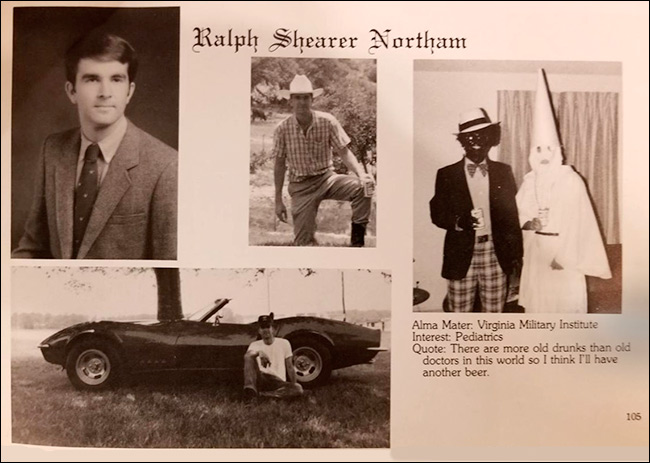
The racially charged photo compilation above appeared in the 1984 yearbook of the medical school Gov. Ralph Northam attended with his name on the page.


By Jim Ellis

Virginia Democratic Gov. Ralph Northam

Feb. 5, 2019 — Virginia Democratic Gov. Ralph Northam continues to reel, and many believe the increasing pressure upon him to resign will force him from office within the next 48 hours.

Northam defeated former Republican National Committee chairman Ed Gillespie, 54-45 percent, in the 2017 statewide election. His term will expire at the beginning of 2022.

The number of Democrats publicly opposing Northam over the publication of a racially charged medical school year book picture increased substantially over the weekend, capped by a joint pro-resignation statement issued from Sens. Mark Warner and Tim Kaine, along with House Education & Labor Committee chairman Bobby Scott (D-Newport News).

Former Gov. Terry McAuliffe, who Northam served as lieutenant governor, and Congressional Black Caucus member Donald McEachin (D-Richmond) also joined the chorus of detractors in addition to Democratic National Committee chairman Tom Perez, former Vice President Joe Biden, several other presidential candidates, and ex-Virginia Gov. Doug Wilder, the state’s first African American governor who was elected in 1989.

Continue reading

American Electorate Tracking Poll:
A Look at The Underlying Numbers

By Jim Ellis

Jan. 29, 2019 — In the past couple of days, the new Morning Consult American electorate tracking poll (Jan. 18-22 — 1,996 US registered voters; 35 percent self-identified Democrats, 33 percent Independent, 32 percent Republican) captured media attention because it released a national Democratic presidential primary ballot test.

The results concluded that former Vice President Joe Biden is leading Sen. Bernie Sanders 17-12 percent while 19 other candidates or potential candidates all fell into single digits. (Some reports indicated Biden’s edge over Sanders was 26-16 percent, but this was done by eliminating some minor candidates and extrapolating the remaining preference votes among the major candidates. The actual polling results for the entire field are the ones quoted in the first sentence of this paragraph.) But, the figures are largely irrelevant because the ballot test was asked of the whole respondent pool and not just the Democrats and Independents who lean Democratic.

The inclusion of the Republican and Republican-leaning Independents certainly would skew this data, thereby not accurately depicting where the candidates stand among Democrats, and more particularly, Democratic primary voters and likely caucus attenders. This makes the results highly questionable as they relate to where national Democrats are headed in choosing a presidential nominee.

The ballot test, however, was just one query of 82, an extensive segmented questionnaire that, for the most part, provides us interesting and useful issue data.

While President Trump is clearly in what could be the lowest point of his presidency in terms of popularity and job approval – Morning Consult finds him with a 40:57 percent favorable to unfavorable ratio – those highly negative opinions don’t necessarily carry through to other Republicans.

Continue reading

What to Expect

We’re back after going dark briefly over the Christmas holiday. (No, just in case you were wondering, we’re not part of the government shutdown.) We trust that you are rested, recharged and ready for the new year and the ever-evolving political developments that will come.

By Jim Ellis

Jan. 2, 2019 — We kick off a new calendar and political year looking at several anticipated events. On the presidential front, we can expect several candidate announcements coming in January, along with a changing primary/caucus schedule. Additionally, some close losing congressional candidates are already declaring they want a re-match.

Sen. Elizabeth Warren (D-MA) began the new year by forming a presidential exploratory committee and stating that she would begin her potential national campaign with a four-city information-gathering tour in Iowa, site of the first presidential votes scheduled for early February of 2020.

Four potential Democratic candidates are reportedly close to hiring key personnel either as national managers or Iowa state leaders. Aside from Sen. Warren, Sens. Kamala Harris (D-CA), Cory Booker (D-NJ), and Kirsten Gillibrand (D-NY), are apparently poised to make staffing announcements possibly within the first two weeks of this new month and year.

An imminent presidential candidacy declaration is expected from former Housing and Urban Development Secretary Julian Castro (D-TX), who formed an exploratory committee in early December. Rumors in Texas abound, however, that while Castro may begin to compete in the presidential race he could pivot out of the national campaign and into a US Senate challenge against Sen. John Cornyn (R-TX) if he fails to gain traction.

Continue reading

The Next Special

By Jim Ellis

Feb. 23, 2017 — Former South Carolina Congressman Mick Mulvaney’s (R-Lancaster/Rock Hill) resignation officially launches the fourth US House special election, as individuals are now formally becoming candidates. Though Gov. Henry McMaster (R) has not yet set the special election calendar, state election law mandates when voting must occur.

Under South Carolina law, a partisan primary special election for a commensurate vacant position is held on the 11th Tuesday following an incumbent leaving a particular office. Since Mulvaney resigned just after being confirmed as director of the Office of Management & Budget on Feb. 16, the special election clock for filling the now open 5th Congressional District began ticking.

Last week’s resignation means May 2, the 11th Tuesday after the date of vacancy, will host the respective partisan primaries. If no candidate obtains majority support in the party primary, the run-off will occur on the 13th Tuesday following the vacancy date, meaning May 16 in this case. The special general then follows on the 18th Tuesday post-vacancy, thus translating into June 20.

Continue reading

Graham Out; Senate Primary Preview

By Jim Ellis

April 25, 2016 — Ever since the Florida State Supreme Court decided to re-draw the congressional boundaries halfway through the decade, freshman Rep. Gwen Graham (D, FL-2, Tallahassee) has been in the political wilderness. The court declared eight of the state’s districts unconstitutional last July and finished the new map earlier this year, radically changing the original plan as enacted by the legislative and executive branches.

After the preliminary map became public it was evident that Rep. Graham was becoming a political casualty. Wanting to draw a minority 5th District that stretched from Jacksonville to Tallahassee instead of the traditional draw that began in J’ville and then meandered through Gainesville and Sanford on its way to Orlando, the court sacrificed Graham by removing the Democratic base from the 2nd District seat and transferring it to the new District 5.

Rumors were rampant that Graham, the daughter of former governor and US Sen. Bob Graham (D), would enter the open Senate race. As time passed with no movement in that direction, it was apparent she saw her career heading in a different direction. Yesterday, Rep. Graham announced that she will not seek re-election, and broadly hinted that running in the open 2018 governor’s race is within her political future.

Continue reading