
Tag Archives: New York

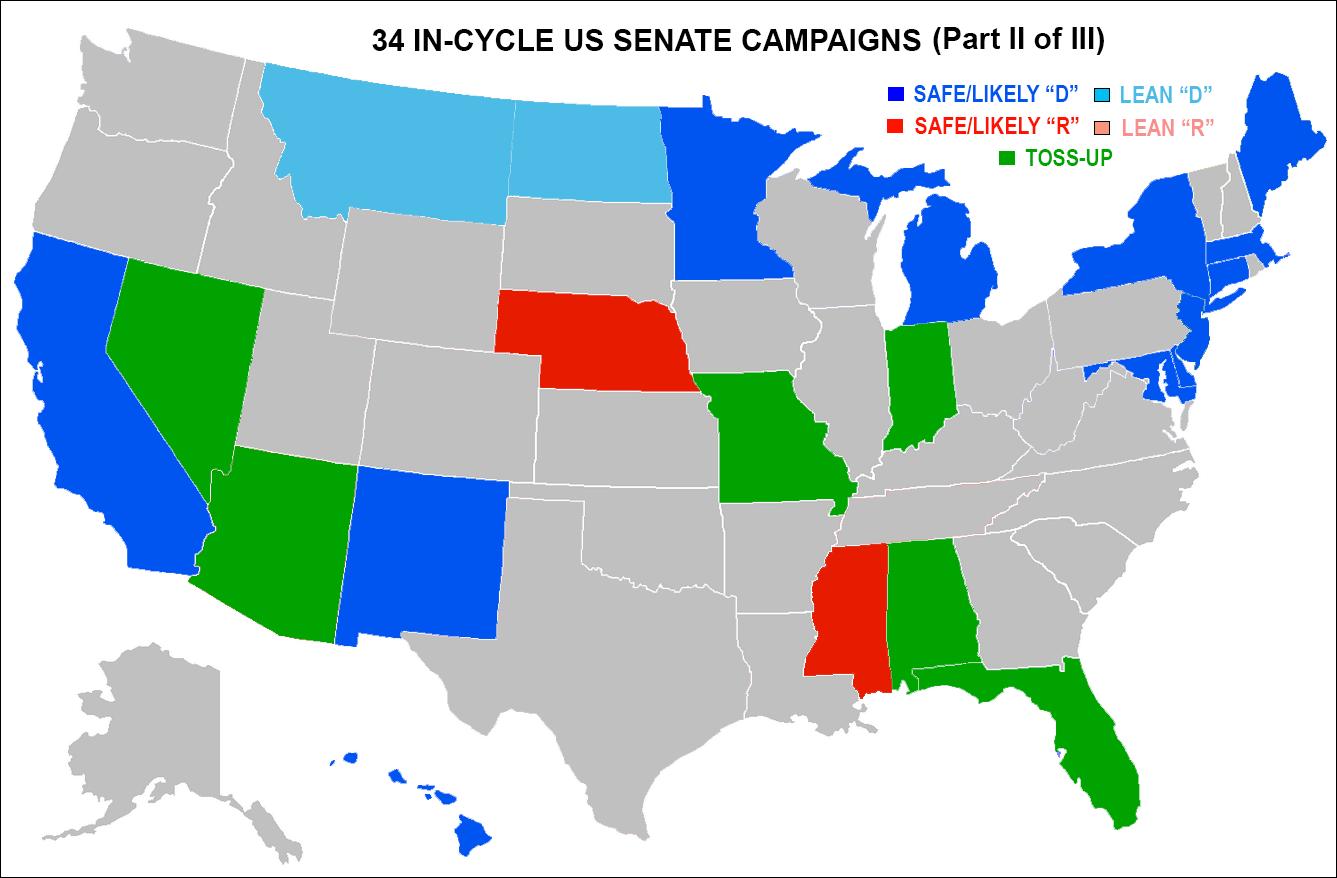
Senate Candidate Review – Part II

By Jim Ellis

Sept. 26, 2017
— Yesterday, we reviewed the first half of the 33 in-cycle Senate races in terms of serious candidate personnel. Today, the remaining 17 states are covered.

As a reminder, no current Senate incumbent has announced his or her retirement.

(Regular type means the individual is an announced contender; italics denote possible candidate.)

NEVADA — TOSS UP
Sen. Dean Heller (R)
Danny Tarkanian (R) – Businessman, frequent candidate
Rep. Jacky Rosen (D) – US Representative, 3rd District
Rep. Dina Titus (D) – US Representative, 1st District

NEW JERSEY — LIKELY D
Sen. Bob Menendez (D)
• Sen. Menendez federal trial has frozen potential Democratic and Republican Senate hopefuls. After the Menendez legal situation is decided, much could happen in this state.

NEW MEXICO — LIKELY D
Sen. Martin Heinrich (D)
Mick Rich (R) – State Labor Commission member
Richard Berry (R) – Albuquerque mayor
John Sanchez (R) – Lt. Governor

Continue reading

The Crystal Ball:
Points of Disagreement

By Jim Ellis

July 31, 2017 — University of Virginia professor Larry Sabato has released his latest “Crystal Ball” political ratings, but further arguments must come to the forefront about some of his individual race categorizations.

In the first part of his latest report, Sabato illustrates that the number of Democrats already running for Congress shatters the new candidate rate of previous off-election years. Currently, 209 Democrats have declared themselves as US House candidates at this point in the election cycle, obliterating the mean average of 42.6 derived from the period beginning in 2003 to the present. For Republicans, 28 non-incumbent candidates have currently declared, well below their non-election year average of 42.8 within the same post-2003 time frame.

But, so many Democratic candidates are declaring in the same districts, thus skewing the situation. For example, in the 14 seats where a GOP incumbent voted in favor of the healthcare legislation sitting in a district that Hillary Clinton carried, 57 Democratic candidates have already declared. In the seven competitive California Republican seats where national Democratic Party leaders pledge to heavily contest, 34 Dems have become candidates, though duplication does exist to some extent between the two aforementioned categories. In three more sites featuring presumed competitive 2018 campaigns: AZ-2 (Rep. Martha McSally, R-Tucson), FL-27 (open seat; Rep. Ileana Ros-Lehtinen, R-Miami), and VA-10 (Rep. Barbara Comstock, R-McLean), an additional 23 candidates are competing within this trio of CDs.

Therefore, we find in these 16 unique, prime, targeted congressional seats, a total of 72 individuals who are active Democratic candidates. We also know today that 56 of these competitors will lose their primary because, of course, every district can only nominate one candidate per political party.

Continue reading

Senate ’18 Updates – Part III

By Jim Ellis

March 21, 2017 — Today, we continue to examine the latest happenings for the coming 2018 Senate campaigns.

• New Mexico:
The open governor’s race is attracting most of the early political attention in the Land of Enchantment. Once the field to replace term-limited Gov. Susana Martinez (R) solidifies itself, it’s possible we could see more interest develop for opposing first-term Sen. Martin Heinrich (D). Lt. Gov. John Sanchez, US Rep. Steve Pearce (R-Hobbs), and Albuquerque Mayor Richard Berry are all potential Republican gubernatorial candidates. So far, only State Labor Commissioner Mick Rich (R) is an announced US Senate candidate.

• New York: Sen. Kirsten Gillibrand (D) is preparing for re-election to a second six-year term in 2018. Presidential overtones will affect this race, as the senator is being mentioned as a possible national Democratic candidate. Little in the way of Republican Senate opposition is forming against her right now.

• North Dakota: Sen. Heidi Heitkamp (D) attracted a great deal of media attention when President Trump first interviewed her for Agriculture Secretary during the post-election transition period. A 50-49 percent winner in 2012, Heitkamp defeated one-term at-large US Rep. Rick Berg (R), and now she prepares for a second term possibly against another at-large congressman. Rep. Kevin Cramer (R-Bismarck) says he will decide whether to run for the Senate “in the next few months.” Obviously, a Heitkamp-Cramer race would be a hard fought contest, but it is far from certain that the congressman will make the challenge. This is clearly a race to watch, and a top Republican conversion target, especially if Rep. Cramer decides to run.

Continue reading

Polarized, or Not?

By Jim Ellis

March 1, 2017 — Much is being made about President Trump’s early job approval ratings. Almost across the board, they are low, and particularly so for a new national chief executive, which has naturally attracted media attention.

In their late February report about political polarization, the Gallup polling organization, which began testing presidential job approval back in the Truman Administration and has regularly continued the practice ever since, argues that polarization among the self-identified Republicans and Democrats is a major obstacle for President Trump to overcome. They further make the point that this is not a new phenomenon, as partisan approval polling detected similar numbers for presidents Barack Obama and George W. Bush.

The Gallup analysis, on and around the Feb. 20 time frame, found President Trump’s job approval rating to be 42 percent. When they looked at the two previous presidents, also hitting 42 percent approval rating at certain points in their own presidencies, Gallup found the level of partisan support and opposition among Democrats and Republicans for the president of their own party was virtually identical.

Continue reading

Democrats Play Offense

By Jim Ellis

Feb. 1, 2017 — The Democratic Congressional Campaign Committee (DCCC), in a memo from Executive Director Dan Sena, on Tuesday released their first 2018 target list of who they believe are the vulnerable Republican US House members. A total of 59 districts occupy the list; some that make sense, while others are long shots to say the least.

Included are eight freshmen members: representatives Brian Mast (FL-18), Jason Lewis (MN-2), Ted Budd (NC-13), Don Bacon (NE-2), John Faso (NY-19), Claudia Tenney (NY-22), Lloyd Smucker (PA-16), and Scott Taylor (VA-2). The freshman targets’ win percentages span from a low of 43.7 percent (Tenney) to a high 61.3 percent (Taylor), with an average of 51.9 percent among the eight.

Within the entire group of 59 targets, only five failed to reach majority support in their districts: representatives Tenney (43.7 percent), Lewis (46.9 percent), Will Hurd (TX-23; 48.3 percent), Martha Roby (AL-2; 48.8 percent), and Bacon (48.9 percent).

In the 59 Republican CDs, Hillary Clinton’s performance was better than former President Obama’s 2012 showing in 23 of them, her best Republican district being Rep. Ileana Ros-Lehtinen’s South Florida FL-27, where the 2016 Democratic nominee garnered 58.6 percent. Sophomore Rep. Carlos Curbelo’s neighboring 26th District was her second-best seat. Here, Clinton tallied 56.7 percent of the vote.

Continue reading

Election 2016: Urban vs. Rural

By Jim Ellis

Jan. 26, 2017 — Now that the election returns are official and divided into congressional district and county totals, we can now see exactly how the presidential election unfolded.

It became clear from early Election Night totals that Donald Trump won the national vote because of his performance in the outer suburbs and rural areas in the 30 states that he carried over former Secretary of State Hillary Clinton. His margins there, largely because of turnout, were enough to compensate for Clinton’s larger-than-expected advantages in the major cities and inner suburbs.

In looking at the country’s largest metropolitan statistical areas, we find that Clinton scored an average 59.9 percent of the vote, when averaging her percentage performance in the nation’s 10 most populous urban regions. This compares to President Trump’s 35.8 percent. Keep in mind that the national popular vote percentage total was 48.1 – 46.0 percent.

In the rural areas surrounding these specific urban centers, the numbers dramatically changed. Counterbalancing the Clinton margins in the metroplexes, Trump’s lead in the outer suburban and rural regions in the states he carried was roughly equivalent to the former secretary of state’s urban advantage but with greater turnout. In the corresponding Trump state rural regions, the new president averaged 56.8 percent as compared to Clinton’s 39.7 percent.

Continue reading

House Becoming Clearer

By Jim Ellis

Nov. 4, 2016 — The late turnout trends, as influenced greatly by how the presidential race is closing, may well be increasing Republican/right-of-center voter participation. If so, this will have great effect upon the House races, potentially holding down Democratic gains because more heavily contested GOP incumbents will survive.

Looking at all House as we head into the final weekend of campaigning, it appears that 226 seats are rated as Safe Republican, Republican Favored, or Lean Republican. Democrats look to have 189 seats where their candidates are rated as safe, favored or leaning to their party.

The remaining 20 are toss-up campaigns. Sixteen of these are in current Republican CDs, while the remaining four are Democratic.

Included in what we can refer to as the “decided count”, are five Republican seats headed to the Democratic column and one Dem seat returning to the GOP. Four of these six turning districts are directly related to the mid-decade redistricting process in Florida and Virginia.

The one Democratic seat going Republican is the open northern Florida seat of retiring Rep. Gwen Graham (D-Tallahassee). Because the adjacent 5th District was drawn to elect a minority candidate in a drastically different manner than the previous 5th District, a major chunk of Rep. Graham’s Democratic base was removed from her 2nd District. Without a reasonable place to run for re-election, Graham retired after one term, but we will likely see her in the 2018 open governor’s race. The new 2nd District will go to Dr. Neal Dunn, who won a two-point Republican primary victory in late August. Under the new draw, the GOP nomination is tantamount to election in the fall.

Continue reading