Tag Archives: Nebraska

Bannon: How Much a Factor?

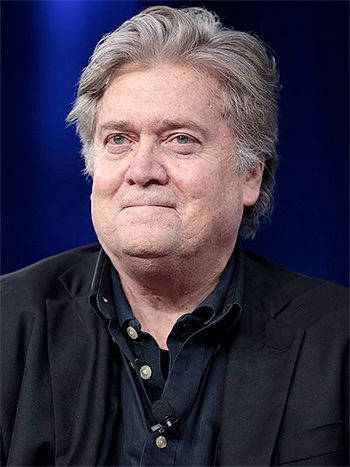
Steve Bannon (Photo by Gage Skidmore)

Steve Bannon (Photo by Gage Skidmore)

By Jim Ellis

Oct. 5, 2017 — Several articles have appeared in the past few days contemplating former presidential advisor Steve Bannon’s perceived political strength, most specifically regarding his actions involving recruiting Republican primary challengers against Senate Majority Leader Mitch McConnell’s (R-KY) loyalists.

While Bannon appears in good stead vis-à-vis financial backers — with the billionaire Mercer family serving as his monetary base — those running the McConnell-aligned outside political operation downplay just how strong the insurgents might be opposite 2018 Senate GOP incumbents standing for re-election.

Valid points resonate with both sides. Buoyed by Alabama former state Supreme Court Chief Justice Roy Moore’s victory over appointed Sen. Luther Strange in last week’s special Republican run-off election, the Bannon forces, who heaped attack ads on the interim incumbent, were naturally taking a great deal of credit for the victory. And, without doubt, anyone thinking of challenging a sitting senator is greatly encouraged after seeing the Alabama outcome.

Continue reading →

Senate Candidate Review

By Jim Ellis

Sept. 25, 2017 — After Friday’s review of the open House races, today we update the first half of the 33 in-cycle Senate races in terms of serious candidate personnel. Tomorrow, we will complete the remaining 17 states.

In contrast to the House where 26 regular cycle seats are open, no current Senate incumbent has announced his or her retirement.

(Regular type means the individual is an announced contender; italics denote possible candidate.)

ARIZONA — TOSS UP
Sen. Jeff Flake (R)
Kelli Ward (R) – former State Senator
Jeff DeWit (R) – State Treasurer
Rep. Kyrsten Sinema (D) – US Representative
State Rep. Randy Friese (D) – Physician; Tucson area state legislator
• Sen. Flake is in trouble in the Republican primary largely due to his personal feud with President Trump. Rep. Kyrsten Sinema (D-Phoenix) waits in the wings. Should she enter the race, there is a strong chance the Democrats coalesce behind her.

CALIFORNIA — SAFE D
Sen. Dianne Feinstein (D)
State Sen. Kevin de Leon (D) – State Senate President
• Indications are suggesting that Sen. Feinstein, now 84 years old, will seek re-election. She should have little in the way of opposition, but state Senate President Kevin de Leon (D-Los Angeles) made public statements about challenging the senator after the latter made a favorable comment about President Trump. Unlikely such a challenge will actually happen, however.
Continue reading →

Flake Opposition Mounting

Sen. Jeff Flake (R-AZ)

Sen. Jeff Flake (R-AZ)

By Jim Ellis

July 5, 2017 — With the Republican healthcare overhaul bill remaining in a controversial state, and Democrats already trying to use it as a rallying point for potential 2018 candidates, the Arizona Senate field is beginning to form. Currently, three potential challenger candidates continue to weigh their options on the political sidelines.

Because Democrats have so few targets in the present election cycle – Republicans must only protect eight of the 33 states holding Senate elections, and six of those are in arguably their strongest political domains: Mississippi (Wicker), Nebraska (Fischer), Tennessee (Corker), Texas (Cruz), Utah (Hatch), and Wyoming (Barrasso) – they have no choice but to go hard after the two GOP incumbents entwined in more marginal political situations: Sens. Dean Heller (R-NV) and Jeff Flake (R-AZ).

Though Arizona voters routinely elect many more Republicans than Democrats, despite many campaigns ending in relatively close fashion, the Dems are forced to make a major play against Sen. Flake because they simply have no other secondary place with as much 2018 competitive potential. On defense in 25 states, Senate Democrats will not win the majority because a net gain of two, including defeating Sen. Flake, would yield only a 50-50 tie. Such a division would allow Vice President Mike Pence to ensure that the GOP majority continues in his role as the body’s tiebreaker.

Last week, both Phoenix Mayor Greg Stanton (D) and state Rep. Randy Friese (D-Tucson), the latter man coming to notoriety as the doctor who saved Rep. Gabrielle Giffords’ (D-Tucson) life when an insane gunman tragically shot her, brought forth public attacks on the current healthcare legislation and began sounding like candidates.

Mayor Stanton and Dr. Friese confirm they are considering entering the Senate race, and it’s not out of the realm of possibility that one or both men could announce their candidacy on the heels of the Senate healthcare vote, particularly if Sen. Flake supports the legislation. Both would be credible candidates and it is unclear at this writing if one would step aside in favor of the other.

Another individual hovering in the background of this Grand Canyon State political picture is Rep. Kyrsten Sinema (D-Phoenix). She has been on a fundraising tear, and though already announcing her intention to seek a fourth term in the House, Sinema does admit to be considering a Senate bid if the circumstances are favorable. By that, she means Sen. Flake drawing a strong Republican primary challenger. It is also unclear if Rep. Sinema will risk her now safe Maricopa County House seat to join what could be a crowded Democratic primary against potentially top-tier candidates even if she perceives Flake to be politically weak.

As we will remember from the last campaign cycle, Sen. Flake became embroiled in a public feud with then-presidential candidate Donald Trump and relations between the two men remain less than cordial. After the election, Flake’s internal Republican polling standing suffered greatly as a result, thus making him potentially vulnerable in next year’s Republican primary. Already, former state Sen. Kelli Ward is an announced GOP challenger, but she is not typically regarded as a heavyweight candidate even though she held Sen. John McCain to a 51-40 percent re-nomination percentage in the 2016 Republican primary.

At the end of last year, state Treasurer Jeff DeWit (R) was polling strongly against Flake, actually leading him in some internal polls, but has yet to come forward to announce a Senate challenge. He has said he will not seek re-election to his current position, however.

The Arizona race will clearly be an interesting one. Republicans still maintain a 1.259 million to 1.102 million voter registration edge over Democrats with 1.235 million categorized as Independents. Though the party registration figures are at virtual parity, the GOP electoral resume is strong.

The only Democrat to win a US Senate seat here since 1962 is Dennis DeConcini, who served three terms before retiring in the 1994 election cycle. The Dems have fared better in governors’ races during that same 55-year time span, electing six of the 13 state chief executives who have occupied the office. Currently, the US House delegation stands at 5R-4D, while the GOP controls both houses of the state legislature.
More Races Called

By Jim Ellis

Nov. 10, 2016 — As outstanding and absentee votes continue to be tallied, more races are being decided. Yesterday’s biggest development was concluding the year long toss-up battle between New Hampshire Sen. Kelly Ayotte (R) and Gov. Maggie Hassan (D) in what proved to be a laboriously slow counting process. With the election dust finally settling, we now see a victory for Gov. Hassan. From more than 707,000 votes cast, her unofficial victory margin appears to be just 716 votes.

Sen. Ayotte’s loss means the Republican majority margin will likely end at 52-48, since the Dec. 10 Louisiana run-off election will probably yield a John Kennedy (R) win. Kennedy, the four-term state treasurer, placed first on Tuesday night in a field of 24 candidates followed by Democrat Foster Campbell, a Louisiana public service commissioner and multiple-time statewide candidate.

This isn’t an easy race for Kennedy, however. Often, after one party wins a national election an emotional let down can occur in a quick subsequent vote, and a lack of enthusiasm allows the losing party to rebound. Additionally, we merely have to retreat to October 2015 to find the last time the Democrats won a Louisiana statewide election (governor’s campaign: John Bel Edwards-D defeated Sen. David Vitter-R).

Continue reading →

House Becoming Clearer

By Jim Ellis

Nov. 4, 2016 — The late turnout trends, as influenced greatly by how the presidential race is closing, may well be increasing Republican/right-of-center voter participation. If so, this will have great effect upon the House races, potentially holding down Democratic gains because more heavily contested GOP incumbents will survive.

Looking at all House as we head into the final weekend of campaigning, it appears that 226 seats are rated as Safe Republican, Republican Favored, or Lean Republican. Democrats look to have 189 seats where their candidates are rated as safe, favored or leaning to their party.

The remaining 20 are toss-up campaigns. Sixteen of these are in current Republican CDs, while the remaining four are Democratic.

Included in what we can refer to as the “decided count”, are five Republican seats headed to the Democratic column and one Dem seat returning to the GOP. Four of these six turning districts are directly related to the mid-decade redistricting process in Florida and Virginia.

The one Democratic seat going Republican is the open northern Florida seat of retiring Rep. Gwen Graham (D-Tallahassee). Because the adjacent 5th District was drawn to elect a minority candidate in a drastically different manner than the previous 5th District, a major chunk of Rep. Graham’s Democratic base was removed from her 2nd District. Without a reasonable place to run for re-election, Graham retired after one term, but we will likely see her in the 2018 open governor’s race. The new 2nd District will go to Dr. Neal Dunn, who won a two-point Republican primary victory in late August. Under the new draw, the GOP nomination is tantamount to election in the fall.

Continue reading →

House in Flux?

By Jim Ellis

Aug. 22, 2016 — Several analysis articles have appeared in the last few days indicating that the House majority might well be in play for the Democrats. Is this reality, wishful thinking, or just a partisan rhetorical ploy to engage the party base?

To re-cap, the Republicans have their largest House majority since the 1928 election, currently standing at 247-R to 186-D, with two Democratic vacancies. In order for the Democrats to secure even a one-seat majority, they would have to re-elect incumbents and candidates in all 188 of their current districts and then convert 30 Republican positions.

Initially, not all 188 Democratic seats are secure. In fact, at least one is surely coming the GOP’s way. After the court-mandated mid-decade redistricting operation in Florida, the 2nd District became a virtual Republican gimme seat. Freshman Rep. Gwen Graham (D-Tallahassee) choosing not to seek re-election guarantees a Republican victory.

Continue reading →

The Backfired Ploy

By Jim Ellis

May 16, 2016
— The Democratic Congressional Campaign Committee took a big chance in the closing days of the Nebraska primary just concluded, and their ploy crashed and burned.

The DCCC, understanding that Tea Party supporting former state senator and county commissioner Chip Maxwell (R) would be an easier opponent for their freshman incumbent, Rep. Brad Ashford, to beat bought over $400,000 worth of ad time to contrast Maxwell and retired Air Force General Don Bacon (R).

Their ad (above) portrays Maxwell as the “Tea Party conservative” in the Republican primary and urges GOP voters to “look up the facts” about the two candidates. In directly appealing to the group of base conservative voters the Dem party leaders hoped to confuse them in order to promote the weaker general election Republican candidate.

Continue reading →

Trump Towers

By Jim Ellis

May 12, 2016 — Though his presidential campaign opponents have dropped out of the race, it was still a point of curiosity to examine Donald Trump’s recorded percentages in the last two Tuesday primaries.

It was a foregone conclusion that he would win West Virginia – he’s done very well in coal country, and this state is in many ways the industry’s home – but Nebraska is likely a state that would have voted for Sen. Ted Cruz had the contested campaign continued.

True to form, Trump broke 75 percent of the vote in West Virginia and topped 60 percent in Nebraska. This suggests that many establishment Republicans coming out against him during the past week had little effect on the individuals voting in these two primaries.

Though Hillary Clinton remains the presumed Democratic nominee, she lost yet another primary. After she spoke out earlier about shutting down the coal industry — something that wouldn’t go over well in West Virginia — it was expected she would falter in the Mountain State. She did. True to form, Sen. Bernie Sanders beat her 51-36 percent. However, Clinton did manage to place first in the Nebraska primary, a beauty contest for Democrats since the delegates were apportioned weeks ago.

Continue reading →

Nebraska, West Virginia Primaries

By Jim Ellis

May 11, 2016 — Though the presidential nomination contests are virtually over, voters are still streaming to the polls for nine Republican and 13 Democratic intra-party elections. Now that we are progressing further into the election cycle more states include down ballot races along with the presidential contest. That was the case in Nebraska and West Virginia yesterday. Though Hillary Clinton remains the presumed Democratic nominee, she lost yet another primary. It was expected she would fall in West Virginia after coming out earlier for shutting down the coal industry. True to form, Bernie Sanders beat her 51-36 percent. She did manage to place first in the Nebraska primary, a beauty contest for Democrats since the delegates were apportioned weeks ago.

Nebraska

It was interesting to see how presumptive Republican nominee Donald Trump fared in Nebraska, capturing 60 percent of the vote. Original projections slated this state for Sen. Ted Cruz (R-TX), and with it 36 winner-take-all Cornhusker delegates. Trump now wins, but the percentage is worth noting. The Midwest and Rocky Mountain region has been Cruz’s strongest territory, in addition to his home state of Texas, which is one reason Trump’s Indiana victory last week became so significant. The changing regional political winds in a state originally thought certain to go to Cruz helped end the race.

With many Republican establishment leaders publicly eschewing Trump’s candidacy, it doesn’t appear these actions hurt the future nominee and may actually have helped reinforce his independent, anti-establishment persona.

Continue reading →

Where We’re Headed

By Jim Ellis

April 29, 2016 — The 2016 presidential campaign has taken a dramatic turn in a very short amount of time. Is the race reaching its end, or will we see yet another twist?

Before last week’s New York primary, Donald Trump was reeling, clearly experiencing the most significant momentum downturn since his campaign began. Then came the primary, and he exceeded his pre-determined delegate goal, thus righting the ship. In this week’s eastern regional primary, the real estate mogul performed in similar fashion and even topped his New York finish. Now, it is Sen. Ted Cruz who is suddenly facing elimination as the Indiana primary quickly approaches next Tuesday. For Trump to remain on his first-ballot victory track, he must take at least 39 votes from the 57 Indiana Republican delegates.

According to The Green Papers.com website that compiles political statistics, Trump has a first-ballot delegate count of 956, which tells us he is 281 away from winning the nomination. This means that the GOP front-runner must obtain 56 percent of the remaining 502 delegates from the 10 states yet to vote. Trump is the only candidate who can qualify for a first-ballot victory and do so without the aid of unbound delegates. Sen. Cruz and Gov. John Kasich (R-OH) can now only band together in hopes of denying Trump the outright majority in order to force a contested convention.

Now it is Sen. Cruz who desperately needs a win. Since his new goal is to deny Trump as many delegates as possible, any sizeable Indiana victory will blunt his opponent’s momentum and stop the march toward a first ballot nomination. Gov. Kasich’s decision to not campaign there will help, but there will have to be a sizable push from the Ohio governor to encourage his Indiana supporters to vote for Cruz. With a series of recent polls finding Cruz trailing Trump from five to eight points, the Kasich push is a critical component for the Texas senator to move into first place. Failure to win Indiana may prove fatal to Sen. Cruz’s 2016 presidential aspirations.

Continue reading →