
Tag Archives: Ellis Insight

NY-27: Battle Lines Drawn

State of New York congressional districts

By Jim Ellis

Jan. 29, 2020 — Though New York Gov. Andrew Cuomo (D) has not officially called the special election to replace resigned Rep. Chris Collins (R), and the Democrats have not yet officially named their party standard bearer, it is now clear who will be vying for the vacant congressional seat and when the election will occur.

It is all but certain that the governor will schedule the special election concurrently with the state’s presidential primary on April 28. Under New York election law, the party county chairmen meet and together choose their congressional district nominee in the event of a vacancy. In the 27th, eight counties comprise the CD so only eight individuals from each party choose the candidates who will face each other in the special general election. Under this system, the public only votes once.

We learned Monday that the eight Republican county chairmen had selected Erie County state Sen. Chris Jacobs to advance into the special election. Sen. Jacobs had previously indicated that he would not seek re-election to the Senate and instead enter the 2020 regular Republican congressional primary regardless if Rep. Collins was still in office. The congressman later pled guilty to conspiracy to commit insider trading and lying to the FBI and has been sentenced to a prison term. He resigned from the House at the end of September.


Continue reading

One Week Out From Iowa,
It’s Looking Like a Four-Way Split

A four-way split? 2020 Democratic presidential candidates (from left) South Bend Mayor Pete Buttigieg, Sen. Bernie Sanders, former Vice President Joe Biden and Sen. Elizabeth Warren. (PBS.org photo)

By Jim Ellis

Jan. 28, 2020 — Now, just about one week from the first votes of the 2020 presidential election campaign being cast in Iowa, the most current polling suggests that we could see a four-way split for delegate apportionment in the first two voting states. After Iowans meet in their precinct meetings next Monday, New Hampshire voters will visit their polling places in the nation’s first 2020 presidential primary eight days later on February 11th.

Two new surveys each come from the two states: YouGov/CBS News and Suffolk University/USA Today in Iowa, and the University of New Hampshire/CNN and Marist College/NBC News in the Granite State.

In Iowa, Suffolk University/USA Today (Jan. 23-26; 500 likely Iowa Democratic Caucus attenders) finds former Vice President Joe Biden leading Sen. Bernie Sanders (I-VT) and the rest of the field, 25-19-18-13-8 percent. In third place is former South Bend Mayor Pete Buttigieg, while Sen. Elizabeth Warren (D-MA) follows, and Sen. Amy Klobuchar (D-MN) takes the drop into fifth place.

Based upon this poll, Biden, Sanders, and Buttigieg would qualify for delegate apportionment, while the actual vote would likely push Sen. Warren over the minimum threshold, as well. Iowa has 41 first-ballot delegates.

Continue reading

Late Senate Primaries

By Jim Ellis

Jan. 27, 2020 — Our final installment pertaining to the in-cycle Senate races covers the contests with primaries from mid-August through September:

AUGUST 6

Tennessee: Sen. Lamar Alexander (R) is retiring and the Tennessee open Senate seat has generated little in the way of political competition. Republican leaders, including President Trump, have joined together in support of former US Ambassador to Japan, Bill Hagerty, and he is a heavy favorite to win the party nomination and the general election. Nashville surgeon Manny Sethi is challenging Hagerty in the Republican primary, but him topping the former ambassador for the party nomination would be a major upset.
Dr. Sethi does have the wherewithal to compete, however. Through September, he loaned his campaign over $1.5 million in addition to raising almost $900,000. For the fourth quarter, Hagerty is going to report over $1.5 million raised with $3 million in the bank.
Democrats have virtually conceded the general election, largely as a response to then-Rep. Marsha Blackburn (R) defeating the person they believed was their best possible Democratic candidate in the last election, the state’s former two-term governor, Phil Bredesen. Blackburn’s strong 55-44 percent victory margin against the best they have has clearly dissuaded potential Democratic candidates who may have considered entering this year’s open contest.
Of the three who look to file on April 2, attorney and Iraq War veteran James Mackler, who exited the 2018 Senate race at the party leadership’s behest, is now their candidate of choice but he appears to be a sacrificial lamb at this point.

AUGUST 11

Minnesota: Then-Lt. Gov. Tina Smith (D) was appointed to the Senate in 2018 when then-Sen. Al Franken (D) resigned in disgrace over a sexual harassment scandal. Smith won the subsequent special election, 53-42 percent, over state Sen. Karin Housley (R-St. Mary’s County). She now stands for a full term and will likely draw former one-term US representative and radio talk show host Jason Lewis (R).
The former congressman is capable of running a credible campaign, and should the presidential race again get close in Minnesota as it did in the last election with Hillary Clinton carrying the state by less than two percentage points, the Senate race could conceivably become close. In any event, Sen. Smith is certainly favored to win again, but the campaign bears watching in case developments begin to break the Republicans’ way.

Continue reading

Delegate Reallocation
Brings Increase to 4,750

By Jim Ellis

Jan. 22, 2020 — As we approach the first votes being cast for the Democratic presidential nomination next month, the Democratic National Committee has reallocated delegate slots among certain state contingents, thus increasing the size of the overall delegate universe to 4,750.

The changes are relatively substantial within the states when compared to the last national convention in 2016, while the recent Super Delegate total sees an increase of five new votes. The alterations within the state counts — an increase in every affected place but California — feature an additional 210 delegate votes when compared with the totals from four years ago.

Most of the boosts reflect a reward for increased Democratic votes in the 2016 and 2018 elections. The calculations include results in the recent races for president, US Senate, US House, governor, and for state legislature. States that hold their presidential nominating event after April 1 are also rewarded.

The largest increases are found in New York, Pennsylvania, and New Jersey where their respective delegations have grown by 50, 33, and 19 slots respectively, largely due to Democratic gains in the US House and state legislatures particularly from the 2018 elections. New Jersey, for example, converted a governor’s chair to the Democratic column in their 2019 election, after gaining five congressional seats in 2018 and ‘16, thus accounting for their delegation increase. And, all three states vote after April 1.

California’s regular delegate total has been reduced by one vote, possibly for moving their previous June primary to before April 1, on Super Tuesday, March 3. The state still has, by far, the largest contingent with 494 total delegates and 415 of those voting on the first ballot. The next largest delegation, after calculating their increase, is New York with 320 overall delegate slots, 274 of which are eligible to cast first-ballot votes.

Continue reading

Impeachment Data: Many Polls
Show Georgia Numbers Improving

By Jim Ellis

Jan. 9, 2020 — The Mason-Dixon Polling & Strategy company surveyed the Georgia electorate to test President Donald Trump’s approval rating after being impeached in the House and, as in several other places, his Peach State standing appears slightly better today than it was in the previous year.
Georgia is a critical part of the Trump coalition and one of five base states that must support him if he is to have the necessary vote footing to again win an Electoral College majority. Arizona, Texas, Florida, and North Carolina are the other four entities that voted for the president in close margins back in 2016, are clearly politically competitive today, and must go his way again in 2020.

The Mason-Dixon poll (Dec. 19-23; 625 registered Georgia voters; live interviews) finds the president’s approval ratio within the Georgia respondent group to be 50:46 percent favorable to unfavorable despite being his impeachment. The last time M-D conducted a similar poll, in February of 2018, Trump’s approval index stood at 50:50 percent.

To put his Georgia numbers in perspective, the president’s job approval rating nationally is habitually upside-down. Such is the case today, as the latest daily job approval scores post the president at 40:55 percent (Morning Consult; Jan. 6-7; 2,038 US adults), 48:50 percent (Rasmussen Reports; Jan. 2-6; 1,500 likely US voters), and 44:54 percent (YouGov; Jan. 4-6; 731 registered US voters) positive to negative.

The encouraging Georgia statistical news for Trump is even more significant when considering that the state’s African-American population has outpaced the national black growth rate. It is well known that the African-American segment is the Democratic bedrock vote with near unanimous levels of support for the party’s candidates. The fact that Trump has improved in the face of impeachment and a growing black population means that his standing in Georgia is about as strong as could reasonably be expected considering the tall obstacles before him.

Continue reading

New Poll: Jones vs. Sessions

By Jim Ellis

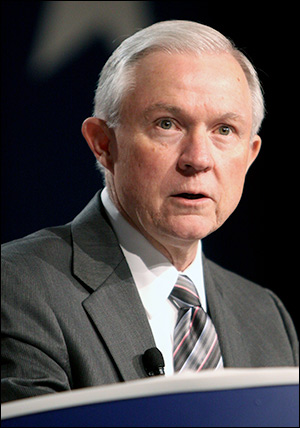
Former Senator and US Attorney General, Jeff Sessions (R)

Jan. 8, 2020 — JMC Analytics and Polling just released their December statewide Alabama poll (Dec. 16-18; 525 likely Alabama voters) testing Sen. Doug Jones (D) against the Republican senatorial field including former senator and US attorney general Jeff Sessions.

Though JMC segmented demographics and geography within the polling universe they surprisingly did not identify partisan leanings. Therefore, it becomes difficult to see just how Republicans, Democrats, and Independents individually break and whether or not Sessions’ past public feud with President Trump is hurting him among GOP base voters.

The ballot test results, however, lead us to conclude that the former senator’s support within the Trump universe may be somewhat weak largely because he does no better than lesser known Republican candidates.

Sen. Jones is clearly the most vulnerable of the 11 Democratic incumbents standing for re-election in the 2020 cycle, not including Massachusetts Sen. Ed Markey’s Democratic primary challenge from Rep. Joseph P. Kennedy III (D-Newton). Considering that Republicans have a 53-47 advantage in the Senate and must defend 23 of the 35 in-cycle seats, re-taking Alabama is critically important to Republican majority goals.

According to the JMC data, Sessions would lead Sen. Jones, 46-41 percent, which is a credible showing for a Democrat in Alabama irrespective of incumbency. Pairing with the other Republican candidates produces similar results. Against former Auburn University head football coach Tommy Tuberville (R), Sen. Jones would trail 40-47 percent. If US Rep. Bradley Byrne (R-Mobile) were the GOP nominee, the spread would be 44-40 percent in the Republican’s favor.

Continue reading

The North Carolina Filings

All the best for a wonderful holiday season.
Ellis Insight daily updates will return on Jan. 3, 2020.

By Jim Ellis

Dec. 24, 2019 — Candidate filing in the Tar Heel State closed Friday, and the North Carolina political contestants are now set for the March 3 Super Tuesday state primary. In addition to the presidential race, North Carolina voters will choose nominees for governor, US Senate, 13 congressional races, the state constitutional offices, and state legislature.

No surprises came from the presidential filings, though 38 individuals filed to run for the nation’s highest office. Twenty of the 38 are minor party candidates, however. Fifteen Democrats are running, including all of the major contenders. President Trump draws Republican primary opposition from former Massachusetts governor Bill Weld and Illinois ex-congressman Joe Walsh.

Sen. Thom Tillis sees only minor Republican primary opposition and now is a cinch for re-nomination. Businessman Garland Tucker was expected to run a competitive primary race but decided to end his effort prior to the filing deadline. When Rep. Mark Walker (R-Greensboro) was drawn out of a winnable district in the court-mandated redistricting plan, he began considering entering the Senate race. The congressman, however, ultimately decided to wait a cycle and looks to run for Sen. Richard Burr’s (R) open seat in 2022.

Five Democrats filed for the Senate, but the nomination battle is realistically between former state senator Cal Cunningham, who is the party leadership favorite, and state Sen. Erica Smith (D-Gaston). The eventual Democratic nominee will face Sen. Tillis in what promises to be a competitive general election in a state that has defeated more incumbents in the modern political era than any other place.

Continue reading