
By Jim Ellis

Colorado Elector Michael Baca / 9NEWS
Thirty states, including Colorado, have a statutory requirement that the official electors, in Colorado’s case nine individuals, cast their vote for the presidential candidate who carried the state. In the 2016 election, Hillary Clinton carried the Centennial State over Donald Trump, 48-43 percent.
Baca was coalescing with other electors around the country, the so-called “Hamilton Electors,” who thought they could convince enough members in Trump states to vote for another candidate in order to force him below the 270 minimum electoral vote threshold. In the election, Trump’s victory states awarded him 306 electoral votes. Places like Colorado, however, that went for Clinton, would do Trump no damage if its electors did not carry through with the voters’ expressed desire, illustrating one of several ways that the “Hamilton” strategy was fundamentally flawed.
After Baca’s removal, he quickly filed his lawsuit arguing that his constitutional rights were violated because the state has no authority to bind its electors. Baca lost at the federal district level but now has won a 2-1 appellate decision before a three-judge panel.
What happens now? The 10th Circuit is in conflict with a previous Washington state Supreme Court ruling that came to the opposite conclusion. Thus, it is likely that the US Supreme Court will be petitioned though the Washington ruling, because it comes from a state court, is a lesser factor in the federal domain.
The Colorado elector legal action, like the Compact Coalition that is attempting to convince states holding a majority of electoral votes to agree to have their electors vote for the national popular vote winner regardless of how the individual state voted, is designed to eliminate the Electoral College’s power and change the US voting system to a straight popular vote.

 Aug. 2, 2019 — In the latter half of July, several different pollsters conducted Democratic presidential primary polls in seven important primary states. In Iowa, New Hampshire, South Carolina, California, Texas, Michigan, and Illinois — all states whose voters will cast primary ballots on or before March 17 — contain an aggregate 1,012 first-ballot delegates.
 July 16, 2019 — We’ve seen an interesting trio of polls released over the past week that tested the New Hampshire Democratic electorate all within the same relative time span. The cumulative result produced three different leaders and found the top five candidates all within striking range of the top position.
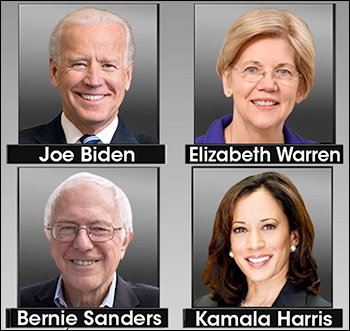 June 17, 2019 — A new large-sample Golden State poll released from the University of California at Berkeley and the Los Angeles Times (June 4-10; 2,131 likely California Democratic primary voters from a pool of 4,435 registered voters) yields some surprising results. The three most unexpected findings first show a tight race among the four top contenders, Sen. Elizabeth Warren (D-MA) surging into second place, and home-state Sen. Kamala Harris only finishing fourth but not substantially behind.

 April 11, 2019 — One of the most interesting facets of the Democratic presidential nomination process sounds mundane, but it may be more telling than any single campaign factor.