Tag Archives: California

Super Tuesday Voting

Nikki Haley suspends her campaign. (CBS video)

By Jim Ellis — Wednesday, March 6, 2024

President

Biden, Trump: Almost Clean Sweeps — President Joe Biden and former President Donald Trump both took major steps forward to clinching renomination with almost clean sweeps in the Super Tuesday voting entities. Both men were respectively one entity short of winning every primary and caucus.

Former UN Ambassador Nikki Haley topped former President Donald Trump in the Vermont Republican primary, and President Biden lost the American Samoa Caucus to unknown candidate Jason Palmer. Irrespective of those bumps along the nomination road, both President Biden and former President Trump are on track to become their party’s presumptive nominee before March 20.

Haley, calling for Trump to mend fences with those who supported her throughout the primary process, announced this morning that she was suspending her campaign for the presidency. “The time has now come to suspend my campaign,” she said. “Our congress is dysfunctional and only getting worse. … Our world is on fire because of
America’s retreat. If we retreat further, there will be more war, not less. … We must bind together as Americans. Our country is too precious to let our differences divide us. It is now up to Donald Trump to earn the votes of those in our party and beyond it who did not support him. And I hope he does that.”

Senate

California: Schiff, Garvey Advance — Because the California counting system requires such a long period due to signature verification for the millions of mail-in ballots cast throughout the country’s most populous state, it may be several weeks before we have final totals. That means some of the many competitive races on the ballot may be undecided for quite a long period though most contests already have a projected winner.

The state’s premier campaign is the open Senate race where appointed Sen. Laphonza Butler (D) is not seeking a full term. Gov. Gavin Newsom (D) chose her as the interim senator when incumbent Sen. Dianne Feinstein (D) passed away in September.

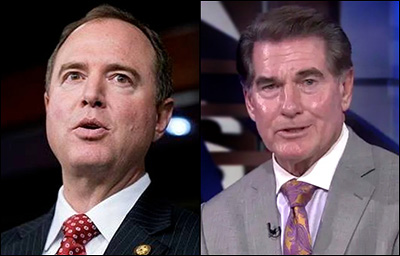
With more than half the votes recorded, both Rep. Adam Schiff (D-Burbank) and retired baseball star Steve Garvey (R) have been projected to capture ballot positions in the general election. At this point, Rep. Schiff has 33 percent of the vote to Garvey’s 32 percent. They defeated Reps. Katie Porter (D-Irvine) and Barbara Lee (D-Oakland) who attracted 14 and seven percent of the vote, respectively. The final tallies could change, but it appears clear that Schiff and Garvey will continue onto the general election while all other contenders are now officially eliminated.

Texas: Allred Wins Outright — In a result that would have to register as a mild surprise, US Rep. Colin Allred (D-Dallas) secured majority support in the crowded US Senate Democratic primary to clinch the party nomination outright. He will now challenge Sen. Ted Cruz (R) in November.

House

Alabama: Moore Wins; CD-2 in Runoffs — The 1st District paired incumbents battle ended differently than polling suggested as Rep. Barry Moore (R-Enterprise) recorded a close victory over fellow Congressman Jerry Carl (R-Mobile). The two were tossed into the same district as a result of the court-ordered redistricting map designed to create a new majority minority seat. Rep. Moore, at this writing, looks to have secured a 52-48 percent victory margin.

Though Carl represents 59 percent of the new district and Moore the remainder, Moore performed much better in the portion of the new district that he currently represents. Therefore, Moore’s strong margins in familiar territory were enough to overcome Carl’s Mobile-area base. Rep. Moore is now a lock to win the general election.

The new open 2nd District will, as expected, feature runoff elections for both parties. The Democrats will host a secondary runoff race between former Obama Justice Department official Shomari Figures and state House Minority Leader Anthony Daniels (D-Montgomery).

For the Republicans, ex-state legislator Dick Brewbaker has qualified for the runoff but a tight battle for the second position exists between conservative attorney Caroleene Dobson and state Sen. Greg Albritton (R-Baldwin County), and it will require political overtime to determine which of the latter two advances.

The runoff elections are scheduled for April 2. The eventual Democratic nominee will be a heavy favorite to clinch the seat in November.

Governor

North Carolina: Nominees Chosen Today — As expected, the open governor’s primary yielded a general election that will feature Lt. Gov. Mark Robinson for the Republicans and Attorney General Josh Stein as the Democratic nominee. Both easily won their respective primary elections last night. A tight general election is forecast.

Super Tuesday Preview – Part I

By Jim Ellis — Monday, March 4, 2024

The Super Tuesday primaries are tomorrow and while the presidential nominations appear set, five states will also hold their full ballot 2024 nomination elections. Today, we look at the Alabama, Arkansas, and California primaries. Tomorrow, North Carolina and Texas.

California

Rep. Adam Schiff (D-Burbank) / Former baseball great Steve Garvey (R)

The Golden State hosts the most action in the Super Tuesday state primaries. A hot open US Senate race is featured, and competition exists in as many as 20 of the state’s 52 congressional races, seven of which are open seat contests.

The final Senate poll, from the University of California at Berkeley’s Institute of Government Studies for the Los Angeles Times (Feb. 22-27; 6,536 registered California voters; 3,304 of whom have already mailed their ballots; online) contains a surprise.

For the first time since this open Senate race began, Rep. Adam Schiff (D-Burbank) has lost his first place spot. Republican former baseball star Steve Garvey has captured the lead largely because Schiff has been spending heavily to label him as too conservative in an attempt to unify Republicans and block Rep. Katie Porter (D-Irvine) from qualifying for the general election.

The ballot test finds Garvey posting 27 percent support with Rep. Schiff close behind with 25 percent. Porter would be eliminated if this poll’s findings are correct. She attracts 19 percent support, while Rep. Barbara Lee (D-Oakland) drops to eight percent preference. Garvey and Schiff would then advance into the general election. An inter-party general election heavily favors Democrats.

In the top two all-party jungle primary House races, several could be headed for general elections featuring members of the same political party.

The districts potentially producing double-Democratic finalists are the 12th (open; Rep. Lee running for Senate),16th (open; Rep. Anna Eshoo-D retiring), 25th (Rep. Raul Ruiz-D being challenged), 26th (Rep. Julia Brownley vs. Councilman Chris Anstead), 29th (open; Rep. Tony Cardenas-D retiring), 30th (open; Rep. Schiff running for Senate), 31st (open; Rep. Grace Napolitano-D retiring), and 34th (Rep. Jimmy Gomez-D again being challenged).

The vacant 20th District (Rep. Kevin McCarthy-R resigned) could potentially produce a double-Republican general election.

Competitive inter-party races already look set in the 3rd (Rep. Kevin Kiley-R vs. Jessica Morse-D), 9th (Rep. Josh Harder-D vs. Stockton Mayor Kevin Lincoln-R), 13th (Rep. John Duarte-R vs. former Assemblyman Adam Gray-D), 21st (Rep. Jim Costa-D vs. Michael Maher-R), 22nd (Rep. David Valadao-R vs. ex-Assemblyman Rudy Salas-D), 27th (Rep. Mike Garcia-R vs. George Whitesides-D), and 41st (Rep. Ken Calvert-R vs. Will Rollins-D).

In several other competitive seats, the general election slate is uncertain heading into tomorrow’s primary, though all mentioned incumbents will claim the first general election ballot slot. Those are: Districts 40 (Rep. Young Kim-R), 45 (Rep. Michelle Steel-R), 47 (open; Rep. Katie Porter-D running for Senate), and 49 (Rep. Mike Levin-D).

Though the California jungle primary can’t elect any candidate outright, tomorrow’s voting will provide us with a significant number of political answers.

Alabama

In adherence to the US Supreme Court’s ruling on the Alabama racial gerrymandering case, the state’s congressional map has been redrawn. Tomorrow’s focus will be on two major House races, the Republican pairing between Reps. Jerry Carl (R-Mobile) and Barry Moore (R-Enterprise) in a newly crafted 1st District that stretches from Mississippi to Georgia along Alabama’s Florida border, and an open 2nd CD from Montgomery to Mobile that is designed to elect an African American candidate.

Even though Alabama is a runoff state, the Carl/Moore contest will be decided tomorrow since they are the only two candidates on the ballot. Therefore, the winner will have majority support and become the prohibitive favorite for the general election. Carl currently represents 59 percent of the new district, and Moore, 41 percent. Both have been attacking the other as weak on the southern border.

The most recent poll, from Auburn University at Montgomery with the Survey Research Center at the University of Georgia (Feb. 27; 1,909 likely AL-1 voters; text to web) found a ballot test result that favors Rep. Carl, 43-35 percent, but suggests the final outcome will yield a close result.

In the 2nd CD, we can expect the primary vote to produce runoff elections for both parties. A total of 11 Democrats and seven Republicans are competing for their respective nominations. The field includes two state senators, four state representatives, including the House Minority Leader and Minority Whip, and one local official. The eventual Democratic nominee becomes a clear favorite in the general election.

Arkansas

The presidential contest is the only statewide race on the Arkansas ballot and all four of the state’s US House members are seeking another term. Tomorrow’s only semi-competitive battle occurs in the northwest Arkansas 3rd Congressional District where seven-term US Rep. Steve Womack (R-Rogers) faces state Sen. Clint Penzo (R-Springdale).

The challenger had raised less than $94,000 and had $65,000 cash-on-hand through the Feb. 14 pre-primary filing. This suggests little activity on his part, and we can expect a big Womack victory tomorrow night. No change is expected in the Arkansas delegation for the next Congress.

California Democrat Candidates Boost Republicans in Senate Race

Click on above image to watch ad.

By Jim Ellis — Monday, Feb. 26, 2024

Senate

Senate Ad Campaign: Schiff, Porter Promote GOP Opponents — The California US Senate primary campaign may become regarded as the most unique in American history. Due to the top-two jungle system that the state’s voters adopted in the 2010 ballot proposition, we now see the unusual situation of two Democratic US Senate candidates using their own campaign funds to help boost specific Republican opponents.

Rep. Adam Schiff (D-Burbank) from the beginning has led the open race in all jungle primary polling. In the past couple of weeks, he began airing ads to, in a backhanded way, help Republican baseball great Steve Garvey finish second behind him, thus setting up a traditional Democrat/Republican general election, a contest Schiff is virtually assured of winning.

Schiff began financing ads supposedly against Garvey, saying in effect that he is too conservative for California. The ad message is actually targeted for Republican voters. If they coalesce around Garvey to the point that he is elevated into second place ahead of fellow Democratic candidate Rep. Katie Porter (D-Irvine), and Porter is eliminated, Schiff’s road to the Senate after the March primary becomes much easier.

Porter herself is now adopting a similar strategy in hoping to elevate herself over Garvey, thus creating a highly competitive Democrat vs. Democrat general election. The most recent polls, however, suggest the Schiff strategy is working.

With the March 5 primary fast approaching, Emerson College surveyed the California electorate in a partnership with The Hill newspaper and the Inside California Politics blog (Feb. 16-18; 1,000 registered California voters; 935 likely jungle primary voters; multiple sampling techniques) and again found Rep. Schiff leading the open US Senate field, this time with 28 percent of the vote. In second place, and for the first time with a sizable advantage over the third-place finisher, is Garvey, with 22 percent. Following are Reps. Porter and Barbara Lee (D-Oakland) with 16 and nine percent, respectively.

Garvey raised only $610,000 through the end of 2023, which meant there was little way he could finance a major statewide media and digital buy. Therefore, Schiff is taking it upon himself to help Garvey by “attacking” him with the idea that Republican voters will respond and unite behind him.

Now Porter is getting into the act, seeing that the Schiff strategy is helping to move Garvey’s numbers. She launched short 15-second ads “attacking” Republican Eric Early, who has even less in the way of campaign resources than his partisan opponent. The ad script claims Early is “too MAGA for California,” and criticizes Garvey for not saying who he would support for president.

Porter’s target is the hardcore Trump voter who she hopes to peel away from Garvey in enough volume to allow her to slip into second place with her share of the state’s much larger left-of-center/Democratic base.

With President Joe Biden having virtually no opposition and his approval numbers, though in positive territory, still rather weak, it is possible we could see a lower Democratic primary turnout, and such an occurrence could also boost Garvey’s chances for second place.

In the 2022 election, just over 7 million people voted in the California jungle primary, and in the 2020 presidential primary election, the total turnout exceeded 8.3 million voters. Most believe the 2024 turnout will be under the state’s last presidential election primary turnout, the aforementioned 2020 statistics.

In the national presidential election, due to delegate selection, states must hold partisan primaries or caucuses. Therefore, the top two system is not in effect for nominating a presidential candidate. In 2020, 68 percent of the voters participated in the Democratic primary and 29 percent cast a Republican ballot.

If the Democratic participation rate becomes lower than 2020, and the Republican number slightly improves, then Garvey may well have a chance to finish second. With the larger number of Democratic candidates potentially further splitting perhaps a lower turnout base, then Republican hopes of qualifying a general election candidate grow.

Reps. Schiff and Porter are demonstrating a different way of campaigning in what is a rare primary structure, and thus possibly exposing one of the system’s flaws. Regardless of whether the Schiff and Porter campaign tactic is something the voters intended when they adopted the voting structure, at least one of the Democrats’ strategies may prove effective.

The outcome of this race is just one more point of interest to watch in what will be a very busy Super Tuesday primary night throughout the nation.

Trump Projected to Win Electoral College; California Primary Poll Jockeying; Texas Senate Race Numbers; NJ-8 Dueling Dem Polls

By Jim Ellis — Thursday, Feb. 22, 2024

President

Former President Donald Trump

Decision Desk HQ: Projects Trump at 312 EVs — The Decision Desk HQ, in association with The Hill newspaper, has forecast a new 50-state electoral vote projection. All swing states are averaged based upon data from at least five recent polls. The new estimates give former President Donald Trump his largest-ever Electoral College vote lead, 312-226.

The key swing states of Arizona, Georgia, Michigan, Nevada, North Carolina, Pennsylvania, and Wisconsin are all landing in the Trump camp according to DDHQ. To win the 2024 election, Trump needs to convert states that equal 35 electoral votes. According to this projection, Trump is improving his stance by 80 electoral votes when compared with his 2020 performance.

Senate

California: Primary Battle Over Second Place — Emerson College surveyed the California electorate in a partnership with The Hill newspaper and the Inside California Politics blog (Feb. 16-18; 1,000 registered California voters; 935 likely jungle primary voters; multiple sampling techniques) again found US Rep. Adam Schiff (D) leading the open US Senate field, this time with 28 percent of the vote. In second place, and for the first time with a sizable advantage over the third-place finisher, is former baseball great Steve Garvey (R) with 22 percent. Following are Reps. Katie Porter (D-Irvine) and Barbara Lee (D-Oakland) with 16 percent and nine percent, respectively.

The poll has a number of positive points for Garvey. Aside from the Emerson/Hill data suggesting he secures a general election slot, he does well with older voters. He registers a 33 percent preference total from those over 70 years of age, which is typically the highest turnout sector, and scores in second position with who voters believe would best handle the crime, homelessness, war in Israel, and immigration issues, while rating only three points below who would best handle abortion.

Additionally, the third-place finisher, Rep. Porter, does best with the youth vote, but this segment has the poorest participation history.

The California jungle primary is scheduled for Super Tuesday, March 5. The top two finishers regardless of political party affiliation or percentage attained will advance to the general election. Sen. Laphonza Butler (D), who Gov. Gavin Newsom (D) appointed to replace the late Sen. Dianne Feinstein (D), is not running for a full term.

Texas: Rep. Allred Establishes Strong Primary Lead, Cruz Likewise in General — YouGov, polling for the Texas Politics Project at the University of Texas at Austin (Feb. 2-12; 1,313 registered Texas voters; 1,200 likely Texas primary voters; online), tested the Lone Star State electorate for the coming March 5 primary election, and found US Rep. Colin Allred (D-Dallas), who has been using his resource advantage to advertise heavily, exceeding the 50 percent threshold within the Democratic primary segment. According to the YouGov results, Allred records a 52 percent preference figure as compared to state Sen. Roland Gutierrez’s (D-San Antonio) 14 percent.

Former Nueces County District Attorney Mark Gonzalez and state Rep. Carl Sherman (D-Dallas) register support figures of only five and two percent.

Within the general election sample, however, the tables turn. Here, Sen. Ted Cruz (R) records his best polling stance of the current campaign, with a 46-32 percent margin over Rep. Allred. The Daily Kos Elections site analysts criticized the poll because the questionnaire did not assign a party label with each candidate. They reason that Allred would have received better support had such been the case.

Two points of disagreement: first, the primary question was asked before the general election question, thus the voters were already told that Allred was a Democrat. Second, it is more likely that Sen. Cruz, who has not been overly popular in the state, would have actually benefited more with party labels since Texas has been a solid state for the GOP since the early 1990s.

House

NJ-8: Dueling Internal Dem Primary Polls — Last week, Rep. Rob Menendez (D-Jersey City) released the results of his internal TargetSmart survey that posted him to a relatively strong 46-22 percent advantage over Hoboken Mayor Ravi Bhalla in their quest for the Democratic nomination. On Wednesday, the Bhalla campaign countered with their own poll, this one from GQR Research another highly rated polling firm. This data (released Feb. 20; 403 likely NJ-8 Democratic primary voters) finds a much different ballot test, with the incumbent leading only 44-41 percent.

These polls, seemingly both well conducted, are far apart in how they view the race. This will be another of the most interesting primary contests to watch during our current election cycle.

DCCC’s Initial Targets

By Jim Ellis — Tuesday, Feb. 13, 2024

House

The Democratic Congressional Campaign Committee (DCCC) released their first targeting list entitled “Red to Blue,” though the group of 17 House districts actually contained one already in the Democratic column.

In alphabetical order by state, the list of 17 includes 16 Republican districts where the DCCC has endorsed a Democratic candidate:

STATE DISTRICT INCUMBENT DCCC CANDIDATE
Arizona 13 DUARTE, JOHN ENGEL, KIRSTEN
California 6 CISCOMANI, JUAN GRAY, ADAM
California 22 VALADAO, DAVID SALAS, RUDY
California 27 GARCIA, MIKE WHITESIDES, GEORGE
California 41 CALVERT, KEN ROLLINS, WILL
Colorado 3 OPEN FRISCH, ADAM
Iowa 1 MILLER-MEEKS, M. BOHANNON, CHRISTINE
Iowa 3 NUNN, ZACH BACCAM, LANON
Michigan 7 OPEN HERTEL, CURTIS
Michigan 1 ZINKE, RYAN TRANEL, MONICA
Nebraska 2 BACON, DON VARGAS, TONY
New York 3 SPECIAL ELECTION SUOZZI, TOM
New York 17 LAWLER, MIKE JONES, MONDAIRE
New York 19 MOLINARO, MARC RILEY, JOSH
Oregon 5 CHAVEZ-DeREMER, L. BYNUM, JANELLE
Texas 15 de la CRUZ, MONICA VALLEJO, MICHELLE
Virginia 2 KIGGANS, JEN SMASAL, MISSY COTTER

The Michigan district included in the above list is that of Democratic Rep. Elissa Slotkin (D-Lansing). Her run for the Senate leaves her central Michigan seat open, but the Democrats winning here in 2024 would not result in a party division gain.

President Joe Biden carried only six the 16 Republican districts, and the FiveThirtyEight data organization provided a numerical rank so as to consider lean Democratic in those same six districts. Therefore, on this list, the half-dozen names below should be viewed as the most achievable targets, which, as you will see, are California and New York dominant.

They are:

  1. CA-13 (Duarte)
  2. CA-22 (Valadao)
  3. CA-27 (Garcia)
  4. NY-3 (Special election; Santos)
  5. NY-17 (Lawler)
  6. OR-5 (Chavez-DeRemer)

This underscores that the key states to determine the next House majority are the Golden and Empire States.

Most of the endorsed Democratic candidates (12 in the 16 Republican held seats) previously ran and lost their race in 2022. A total of 10 unsuccessfully opposed the current GOP House incumbent, while two lost other races (Tom Suozzi, Governor; Mondaire Jones, NY-10).

Curiously, some other vulnerable districts were excluded from this first release. Likely, this is due to one of three reasons: the DCCC has not yet endorsed a candidate; they don’t see a sufficiently competitive challenger within the current field; or, they perceive the Republican incumbent as being too strong.

They are:

DISTRICT CANDIDATE
AZ-1 David Schweikert
CA-40 Young Kim
CA-45 Michelle Steel
FL-13 Anna Paulina Luna
FL-27 Maria Elvira Salazar
MI-10 John James
NJ-7 Tom Kean Jr.
NY-4 Anthony D’Esposito
NY-22 Brandon Williams
PA-1 Brian Fitzpatrick
PA-10 Scott Perry
WI-1 Bryan Steil

Most of the members included within this latter group will be added to later target lists. The fact that Rep. Steil’s name is not yet appended to the “Red to Blue” listing suggests that the Wisconsin State Supreme Court may not order a redraw of the congressional map this cycle. Keeping Rep. Steil’s congressional district intact would give him little incentive to launch a statewide campaign against Sen. Tammy Baldwin (D).

At this point in the new redistricting process, Republicans are likely gaining a net one seat, but the New York redraw hasn’t yet occurred.

The GOP is assuredly gaining three seats from North Carolina, while the Democrats look to increase by one each in Alabama and Louisiana. Since the Georgia and Florida maps will not likely change for the 2024 election portends good news for Republicans; likewise for the Democrats in New Mexico.

McDaniel Reported Out at RNC; Trump Way Ahead in New Poll; Schiff Helps Garvey; Another Close Ohio Poll; Utah’s Tight Senate Race; House News

By Jim Ellis — Thursday, Feb. 8, 2024

President

Ronna McDaniel / Photo by Gage Skidmore

Republican National Committee: Trump Recommends New Chairman — As reports intensify that RNC chair Ronna McDaniel will be leaving the committee after the South Carolina primary, former President Donald Trump has made a replacement recommendation.

The news media is reporting that North Carolina Republican Party chairman Michael Whatley is Trump’s choice largely because he was “so powerful on election fraud” in 2020, according to the ex-president’s statement. It is a virtual certainty that the committee members will adopt Trump’s recommendation, but the question to be asked is how strong a fundraiser is Whatley? While Trump may be most concerned with his election fraud narrative, the RNC is under-performing in the campaign resource battle and must quickly upgrade their efforts.

South Carolina: Trump Way Ahead in New Poll — A new Monmouth University poll for the Washington Post (Jan. 26-30; 815 registered South Carolina voters; live interview & online) sees former President Donald Trump posting a significant 58-32 percent lead over former Gov. Nikki Haley in her home state of South Carolina leading to the Feb. 24 Republican primary election.

Trump holds an advantage among both men and women in the statewide voter sample, and within all age groups. He trails Haley only among college-educated voters, but by only two points, and certain non-evangelical voter groups. Additionally, 90 percent of the respondents saying they would vote for Trump in the primary election would do so in the general election even if he is convicted of some of the many legal charges he faces.

Senate

California: Schiff Helps Garvey — Confident he will finish first in the March 5 open California US Senate primary, Rep. Adam Schiff (D-Burbank) is running ads “against” Republican baseball great Steve Garvey claiming he is too conservative for California in that he twice voted for Donald Trump. In reality, Schiff is attempting to help Garvey finish second in the top two jungle primary, thus eliminating Rep. Katie Porter (D-Irvine), which would allow him to escape having to run a double-Democratic general election.

Having Garvey, or any Republican as an opponent, would virtually guarantee that Schiff would win the seat in November. The ads’ actual purpose is to move more Republicans to Garvey, and thus edge him into second place.

A new University of Southern California for the Center for Urban Politics and Policy at California State University at Long Beach (Jan. 21-29; 1,416 likely Califoria jungle primary voters) survey sees Rep. Schiff holding a 25-15-15-7 percent lead over Garvey and Rep. Porter (D-Irvine). Congresswoman Barbara Lee (D-Oakland) trailed the other major candidates in fourth position. Therefore, a small push from Schiff might just help Garvey succeed.

Ohio: Another Close Poll — The March 19 Ohio Republican primary will be a hugely important election. Among other races, it will decide which GOP candidate will challenge Sen. Sherrod Brown (D) in one of the country’s most compelling statewide campaigns. The Emerson College poll (Jan. 23-25; 1,844 registered Ohio voters; multiple sampling techniques) sees all three Republican candidates coming to within one or two points of Sen. Brown with the incumbent failing to reach 40 percent support in all iterations.

In the Republican primary, the battle is equally close. Businessman Bernie Moreno, who former President Trump and Sen. J.D. Vance support, nips Secretary of State Frank LaRose, 22-21 percent, with state Sen. Matt Dolan (R-Chagrin Falls) trailing with 15 percent. In 2022, Sen. Dolan came on strong at the end, failing to reach second place by one percentage point after lagging during the early part of the campaign. Therefore, the Republican nomination is still very much in doubt.

Ohio features a modified primary system that allows voters to change their registration on the day of the election in order to choose a selected primary.

Utah: Rep. Curtis Begins with Small Lead — Dan Jones & Associates, Utah’s top media polling firm, released a new US Senate Republican primary survey, the first since US Rep. John Curtis (R-Provo) joined the field. The survey (Jan. 16-21; 428 registered Utah Republican voters) finds Rep. Curtis posting a tepid 18-14 percent lead over attorney Brent Orrin Hatch, the son of the late seven-term Sen. Orrin Hatch (R). Following at eight percent is former state House Speaker Brad Wilson. With a majority of the Republican voters still undecided, this contest is wide open.

The state’s April Republican nominating convention will send two candidates to the primary ballot. The others will have to petition for a ballot line. The Utah primary is scheduled for June 25. Sen. Mitt Romney (R) is retiring after one term.
Continue reading

Fong’s Fight; Rep. Jamaal Bowman in Primary Battle; Another US House Member to Resign; More Primary Trouble for Rep. Nancy Mace

By Jim Ellis — Thursday, Feb. 1, 2024

House

California Assemblyman Vince Fong (R-Bakersfield) / Photo by Kevin Sanders for California Globe

CA-20: Candidates Qualify for Special Election — The California Secretary of State has attested that nine candidates have qualified for the March 19 special election to replace resigned former Speaker Kevin McCarthy (R-Bakersfield). Controversy, however, still surrounds the favorite to win the electoral contest, Assemblyman Vince Fong (R-Bakersfield).

Since Fong had already filed for re-election before Rep. McCarthy resigned from the Congress, the Secretary of State ruled that he could not enter the congressional race because such action would violate a California election law that prohibits individuals from simultaneously running for multiple offices. Fong sued over the administrative ruling and won in Superior Court. Therefore, he has been slated as a congressional candidate while not being removed from the state assembly ballot. The state is appealing the court ruling, so even if Fong wins the special election as expected, he could be hampered by a future court decision.

Also qualifying are Tulare County Sheriff Mike Bourdeaux (R), and seven other Republicans, Democrats, and No Party Preference candidates. If no one receives majority support on March 19, the top two finishers, regardless of party affiliation will advance to a special general election on May 21. The regular election cycle primary is scheduled for March 5, featuring most of these candidates. The special election winner will serve the balance of Rep. McCarthy’s final term.

NY-16: Serious Primary Challenge Unfolding — New York US Rep. Jamaal Bowman (D-Yonkers), while receiving good news that the House Ethics Committee is not going to pursue further action against the congressman for pulling a fire alarm in a House office building, is now facing a backlash over social media posts he made after the 9/11 attack. The posts referred to theories that the US government orchestrated the terrorist massacre, and a ring of globalist bankers were actively involved in the conspiracy.

“Well over a decade ago, as I was debating diving into a doctoral degree, I explored a wide range of books, films, and articles across a wide swath of the political spectrum and processed my thoughts in a personal blog that few people ever read. I don’t believe anything that these cranks have said, and my life’s work has proven that.”

While Bowman may survive these controversies in the short term, he faces a very difficult Democratic primary election in June. His principal opponent, Westchester County Executive George Latimer is reporting a dollars raised figure of $1.4 million since his declaration of candidacy in early December. Latimer is a veteran campaigner, having been elected four times to the state Assembly, once to the state Senate, and twice to his current position. Therefore, Rep. Bowman must be considered as a highly vulnerable incumbent as he heads into a serious renomination fight.

NY-26: Rep. Higgins to Resign Friday — New York US Rep. Brian Higgins (D-Buffalo), who announced back in November that he would resign the House seat he has held for almost 20 years to take a position in the non-profit sector back in Buffalo, issued a statement saying that he will leave Congress on Friday. Once the seat is officially vacant, Gov. Kathy Hochul (D) will have 10 days to call a special election for a period no less than 70 and no greater than 80 days from the scheduling announcement.

The local Democratic county chairmen have already chosen state Sen. Tim Kennedy (D-Buffalo) as the party’s special election nominee. Republicans are not likely to be competitive in the Buffalo anchored district which carries a partisan rating of D+18 according to the FiveThirtyEight data organization. At this point, the local Republican county chairs have not announced a special election nominee.

SC-1: More Trouble for Rep. Mace — Earlier in the week, we reported that South Carolina US Rep. Nancy Mace’s (R-Charleston) former chief of staff, Dan Hanlon, had filed a campaign committee to challenge her in this year’s Republican primary. Now, a former Nikki Haley gubernatorial cabinet official, Catherine Templeton, announced that she, too, will oppose the congresswoman.

Templeton, the former director of the South Carolina Department of Health and Environmental Control ran for governor in 2018 but finished third in the Republican primary, losing to Gov. Henry McMaster. As lieutenant governor in 2017, McMaster ascended to the governorship when Haley was appointed UN Ambassador.

With the US Supreme Court still deciding whether the lawsuit challenging the 1st District as a racial gerrymander is valid, there is still a possibility that this seat could be redrawn before the candidates appear on the ballot. The South Carolina primary is June 11, with a runoff scheduled for June 29 if no candidate receives majority support. Unless the district is ordered changed, the eventual Republican nominee becomes a prohibitive favorite in the general election.