The Ups & Downs of Early Voting; New Alabama CD Normalizing; A One-Point Race in Montana; Long Island GOP Candidates Struggling

By Jim Ellis — Friday, Oct. 25, 2024

Early Voting

National Vote: Some 25 Million Early Votes — Almost 25 million people have already cast their ballots in the 2024 general election and while both Democrats and Republicans are slightly ahead of their 2020 percentage turnout benchmark, we see big increases in the rural vote, while the most consistent voters dominate the early ballot casts.

According to the TargetEarly/TargetSmart data organization, early voters from the rural areas are up a full eight points over their 2020 performance and almost four percentage points over the 2022 turnout statistics. Conversely, urban voters are down 10 points from 2020 and six from the 2022 benchmark. Those listed as frequent and “super voters,” the latter meaning individuals who participate in every election, dominate the 2024 early voting statistics.

The first-time voter category is down about nine percentage points as compared to 2020, while the infrequent voter is down five points. Those categorized as “frequent voters” are down three points from 2020 and five points when compared with the 2022 statistics. The “super voter” category dominates early voting. This group is up 17 points over the 2020 performance and five in comparison to 2022.

House

AL-2: Figures Expands Lead — The newly created 2nd Congressional District is now beginning to perform as drawn. The original intent was to draw the seat to elect an African American representative and after a flirtation with Republican Caroleen Dobson, the electorate appears to be returning to normal trends. The legislature was under court order to draw a second majority minority seat, and this district is the result.

A Schoen Cooperman Research survey conducted for the Protect Progress liberal Super PAC (Oct. 14-17; 400 likely AL-2 voters) finds former Obama Administration official Shomari Figurers (D) leading Dobson by a 49-38 percent count, which should put the race to bed for the Democrats.

MT-1: New Poll Shows One Point Race — While several polls since mid-September have shown Montana Rep. Ryan Zinke (R-Whitefish) pulling away from Democrat Monica Tranel, a new Impact Research survey for the Tranel campaign (Oct. 14-17; 500 likely MT-1 voters; multiple sampling techniques) sees the race coming back into the one point range with the incumbent still maintaining the slightest of leads.

While Rep. Zinke still must be considered the favorite to win at least a close victory, this contest is again closer than it should be in a district that the FiveThirtyEight data organization rates as R+10, and where former President Donald Trump recorded a 52-45 percent showing in 2020.

New York: Polls Find Dems Running Well Against GOP Incumbents — Two of three recently released surveys suggest incumbent Empire State Republicans are struggling to stay in office, and the third is down significantly; Siena College tested two Long Island Districts and found scandal-tainted freshman Rep. Anthony D’Esposito (R-Island Park) trailing badly in the region’s 4th Congressional District. According to the Siena survey (for Newsday; Oct. 13-17; 532 likely NY-4 voters), the congressman trails former Hempstead Town Supervisor and 2022 congressional nominee Laura Guillen (D) by a substantial 53-41 percent deficit figure.

In eastern Long Island, freshman Rep. Nick LaLota (R-Suffolk County) has only a three-point lead over former CNN anchor John Avlon (D). The Siena poll, also conducted for Newsday (Oct. 13-17; 526 likely NY-1 voters), posts the congressman to a 47-44 percent edge.

Survey USA went into the field in the Upstate 19th Congressional District where Rep. Marc Molinaro (R-Red Hook) also trails his Democratic opponent. The S-USA poll (conducted for WNYT media in Albany; Oct. 11-16; 561 NY-19 likely voters; multiple sampling techniques) gives 2022 congressional nominee and attorney Josh Riley (D) a 46-42 percent edge over Congressman Molinaro.

Should the two GOP incumbents lose the election two weeks from now, it will be a major blow toward Republican prospects of sustaining their small US House majority.

Casey Changing Tune in PA; Rogers Up in New Michigan Poll; Zinke Way Up in Montana; Molinaro Trails in NY-19

Pennsylvania Sen. Bob Casey Jr. (D) ad

By Jim Ellis — Thursday, Oct. 24, 2024

Senate

Pennsylvania: Sen. Casey Changing Tune — For the first time, a new poll finds Republican David McCormick taking a small lead over Sen. Bob Casey Jr. (D), which may explain why he is citing agreement with the Trump trade policies in a new ad and drawing a distinction between his position and the Biden Administration’s fracking policy. The AtlasIntel survey (Oct. 12-17; 2,048 likely Pennsylvania voters; online) projects McCormick to hold a 48-47 percent edge over Sen. Casey.

Simultaneously, however, the Bullfinch Group (Oct. 11-17; 600 likely Pennsylvania voters) shows the senator leading their ballot test by seven percentage points, 50-43 percent. Sen. Casey has led throughout the entire election cycle, but his sudden message change to at least partially align himself with former President Donald Trump is eyebrow raising and suggests that the campaign’s internal data might be showing something closer to the AtlasIntel result.

Obviously, these two pollsters have different methodologies in conducting their surveys. Which is the more accurate is difficult to tell at this point. Therefore, we will likely have to wait until Election Day to determine which of the two research entities has the better sampling practice.

Michigan: Rogers Up in New Poll — Similar to what we see in the Pennsylvania race as described below, a new AtlasIntel poll shows Republican former Michigan Rep. Mike Rogers taking a small one-point edge over Rep. Elissa Slotkin (D-Lansing), while another poll conducted simultaneously finds the Democrat holding a nine-point lead.

AtlasIntel (Oct. 12-17; 1,529 likely Michigan voters; online) projects Rogers to be holding a slight 49-48 percent advantage. The Bullfinch Group (Oct. 11-17; 600 likely Michigan voters) finds a Slotkin margin of 51-42 percent.

House

MT-1: Rep. Zinke Up Substantially — Montana Rep. Ryan Zinke (R-Whitefish) was first elected to the state’s at-large House seat in 2014 and re-elected in 2016. Shortly, after the election, then-President-Elect Trump nominated Zinke as US Interior Secretary, a position he held for two years. When Montana earned a second congressional district in the 2020 census, Zinke returned to elective politics and won the Treasure State’s new western 1st District, but with an under-performing margin of 50-46 percent in a seat the FiveThirtyEight data organization rates as R+10.

With 2022 Democratic nominee Monica Tranel back for a rematch, it was thought the ’24 race could again be close. A new Guidant Polling & Strategies survey, however, suggests Rep. Zinke is in position to improve upon his previous performance. The poll (conducted for the Congressional Leadership Fund; Oct. 13-16; 400 likely MT-1 voters; live interview & text) projects the congressman to hold a 52-44 percent advantage.

NY-19: Rep. Molinaro (R) Trails in Dem Internal — A Global Strategy Group large sample survey for the Josh Riley (D) campaign (Oct. 9-13; 801 likely NY-19 voters; live interview & text) gives the challenger a 48-45 percent lead in a district that the 2023 redistricting map actually made slightly more Republican. In comparison to the presidential race, Vice President Kamala Harris leads former President Donald Trump by only one point, meaning the incumbent Republican and former Dutchess County Executive is running behind his party’s presidential ticket.

New York will play a major role in determining the next House majority, and this is a district the Republicans need to keep in their column if they are to have a chance of retaining their small majority.
Expect right-of-center outside groups to increase spending in this district. Riley is outspending the incumbent by almost a 2:1 ratio, while outside groups are helping him in a 3:1 count from combined external spending of over $8 million.

Early, Early Voting

2024 Early Voting / Target Early-Target Smart

By Jim Ellis — Wednesday, Oct. 23, 2024

Voting Patterns

In the first of what promises to be several early voting updates, we take a look at the TargetEarly/TargetSmart pre-election vote calculations from what promises to be a smaller universe than we saw in 2020.

We will remember that voting by mail in the 2020 presidential year was virtually universal, put in place by court order due to the COVID-19 emergency. After the election, the Supreme Court ruled that courts cannot arbitrarily change state election laws on a permanent basis, meaning that unless the state changed its laws since 2020, the system returns to pre-COVID-19 status.

Nationally, we now see almost 14.5 million votes already recorded at this writing, which is just 15.7 percent of the total number we saw throughout the 2020 cycle, a number that exceeded 92.4 million.

The most interesting pattern in these early returns is the increase in rural early voting. Nationally, the rural early ballot returns are up 8.3 percentage points over the 2020 total. Conversely, urban early voting is down 10.8 percentage points. The suburban early vote is up 2.4 points.

The first two stat points appear to help Republicans, while the suburban increase slightly offsets what could be GOP gains. On the other hand, the modeled partisan projection finds Democrats running a bit ahead of their aggregate percentage share in comparison to 2020 (3.7 points), while Republicans are slightly behind their overall performance share from four years ago (-1.3). Therefore, the comparison of the geographic vote versus the partisan complexion appears at least partially inconsistent in terms of which party benefits to the greater extent.

In looking at the seven top battleground states, three, Arizona, Nevada, and Wisconsin, are reporting early vote totals less than 20 percent of the 2020 total. The state with the most early votes as compared to its 2020 performance is Georgia, which has already reached 33.3 percent of its previous total.

Here, the partisan participation trends are on par with what we saw in the 2020 presidential election, but the increase in rural voting (up 6.6 percentage points when compared to Joe Biden’s winning election) and decrease in urban participation at least at this current point in the process (down 4.5 percentage points) suggests these earliest statistics may help Republican candidates.

In Michigan, with early vote totals reaching 28.9 percent of the 2020 totals, Democrats have a big edge in what appears to be the partisan returns (13.4 percentage points better than 2020), with Republicans running at parity. The big drop comes within the Independent sector, which is down 10.9 percentage points in the early going.

Continuing in the Wolverine State, we again see the rural turnout topping the 2020 share percentage (up 4 percentage points) while the urban vote is down 7.2 points. While the partisan numbers would appear to help the Democrats, the geographic voting appears as a Republican benefit.

The other major battleground state to record a large number of early votes, like Michigan with 28.9 percent thus far of the 2020 early vote, is Pennsylvania. We again see the same pattern, where Democrats are up over their 2020 early vote share (6.3 percentage points) while Republicans are at parity and Independents dropping 5.9 percentage points from their previous presidential election performance.

And, as in the other states, the Pennsylvania rural turnout is up, in this case slightly (4.2 percentage points), while the suburban and urban participation counts are at parity with their 2020 standing.

As early voting proceeds, we will likely see more definitive patterns emerge as we move ever closer toward the Nov. 5 Election Day. The early vote numbers suggest that each party remains highly competitive throughout the ballot since the current patterns yield only slight edges to either side.

Senate Money

By Jim Ellis — Tuesday, Oct. 22, 2024

Senate

Sen. Jon Tester (D), Montana, has raised $31.7 million in just the past three months. / Photo by Jared King, Navajo Nation Washington Office

According to The Down Ballot political blog, the Democratic Senate candidates extended their already impressive 2024 cycle fundraising advantage over Republicans as reported in the just released third quarter Federal Election Commission financial disclosure reports.

The Down Ballot calculations indicate that “Democratic candidates collectively raised $452 million dollars, almost twice as much as the $235 million brought in by their GOP rivals.” The gap might be the largest in the Senate races as compared to the Presidential and House campaigns, but just how much will the money advantage mean in terms of winning and losing?

The three biggest fundraisers for the third quarter with incredible totals begin with Sen. Jon Tester’s (D-MT) $31.7 million raised in just the past three months. Closely following are Sen. Sherrod Brown (D-OH) with $29.8 million raised, and Texas Rep. Colin Allred (D-Dallas) securing $29.7 million.

Despite the huge fundraising and spending advantage, however, the latest polling shows all three of these candidates trailing their Republican opponents. In the Montana race, the New York Times/Siena College survey (Oct. 5-8; 656 likely Montana voters; live interview) sees Republican Tim Sheehy leading Sen. Tester, 52-44 percent, despite his overall better than 3:1 fundraising edge.

In Ohio, Sen. Brown posts a cycle-to-date dominance of more than 4:1 in campaign spending, but the latest survey from the Morning Consult track (Oct. 6-15; 1,243 likely Ohio voters; online) gives Republican businessman Bernie Moreno a one-point lead, 48-47 percent.

While Rep. Allred outraised Sen. Ted Cruz (R-TX) $29.7 million to $17.1 million during the Q3 period, the two are at parity for cycle-to-date fundraising: $64.1 million for Allred; $63.7 million for Cruz. The latest YouGov poll for the University of Texas’ Texas Politics Project (Oct. 2-10; 1,091 likely Texas voters; online), however, gives Sen. Cruz a 51-44 percent advantage.

What these fundraising and polling numbers show is that a larger advantage in campaign resources and spending does not necessarily guarantee majority support.

Overall, an aggregate $340-plus million was raised in the 3rd quarter from the 79 charted Senate candidates with an average of $4.3 million per contender in just the 13-plus week reporting period from July 1- Sept. 30. The median average, however, is $1.084 million, meaning an equal number of candidates have raised more and less than that number.

One of the more interesting late-breaking races is the Nebraska Senate race featuring two-term incumbent Sen. Deb Fischer (R). While not having a Democratic opponent, Sen. Fischer faces Independent Dan Osborn, who is making her re-election battle much more difficult than anyone would have imagined at the beginning of the election cycle in what should be a safe Republican state. In the Q3, Osborn out-raised Sen. Fischer, $3.2 million to $915,000, but the incumbent still maintains the overall spending advantage, $7.1 million to $4.2 million.

The biggest Q3 gap in fundraising, as it has been throughout the election cycle, comes in the Michigan Senate race. For the 3rd quarter, Rep. Elissa Slotkin (D-Lansing) raised $18 million versus former Rep. Mike Rogers (R) pulling in $4.4 million, which, incidentally, is his best fundraising quarter for the election cycle. In the cycle-to-date categories, Slotkin leads Rogers $40.3 million to $9.4 million in fundraising and $35.9 million to $6.6 million in spending.

While the polls have always favored Rep. Slotkin, her margin is not overly strong, an average of 4.3 points from 14 October polls. Slotkin’s largest lead is nine points (The Bullfinch Group; Oct. 11-17), collapsing as far as Rogers posting a one-point edge (AtlasIntel; Oct. 12-17).

While the Senate Democratic candidates enjoy a huge advantage in fundraising, the aggregate outside organization spending has brought the two parties closer to parity. Most of the independent expenditures favor the Republican side either in money for pro-Republican candidate ads and programs, or anti-Democratic ads and programs.

Including all levels of federal campaigning (President, Senate, and House), the conservative outside organizations have outspent the liberal organizations by a 2:1 margin, $1.3 billion to $566 million according to the Open Secrets data organization.

It is clear that both sides have more than enough financial resources with which to communicate their message to the American electorate. It is always better to have more money than less, but it is not always necessary to be the top spender in a race.

Electoral Maps Toss Up; Osborne Confusion in Nebraska; Tied Poll for AZ-2 Candidates; Dead Heat in WI-3

By Jim Ellis — Monday, Oct. 21, 2024

President

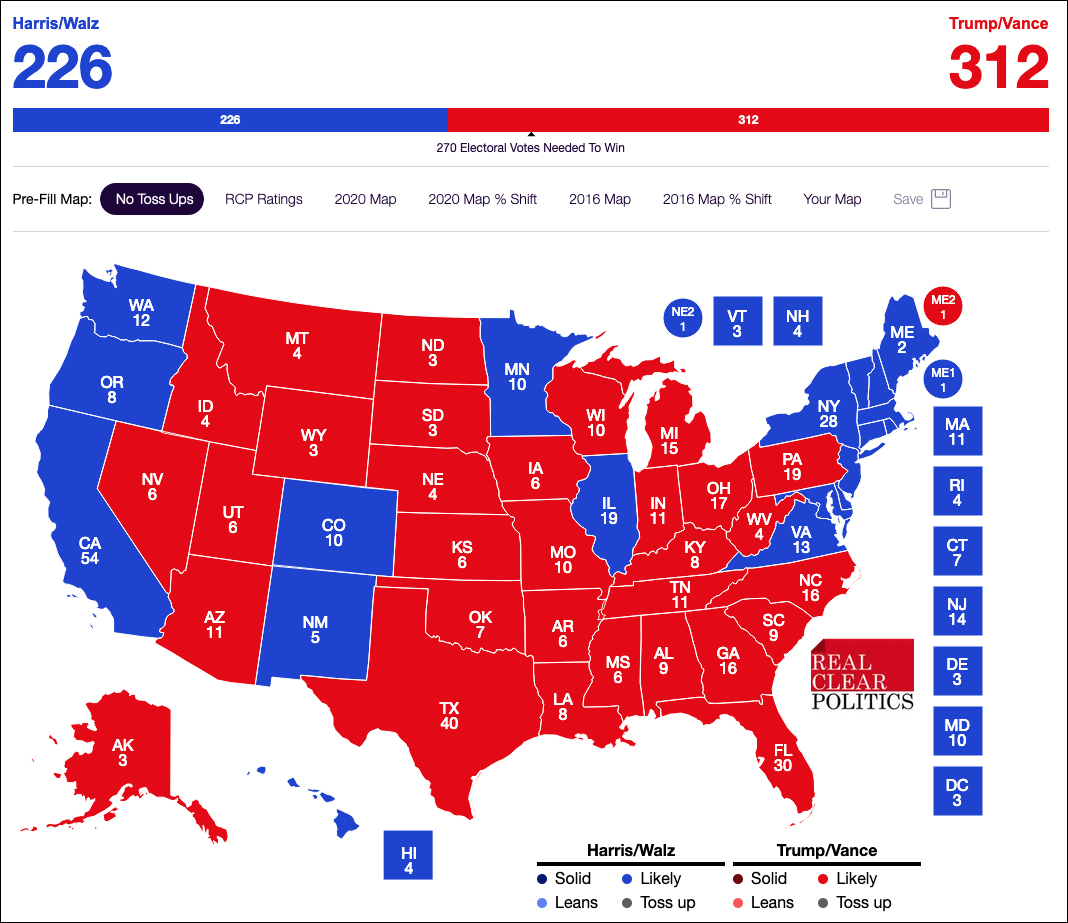
FiveThirtyEight & Real Clear Politics: Dueling Maps — Two data organizations released national maps based upon their polling averages, and both presidential candidates would clinch the election depending upon which map’s data was considered. The FiveThirtyEight data would give Vice President Kamala Harris a 276-262 win. The Real Clear map gives former President Donald Trump a more substantial victory at 312-226.

The differences: FiveThirtyEight gives Harris victories in Michigan, Nevada, Pennsylvania, and Wisconsin, but the victory margin is less than one percentage point in each place. Real Clear places each of the aforementioned states with Trump. Perhaps the most interesting commonality between the two maps is that both Real Clear and FiveThirtyEight see Trump winning Arizona, Georgia, and North Carolina.

Senate

Nebraska: Name Confusion — The most surprising Senate race is the Nebraska campaign between Sen. Deb Fischer (R) and Independent Dan Osborn. Two new developments have occurred. First, retired University of Nebraska championship head football coach and former Congressman Tom Osborne cut a new ad for Sen. Fischer in which he explains that confusion exists because he and the Senate candidate share the same surname. He goes onto explain that he has never met Dan Osborn but does know Sen. Fischer. Coach Osborne, who is a revered legend in the state, then reiterates how important it is to re-elect Sen. Fischer.

We have also seen conflicting polls within the last week with both candidates releasing internal surveys placing them six points ahead. Late last week, Sen. Fischer’s campaign published another new poll to counter Osborn’s last release. The data is again from her campaign pollster, Torchlight Strategies (Oct. 12-15; 625 likely Nebraska voters), and this time places Sen. Fischer seven points ahead at 51-44 percent.

House

AZ-2: Rep. Crane (R) in Shocking Tied Poll — Arizona pollster Noble Predictive Insights released a new survey that surprisingly depicts freshman Rep. Eli Crane (R-Oro Valley) as locked into a dead heat polling result with former Navajo Nation President Jonathan Nez. The FiveThirtyEight data organization rates AZ-2 as R+15. Rep. Crane, even as a freshman, was one of the House leaders to oust then-Speaker Kevin McCarthy (R), thus becoming labeled as one of the Freedom Caucus activists.

This is a race that had not been on anybody’s board but could quickly become a campaign of note. According to the new Federal Election Commission campaign disclosure report for the period ending Sept. 30, both Crane and Nez have over $1 million cash-on-hand with the incumbent having about $400,000 more than the challenger. Assuming this poll is accurate, Rep. Crane will have to increase his turnout operation in order to stave off this upset attempt.

WI-3: Rep. Van Orden (R) in Dead Heat — In a race that has been teetering ever since the August primary, a new Normington Petts survey for the Democratic Congressional Campaign Committee (Oct. 3-7; 400 likely WI-3 voters; live interview & text) projects Democratic challenger Rebecca Cooke to be taking a one point lead over freshman Rep. Derrick Van Orden (R-Prairie du Chien), 49-48 percent, and she leads 51-43 percent within the all-important Independent voter segment.

Rep. Van Orden defeated then-state Sen. Brad Pfaff (D) in the last election, but with a slightly disappointing 52-48 percent margin since the national Democratic establishment didn’t target the race and then-President Trump carried the seat in both 2016 and 2020. Prior to Van Orden winning the seat, former Rep. Ron Kind held the seat in the Democratic column for the previous 26 years. This is now becoming a significant district to watch on election night.

Census Preview: California Could Lose Four Congressional Districts

By Jim Ellis — Friday, Oct. 18, 2024

Redistricting

California Congressional Districts (click on image
for larger view)

Though it is early in the current decade, The American Redistricting Project organization released their latest projections about the 2030 national reapportionment, and the most notable prediction is that California could lose four of their current 52 congressional seats.

Such a downturn would be extraordinary for a state that in the 1980 census gained seven new seats. To put their 1980 number in perspective, the 2020 census yielded seven total seats that switched states.

In 1930, Congress put a cap on the number of US House seats at 435, a figure that is still in existence today. Prior to that time, when states gained in population and were entitled to increased representation, seats were simply added to the chamber and no state lost districts. After 1930, when additional congressional seats were awarded, other states had to lose.

According to the ARP’s early 2030 projections, a total of 13 districts — if the present trends continue throughout the rest of the decade — would change states, almost double the number that switched domains in the current reapportionment.

The projected big gainers are Texas (+4) and Florida (+3). Florida is also thought to be on the bubble for an additional fourth seat. The other one-seat gainers would be Arizona, Georgia, Idaho, North Carolina, Tennessee, and Utah.

Idaho and Tennessee would be new entries as gainers since the others have added seats in the most recent preceding decades. Idaho was the fastest growing state in the country during the last decade, at a rate of 21 percent, but did not increase their representation. Under the apportionment formula, it is difficult for the small states to gain and lose seats, while the big states can more easily gain, but also lose, districts.

The states projected to lose seats, in addition to California, would be New York (3) and Illinois (2) with the following losing one seat apiece: Minnesota, Oregon, Pennsylvania, and Rhode Island.

Oregon would be the most interesting state in this group. In the current 2020 census, the state gained a sixth congressional district. According to the ARP projections, they would lose their new seat in 2030 and return to a five-district contingent.

The addition of Minnesota and Rhode Island on the losing state list is not particularly surprising. Both were on the cusp of losing their eighth and second seats, respectively, in the 2020 census but the reapportionment formula barely spared the pair.

Since 1930, Pennsylvania has been the state that has lost the highest number of seats. Should they lose another in 2030, their delegation will drop to 16. In 1930, the Pennsylvania delegation had 36 members.

Two not on the losing list, reversing the trend from multiple decades, are Michigan and Ohio, though the 13th Michigan seat appears on the cusp of being eliminated.

At this point, states on the cusp of losing seats (but in this count would not) in addition to Michigan, are Louisiana and Wisconsin. States that just miss gaining are Florida, which would mean an addition of four instead of three, and South Carolina, possibly gaining one, while New York would potentially avoid losing a third seat.

The reapportionment would also affect the Electoral College, as it did in the current census. Because of reapportionment, the Republicans, in this case former President Donald Trump, gained a net three electoral votes because of congressional seats changing states. These three votes, in such a close election, could prove determinative since the victory projections for either presidential candidate are very tight.

If the 2030 projections are correct, the 13 seats switching states, under current voting trends, would net the Republicans approximately 11 electoral votes, which would be a massive boost to their prospects of electing future presidents.

The 2030 census is still well into the future, and these projections often change as actual trends begin to form. What the projections do tell us is the changing population patterns begun in the previous decade have accelerated in the current period.

Catholic Voter Survey Results Show Trump Ahead; Michigan Senate Race Heats Up; Rep. Bishop in Tight Georgia Race; Conflicting CA-49 Data

By Jim Ellis — Thursday, Oct. 17, 2024

President

Former President Donald Trump holds a large swing state lead according to a Catholic voter survey.

Catholic Voter Survey: Voters Leaning Toward Trump — The National Catholic Reporter commissioned a voter survey in seven swing states, and particularly in Michigan and Wisconsin, former President Donald Trump has opened a large lead: a dozen points in Michigan and 18 in Wisconsin.

Looking at the seven states as a whole, Trump holds a 50-45 percent advantage over Vice President Kamala Harris within the Catholic sample. The survey was conducted by Mercury Analytics (Oct. 3-8; 1,172 Catholic voters in AZ, GA, MI, NV, NC, PA and WI; online). Harris, however, does well with black (77 percent support) and Hispanic (67 percent support) Catholics within this sampling universe. Trump dominates among white voters with a 16 percent advantage.

Interestingly, the NCR analysis indicated that the Catholic respondents, “were more likely to say they support their preferred candidate for reasons that go against [Catholic] church teaching, with Trump supporters favoring his anti-[illegal] immigration policies and Harris voters backing her views on reproductive rights.”

In the swing states, the largest Catholic percentage of the state population is in Wisconsin (25 percent) and Nevada (25 percent), with Pennsylvania closely following (24 percent). Arizona (21 percent) and Michigan (18 percent) are next, while Georgia (nine percent) and North Carolina (nine percent) lag behind.

Senate

Michigan: Republicans Up Investment — The Fabrizio Ward (R) and Impact Research (D) firms partnered on a Michigan voter poll for AARP (Oct. 2-8; 600 likely Michigan voters from a universe of 1,382 registered Michigan voters; live interview and text) and the results project that Congresswoman Elissa Slotkin (D-Lansing) holds a 49-46 percent edge over former Rep. Mike Rogers (R). The presidential vote, as a point of reference, was tied a 46 percent apiece between Harris and Trump.

The results of this and other similar polls were enough to convince the Senate Leadership Fund to spend an additional $10.5 million in media time. The new expenditure brings the SLF entire investment to $33 million. It appears the three Senate races in which Republicans see recent positive movement are Michigan, Ohio, and Wisconsin.

House

GA-2: Rep. Bishop (D) in Surprising Close Race — Georgia Rep. Sanford Bishop (D-Albany) was first elected to Congress in 1992 and has rarely had a close election. A newly released survey from the co/efficient polling firm (Oct. 3-4; 847 likely GA-2 voters; live interview & text) for Republican nominee Wayne Johnson finds the challenger trailing Rep. Bishop by just three percentage points, 45-42 percent. This is a race that had not been considered competitive and has drawn little in the way of national attention.

Georgia’s 2nd District carries a partisan rating of D+4, according to the FiveThirtyEight data organization. The Down Ballot political blog ranks GA-2 as the 36th most vulnerable seat in the Democratic Conference. Though the seat had not been considered in play, it will now be watched for further developments. Whether outside groups from either side begin spending late money here is a point to be observed.

CA-49: Conflicting Data — As recently as last week, a Survey USA poll of California’s coastal 49th District (Oct. 2-6; 617 likely CA-49 voters) found that three-term Rep. Mike Levin (D-San Juan Capistrano) was comfortably ahead of Republican Matt Gunderson by a 12-point margin, 53-41 percent. Now, the National Republican Congressional Committee has countered with their 1892 organization survey that produces a much different result.

According to the 1892 data (Oct. 5-8; 400 likely CA-49 voters), the gap separating the two candidates is only one point, 46-45 percent, in Rep. Levin’s favor. The nature of this district suggests a close Democratic edge (FiveThirtyEight: D+5), so chances are that the wide range of these two polls likely lands in the middle. Therefore, Rep. Levin must still be viewed as residing in the favorite’s position.

Two Hidden Races

By Jim Ellis — Wednesday, Oct. 16, 2024

House

A pair of campaigns to win a US House seat that have not attracted much political attention could come into play according to the most recent information; they are in Nevada and Texas.

Nationally, it appears the House majority could come down to one or two seats, so every race becomes important. Therefore, even contests that were expected to be non-competitive could be the campaigns that tip the majority to one party or the other.

Two such matches are coming to the forefront in Nevada and Texas. Both contests are in districts rated heavily for the incumbent party, but showing potential flip signs. With the majority margins so close, every campaign’s importance factor increases.

Nevada Rep. Mark Amodei

Similar to Sen. Deb Fischer’s Nebraska re-election situation, Nevada Rep. Mark Amodei (R-Carson City) faces a strong Independent opponent and no Democrat. Greg Kidd is a registered Republican who qualified by petition signature to run in this expansive northern Nevada congressional race as an Independent. Kidd is a venture capitalist and former analyst for the Federal Reserve and has committed $3 million of his own money to his campaign.

There has been no recent polling released for this race, so it is difficult to tell if the ballot test is close. An expenditure the size of what Kidd is capable of making, however, can certainly move numbers, but Rep. Amodei has so far been virtually inactive on the airwaves. Considering Kidd’s personal financial resources and commitment to self-financing his political effort to a major degree, expect Rep. Amodei to immediately increase his campaign presence.

The FiveThirtyEight data organization rates NV-2 as R+13, and the Dave’s Redistricting App statisticians calculate a 53.8R – 40.5D partisan lean. The Down Ballot data organization ranks NV-2 as the 59th most vulnerable seat in the Republican Conference.

While the data suggests the 2nd is a safe Republican seat, the metrics are measured from a Democratic vs. Republican perspective. In this case we see a strong Independent candidate who is a registered Republican but campaigning on abortion rights and pro-prosperity economics. This could well change the paradigm here and make this a more competitive race than the traditional predictive data would suggest.

Mayra Flores

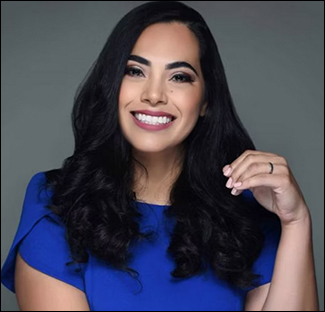
In south Texas, we see a rematch from the 2022 campaign where Rep. Vicente Gonzalez (D-McAllen) and then-Rep. Mayra Flores (R-McAllen) squared off in an incumbent vs. incumbent post-redistricting pairing.

Flores had won a special election in June of 2022 in the 2011 version of CD 34, which stretched along the Gulf of Mexico from Brownsville in the district’s southernmost point then to the north around the Corpus Christi area, and all the way to the outer Austin suburbs. That version of District 34 was rated D+5 according to the FiveThirtyEight data organization.

The 2022 34th District is much different, as it starts just south of Corpus Christi, and stretches to Brownsville, and then west along the Mexican border into the city of McAllen. The new version carries a D+17 rating and is obviously skews much more Democrat than the configuration that elected Flores. Yet, we see new competitive signs.

Despite her losing in 2022 by a 53-44 percent count, a new poll from the 1892 firm for the National Republican Congressional Committee (Sept. 28-Oct. 1; 400 likely TX-34 voters; live interview) finds Flores trailing Rep. Gonzalez by just a 49-46 percent margin. This is largely an under-the-radar race that has drawn little national attention but may be moving up the conversion priority chart.

The poll is another indication that the Republicans are doing better with the Hispanic population. This district is 88 percent Hispanic, and former President Donald Trump, in this same 1892 study, leads Vice President Kamala Harris 49-47 percent despite the seat being drawn to elect a Democrat.

Both NV-2 and TX-34 should receive renewed national interest. Watch for other seemingly safe districts for one party or the other similarly come into play.

Senate Trends

By Jim Ellis — Tuesday, Oct. 15, 2024

Senate

As we get closer to early votes being cast and election day itself, several of the key Senate races are a focal point of attention.

It appears at this point the Republicans are on a path to secure at least a 51-49 majority with wins in West Virginia and Montana, while GOP challengers in Ohio, Pennsylvania, and Wisconsin are getting closer. Democrats are countering with big spending in three Republican states, Florida, Nebraska, and Texas, hoping to score an upset in order to save their small majority.

Ohio businessman Bernie Moreno (R)

Ohio Sen. Sherrod Brown (D) is running for a fourth term and has held the polling lead for the entire campaign, but recent surveys suggest a tightening of the contest. Though former President Donald Trump has established a healthy lead in the Buckeye State, a place he has twice won by eight percentage points, Sen. Brown has continued to post an advantage over GOP businessman Bernie Moreno.

The trend, however, shows a tightening of the race. While Sen. Brown led consistently by five points earlier in the cycle, the most recent nine polls suggest an average lead of only 1.5 percentage points. Therefore, with Trump doing well at the top of the ticket, and Moreno closing the gap, we definitely see a trend moving toward the GOP challenger in this hot Ohio race.

• Overcoming the Casey family political legacy in Pennsylvania is a difficult task for Republicans considering Sen. Bob Casey Jr. (D) has won three statewide campaigns and his father, the late Bob Casey Sr. (D) scored four victories, two as attorney general and two as governor.

The senator has enjoyed consistent polling leads through the election campaign, but the later polls are tightening. Instead of holding an average high single-digit advantage, Sen. Casey’s average lead has dropped to four points according to the last 10 published polls. While the trend is favorable for Republican challenger David McCormick, it may not be strong enough to deny the senator re-election.

• In a similar pattern to that of Sen. Casey, Wisconsin two-term Sen. Tammy Baldwin (D) has also seen her once more formidable lead getting smaller. Typically reaching high single to low double digits over businessman Eric Hovde (R), the senator’s average edge over the last 13 polls has dropped to four percentage points.

Since Wisconsin typically features tight statewide election results, such polling results are not surprising. Considering that both she and Sen. Casey have never trailed in the multitude of surveys conducted in their states, we can also expect Sen. Baldwin to return for another term.

The Democrat challengers in Florida and Texas — along with the Independent that the Nebraska Democratic establishment backs — are continuing to post close polling numbers, but like with the established Democratic incumbents in their competitive campaigns, the GOP incumbents remain favored.

• While polls consistently show Florida Sen. Rick Scott (R) three to four points ahead of former Rep. Debbie Mucarsel-Powell (D), the margin is likely higher. In 2018, when Sen. Scott, then the state’s governor, unseated then-Sen. Bill Nelson (D), he did so with a 10,033-vote victory from a voter pool that exceeded eight million ballots.

At that time, Democrats held a 257,000-person lead in voter registration over Republicans. Today, there are 1.05 million more Republicans than Democrats, indicating that the state has moved over 1.3 million people in the Republicans’ favor since the last time Sen. Scott was on the ballot.

With pollsters missing the Republican voter strength in the Florida statewide races by seven points in 2022, and considering the huge registration changes, the trends below the radar heavily favor a Scott re-election victory.

• A surprise Senate race always seems to appear in every cycle, and we have one forming in Nebraska. Here, Sen. Deb Fischer (R), who doesn’t even have a Democratic opponent, finds herself in a legitimately tight campaign with Independent Dan Osborn. In four polls taken since the beginning of September, Osborn holds an average lead of just under two percentage points.

This contest needs to be monitored, since the trends do suggest an upset is possible. While Trump and Sen. Pete Ricketts (R) enjoy strong double digit leads in the same polls as mentioned above, the Fischer race has become a serious contest. Sen. Fischer may be able to right her political ship since the campaign has sprung into action and is hard at work trying to paint Osborn as a liberal Democrat, but only time will tell if their strategy will be successful.

• In Texas, talk continues, just as it did in 2018, that Sen. Ted Cruz (R) is in danger of losing his seat. While Rep. Colin Allred (D-Dallas) pulls within an average of four points opposite the incumbent over the most recent 12 polls from the beginning of September, the path is still a difficult one for the challenger.

With the Biden-Harris energy policies not favorable to the dominant Texas oil and gas industry, the Lone Star State being most affected by the southern border issue, and south Texas sees Hispanic support rising for Republicans, the timing doesn’t appear favorable to reverse a Republican statewide winning streak that begin in 1996.

While the trends undoubtedly suggest a close finish, as was the case when Cruz defeated then-Rep. Beto O’Rourke (D) by just three points in 2018, the most likely outcome this year is another Cruz victory. The Democrats are increasing strength in the Houston, Dallas, Austin, and San Antonio metro areas, but their gains are not large enough to neutralize the rest of America’s second-most populous state.

All six of the races covered above are well worth increased political attention as the campaign cycle draws to a close. While the Republicans appear to be on track to secure at least a minimum majority, an upset in one of the Republican incumbent campaigns could reverse such an impending trend.

Political Overtime

By Jim Ellis — Monday, Oct. 14, 2024

Election Day

It is quite possible that we will not know the outcome of the presidential election or certainly the US House majority on election night, meaning an undetermined number of days will be required to finally arrive at a definitive winner, or sets of winners in an US House election cycle that promises to deliver multiple tight finishes.

Close elections will bring much scrutiny, and outcomes of several key races in such a situation may not occur until shortly before the state election certification deadline, which in some instances means the middle of December.

There is a strong likelihood that we will see US Senate results on election night. With West Virginia sure to flip from Democrat to Republican and the Montana race today leaning decidedly Republican could mean that a new GOP majority would be announced on election night.

Should, however, an unexpected upset of a Republican member, i.e., Sens. Rick Scott (FL), Deb Fischer (NE), or Ted Cruz (TX), occur, then political overtime is possible, and an extended counting period would come into play if the affected races’ outcomes will determine majority control.

The presidential election is already coming down to seven key swing states, and the domain in this category with the longest certification period is Georgia with a 2024 certification deadline of Dec. 27. The battleground state with the shortest certification period is Nevada, which is Nov. 19.

The unofficial Arizona deadline is Dec. 2; Michigan is Nov. 25; North Carolina will be Nov. 26; and Pennsylvania and Wisconsin are both unofficially scheduled to certify their election results by Nov. 28.

Therefore, if only a few votes in one or more of these states or districts is separating the candidates and the outcome is unclear, then it could be close to a month after election day until we discover a winner. Thus, 2024 could be reminiscent of the 2000 election in Florida, which consumed 36 days to finally determine that George W. Bush had won the state and thereby the election.

The most likely political overtime scenario, however, involves the House majority. Currently, Republicans hold a five-seat edge, but this election could conceivably deliver an even smaller controlling margin to either party. If so, then the races that are forced into political overtime — and in House races there are usually several — will have a direct effect upon which party controls the chamber.

In this case, mid-December could well be the deciding timeline. California and New York, where both states have several competitive races, also have the longest certification periods. In this election year, New York and California election certification deadlines are Dec. 12 and 13, respectively.

Other states where we could see House political overtime are Maine and Alaska, which have certification deadlines of Nov. 25 and 26, while a number of states that feature competitive House races will certify on Dec. 2: Arizona, Colorado, Iowa, Montana, Nebraska, and Virginia.

Even later are Connecticut and Washington (both on Dec. 5), and Oregon on Dec. 12.

While the political world will be in great anticipation of election day, Nov. 5, particularly for determining the House majority, that date may be only the start of what promises to be a laborious and contentious post-election period. At this writing, it appears almost certain that political overtime will be necessary to determine which party will ultimately control a small House majority.