
By Jim Ellis — Monday, September 21, 2026
House
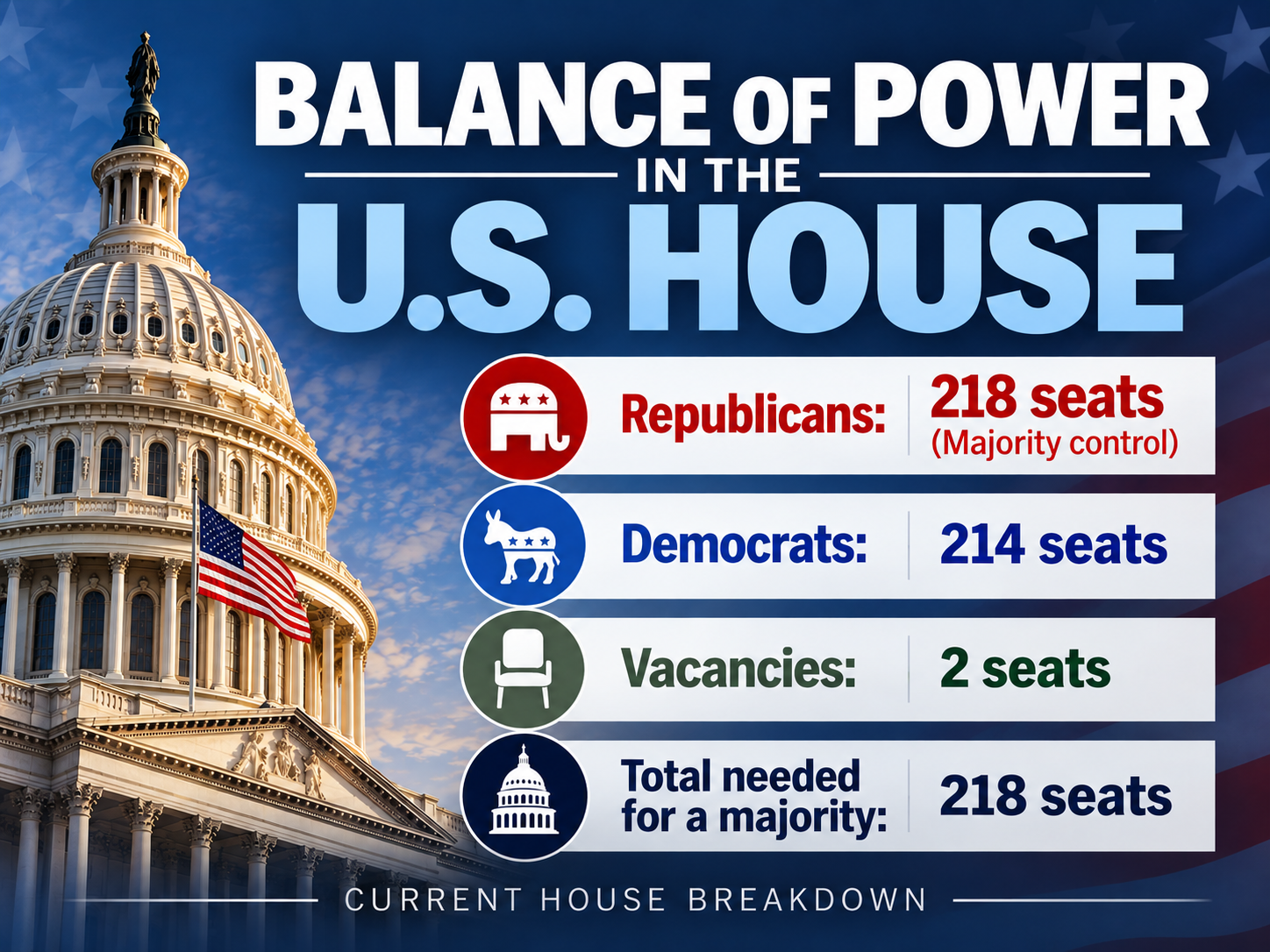
Perusing most political media – and now the prediction markets – the prevailing wisdom holds that Democrats will claim the House majority in November. The central question is, however, from where do those 218-plus seats come?
Examining the national map, roughly 45 House seats across 25 states appear genuinely competitive. A potential flaw in much of the prevailing analysis is an underestimation of the new redistricting maps and the number of seats likely to move toward Republicans as a result. Redistricting remains a meaningful mitigating factor against projected Democratic gains.
Within the 45 most competitive races, at least 15 Republican‑held seats appear positioned to flip to the Democrats. Countering this, however, are as many as 13 Democratic seats that could move toward Republicans, largely due to favorable redistricting. If this scenario materialized, Democrats would fall just short of a majority, producing a 218R–217D House.
Expanding to the next tier of competitiveness, Democrats appear viable in an additional 15 seats, stretching their theoretical gain to 30. Subtracting the Republicans’ potential 13 pickups yields a 17‑seat Democratic gain, translating to a 232D–203R majority.
A more realistic outlook may place Democrats flipping about 20 Republican seats, while Republicans counter with 10- to 13-seat gains. Under the lower GOP estimate – 10 seats – the House would stand at 225D–210R.
Across the 25 competitive states, Democrats could plausibly take four to five Republican seats in California and one in Utah, with additional single‑seat opportunities in Colorado, Iowa, Michigan, Nebraska, New Jersey, New York, Pennsylvania, Virginia, and Wisconsin. None, however, are guaranteed.
Republicans, meanwhile, are positioned to convert Democratic seats in Texas (3-5), Florida (3-4), and single seats in Alabama, Louisiana, Maine, North Carolina, Ohio, and Tennessee – again, with no guaranteed flips.
Several states feature multiple battlegrounds: two competitive districts in Arizona, three in Iowa, and three of four districts in Nevada, for example.
Additional multi‑seat battlegrounds lie in Colorado, Michigan, North Carolina, Ohio, Pennsylvania, and Virginia, with single‑district opportunities in Kentucky, Montana, New Mexico, and Washington. With House competition active in half the country, the political terrain is broad.
Recent voter registration trends offer further electoral clues. Of the 25 competitive states for US House races, 16 register by political party.
Since the 2024 general election, Democrats have gained registration strength in only four of the 16 states (Iowa, New Jersey, New York, and Utah).
Republicans have gained in seven (California, Florida, Iowa, Kentucky, Louisiana, New Jersey, and New York), while Independent or non‑affiliated voters have grown the most, increasing in 11 of the 16 party‑registration states (Arizona, California, Colorado, Kentucky, Nebraska, Nevada, New Mexico, New York, North Carolina, Pennsylvania, and Utah).
Both parties lost registrants in eight states, largely due to voter‑file purges that various state laws individually mandate. These purges remove inactive voters, often in sizable numbers. In all eight states where both parties declined, Republicans lost fewer voters than Democrats, a pattern that could further mitigate some of the Democratic gains many prognosticators expect.
The picture shifts again when factoring in the substantial growth among Independent/non‑affiliated voters. While registration alone cannot determine their partisan lean, most voters in this category ultimately favor a particular party.
Even though Democrats appear to be losing more registrants than Republicans, a strong Democratic lean among the expanding Independent bloc could offset some of that loss and meaningfully reshape the electoral landscape.