Category Archives: Special ELection

A Rematch in Michigan; Dems to Target NY-22; RI Special Election Emerges; the Race for WVa Gov.

By Jim Ellis — Friday, March 3, 2023

House

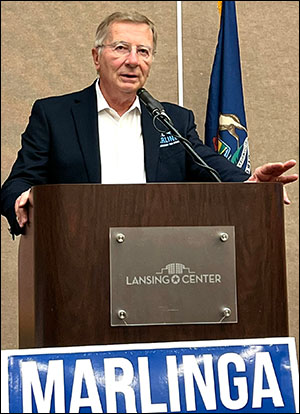
Former local judge and ex-Macomb County prosecutor Carl Marlinga (D)

MI-10: Re-Match Likely — Michigan’s new Detroit suburban 10th District was drawn as a competitive seat, and the 48.8 – 48.3 percent finish in Republican John James’ favor certainly lent support to the pre-election predictions. Though he did not contest the original outcome by calling for a recount, it appears that former local judge and ex-Macomb County prosecutor Carl Marlinga (D) is reportedly telling supporters that he is planning to return for a re-match.

Rep. James (R-Farmington Hills), who twice lost tight US Senate battles, has already said he will not join the open statewide 2024 candidate field so he can defend this politically marginal House district. We can expect another major competitive battle here next year.

NY-22: Democrat Already Exits — Freshman Rep. Brandon Williams (R-Syracuse) is a newcomer to elected politics and is expected to be a major Democratic target in the 2024 election considering he is one of less than 20 members holding a district opposite of the electorate’s partisan lean. Only weeks ago, Manlius Town Council member Katelyn Kriesel announced that she would file to oppose the new congressman next year. However, she opted out of the race on Wednesday citing family reasons.

NY-22 will be a major target, but for the short term, anyway, Democrats lack a candidate. Expect one to emerge, but now it appears that time is favoring Rep. Williams.

RI-1: Movement Beginning for Special Election Battle — Last week, Rhode Island US Rep. David Cicilline (D-Providence) announced that he will be resigning his seat on June 1 to become president & CEO of the Rhode Island Foundation, a funding organization that supports projects in the Ocean State. The move means we will see a special election in the state’s 1st District later this year.

So far, Attorney General Peter Neronha (D) says he will not run for the congressional seat, but others are assessing their political prospects. Two who appear to be leaning toward running are state House Speaker Joe Shekarchi (D-Warwick) and Biden White House aide Gabe Amo (D).

Other potential candidates include Lt. Gov. Sabina Matos (D), former Secretary of State and ex-gubernatorial candidate Nellie Gorbea (D), state Senate Majority Leader Ryan Pearson (D-Cumberland), and many local mayors and state legislators. The battle will be in the Democratic primary since the FiveThirtyEight data organization rates RI-1 as a heavily Democratic district at D+32.

Governor

West Virginia: State Auditor Enters Open Race — Elected state Auditor J.B. McCluskey (R) announced that he will forego re-election to become an open-race gubernatorial candidate. Gov. Jim Justice (R) is ineligible to seek a third term but may declare his candidacy opposite Sen. Joe Machin (D) in the next few days.

McCuskey and Secretary of State Mac Warner (R) are the only statewide officials in the candidate field. State Delegate Moore Capito (R-Charleston), son of Sen. Shelley Moore Capito (R), and businessman Chris Miller (R), son of US Rep. Carol Miller (R-Huntington), are already in the field along with private preschool owner Rashida Yost (R) and rancher Terri Bradshaw (R). No Democratic candidate has yet stepped forward.

Calif. Rep. Lee Declares for Senate;
RI-1 Resignation; VA-4 Winner;
Dems Disqualified in Mississippi

By Jim Ellis — Thursday, Feb. 23, 2023

Senate

California Rep. Barbara Lee (D)

California: Rep. Barbara Lee (D) Declares for Senate — In an expected move, 12-term California US Rep. Barbara Lee (D-Oakland) announced that she will officially join the open US Senate campaign to replace retiring Sen. Dianne Feinstein (D). Rep. Lee had already filed a Senate committee with the Federal Election Commission, and had been making it clear she would announce once Sen. Feinstein made her retirement plans public.

Already declared are fellow Reps. Katie Porter (D-Irvine) and Adam Schiff (D-Burbank). Schiff has recruited endorsements from 15 members from the California Democratic delegation, including former House Speaker Nancy Pelosi (D-San Francisco). At this point, however, no statewide elected office holders are making a move to run for the Senate. California features an all-party jungle primary system, so it is likely that two Democrats will advance to the general election. In 2024, because it is a presidential election year, the California primary moves to Super Tuesday, March 5, 2024.

While Rep. Lee is the only major candidate at this point hailing from northern California, she will be a decided underdog on the fundraising circuit. Both Reps. Porter and Schiff are two of the most prolific House fundraisers in the country. Though the seat will remain in Democratic hands, this race will continue to feature a highly competitive cycle-long open seat campaign.

House

RI-1: Rep. David Cicilline (D) to Resign — Rhode Island Rep. David Cicilline (D-Providence) announced that he will resign from the House on May 31 to accept a new position as president and CEO of the Rhode Island Foundation. Cicilline’s move will require Gov. Dan McKee (D) to schedule a special election later in the year to fill the congressional post.

The Rhode Island Foundation is a 100-plus year-old donating nonprofit entity with an endowment of more than $1.3 billion according to their latest public financial statement. The organization specializes in providing financial grants and scholarships particularly in the areas of community development and education.

The FiveThirtyEight organization rates RI-1 as D+32. The neighboring 2nd District has a D+17 rating, but hosted a competitive 2022 open seat race after veteran Rep. Jim Langevin (D-Warwick) decided to retire. State Treasurer Seth Magaziner (D) recorded a 50-47 percent win over former Cranston mayor and two-time Republican gubernatorial nominee Allan Fung in a race the national GOP had high hopes of winning.

VA-4: State Sen. McClellan (D) Wins Special Election — Virginia state Sen. Jennifer McClellan (D-Richmond) easily won the state’s 4th District special election Tuesday night, earning the right to succeed the late Congressman Donald McEachin (D-Richmond) who passed away at the end of November.

McClellan was the clear favorite going into the election after winning the Democratic nomination process in December. She easily defeated Republican Leon Benjamin, a frequent candidate, with 74 percent of the vote. The 4th District, which stretches from Richmond to the North Carolina border, is heavily Democratic. The FiveThirtyEight data organization rates the district D+30, while Dave’s Redistricting App scores the seat’s partisan lean at 66.8D – 31.6R.

Governor

Mississippi: Two Democrats Disqualified — A pair of minor Democratic gubernatorial contenders have been disqualified from the ballot for failing to meet the state’s candidate requirements. This means that Public Service Commissioner Brandon Presley, cousin to the late music legend Elvis Presley, will be unopposed for the party nomination.

With Gov. Tate Reeves (R) facing only minor opposition in the Aug. 8 Republican primary, we will now assuredly see both the governor and Presley advancing into the general election. Therefore, a defined Mississippi gubernatorial campaign commences and will continue for the better part of this year. The general election date is Nov. 7.

Dean of Senate Makes Farewell Speech; McCarthy Vote Count on Shaky Ground; VA-4 Update

By Jim Ellis — Thursday, Dec. 22, 2022

Senate

Vermont Sen. Patrick Leahy (D)

Vermont: Dean of Senate Makes Farewell Speech — Sen. Patrick Leahy (D-VT) was first elected in 1974 and went onto win seven more statewide elections. He is the third-longest serving senator in the history of the United States — in office for 48 years — and now is retiring as a historic figure in American politics. Sen. Leahy made his farewell speech on the Senate floor Tuesday in the waning days of his final term. The new dean of the Senate will be Sen. Chuck Grassley (R-IA) who was first elected in 1980. Two other top-10 senators in seniority, Richard Shelby (R-AL) and Jim Inhofe (R-OK) are also retiring when this Congress officially ends at the end of the year.

House

Speaker Race: McCarthy Vote Count Appearing Weak — More media attention is being paid to the impending House Speaker’s race to be settled when the new House convenes on Jan. 3, 2023. Earlier in the week, Speaker-Designate Kevin McCarthy (R-CA), who has the official Republican conference nomination for Speaker by virtue of winning a 188-31-5 vote in defeating Arizona Rep. Andy Biggs and others, released a list of his strongest supporters. For his part, Biggs pledges to challenge McCarthy in the January roll call vote signaling the beginning of the Congress.

McCarthy’s list of his strongest supporters, those who say they will vote for no other in what could become a lengthy process should the Speaker election progress through multiple rounds, is smaller than one would have otherwise surmised. The total only identified 54 such Republican members, not even a full quarter of the conference. Some believe this number signifies weakness as opposed to strength. In a Fox News article by Chad Pergram published Tuesday, the reports suggest the number of Republican members who could vote for someone else on the floor could be as high as 20, though only five have publicly expressed at least preliminary public opposition.

The last time a Speaker election went multiple rounds occurred in 1923. The voting will continue until some candidate receives majority support of the present and voting House members. No doubt, this will be the most interesting Speaker election we will have witnessed to date in the modern political era.

VA-4: Counting Didn’t Begin Until Yesterday — The Democrats held their “firehouse primary” Tuesday to choose a special election nominee to succeed the late Rep. Donald McEachin (D-Richmond), but considering we now regularly see the slow counting of votes during the present political period, the tabulation process did not begin until a day later.

State Sen. Jennifer McClellan (D-Richmond) is the party leadership’s choice and faces a challenge from controversial state Sen. Joseph Morrissey (D-Richmond), who was once convicted of having sexual relations with a minor (a girl who he later married), was summarily forced to resign his seat in the House of Delegates but then won it back as an Independent in the special election to elect a successor. He later resigned again and moved into a Richmond Senate district where he would then defeat a Democratic incumbent. Former state delegate Joe Preston and businessman Tavorice Marks also are in the race.

The Democratic winner will face the new Republican nominee, pastor Leon Benjamin who has twice been the GOP’s congressional candidate in this district. In a D+30 district according to the FiveThirtyEight data organization, the winner of this Democratic nomination has the clear inside track for the special election on Feb. 21.

Electoral College — Left Coast, Right Coast; Republicans Choose Nominee in VA-4; North Carolina Supreme Court Rejects Map

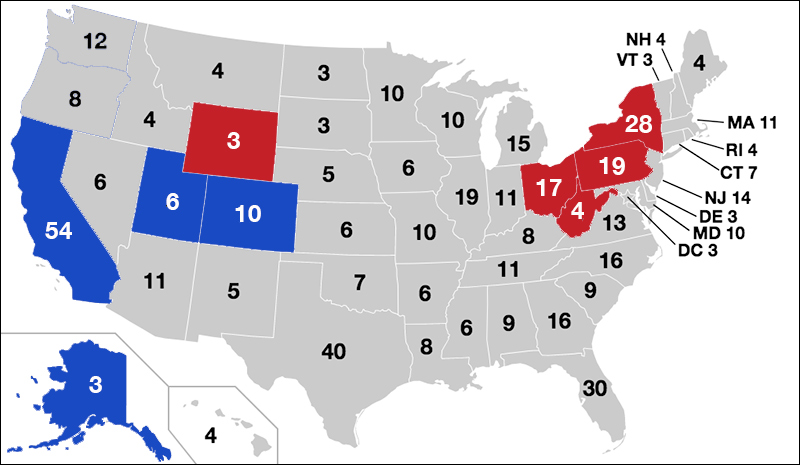
Electoral College Votes Per State, 2022 — blue moving more left, red moving more right


By Jim Ellis — Tuesday, Dec. 20, 2022

President

Electoral College: West Moving Left, East Moving Right — The researchers at the University of Virginia’s Center for Politics have completed a study regarding the country’s ideological shift during the past 20-plus years. Tracking all 50 states’ presidential votes from the 2000-2020 elections, we first see all of the western states now voting Democratic in greater percentages with the exception of Wyoming. The biggest shifts came in Alaska, California, Colorado, and Utah, though two of those four states still regularly produce at least smaller majority or plurality Republican victories.

Conversely, the south and east have trended more Republican with the strongest swings generally occurring in central south with only Maryland, Rhode Island, Vermont, and Virginia becoming more Democratic. Mid-Atlantic states such as New York, Ohio, Pennsylvania, and West Virginia have moved decidedly more Republican, though two of these four continue to regularly deliver clear Democratic majorities. Remaining constant in their voting pattern during this entire 20-year span are Illinois, Maine, Massachusetts, Minnesota, and South Carolina.

House

VA-4: Republicans Choose Special Election Nominee — Republicans re-nominated their 2020 and 2022 candidate in the Saturday, Dec. 17 “firehouse primary” through Ranked Choice Voting. The local 4th District Republican Party leadership did not release the actual results, only to say that pastor and US Navy veteran Leon Benjamin had defeated former Mecklenburg School Board member Dale Sturdifen, and non-profit advocacy organization director Derrick Hollie. Benjamin now advances to the Feb. 21 special general election to replace the late Rep. Donald McEachin (D-Richmond). He will again be a decided underdog in a district that the FiveThirtyEight data organization rates D+30.

The Democratic firehouse primary will be held today. Four candidates filed to run: state Sens. Jennifer McClellan (D-Richmond) and Joseph Morrisey (D-Richmond), former state Delegate Joseph Preston, and businessman Tavorise Marks. While the special election will be held in late February, Gov. Glenn Younkin’s (R) call required the parties to choose nominees by Dec. 23.

In another development, Colette McEachin, the late congressman’s widow, announced her endorsement of Sen. McClellan, joining most of the Virginia Democratic establishment who has already done so.

States

North Carolina: NC Supreme Court Tosses State Senate Map — The North Carolina state Supreme Court, with the 4-3 Democratic majority on the cusp of expiring, rejected the NC Senate map on a partisan vote as a partisan gerrymander. But, the action is likely to be short-lived and adds fuel to the speculation that the new legislature will re-draw all of the state’s redistricting maps after commencement. Doing so may well render moot the partisan gerrymandering case that the US Supreme Court recently heard.

Under North Carolina legislative procedure, the governor has no veto power over redistricting legislation, so whatever the legislature passes will become law. Because of the current court’s farewell action, the state Senate map must be re-configured. Since Republicans gained two seats on the state Supreme Court in the November election and will have a 5-2 majority beginning in January, the likelihood of not only the Senate map being redrawn but also the state House and congressional delegation plans is greater. The latter two maps are court-drawn interim placeholders, which the legislature can replace at any time.

Opposition Candidates Announce to Run Against VA Sen. Kaine; Quick “Firehouse” Primary Set; Retiring Congressman Plans Mayoral Run

By Jim Ellis — Friday, Dec. 16, 2022

Senate

Virginia Sen. Tim Kaine (D)

Virginia: Many Announce Against Sen. Kaine — For a Senate race that appears safe in this early part of the 2024 election cycle, the Virginia contest is surprisingly already drawing a great deal of candidate interest. It’s unlikely that any of the five Republicans and one Democrat who have announced their candidacies can defeat Sen. Tim Kaine (D), but we are at least assured of seeing a multi-candidate Republican nomination battle.

Of the five announced candidates, only two, financial advisor and retired Army officer Eddie Garcia and attorney and Navy veteran Chuck Smith, seem credible enough to become potentially viable candidates.

House

VA-4: Republicans Schedule Quick Firehouse Primary — Gov. Glenn Youngkin’s (R) call to the political parties to choose their nominees by Dec. 23 for the Feb. 21 special congressional election to replace the late Rep. Donald McEachin (D-Richmond) has given the party leaders precious little time, but now both entities have scheduled “firehouse primaries.” As reported yesterday, the Democrats will hold their primary next Tuesday, Dec. 20. Now the local Republicans are moving even quicker. They will hold their special primary tomorrow, Saturday, Dec. 17.

The schedule is ridiculously short and does not give the candidates time to campaign nor the voters an adequate ability to know who is running and where to vote, since the polling places in a “firehouse” primary are very scarce. At this point, Democrats have five candidates and Republicans four.

Governor

Louisiana: Sen. Kennedy Releases Another Poll — While Sen. John Kennedy (R) says he will make a decision about running for governor after the first of the year, he continues to release polling data showing him holding a lead against a field of prospective open seat 2023 gubernatorial candidates.

His latest survey, again from Torchlight Strategies (Dec. 6-9; 861 likely Louisiana 2023 gubernatorial election voters; live interview and text), projects Sen. Kennedy to be holding a 42-22-14 percent lead over state Transportation Secretary Shawn Wilson (D) and attorney general and former US Congressman Jeff Landry (R) in what will be an Oct. 14, 2023 jungle primary. In potential runoff pairings, which would be scheduled for Nov. 18 of next year, Sen. Kennedy would lead AG Landry 46-21 percent and Secretary Wilson by a much larger 58-27 percent.

These numbers, and the fact that Kennedy is releasing them, clearly suggests that the senator will affirmatively announce his gubernatorial campaign in January. Incumbent Gov. John Bel Edwards (D) is ineligible to seek a third term.

Cities

West New York: Retiring Congressman Plans Mayoral Run — Though New Jersey Rep. Albio Sires (D-West New York) is retiring from the House of Representatives this year after serving eight terms, he is apparently not finished with elective politics. Reports suggest that Sires will soon announce his candidacy for mayor of West New York, a town in New Jersey — one of the elected positions he held before winning his seat in Congress.

Sires served as mayor from his original election in 1995 until he won the US House position in 2006. Beginning in 2001, he was also an elected member of the New Jersey state Assembly, where he became Speaker in 2002.

Cruz Polling Up for Renomination, Down for President; Ariz. Dem Primary Looking Competitive; VA-4 Special Election Scheduled;
Sen. Braun Announces Candidacy

By Jim Ellis — Wednesday, Dec. 14, 2022

President

Texas Sen. Ted Cruz (R)

Texas: Cruz Polling Up for Renomination, Down for President — According to a Texas-based Republican pollster, Sen. Ted Cruz is in strong shape among prospective GOP primary voters for renomination, but not for a presidential campaign. The CWS Research firm recently conducted a Texas poll (Nov. 8-29; 860 likely Texas 2024 Republican primary voters; interactive voice response system and online) and finds the senator posting a strong 81 percent renomination score, but only records three percent support for another presidential bid.

The CWS poll leader is former President Donald Trump at 37 percent preference with Florida Gov. Ron DeSantis following closely with 34 percent. Former Vice President Mike Pence and ex-UN Ambassador and South Carolina Gov. Nikki Haley also finish slightly ahead of Sen. Cruz in his home state. Pence draws five percent backing and Haley four percent, as compared to Sen. Cruz’s three percent.

Senate

Arizona: Dem Primary Could Be Competitive — Apparently Rep. Ruben Gallego (D-Phoenix) is not the only Arizona Democratic congressman considering a run for the Senate. According to a report from the Daily Kos Elections site, Rep. Greg Stanton (D-Phoenix) — who served six years as mayor of Phoenix and nine years on the Phoenix City Council before being elected to the US House in 2018 — has conducted a statewide US Senate poll. If he were to run in what would now be an open US Senate Democratic primary since new Independent incumbent Sen. Kyrsten Sinema will advance directly into the general election, a tough battle would develop in an August 2024 primary between the two Phoenix-based congressional Democrats.

Rep. Stanton was re-elected in November with a 56-44 percent margin against a credible Republican, businessman Kelly Cooper. This, after his district was changed from a D+15 to a D+1 rating according to the FiveThirtyEight data organization calculations, meaning he rather impressively exceeded expectations.

House

VA-4: Special Election Scheduled — Gov. Glenn Youngkin (R) has surprisingly scheduled the special congressional election to replace the late Rep. Donald McEachin (D-Richmond) for Feb. 21. With Democrats certain to hold this seat in the special election, it was thought Gov. Youngkin would delay a bit longer, possibly to early April, in order to give the Republicans a further one-seat edge in the House party division count.

With the Feb. 21 general election date that will fast approach, the political parties must quickly assemble and determine how their nominees will be chosen. At this point, their realistic options are to nominate in a special district convention or hold a “firehouse primary,” that is an election with very few polling places around the district.

The Democratic nomination will be the contest to watch, since the 4th District is rated as D+30. At this point, state Sen. Jennifer McClellan (D-Richmond) and Delegate Lamont Bagby (D-Richmond) have announced their intention to file as candidates. For the Republicans, two-time nominee Leon Benjamin and insurance agent and frequent candidate Ron Wallace have declared that they will run.

Governor

Indiana: Sen. Braun Announces — First-term Hoosier State Sen. Mike Braun (R) made his obvious intentions to run for governor official Monday with his formal announcement. He will be a strong favorite for the Republican nomination, which gives him the inside track in the general election.

There is a good possibility that his Democratic opponent will be former US senator and current Ambassador to the Holy See, Joe Donnelly. The Holy See is the government of the Roman Catholic Church, which is led by the Pope in his role as the bishop of Rome. Ironically, this would set a re-match between the two men of the 2018 Senate race, a campaign that Sen. Braun won with a 51-45 percent victory margin. The Braun announcement now sets into motion a competitive Senate campaign that will likely feature a crowded Republican primary.

Examining the Role of the RCV System in Alaska’s Special Election; Rep. Crist Resigns in Fla.; Indiana “Shock” Poll

By Jim Ellis — Friday, Sept. 2, 2022

House

Sarah Palin (R)

AK-AL: Sarah Palin Loses Special Election — The headline here is that former Alaska governor and 2008 GOP vice presidential nominee Sarah Palin fell to Democrat Mary Peltola in the at-large Alaska special election, and the first full usage of the state’s new Ranked Choice Voting (RCV) system was fully in play. Yesterday we reported the results; today we’ll delve into the RCV system that delivered those results.

At the end of the final counting, which was when the Aug. 16 deadline to accept ballots in the primary election expired, 60 percent of voters chose a Republican candidate. However, the RCV system yielded a Democratic victor. Therefore, in a system that is designed to create a majority candidate, in this case the RCV system produced a minority vote share winner.

The finalists from the jungle primary election began with Peltola, who recorded 40.2 percent of the vote. Palin secured 31.3 percent, and Nick Begich III (R) captured 28.5 percent. Begich III is the grandson of former Democratic US Rep. Nick Begich, Sr. (D), and the nephew of former US senator and ex-Anchorage Mayor Mark Begich (D). In finishing third, Begich was eliminated from further competition, and his first-place votes were located and then allocated to the remaining two candidates via the voters’ ranking.

Former state Rep. Mary Peltola (D) winner of the Alaska special election race.

As we predicted, based upon the experiences of other states and cities that have used the RCV system, a large number of votes were disqualified, or “exhausted” to use the Alaska vernacular.

Of the 192,158 individuals who participated in the special election and/or regular primary, a total of 3,401 ballots were listed as “blank,” meaning the individuals voted in the election but bypassed the special congressional contest. Another 342 ballots were categorized as “overvotes.” This terminology suggests the owners of such ballots voted incorrectly. Typically, it means the individual, presumably inadvertently, voted more than once for the same candidate, thus disqualifying the ballot.

The categories that likely cost Palin the election, despite the large majority voting for a Republican candidate, came in RCV’s Round 2. In that round, a total of 11,222 Begich voters did not properly manage the RCV system on their ballots, which was to rank the three candidates in the order of the individual voter’s preference.

Lawyers who challenged the RCV system in other places around the country warned that their experience showed a large number of disqualified, or “exhausted,” ballots would be present here, which certainly proved to be the case.

This latter number added to the initial overvotes, meant a total of 11,269 Begich first-place voters saw their ballot disqualified, more than twice the number of votes (5,219) that comprised Palin’s deficit against Peltola’s final victory total. Adding this number to those who chose to bypass the special congressional race meant that 14,965 individuals who voted in this election failed to have their ballot count in the RCV process.

The second category leading to Palin’s demise were the 15,445 individuals who voted for Begich on the first ballot, but decided to support Peltola with their second choice. This is a much higher number than our pre-election estimate projection, and are chiefly responsible for the ex-governor failing to win the general election.

A possible reason that some of these voters chose Peltola is that the Begich name identification comes from the current candidate’s family predecessors mentioned above who were, and are, affiliated with the Democrats. It is possible that the multiple confusion factors present in this race also extended to Begich’s name, with many traditional Democratic voters still thinking he is a member of their party and not noticing his Republican label on the ballot.

Also adding to the confusion factor was the RCV system being used only in this special general election that was run concurrently with the regular state primary. In all other races on Aug. 16, voters were simply choosing one candidate to advance into the general election, where four jungle primary candidates from each race would do so. Therefore, the almost 15,000 ballots being disqualified before the end of the RCV special election process suggests a large amount of confusion within the electorate.

With the same three finalists again advancing into the regular election from the regular congressional primary, which was also held on the same day (Aug. 16), thus producing one more confusion factor, we could see a rerun of the RCV results in the November election. If either Palin or Begich were to withdraw from the regular general election, however, Peltola’s fate would then likely be sealed, since the Republican vote would then presumably overwhelm the number of her Democratic preference ballots.

While the intrigue associated with this one race has now been resolved, new questions will immediately begin to unfold for the impending general election. For now, however, Mary Peltola will be sworn in as the House of Representatives’ newest member.

FL-13: Rep. Crist Resigns — Congressman Charlie Crist (D-St. Petersburg) resigned his Pinellas County-anchored US House seat Wednesday in order to fully concentrate on his gubernatorial campaign. Crist won the statewide Democratic primary on Aug. 23 and will face Gov. Ron DeSantis (R) in the general election. Another member of the Florida congressional delegation, Rep. Ted Deutch (D-Boca Raton), who announced in February that he would leave Congress to become the CEO of the American Jewish Committee, will reportedly officially resign on Oct. 1.

With the Crist and Deutch resignations, the Democrats will be down to 220 seats in the House even after adding New York Rep. Pat Ryan (D-Poughkeepsie) after his special election victory certification and the Alaska at-large seat where Democrat Mary Peltola was declared the special election winner. It is unclear if Gov. DeSantis will call a special election to fill the Florida vacancies or just leave them vacant until the new term begins in January.

Senate

Indiana: Shock Poll — Hoosier State Democratic US Senate nominee Tom McDermott’s campaign released the results of their recently conducted Change Research poll (Aug. 20-24; 2,111 likely Indiana general election voters; online), which posted Sen. Todd Young (R) to only a 45-42 percent lead. The Indiana Senate race had been considered non-competitive. The Young campaign responded with criticism over the online methodology and weighting system that Change Research employs. Expect the Young campaign to quickly counter this data with a poll release of their own.

Governor

South Carolina: Gov. McMaster Leading in Consecutive Polls — In a race that had not been polled during the general election period to-date, two new surveys were released on consecutive days. Yesterday, we reported that Gov. Henry McMaster (R) led in The Trafalgar Group survey (Aug. 25-28; 1,071 likely South Carolina general election voters; multiple sampling techniques) by a 51-43 percent margin over former Congressman Joe Cunningham, who won the Democratic nomination back in the June primary.

The next day’s polling release featured a survey from the Democratic firm, Blueprint Polling (Aug. 24-25; 721 likely South Carolina general election voters; live interview), that actually posted McMaster to a larger lead than the Trafalgar result, 50-39 percent.