Category Archives: House

The California Ballot Report

By Jim Ellis

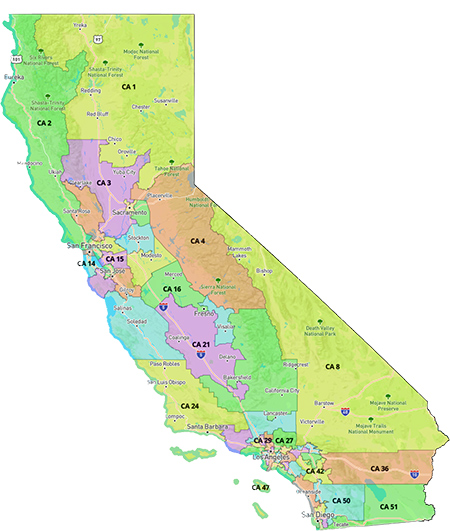
                     California Congressional Districts

Nov. 10, 2020 — The California Secretary of State — as has been the office’s practice because the counting process there is always so long — has issued its report on how many ballots are outstanding on a countywide basis.

The ballot reception period here will not conclude until Nov. 20, though vote envelopes would have had to be postmarked on Nov. 3 in order to be admitted to the count.

The SoS office is, at this point, showing a generally low number of outstanding ballots, but when looking at the total votes cast in the districts when adding the outstanding number to the recorded votes, the aggregate totals look reasonable and are all much higher than the 2016 congressional vote in each district. If the outstanding ballot number is in actuality near completion, then the races will be called right after Nov. 20, since there will be little in the way of adding extra votes to the district totals.

Extrapolating the number of ballots remaining to be counted with the area of the specific county within the congressional districts in question could provide a projection basis to in order to estimate how many votes the trailing candidate would need to win their respective race.

Below is a recap of the five most contested races in the state. Technically, Reps. Jimmy Gomez (D-Los Angeles) and Ken Calvert (R-Corona) are also uncalled, but their margin is large enough that each should be re-elected. The eighth race not technically called is in the Sacramento area, but challenger Brynne Kennedy (D) has already conceded to Rep. Tom McClintock (R-Elk Grove).


CA-8:
Jay Obernolte (R) vs. Christine Bubser (D)
• Current Standing: Obernolte +24,925 votes (55.5% to 44.5%)
• Estimated Remaining Votes: 76,223
• Minimum % Bubser Needs to Reverse: 66.3%

Inyo County: Obernolte 50.5 – 49.5%
• Estimated Remaining Votes: 370

Mono County: Bubser 60.1 – 39.9%
• Estimated Remaining Votes: 245

San Bernardino County: Obernolte 56.2 – 43.8%
• Estimated Remaining Votes: 75,608

If the estimates of the number of outstanding ballots are near correct and relatively complete, and the county percentages remain constant as compared with their previous performance, Obernolte would win with more than 55 percent.


CA-21
Rep. T.J. Cox (D-Fresno) vs. Ex-Rep. David Valadao (R)
• Current Standing: Valadao +4,570 votes (51.8% to 48.2%)
• Estimated Remaining Votes: 70,047
• Minimum % Cox Needs to Reverse: 53.3%

Fresno County: Valadao 51.5 – 48.5%
• Estimated Remaining Votes: 8,151

Kern County: Cox 61.3 – 38.7%
• Estimated Remaining Votes: 58,661

Kings County: Valadao 62.1 – 37.9%
• Estimated Remaining Votes: 1,529

Tulare County: Valadao 50.0 – 50.0%
• Estimated Remaining Votes: 2,114

If the estimates are near correct and the county percentages remain constant in the after-county as compared with their previous performance, Rep. Cox would win a close victory with less than 51 percent. Realistically, this race is likely too close to call.
Continue reading


Outstanding Races Update

By Jim Ellis

Nov. 9, 2020 — A few races were called over the weekend, while political overtime drags on for others.

Alaska senate race still undecided between physician and commercial fisherman, Democrat Al Gross (left), and first-term Republican incumbent Dan Sullivan.

The uncalled Senate races will likely remain in their current position throughout this week. Currently, Alaska Sen. Dan Sullivan (R) holds a big lead over physician Al Gross (I/D), 62.3 – 32.1 percent, with a vote margin of 57,616. Despite the large spread, the race is not called because only 58 percent of the vote is reporting. The Alaska cut-off date for receiving ballots postmarked Nov. 3 is this Friday, Nov. 13. Therefore, it is presumed that we will not have a final declaration until the weekend at the earliest.

The North Carolina situation remains frozen. Sen. Thom Tillis (R) holds a 95,739-vote lead with all counted but those ballots that could come in through Nov. 12. It appears the universe of requested ballots not yet returned could only be a maximum of approximately 116,500. The ballots must now be in the mail stream as they would have to have been postmarked on Nov. 3. Mathematics suggest a Tillis victory will occur, but such a declaration is not yet official.

As we know, both Georgia Senate races will advance to their respective runoff elections on Jan. 5. The political battles feature Republican Sen. David Perdue (49.7 of requested ballots not yet returned) and Democrat Jon Ossoff (47.9 percent). The special election features Democratic Rev. Raphael Warnock (32.9 percent) and appointed Republican Sen. Kelly Loeffler (25.9 percent).

The House races are not fully complete, as 24 contests remain in abeyance. At this point, Republicans have gained a net five seats among the 411 campaigns that have been decided. Of the remaining 24, the GOP candidates lead in 18, but many will likely flip back toward the Democrat as counting concludes. In the end, it is likely that the Republicans will gain between seven and nine seats, meaning they will hold 208 to 210 House seats as compared with 227 to 225 for the Democrats.

In the past few days, the following races have been declared and the winners are listed below:

AZ-6: Rep. David Schweikert (R)
CA-50: Darrell Issa (R) – Open Seat – Republican hold
GA-7: Carolyn Bourdeaux (D) – Open Seat – Democratic gain
IN-5: Victoria Spartz (R) – Open Seat – Republican hold
MI-3: Peter Meijer (R) – Open Seat – Republican gain
MI-8: Rep. Elissa Slotkin (D)
MI-11: Rep. Haley Stevens (D)
MN-1: Rep. Jim Hagedorn (R)
MN-2: Rep. Angie Craig (D)
NV-3: Rep. Susie Lee (D)
NV-4: Rep. Steven Horsford (D)
NJ-2: Rep. Jeff Van Drew (R)
NY-4: Rep. Kathleen Rice (D)
PA-7: Rep. Susan Wild (D)
PA-8: Rep. Matt Cartwright (D)
PA-10: Rep. Scott Perry (R)
PA-17: Rep. Conor Lamb (D)
WA-3: Rep. Jaime Herrera Beutler (R)

The remaining races are still undecided:
Continue reading

Outstanding Senate & House Races

By Jim Ellis

Nov. 5, 2020 — Two Senate races were called yesterday, one for Sen. Susan Collins (R-ME), who scored a 51-42 percent victory over state House Speaker Sara Gideon (D-Freeport). Gideon conceded the race yesterday even though the count had not ended. In Michigan, Sen. Gary Peters (D) was projected as the winner with a very close (49.6 – 48.5 percent) count over GOP challenger John James.

The two calls mean that the high number for the Senate Republican majority is 52, with the Democratic maximum being 51. The most likely outcome from the current trends and potentially projecting the runoff election under what may be a Biden victory at the presidential level is either a Republican majority of 51 or 52 seats.

In the House, 40 races remain uncalled, yet many of them are now reporting 100 percent of the vote being received. Of the 40, the Republicans lead in 25 and the Democrats 15. This would translate in a Republican net gain in the House of most likely between five and nine seats.

Below is a chart of the races that remain uncalled and which candidate is currently leading:

Senate

STATE LEADING CANDIDAGE RACE STATUS % REPORTING
Alaska Sen. Dan Sullivan 62.3% 50
Georgia-A Sen. David Perdue (R), must reach 50% 50.2% 97
Georgia-B Rev. Raphael Warnock (D) 32.5% 96
Sen. Kelly Loeffler (R) 26.2% Runoff
Maine Sen. Susan Collins (R) 51.1% Winner
Michigan Sen. Gary Peters (D) 49.6% Winner
N. Carolina Sen. Thom Tillis (R) 48.7% 93

House

Continue reading

Election Day Results & Analysis

By Jim Ellis

Nov. 4, 2020 — Last night’s national election, as predicted, is now it in political overtime.

The presidential race won’t be decided for more than a day, and possibly not until all ballots are received and counted in Pennsylvania, which as of this writing could drift into Friday. The state’s post-election ballot reception deadline, is Nov. 6, at 5:00 pm.

It appears that former vice president Joe Biden (D) has the inside track to unseat the president, but Trump still has a narrow path to victory.

It is likely that the Republicans have held the Senate majority despite what appears to be a close loss at the top of the ticket. Defending 13 of the most vulnerable 16 Senate seats, the GOP may break even. Converting Alabama and leading in Michigan offsets the loss of seats in Arizona and Colorado. Four races remain undecided.

Republicans had a much better night in the House than expected. With 43 races still uncalled, a reasonable projection suggests the Democrats will return to the House with a majority margin approximately seven seats less than in the current Congress. This would make the new majority 226D-209R, and certainly put House control front and center for the 2022 election cycle.

In the 11 governor’s races, we saw one state flip from Democrat to Republican, the open Montana race that completed a Republican sweep of the top four statewide offices. At-Large Rep. Greg Gianforte (R) was elected the state’s new governor, replacing term-limited Gov. Steve Bullock (D) who lost the Senate race to incumbent Steve Daines (R).

Continue reading

A Full Congressional Race Recap

By Jim Ellis

Nov. 3, 2020 — Below is a rundown on the key campaigns today and which seats may flip. The Senate races are close with both parties having a chance to claim the majority. The House looks to stay under Democratic control with the main question being whether they expand their majority or Republicans can diminish the majority’s 17-seat margin. Here’s how things line up today:


SENATE

Potential Democrat to Republican Flips:

• Alabama – Tommy Tuberville positioned to win
• Michigan• John James close in some polls; outside chance for upset
• Minnesota• Jason Lewis with long-shot chance to defeat Sen. Tina Smith


Potential Republican to Democrat Flips:

• Arizona – Though closing, Martha McSally will likely come up short against Mark Kelly
• Colorado – Sen. Gardner appears headed for a loss
• Georgia-A – Sen. Perdue polling is slipping; could lose or be forced to a runoff
• Maine – Sen. Collins rebounded but Ranked Choice Voting could defeat her if race leader is under 50 percent


Toss-Up to Leaning Republican

• Alaska – Sen. Sullivan sees polling now going his way; typical Alaska pattern
• Georgia-B – Rev. Warnock finishes first but forced to run-off; tight between Sen. Loeffler and Rep. Collins for second position; runoff is Jan 5
• Iowa – Sen. Ernst’s numbers improving; small lead; momentum is her way
• Kansas – Rep. Marshall should prevail, but margin may be small
• Kentucky – Sen. McConnell wins
• Montana – Sen. Daines with slight advantage; R turnout model should help save him
• North Carolina – Tight, but Sen. Tillis has the momentum; Cunningham hurt by scandal; GOP early vote numbers better than 2016
• South Carolina – Sen. Graham looks to score close win despite massive spending against him
• Texas – Sen. Cornyn clear favorite, but win percentage may be down; early vote a plus for GOP


HOUSE

• Alabama – no change in delegation
• Alaska – Rep. Young up in polling late; should prevail
• Arizona – Rep. O’Halleran wins Rep. Schweikert in clear danger of losing
• Arkansas – no change in delegation
• California – Reps. LaMalfa and McClintock have competitive opponents but should win
            – Assemblyman Jay Obernolte holds open 8th CD for Republicans
            – Ex-Rep. Valadao in strong position to re-claim the seat he lost in 2018.
            – Rep. Cisneros wins another close race against GOPer Young Kim Rep. Rouda prevails against Supervisor Michelle Steel (R)
            – Former Rep. Darrell Issa returns winning District 50
            – Ex-State Dept official Sara Jacobs wins double-Dem general in CA-53
• Colorado – Lauren Boebert in close general after ousting Rep. Tipton in R primary; 2nd Amendment key issue and might be difference in her winning
• Connecticut – no change in delegation
• Delaware – no change in delegation
Continue reading

On Election Night, Keep Your Eyes on Arizona, Florida and Wisconsin

By Jim Ellis

Oct. 29, 2020 — There has been prevalent speculation that we may not see a winner in the presidential election and certainly in some Senate and House races come the evening of Nov. 3, but research into the processing and counting systems of each state suggests such a conclusion may actually prove unlikely.

The election procedures in Arizona, Florida, and Wisconsin all point to having a victory projection coming from these states on election night, thus making them the “tells” for the national vote. If President Trump loses either Arizona or Florida, it will almost assuredly secure a Joe Biden victory. On the other hand, should the president sweep the three aforementioned states, he will be headed toward clinching re-election.

The huge number of precast, or early votes, around the country is another mitigating fact that may halt the need to advance into political overtime, at least for the presidential race. Through Monday, almost 60 million people have voted (59,095,114 according to the Target Smart statistical organization), meaning these ballots and many more will be stacked in vote centers awaiting processing and counting.

The overwhelming early voting response, up 100 percent from this time in 2016, will assuredly lessen the number of in-person voters on Election Day, especially since the early vote number will continue to grow throughout the balance of this week.

Generally, the state processing and tabulation procedures fall into one of three categories: counting the ballots as they arrive, but not releasing totals until after the polls close; keeping the received ballots until the morning of Election Day when counting can begin; or, having to wait until the polls close before beginning to count.

First, the pre-election counting states: 23 may begin tallying as ballots are received but are prohibited from releasing any vote totals. They are:

• Arizona
• Colorado
• Connecticut
• Delaware
• Florida
• Hawaii
• Indiana
• Iowa
• Kentucky
• Louisiana
• Maryland
• Montana
• Nebraska
• Nevada
• New Hampshire
• New Jersey
• New Mexico
• North Carolina
• Ohio
• Oklahoma
• Oregon
• Utah
• Wisconsin

Eleven states are authorized to begin counting the morning of Election Day:
Continue reading

Arizona’s Importance

By Jim Ellis

Does Arizona hold the key in the Trump-Biden election?

Oct. 9, 2020 — Now moving quickly toward Election Week, it is becoming apparent that the ultimate bellwether state for the 2020 presidential election is the Grand Canyon State of Arizona. Formerly a rock solid Republican political domain, the state has been trending toward the political center in recent elections, most particularly 2018.

Coming into the closing weeks of this year’s presidential campaign, it appears that Arizona may be this election’s “tell.” While it’s possible mathematically for President Trump to win in the Electoral College without Arizona, realistically doing so may be a bridge too far.

The principal reason is Arizona has 11 electoral votes, and the idea that Trump could replace it with taking Wisconsin or Minnesota, for example, fails because those states each have 10 votes. Therefore, losing Arizona would lead to him either falling into a tie, or losing the national electoral vote count, 270-268.

The latter electoral vote margin occurs if he also drops the 2nd Congressional District of Nebraska, a state that is one of a pair to split their electoral votes. The most recent public NE-2 poll, from Siena College/New York Times (Aug. 25-27; 420 NE-2 likely voters, live interview), finds the president trailing former vice president Joe Biden in the Omaha metro district, 41-48 percent.

The Trump math also fails without Arizona even if he carries Pennsylvania as his lone Great Lakes State. Losing Arizona, Michigan, and Wisconsin from his 2016 state coalition map, along with NE-2, would also yield a 270-268 Biden victory.

Earlier this week, the Data Orbital polling firm headquartered in Phoenix and is the most prolific survey research firm in testing the Arizona electorate from statewide through local offices, released their latest presidential and US Senate numbers. Their poll (Oct. 3-5; 550 likely Arizona voters, live interview) is the first Arizona survey taken wholly after both the first presidential debate and President Trump being hospitalized for COVID-19.

Continue reading