Category Archives: 2022

Rep. Taylor Withdraws From Race

Former Texas Collin County Judge (Executive) Keith Self is now the new 3rd District Republican nominee after north Texas area Congressman Van Taylor (R-Plano) decided to withdraw from the runoff election resulting from Tuesday’s primary.

By Jim Ellis

March 4, 2022 — It was on a somewhat surprising note that north Texas area Congressman Van Taylor (R-Plano) was forced into a runoff from Tuesday’s primary election, but Wednesday’s related events proved astonishing.

Rep. Taylor has announced that he is withdrawing from the runoff, making public an extra-marital affair in which he engaged. Apparently, affair rumors began to surface late in the primary contest. Clearly knowing the story would become public, he admitted the indiscretion and immediately departed the race.

Under Texas election procedure, a candidate qualifying for a runoff election can decline to participate. The concession means the opponent automatically wins the party nomination. Thus, former Collin County Judge (Executive) Keith Self is the new 3rd District Republican nominee with an accompanying ticket to Washington, DC after the Nov. 8 election.

Taylor only secured 48.7 percent of the vote in Tuesday’s primary, meaning that a majority of Republican primary voters chose another candidate. This is never a good sign for any incumbent and the chief reason that most incumbents fail when forced to the secondary election. Adding the personal baggage obviously told Rep. Taylor that his re-election chances were irreparably diminished.

Self is a retired career West Point Academy Army officer who placed second in the primary with 27.1 percent, outlasting third-place finisher Suzanne Harp, a hard-charging businesswoman who proved to be surprisingly strong. The new congressional nominee presided over Collin County, an entity with now more than 1 million people, for three terms and chose to retire in 2018. In the congressional primary, he campaigned to Rep. Taylor’s right.

Continue reading

Four More Reps Departing

By Jim Ellis

March 2, 2022 — Sen. Jim Inhofe’s (R-OK) impending resignation has begun an Oklahoma game of political musical chairs. One member of the Sooner State US House delegation announced that he will run in the special election, and another is soon expected to follow suit.

A third member, a committee chairman from Florida, announced that he will resign to become CEO of an advocacy organization. Finally, a freshman from Hawaii is sending signals that he won’t seek a second term.

Oklahoma Rep. Markwayne Mullin (R-Westville) is now a US Senate candidate, formally entering the special election to succeed resigning Sen. Inhofe. Inhofe will serve through the balance of this year, with his successor coming from the regular election calendar and taking office at the beginning of the next Congress.

Rep. Mullin announced his statewide intentions Monday, and his move will create a crowded Republican primary in the state’s easternmost congressional district, a newly drawn 2nd CD that would have supported former President Donald Trump with a whopping 76-22 percent margin.

Reports suggest that two-term Rep. Kevin Hern (R-Tulsa) will also soon join the Senate race and risk his safely Republican district anchored in the state’s second largest city of Tulsa. Both will oppose now-former Inhofe chief of staff Luke Holland, whom the senator is publicly supporting.

Additionally, state Sen. Nathan Dahm (R-Broken Arrow), who was challenging Sen. James Lankford in the regular Senate election, said that he, too, will switch to the open special election. Sen. Lankford’s other primary opponent, pastor Jackson Lahmeyer, indicated that he will also likely move to the open special election contest. Former state House Speaker and 2016 US Senate candidate T.W. Shannon is another potential Republican Senate candidate.

As sitting members, both Reps. Mullin and Hern can transfer their federal money raised for their House campaigns to a Senate committee. At the end of the year, Rep. Mullin had more than $944,000 in his account, and Rep. Hern just under $560,000. State Sen. Dahm had just under $83,000 in his US Senate campaign account. It is clear the Oklahoma Senate primary will become a major nomination campaign.

The Sooner State candidate filing deadline is April 15 for the June 28 primary election. Should no candidate receive majority support, which is a likelihood, a runoff election between the top two finishers will be held on Aug. 23.

Also, Florida Rep. Ted Deutch (D-Boca Raton), chairman of the House Ethics Committee, announced on Monday that he will be leaving Congress when the House recesses to accept a position to run the American Jewish Committee advocacy organization.

Deutch first came to the House when winning a 2010 special election after then-Rep. Robert Wexler (D) resigned the seat, and leaves what is now a safely Democratic domain in which over 80 percent of the constituency lies in Broward County and the other 20 percent in Palm Beach County. The current 22nd District supported President Biden, 57-42 percent, but with redistricting still not completed in Florida Republican map drawers may find it more appealing to significantly change the district boundaries with no incumbent on the succeeding ballot.

Continue reading

Texas Primary Results; Reps. Cuellar and Taylor to Runoffs

By Jim Ellis

March 2, 2022 — Both Gov. Greg Abbott (R) and former US Rep. Beto O’Rourke (D) won their respective gubernatorial primary outright last night, the nation’s first nomination contest in the 2022 election cycle.

Gov. Abbott easily captured the nomination to run for a third term, defeating former Texas Republican Party chairman Allen West and ex-state Sen. Don Huffines with 67 percent of the vote. O’Rourke topped a group of Democratic candidates to easily secure his nomination, attracting a whopping 91 percent. Several thousand votes remain to be counted. Gov. Abbott will be favored in the general election.

Lt. Gov. Dan Patrick (R), state Agriculture Commissioner Sid Miller (R), and State Comptroller Glenn Hegar (R) were all easily re-nominated and are prohibitive favorites in the general election.

Attorney General Ken Paxton, as expected, was forced into a Republican runoff election and will face Land Commissioner George P. Bush, son of former Florida Gov. Jeb Bush in what will be a highly competitive contest. AG Paxton recorded 42.7 percent support compared with Bush’s 22.8 percent. Former state Supreme Court Justice Eva Guzman and US Rep. Louie Gohmert (R-Tyler) followed with 17.4 and 17.1 percent, respectively.

Bush’s open Land Commissioner position will also go to a secondary election with state Sen. Dawn Buckingham (R-Lakeway) garnering 41.9 percent. Her runoff opponent will be pastor Tim Westley who appears to have clinched second place with 14.8 percent of the vote. The Texas runoff election is scheduled for May 24.

A pair of incumbents are forced into runoff elections while all other incumbents won their elections outright. The open seat contests also unfolded as expected.

Reps. Henry Cuellar (D-Laredo) will again face opponent Jessica Cisneros in a secondary May 24 election. After trailing all night, Cuellar finished first with 48.5 percent as compared to Cisneros’ 46.8 percent, a difference of 807 votes. Third place finisher Tannya Benavides’ small 4.7 percent share is enough to force the runoff as neither top finisher reached 50 percent.

In north Texas, Rep. Van Taylor (R-Plano) will also be forced to a runoff. He came within 1.3 percentage points of winning outright. Former Collin County Judge (Executive) Keith Self advances but recorded only 26.5 percent of the vote. He outlasted financial executive Suzanne Harp by just over 3,600 votes.

Continue reading

Texas Primary Today

By Jim Ellis

March 1, 2022 — The national primary season begins today in the Lone Star State and some nominees will be chosen outright while others can advance to a May 24 runoff election. The majority of the candidates will be eliminated, however.

Texas has all of their statewide offices on the ballot in 2022, as well as 38 congressional races, two more than in the previous decade since the state earned two new seats in national reapportionment. Neither Texas US senator is in-cycle his year.

This should be a relatively quiet primary day for the top of the ticket candidates as Gov. Greg Abbott and former US Rep. Beto O’Rourke will easily win outright in their respective Republican and Democratic nomination elections. Surveys, however, only show early single-digit leads for Gov. Abbott in general election pairings, which is typical for Texas polling. Often races begin in rather close fashion only to see the Republican nominee pull away at the end.

The race garnering the most attention is the attorney general’s contest, where two-term incumbent Ken Paxton is likely headed to a runoff election against either Land Commissioner George P. Bush, son of former Florida governor and presidential candidate Jeb Bush, or state Supreme Court Justice Eva Guzman. US Rep. Louie Gohmert (R-Tyler), while being part of the equation that likely denies Paxton re-nomination tomorrow night, does not appear in competitive position.

AG Paxton continues to have a 2015 federal indictment hanging over his head without action, former aides levying (at this point unproven) charges that he was involved in a bribery scam, and dealing with an extra-marital affair that has come to the surface. All of this has put him in an obvious vulnerable position for re-election.

Four serious Democratic candidates are vying for their party’s nomination, with ACLU south Texas lawyer Rochelle Garza, civil rights attorney Lee Merritt, who under scrutiny has yet to produce his Texas law license, former Galveston Mayor Lee Merritt, and retired Harris County Judge Mark Fields. Two of these candidates advancing into a runoff is a virtual certainty.

Several primary contests will be decided tomorrow night in congressional races, with the most competitive battles underway in open seats. Twenty of the state’s incumbents seeking re-election have primary opposition, but only two face what can be characterized as serious opponents. Democratic Rep. Henry Cuellar (D-Laredo) has the most serious challenge, and a highly publicized FBI investigation certainly doesn’t help his situation.

The following are the congressional races to watch tomorrow night:

District 1: Rep. Louie Gohmert (R-Tyler) – Open Seat

2022 TX-1: 538 Stat Projection: R+50 | Previous Projection: R+50
2022 TX-1: Dave’s Redistricting App: 72.5% R; 25.6% D

• Percent of Former District 1 in New District 1: 72.4 (Gohmert)
• Percent of Former District 4 in New District 1: 27.6 (Fallon)

With Rep. Gohmert retiring after what will be nine terms, four candidates are battling for the Republican nomination in what is a super-safe east Texas seat for the GOP. Smith County Judge (called County Executives in most states) Nathaniel Moran appears to be the favorite since the Tyler area is the 1st District’s population anchor. Moran is a possibility to win outright, but he is virtually assured of clinching one of the runoff slots.


District 3: Rep. Van Taylor (R-Plano)

2022 TX-3: 538 Stat Projection: R+23 Previous Projection: R+11
2022 TX-3: Dave’s Redistricting App: 58.7% R; 38.6% D

• Percent of Former District   3 in New District 3: 73.3 (Taylor)
• Percent of Former District   4 in New District 3: 18.3 (Fallon)
• Percent of Former District 32 in New District 3:   8.5 (Allred)

Rep. Van Taylor’s top opponent, former Collin County Judge Keith Self, has won three elections in a political entity that houses more than 1 million people, so he is a known figure to north Texas Republican voters. He has not raised much in the way of funding, however, but does have some outside help. There are two other candidates on the ballot, so a runoff is mathematically conceivable but highly unlikely.

Rep. Taylor is the clear favored to win outright. The 3rd District was made much more Republican in redistricting, thus tomorrow night’s election will likely be the determining factor for the entire election cycle.


District 8: Rep. Kevin Brady (R-The Woodlands) – Open Seat

2022 TX-8: 538 Stat Projection: R+26 Previous Projection: R+50
2022 TX-8: Dave’s Redistricting App: 63.5% R; 34.4% D

• Percent of Former District   8 in New District 8: 42.4 (Brady)
• Percent of Former District   7 in New District 8: 30.1 (Fletcher)
• Percent of Former District 10 in New District 8: 19.0 (McCaul)
• Percent of Former District 36 in New District 8:   6.5 (Babin)
• Percent of Former District   2 in New District 8:   1.9 (Crenshaw)

Rep. Kevin Brady is retiring after what will be 26 years in the House, and leaves a Republican primary battle that will likely be decided tomorrow night. Internal polling shows retired Iraq and Afghan War veteran Morgan Luttrell in position to win outright in a field of 11 candidates, which is a difficult feat. Luttrell is the brother of Marcus Luttrell, who came to fame as the “Lone Survivor” in books and a movie about his harrowing experience in Afghanistan.

Consultant and conservative activist Christian Collins, who Sen. Ted Cruz and Texas Reps. Lance Gooden (R-Terrell) and Troy Nehls (R-Richmond) are supporting, appears as Luttrell’s strongest opponent. The eventual Republican nominee will have little trouble in the general election.
Continue reading

Democrats Score in Pennsylvania and North Carolina Redistricting

Click on above map or this link to see an interactive Pennsylvania redistricting map on: FiveThirtyEight

By Jim Ellis

Feb. 25, 2022 — Democrats notched major gains as courts in Pennsylvania and North Carolina Wednesday chose maps that will largely favor their party as we move toward the midterm elections in November.

The Pennsylvania State Supreme Court, to no one’s surprise, since they have consistently ruled as a partisan Democratic panel, adopted on a 4-3 vote a new congressional map that will cost sophomore Rep. Fred Keller (R-Middleburg) his current seat, but does give the Republicans a rather surprising chance to convert two seats in the eastern part of the state.

Though Reps. Susan Wild (D-Allentown) and Matt Cartwright (D-Moosic/Scranton) must still be regarded as clear favorites for re-election, they will again find themselves embroiled in highly competitive battles come November.

All other PA incumbents appear in strong shape for re-election. Additionally, the two open Democratic seats in the Pittsburgh area have been restored, both the downtown district from which Rep. Mike Doyle (D-Pittsburgh) is retiring, now numbered 12, and the western Allegheny County 17th CD that Rep. Conor Lamb (D-Pittsburgh) is vacating to run for the Senate.

The current Keller seat, labeled District 12, is a safe Republican district that stretches from just west of Harrisburg in Perry County all the way to the New York border. The population anchor is Lycoming County and the city of Williamsport, home of the Little League World Series. Keller won a 2019 special election after then-Rep. Tom Marino (R) resigned the seat to accept an offer in the private sector.

The new map splits the current 12th District into three seats, and places Rep. Keller’s home in veteran Rep. Glenn “G.T.” Thompson’s (R-Howard) 15th CD. Overlaying the current map over the new plan, Keller sees that 40 percent of his district lies within the confines of Rep. Thompson’s seat; but the congressman announced late Wednesday night that he will instead challenge Rep. Dan Meuser (R-Dallas) in the new 9th District. Approximately 34 percent of Keller’s current district moved to the new 9th with the new map, as compared to Meuser having more than 60 percent carryover territory.

Assuming Keller follows through, this will become the seventh intra-party pairing, and the fourth involving Republicans.

In eastern Pennsylvania, the adopted map attempts to make Rep. Cartwright’s 8th District a bit more Democratic, but it comes at the potential expense of District 7’s Rep. Wild, who won re-election in the last cycle with only a 52-48 percent spread over businesswoman and former Lehigh County Commissioner Lisa Scheller (R). According to the FiveThirtyEight data organization, the new 7th rates as a R+4, which is down from the EVEN rating the seat held under the current map.

On the other hand, Dave’s Redistricting App records the Democratic percentage at 50.1 for the new PA-7 compared to the Republican 47.4. Rep. Cartwright sees his 8th District hold a 49.7 – 47.6 percent split in favor of the Democrats, but the FiveThirtyEight rating is R+8. Even what appears to be a fairly lofty figure to overcome, however, is still a tick down from the R+9 in the current district that Cartwright carried 52-48 percent in 2020.
Continue reading

Redistricting After-Effects

Click the map above or this link to go to an interactive version: Dave’s Redistricting App

By Jim Ellis

Feb. 24, 2022 — As more states complete their redistricting process and additional data becomes available, we are beginning to catch a glimpse of each party’s path to either keeping or re-claiming the House majority in the coming midterm election.

The FiveThirtyEight statistical organization along with the Dave’s Redistricting App operation are the two data groups that are charting each district as the states complete their decennial task of drawing new congressional district boundaries.

At this point, we have usable projection data from the two organizations in 350 of the nation’s 435 congressional districts, meaning newly completed maps in all but eight states. (FiveThirtyEight has not yet analyzed the new North Carolina map because the court has not yet given final approval, but Dave’s App has calculated based upon the version now before the judicial panel.) As an aside, several of the outstanding states are large, including Florida (28 congressional districts), Ohio (15 CDs: map was complete but rejected before the state Supreme Court), and Pennsylvania (17 CDs).

At this point we can see, after analyzing each of the 350 completed districts, that redistricting in and of itself will return only a narrow advantage to one party or the other. Considering the still incomplete outstanding states, it is unclear which political entity may earn a slight advantage once the entire process is finalized. Currently, newly created maps are complete (or pending court approval) in 42 states, including five of the six at-large domains whose single-state districts are included in the aforementioned aggregate number.

The FiveThirtyEight projections and Dave’s Redistricting App agree on party advantage in 344 of the completed districts even though they used different mathematical formulas and election complexion to arrive at their conclusions. Therefore, the assigned D or R-plus ratings from FiveThirtyEight consistently align with Dave’s numerical projections for Democratic and Republican strength in each of the 344 CDs.

Of the six districts where the two organizations disagree over party advantage, in each of the half-dozen CDs, the FiveThirtyEight data has projected a stronger Republican number. Three of the six lie in the state of Michigan.

The conflicting districts are:

STATE-DIST MEMBER FiveThirtyEight DAVE R DAVE D
CO-8 NEW SEAT            R+3 46.91% 48.24%
MI-7 SLOTKIN, ELISSA            R+4 47.75% 49.18%
MI-8 KILDEE, DAN            R+1 46.05% 50.84%
MI-10 CREATED SEAT            R+6 47.82% 49.44%
TX-15 CREATED SEAT            EVEN 46.73% 51.02%
VA-2 LURIA, ELAINE            R+6 48.35% 49.58%

(Note: a “New Seat” is one drawn in a state that was awarded an extra seat, or two in the case of Texas, through national reapportionment. A “created seat” is a new open district that came as a result of the redistricting process.)

Totaling the 344 districts where FiveThirtyEight and the Dave’s App are in agreement as to party advantage, the Democrats would gain 12 Republican, new, or created districts; while the GOP would gain 10 Democratic, new, or created seats.

Continue reading

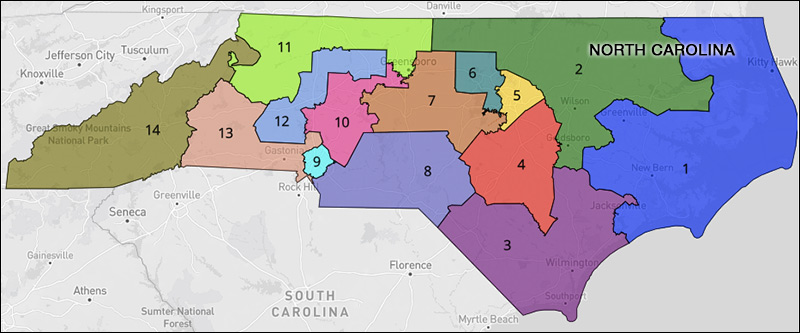
North Carolina Redistricting II

2022 North Carolina Congressional Redistricting Map (click on image or here to go to interactive map: Dave’s Redistricting App)

By Jim Ellis

Feb. 23 2022 — Both houses of the North Carolina state legislature have now passed a new congressional map to replace the original version that the state Supreme Court previously rejected.

The new plan now undergoes judicial review as early as tomorrow before final enactment. The legislators agreed upon a plan to meet the pre-determined judicial schedule. The districts must be set to meet an impending March 4 candidate filing deadline for the March 8 primary that was initially postponed to May 17. Any further redistricting delays will likely move the primary once more, this time to June 7.

The high court struck the plan because the justices determined the map was a political gerrymander and, on the original map, that Democrats were under-represented.

The previous map would likely have produced 10 Republican victories as opposed to four Democratic wins. The current division in 8R-5D. The state gained a new seat in national reapportionment, thus increasing the Tar Heel state delegation to 14 members.

The proposed map is certainly more competitive. Preliminary analysis suggests that the Republican nominee would be favored in six of the seats and the Democrats four, with an additional four being cast into a highly marginal category.

The legislature also restored the previous numbers to the districts, making statistical comparisons easier to understand. The members receiving what should be favorable districts are: Reps. Deborah Ross (D-Raleigh; District 2), Greg Murphy (R-Greenville; District 3), Virginia Foxx (R-Banner Elk; District 5), Richard Hudson (R-Concord; District 8), Dan Bishop (R-Union County; District 9), Patrick McHenry (R-Lake Norman; District 10), Madison Cawthorn (R-Hendersonville/Asheville; District 11), and Alma Adams (D-Charlotte; District 12).

Democrats would then be favored in open District 1 (Rep. G.K. Butterfield (D-Wilson) retiring) and open District 4 (Rep. David Price (D-Chapel Hill) retiring).

Incumbents relegated to highly competitive seats are Reps. Kathy Manning (D-Greensboro; District 6) and David Rouzer (R-Wilmington; District 7). The Dave’s Redistricting App statistical organization rates the Manning 6th District as a seat having a voting pattern that divides the two parties by less than one percentage point: 49.44 percent for Republicans and 49.18 percent for Democrats. The Rouzer District 7 breaks similarly: 49.39 percent for the Democrats and 49.04 percent for Republicans.

According to the FiveThirtyEight statistical organization that has not yet scored the new plan, the previous Manning 6th District rated as a D+21 and the Rouzer 7th CD, an identical partisan spread of R+21. Therefore, these two districts going to an even rating clearly changes the entire map’s outlook, and obviously so for this pair of incumbents.

Continue reading

House Money: Year-End 2021

By Jim Ellis

Feb. 7, 2022 — The Federal Elections Commission finally posted the year-end 2021 campaign financial disclosure numbers, and the Daily Kos Elections site statistical team has already compiled the totals for both the House and Senate.

We concentrate on the House financial picture since all of the competitive Senate races will feature each party’s nominee having more than enough funding with which to communicate their message to the targeted voter segments.

Our first table illustrates the House leadership’s fundraising totals, as they are a key focal point of national funding for their candidates. With a close House partisan division, and a large number of competitive races slated for November, the political dollars will be flowing abundantly.

The text shows the member’s name (party identified by color: red = GOP; blue = DEM ), the amount (in thousands) raised in the 4th quarter of 2021, the cash-on-hand reported in the member’s campaign account on Dec. 31, 2021, and how much the income each campaign committee reports for the entire 2022 election cycle.

Leadership

NAME ST-DIST 4TH QTR CASH-ON-HAND CYCLE-TO-DATE
McCARTHY, KEVIN CA-20 $3,758       $8,350       $14,890
PELOSI, NANCY CA-11 $2,844       $5,420       $15,941
SCALISE, STEVE LA-1 $2,652       $6,524       $12,888
STEFANIK, ELISE NY-21 $1,078       $3,140       $5,050
CLYBURN, JIM SC-6 $523       $2,452       $1,761
HOYER, STENY MD-5 $443       $1,164       $1,916

$1 Million in Qtr 4 – Non-Leadership Incumbents

NAME ST-DIST 4TH QTR CASH-ON-HAND CYCLE-TO-DATE
SCHIFF, ADAM CA-30 $2,806       $16,766       $9,997
PORTER, KATIE CA-47 $2,515       $16,125       $10,231
CRENSHAW, DAN TX-2 $2,115       $4,516       $10,794
CHENEY, LIZ WY-AL $2,043       $4,715       $7,221
JORDAN, JIM OH-4 $1,448       $8,532       $6,891
OCASIO-CORTEZ, AL. NY-14 $1,422       $6,236       $9,879
KIM, YOUNG CA-40 $1,216       $2,564       $4,009
GREENE, MARJORIE T. GA-14 $1,185       $3,512       $8,690
JACKSON, RONNY TX-13 $1,126       $1,079       $2,450
KRISHNAMOORTHI, RAJA IL-8 $1,108       $11,551       $4,447
GOTTHEIMER, JOSH NJ-5 $1,041       $12,012       $3,950
SCHRIER, KIM WA-8 $1,002       $4,022       $3,026

$1 Million in Qtr 4 – Open Seats & Challengers

NAME ST-DIST 4TH QTR CASH-ON-HAND CYCLE-TO-DATE
FLOWERS, MARCUS GA-14 $1,321       $1,544       $4,603
LUTTRELL, MARCUS TX-8 $1,186       $1,618       $1,923
HUNT, WESLEY TX-38 $1,004       $1,555       $2,029

Most Cash-on-Hand – $3 Million +

NAME ST-DIST 4TH QTR CASH-ON-HAND CYCLE-TO-DATE
SCHIFF, ADAM CA-30 $2,806       $16,766       $9,997
PORTER, KATIE CA-47 $2,515       $16,125       $10,231
GOTTHEIMER, JOSH NJ-5 $1,041       $12,012       $3,950
JORDAN, JIM OH-4 $1,448       $8,532       $6,891
McCARTHY, KEVIN CA-20 $3,758       $8,350       $14,890
SCALISE, STEVE LA-1 $2,652       $6,524       $12,888
HARDER, JOSH CA-9 $867       $6,316       $3,660
OCASIO-CORTEZ, AL. NY-14 $1,422       $6,236       $9,879
DELGADO, ANTONIO NY-19 $708       $5,481       $3,219
DOGGETT, LLOYD TX-37 $166       $5,476       $582
PELOSI, NANCY CA-11 $2,844       $5,420       $15,941
SHERRILL, MIKIE NJ-11 $771       $5,078       $2,911
THANEDAR, SHRI MI-13 $5       $5,000       $5
CHENEY, LIZ WY-AL $2,043       $4,715       $7,221
HOULAHAN, CHRISSY PA-6 $464       $4,545       $2,005
CRENSHAW, DAN TX-2 $2,115       $4,516       $10,794
SLOTKIN, ELISSA MI-7 $957       $4,509       $3,894
KHANNA, RO CA-17 $310       $4,330       $3,556
FOSTER, BILL IL-11 $383       $4,264       $917
LaHOOD, DARIN IL-17 $550       $4,244       $2,080
SCHRIER, KIM WA-8 $1,002       $4,022       $3,026
SHERMAN, BRAD CA-32 $244       $3,956       $1,083
PALLONE, FRANK NJ-6 $362       $3,836       $1,296
BROWNLEY, JULIA CA-26 $223       $3,658       $930
SCHRADER, KURT OR-5 $427       $3,563       $1,408
GREENE, MARJORIE T. GA-14 $1,185       $3,512       $8,690
CONNOLLY, GERRY VA-11 $199       $3,497       $1,079
KILMER, DEREK WA-6 $258       $3,464       $1,147
KIM, ANDY NJ-3 $761       $3,300       $3,369
CHU, JUDY CA-28 $214       $3,177       $656
STEFANIK, ELISE NY-21 $1,078       $3,140       $5,050
JEFFRIES, HAKEEM NY-8 $787       $3,119       $3,046
SPANBERGER, ABIGAIL VA-7 $776       $3,036       $3,066

Redistricting:
California & New Jersey Maps

Click on map of California above for detailed view

By Jim Ellis

Jan. 3, 2022 — The California and New Jersey redistricting commissions are completing the last steps of passing what look to be the final congressional plans for each state. The cursory analysis suggests that Democrats may gain a seat in California with Republicans doing likewise in the Garden State.


California

The California Citizens Redistricting Commission members approved and sent toward final adoption a new 52-district congressional map that could give the Democrats even more seats in the delegation, though we will see several more competitive districts come into play. California lost one seat in reapportionment and Democrats are taking the loss of one of their Los Angeles County seats, but look to be replacing it, and then some, in other parts of the Golden State.

The 47th and 40th Districts of retiring members Alan Lowenthal (D-Long Beach) and Lucille Roybal-Allard (D-Downey) were combined to construct a new 42nd CD, which is heavily Democratic. Rep. Karen Bass (D-Los Angeles), who is leaving the House to enter the campaign for mayor of Los Angeles, sees her 37th District, which was on the chopping block in the first draft map, restored almost intact.

Major change is occurring in the Central Valley. Rep. Josh Harder (D-Turlock) sees his 10th District going from an R1 rating according to the FiveThirtyEight statistical analysis organization to R17. Therefore, it is unlikely he will run in his new designated 5th District.

Rep. Jim Costa (D-Fresno) may leave what is a new 13th District at D7 and move to the downtown Fresno seat, now labeled District 21. This seat has much of resigning Rep. Devin Nunes’ (R-Tulare) territory but is rated a D16. Rep. Costa choosing the 21st might allow Rep. Harder to drop down into new District 13, which would be a much more favorable partisan situation but takes him away from his geographical base.

Rep. Mike Garcia (R-Santa Clarita), who won his 2020 election by just a 333-vote margin, sees his designated district, now numbered 27, become at least three points more Democratic. This endangers even further his re-election chances. The 538 organization rated his current 25th CD as a D5. The new 27th becomes a D8.

Several Republicans have proven they can win these D-plus single digit type seats, however. In addition to Rep. Garcia’s two victories in current CD-25, Rep. David Valadao’s (R-Hanford/Bakersfield) 21st district is rated a D9. His new seat, designated District 22, goes to a D10. Another option for him would be to also run in District 13 (D7), which contains some of his current territory. Rep. Young Kim (R-La Habra) won a 39th District that FiveThirtyEight rated as a D6. Her new 45th CD is calculated at D5.

We could possibly see a district swap operation between Reps. Zoe Lofgren (D-San Jose) and Jimmy Panetta (D-Carmel Valley) due to geography, and between Reps. Michelle Steel (R-Orange County) and Katie Porter (D-Irvine) for partisan reasons.

Rep. Steel’s district moves from a R2 to a D6, while Rep. Porter’s adjacent CD shifts in the opposite direction, going from a D6 all the way to a R4. The problem can be solved for both members by them simply switching districts. This would mean Rep. Porter would run in the new coastal 47th with Rep. Steel going to the inland new 40th.

Rep. John Garamendi (D-Walnut Grove) gets a solid Democratic district, but its new positioning is unfavorable to him from a geographic perspective. Garamendi’s new 8th District moves closer to the San Francisco Bay Area making him vulnerable to a challenge from a Bay Area Democratic state or local official. It is likely this new Vallejo-anchored CD would produce a double Democratic general election under the state’s top two jungle primary system.

Several members see their districts downgraded from a partisan perspective. Rep. Tom McClintock (R-Elk Grove/Sacramento) goes from R15 to R8 in a new 3rd District that stretches into southern California along the Nevada border.

Rep. Jerry McNerney’s (D-Stockton) 9th CD goes from D14 to D8, again according to the 538 analysis. Rep. Ken Calvert’s (R-Corona) designated CD, numbered 41, drops from his current R13 to R7. Rep. Mike Levin’s (D-San Juan Capistrano) 49th CD recedes two points from D7 to D5.


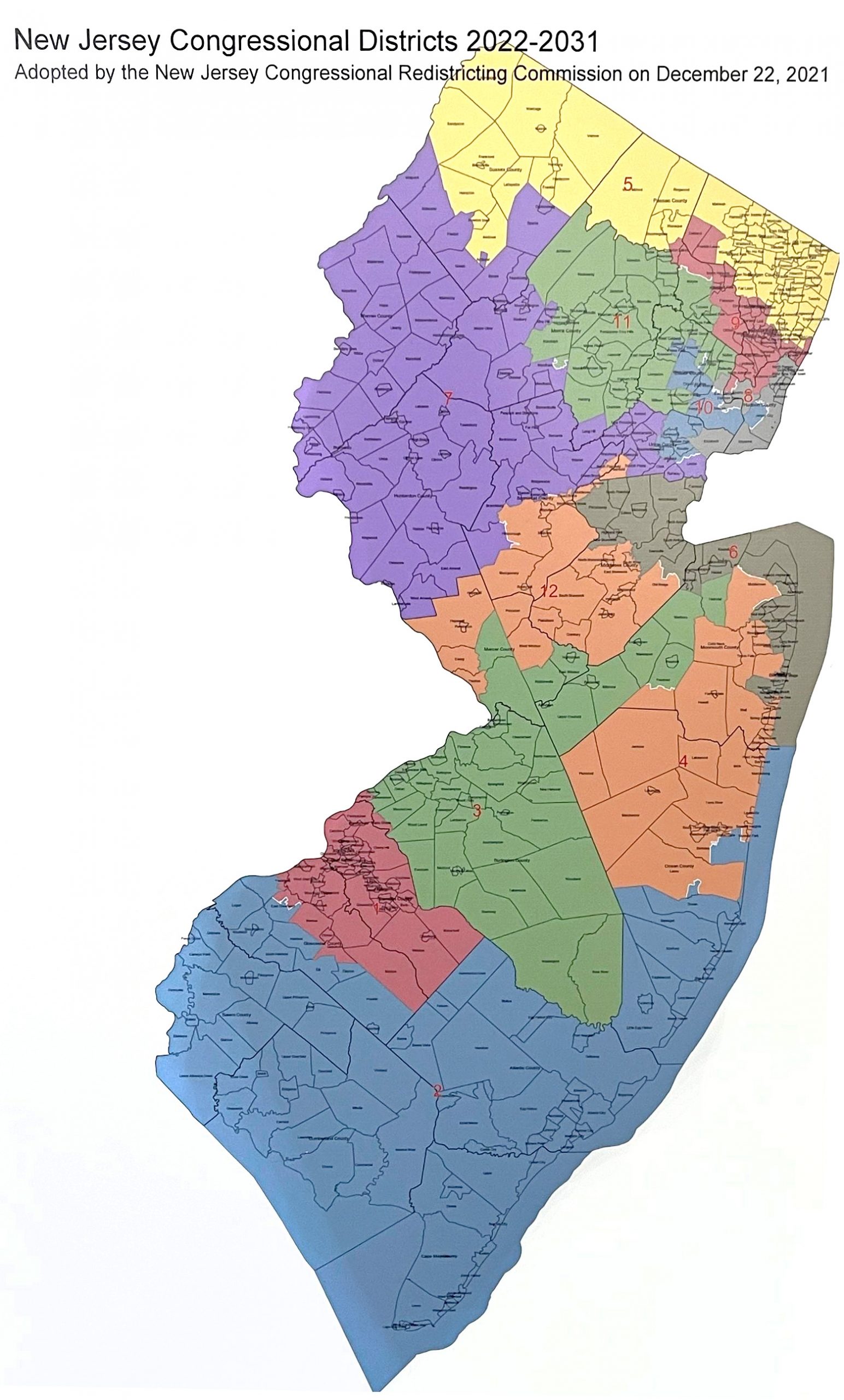
New Jersey

Click on map of New Jersey above to see detailed view

It appears that the New Jersey Redistricting Commission comprised of six Democratic elected officials, six similar Republicans, and a state Supreme Court selected tie-breaking member, have also agreed upon a new congressional map. New Jersey’s representation level remained constant with 12 seats, so it was a matter of adjusting the current districts.

It is evident that the rumor suggesting the commission would adopt a map that drastically weakened Rep. Tom Malinowski’s (D-Rocky Hill) seat in order to strengthen three other Democratic districts, those of Reps. Andy Kim (D-Bordentown), Josh Gottheimer (D-Wyckoff), and Mikie Sherrill (D-Montclair/Morristown) proved true.

It further appears that Rep. Albio Sires’ (D-West New York) retirement did not change the commissioners’ outlook as to which district to weaken. Sires’ 8th District returns virtually intact, another indication that Sen. Bob Menendez’s son, Robert J. Menendez (D), will likely be the retiring congressman’s successor. The latter Menendez currently serves on the NY/NJ Port Commission.

While the NJ Democrats are securing three of their more politically marginal districts, Districts 3, 5, and 11, Republicans appeared poised, probably in the person of state Senate Minority Leader Tom Kean Jr. (R-Edison) who held Malinowski to a 51-49 percent win in 2020, to convert the new 7th CD.

More research will be done on the likely-to-be-adopted California and New Jersey congressional maps when detailed district descriptions become available. It looks like several incumbent members will have decisions before them about where to run in California, while the focus of the New Jersey competitive action will center around the District 7 Malinowski-Kean re-match.

Rep. Lucille Roybal-Allard to Retire

By Jim Ellis

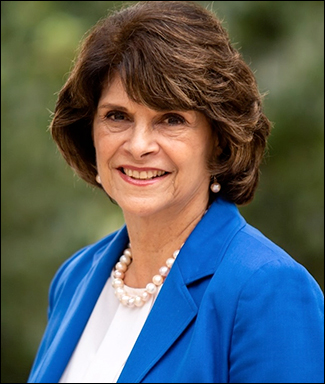
California Rep. Lucille Roybal-Allard (D-Downey)

Dec. 23, 2021 — House retirement announcements keep coming, as late Monday veteran California Rep. Lucille Roybal-Allard (D-Downey) made public her intention not to seek a 16th term next November.

In the 1992 election, Roybal-Allard, then a member of the California Assembly, won the open campaign to succeed her father, US Rep. Ed Roybal (D-CA), as he was concluding his own 30-year congressional career. Combined, the Roybal family will have held the Los Angeles County-based congressional district for 60 consecutive years when Rep. Roybal-Allard completes her current term at the beginning of 2023.

The congresswoman’s retirement announcement comes on the heels of fellow Los Angeles US Rep. Alan Lowenthal’s (D-Long Beach) pronouncement over the last weekend that he will not seek re-election. Both Roybal-Allard and Lowenthal are 80 years old.

The Lowenthal retirement apparently produced discussion within the California Citizens Redistricting Commission membership of collapsing his 47th District and combining it with Roybal-Allard’s 40th, which is nearby. They then agreed upon such a design, which would have meant a major constituency change for the congresswoman, taking her into a substantial amount of territory that she had not previously represented.

The redraw design makes sense particularly when seeing that the Roybal-Allard district, the most Hispanic seat in the nation with a population percentage exceeding 87 percent, is the CD also needing the greatest population influx, some 70,139 individuals, among the 35 California districts requiring more people.

Directly to the west of Roybal-Allard’s 40th lies Rep. Karen Bass’ 37th CD that includes Culver City and part of the Watts area. In late September, Bass announced that she will run for the open Los Angeles mayor’s office, becoming the first California member to create an open seat in the state delegation.

The original redistricting draft combined this district largely with Rep. Maxine Waters’ (D-Los Angeles) CD, but with Reps. Roybal-Allard and Lowenthal now retiring, combining their two seats became the logical redrafting move. The Bass district was then restored.

Combining the 40th and the 47th into a new 42nd CD in conjunction with other adjustments, allows the Commission members to meet the state’s population quota of 760,350 residents per district throughout the Los Angeles metro area. Together, the 18 districts that comprise LA County required a population influx exceeding 620,000 people, hence collapsing a central and southern Los Angeles County pair of districts into one became the commissioners’ most logical solution.

Continue reading