Monthly Archives: September 2021

Oregon Completes Redistricting

Oregon’s new congressional map features six seats for the first time.

By Jim Ellis

Sept. 30, 2021 — Tuesday night, the state of Oregon became the first in the country to complete the redistricting process.

After Republicans decided not to break the quorum in the current legislative session because redistricting power in Oregon solely reverts to the Democratic Secretary of State if the legislature deadlocks, the Democratic House and Senate passed the new congressional, state Senate, and state House maps and sent them to Gov. Kate Brown (D). She immediately signed all three into law, thus the culmination of redistricting 2021 in the Beaver State.

The new congressional map features six seats for the first time, as Oregon was awarded a new district in reapportionment. The Democratic strategy was one of pushing the partisan envelope to the max, but the end result may force them to witness more competitive campaigns than they desire.

The final map looks to have two solid Democratic districts (1 & 3) and one safe Republican seat (2). The remaining three districts (4, 5 & 6) all lean Democratic to varying degrees. The Democrats’ idea is to create a 5D-1R map, but it’s possible in a good Republican year that the GOP gains two, and in a wave election could conceivably even add a third to their partisan column.

The 1st and 3rd Districts share the city of Portland, with CDs 5 and 6 coming into the metro area to annex some of the outer suburbs. The Portland area region is what gives those districts the Democrats the need to tip them further left.

The member in the most difficult situation is Rep. Kurt Schrader (D-Canby). He won his 2020 re-election with only a 52-45 percent margin against a Republican opponent who spent just $221,000 on her campaign effort. More than half of Schrader’s current constituency is now in new District 6, and the partisan numbers in District 5 are slightly worse than they were in the previous version. Therefore, it is a virtual certainty that Rep. Schrader will draw significant Republican opposition in his new district.

An Oregon incumbent who needed an influx of Democrats is House Transportation and Infrastructure Committee chairman Peter DeFazio (D-Springfield). He defeated Republican Alek Skarlatos, 51-46 percent, after the GOP challenger raised and spent over $5.4 million. Of the three new potentially swing districts, the DeFazio 4th is now the strongest Democratic seat but still could play competitively in a wave Republican year.

Data research conducted by the staff at Dave’s Redistricting website and augmented through the Daily Kos Elections statistical analysis provides us with some early partisan details. The model races they use are from 2016 and 2018.

Below are the key population and partisan numbers for the new seats:
Continue reading

Bass for Mayor; Redistricting Update

By Jim Ellis

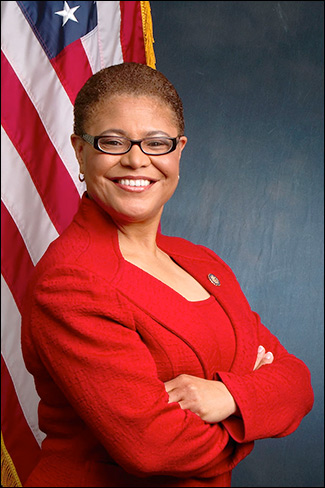
California Rep. Karen Bass (D-Los Angeles)

Sept. 29, 2021 — Reports were surfacing last week that California Rep. Karen Bass (D-Los Angeles), who had been on candidate Joe Biden’s short list for the vice presidential nomination, was deciding whether to eschew re-election next year for a chance to run for LA mayor. Now, she has made the decision. On Monday, Rep. Bass formally entered the citywide race.

The mayor’s election likely will be semi-open. Mayor Eric Garcetti (D) has been nominated as US ambassador to India, and upon obtaining his Senate confirmation, the City Council will be empowered to appoint an interim mayor. That individual will have the opportunity of then seeking a full four-year term during the regular election cycle. Certainly, Rep. Bass could be a potential appointee. Should Mayor Garcetti not receive a timely confirmation as ambassador, he would be ineligible to seek a third term, so in any event, the mayor’s contest will be highly competitive.

From a federal perspective, Bass running for mayor means her 37th Congressional District will be open. Of the 18 congressional districts that are wholly or partially contained within Los Angeles County, 17 of them need a population influx. With California losing a seat, it appears that the Los Angeles area will absorb the reduction.

Since Rep. Bass is the first Golden State House member to announce that he or she won’t seek re-election, her 37th District that needs 38,173 people to meet the state’s CD population quota of 760,350 people for the new 52 district map – a west Los Angeles County seat centered around the Culver City community – now becomes a prime target for elimination.

In the mayor’s race, Bass will at least face Los Angeles City Council President Pro Tempore Joe Buscaino, LA City councilman and former state Senate president and ex-US Senate candidate Kevin de Leon, and LA City Attorney Mike Feuer. It is likely others will enter the race once the political situation surrounding Mayor Garcetti is defined, and the congressional and legislative redistricting picture becomes clearer.

Redistricting Update

Several states are making progress in drawing new congressional maps. Colorado will send a final plan to the state Supreme Court as early as today. Indiana and Maine are close to finalizing maps that will strengthen both states’ political divisions, 7R-2D in the Hoosier State, and 2D-0R in the latter.

Oregon is also moving toward completion of a map that may prove a reach for the Democratic majority. Gaining a sixth seat in national reapportionment, the Democrats are trying to craft a 5D-1R map. Though Republicans have a significant base in the state, the Democrats maintain a tight grip on the statewide races thanks to dominant Portland, which serves as the lynchpin to their Beaver State political success.

Therefore, though the Dems have a clear edge in five of the new CDs, the early partisan analysis figures suggest that the Republicans would have at least an outside chance of prevailing in one of the districts, most likely that of Rep. Kurt Schrader (D-Canby/Salem), and possibly in the new 6th District open seat. More will be known when in depth political data is available and candidates begin to come forward.

The Texas Republican Senate’s congressional map was unveiled yesterday. As predicted, the GOP map drawers used the state’s two new seats as somewhat of a buffer, at least in the Austin area, to strengthen districts that were showing weakness. Should this map be enacted, Reps. Chip Roy (R-Austin), Michael McCaul (R-Austin), John Carter (R-Round Rock), and Roger Williams (R-Austin) all receive much stronger Republican seats. In exchange, one of the new seats goes to Travis County and will await a new Democratic inhabitant.

The other new seat appears destined for Harris County. There, sophomore Rep. Lizzie Pannill Fletcher (D-Houston) moves from a political marginal district to a rock solid Harris-Ft. Bend County Democratic District. This allows the second new seat to fall to a Republican and be fully contained within Harris County. In the northern part of the region, Rep. Dan Crenshaw (R-Houston) receives a substantially better district, and assumes part of Republican Montgomery County.

In the Dallas-Ft. Worth Metroplex, the region doesn’t get a new district, but a reconfiguration allows all incumbents, both Republicans and Democrats, to improve upon their present internal political standing.

This Texas map is a long way from enactment. The state House Democrats are unified to vote against any Republican map, and while the GOP has the strength to pass what they want in the Senate, the state House is a different story. It is likely we will see the current 30-day special session end in deadlock, with another 30-day session to follow. The Democratic strategy is to force the redistricting process to court, while the Republicans will attempt to pass a series of maps into law. Expect this story to be with us for many weeks to come.

Sen. Grassley to Seek Re-Election

By Jim Ellis

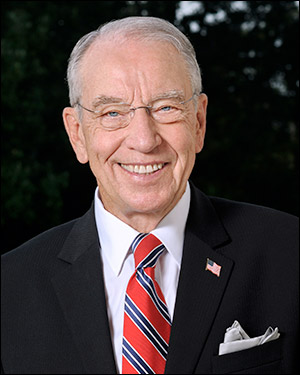
Iowa’s seven-term US Sen. Chuck Grassley (R)

Sept. 28, 2021 — Saying he “ … has a lot more to do for Iowa,” seven-term Sen. Chuck Grassley (R) on Friday announced that he will run for an eighth term next year. Recently, the senator said he would make his decision about launching a 2022 campaign on or before Nov. 1.

Sen. Grassley was one of three Republican incumbents who had not declared their re-election intentions. Sens. Ron Johnson (R-WI) and John Thune (R-SD) both say they will announce their decisions later in the fall. All 14 in-cycle Democrats are on an active re-election track.

Sen. Grassley is already the longest-serving Iowa US senator, originally elected on the same night when Ronald Reagan won the presidency in 1980. He has been an elected official since winning his first term in the state House of Representatives back in 1958. Should he win the coming election and complete his next term, he will have served 70 consecutive years as a public official, counting his time in the state legislature, US House and Senate.

It appears the senator is in strong political shape for the coming campaign. At this point, he faces only state Sen. Jim Carlin (R-Sioux City) in the Republican primary.

When he entered the race, it was speculated that Carlin was attempting to get a head start on an open Republican primary in anticipation that the 88-year-old senator would announce his retirement. He indicated that he planned to stay in the race regardless of Sen. Grassley’s intentions, but now that the incumbent’s campaign is official we will see if Carlin continues in his long shot statewide effort.

The leading Democrat is former Congresswoman Abby Finkenauer. She served two terms in the state House of Representatives, and then defeated incumbent US Rep. Rod Blum (R) in the 2018 election. She would subsequently lose her first re-election bid to current Congresswoman Ashley Hinson (R-Marion/Cedar Rapids). Now, like so many others who have recently lost elections, Finkenauer is attempting to run for a higher office.

Continue reading

The Texas Slow Walk

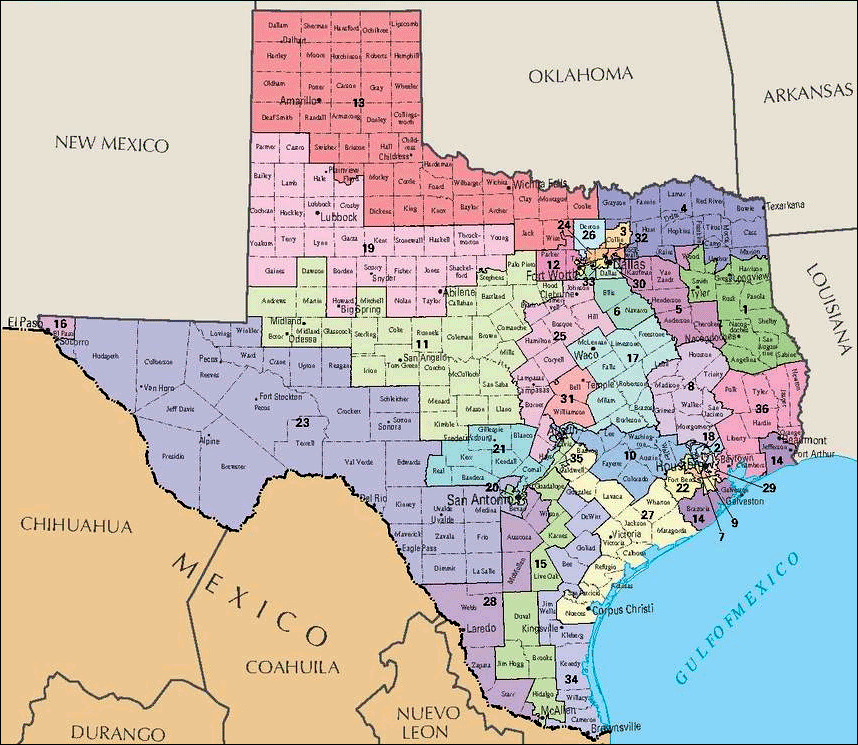
Map of US Congressional districts in Texas

By Jim Ellis

Sept. 27, 2021 — The new Texas congressional map has yet to be released and it may be some time before we see any progress being made toward passing a 38-seat federal plan.

While Gov. Greg Abbott (R) has called the legislature into a special redistricting session, the Democrats’ unified slow-walking strategy may achieve their goal of taking the process away from the Republican legislature and forcing a court to draw an interim map.

The state House of Representatives is the key. While Republicans have an 82-66 majority with two vacancies, it is the Democrats who have consistently been able to coalesce with a few moderate Republicans to elect a minority speaker, in other words a Republican who is in office largely through unified Democratic support.

In this session, the speaker is Rep. Dade Phelan (R-Beaumont), and with the House members indicating they are not moving any map until they agree upon their own new districts, and the Democrats unified to oppose any Republican map at any level, we could see a long redistricting process evolve.

Complicating matters is that Texas has an early primary, and it’s still on the books for March 1. The Census Bureau delaying in getting all the states their census tract data for months, which contain the numbers necessary to draw legal districts, has caused further delays. Therefore, either the process must accelerate or the state will be forced to postpone its primary. Doing so would also defer the May 24 runoff elections for those primaries in which no candidate receives majority support.

Texas cannot default to the previous congressional map. The state was awarded two new seats in reapportionment, so a new map must be constructed. A court could conceivably postpone redistricting, revert to the former map, and order the candidates for the two new seats to run statewide. There is precedence for such a decision.

Currently, the Texas congressional delegation stands at 24 Republicans and 12 Democrats. Where the two new seats will land is subject to debate. Of the 36 current seats, 28 are over-populated and led by freshman Rep. Troy Nehls’ (R-Richmond) 22nd District, which holds 972,309 people according to the 2020 census count. In all, six districts have more than 900,000 people. The Texas target population number is 766,987 residents.

Continue reading

Republican Youngkin Notches First Lead in Virginia Gubernatorial Race

By Jim Ellis

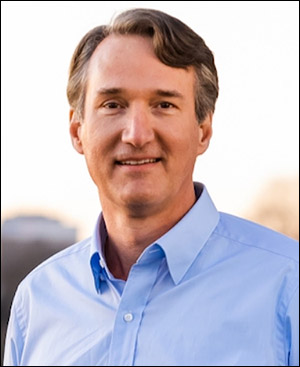
Republican Glenn Youngkin, Virginia candidate for governor

Sept. 24, 2021 — A new University of Mary Washington survey (conducted by Research America, Sept. 7-13; 1,000 total sample 528 likely Virginia gubernatorial election voters, live interview & online) finds Republican Glenn Youngkin (R) leading former Virginia Gov. Terry McAuliffe (D), 48-43 percent, but there are caveats.

While virtually every poll has projected the two candidates recording support percentages in the 40s, this is the first that found the ex-governor and former Democratic National Committee chairman trailing. Two other surveys were also released yesterday, and both of them find results consistent with other pollsters that place both candidates in the 40s, but with McAuliffe holding the advantage.

KAConsulting (Sept. 17-19; 700 likely Virginia voters, live interview), polling for the Presidential Coalition, found McAuliffe topping Youngkin, 46-42 percent. Public Policy Polling (Sept. 17-18; 875 Virginia voters, interactive voice response system) derived an almost identical 45-42 percent McAuliffe ballot test result during a simultaneous time realm.

The Mary Washington study may well be an outlier. While the 48-43 percent margin comes from those describing themselves as likely voters in the Nov. 2 election, when responses from all 1,000 sampled individuals are recorded, the ballot test flips to 43-38 percent in favor of McAuliffe. It is not unusual to see differences when screening for likely voters versus the universe as a whole, but detecting a ten-point swing affecting just one candidate – you will notice McAuliffe scores 43 percent within both groups – raises methodological questions.

The poll becomes even more suspect when seeing that the candidates in the other statewide races, lieutenant governor and attorney general, produce no such GOP swing. In the lieutenant governor’s contest, Republican Winsome Sears has a 47-41 percent lead over Democrat Hala Ayala among likely voters, but the two are dead even at 38 percent support when all respondents are added to the ballot test matrix.

In the AG’s campaign among likely voters, Republican Jason Miyares holds a 46-42 percent edge over incumbent Democrat Mark Herring, but the race flips to 40-37 percent in the attorney general’s favor when all respondents are questioned.

Continue reading

Michigan Gov. Whitmer
Falters in New Polls

By Jim Ellis

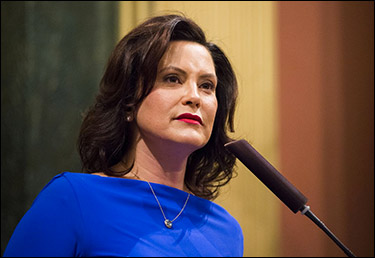
Michigan Gov. Gretchen Whitmer (D)

Sept. 23, 2021 — We have further evidence that the Michigan governor’s race is going to be a highly competitive political contest next year. A pair of new polls, following one in late August, find Gov. Gretchen Whitmer (D) either in a virtual dead heat with, or trailing, former Detroit Police Chief James Craig (R).

The Trafalgar Group and Strategic National, Inc. were both in the Michigan field during virtually the same time realm to test the impending governor’s race. Trafalgar (Sept. 13-15; 1,097 likely Michigan voters; live interview, interactive voice response system, online, and text) actually finds the governor slipping behind Craig by a 50-44% count. Strategic National (Sept. 18-19; 600 likely Michigan voters) arrived at a much tighter contest with the governor still in the lead. Their result projected a razor thin 46.6 – 46.0 percent margin.

Gov. Whitmer has become controversial even nationally through her draconian COVID shut down measures, and then being caught on several occasions as eschewing the dictates for herself and family. As the Strategic National poll shows, however, the governor’s favorable and unfavorable opinions are equivalent … and almost everyone feels strongly about their preference.

In terms of her personal favorability index, the responses divide 50:48 percent favorable to unfavorable. The strongly held position, however, spins toward the negative category. Of those who comprise Gov. Whitmer’s 50 percent positive rating, 35 percent, or 70 percent of those professing a positive opinion, feel strongly.

The negative segmentation is more intense. From the 48 percent who hold a negative view of Whitmer, 42 percent, or 87 percent of those holding an adversarial opinion, believe so strongly. Her job approval rating responses, though a different question, yields an almost identical pattern.

The polarization factor is, unsurprisingly, extreme when it comes to the respondents’ opinion about how she’s handled the coronavirus. By a margin of 52:47 percent, the sampling universe approves of her measures to combat the disease. And, in this instance, those feeling strongly on both sides break about evenly.

Continue reading

Nevada’s Gubernatorial Race:
Ex-Sen. Heller Announces

By Jim Ellis

Former Nevada Sen. Dean Heller (R)

Sept. 22, 2021 — The Silver State of Nevada has been home to some of the nation’s closest statewide elections during the past decade. In almost half of all Nevada statewide political contests since 2012, both party’s nominees have won their elections with only plurality support.

With that backdrop, ex-US Sen. Dean Heller (R), who lost his seat to current incumbent Jacky Rosen (D) in 2018, is making a political comeback attempt in next year’s governor’s race. Heller officially announced his plans Monday after the story broke last week that he would become a candidate.

Part of the announcement came as a surprise, and has more to do with winning the Republican primary than for what he hopes will be a challenge to incumbent Gov. Steve Sisolak (D). Heller, who throughout his career had aligned himself with the pro-choice caucus, pointedly spoke approvingly of the new Texas law governing abortion practices.

In the Republican primary, Heller faces Clark County Sheriff Joe Lombardo and North Las Vegas Mayor John Lee among others. At this point, Gov. Sisolak has no announced Democratic opposition.

According to a July OH Predictive Insights poll (July 6-11; 783 registered Nevada voters), which is the latest Nevada gubernatorial survey available, Gov. Sisolak recorded a 52:39 percent job approval ratio. As with most polls in today’s politics, the bulk of support comes from members of one’s own party, but in this case, 30 percent of the sampled Republicans also gave the governor a positive review.

Gov. Sisolak, a former Clark County Commissioner who previously served as a member of the Nevada Board of Regents, was elected the state’s chief executive three years ago with a 49-45 percent win over then-Attorney General Adam Laxalt (R), grandson of former US senator and Nevada governor, Paul Laxalt (R). Laxalt is also making a political comeback in 2022, running against incumbent Catherine Cortez Masto (D) for the US Senate.

Both the ’22 Nevada governor and US Senate have the potential of ending in close fashion. Since 2012, inclusive, 18 statewide races have been conducted. Democrats won 10 and Republicans’ eight, but six of the GOP victories came in the Republican wave year of 2014 when the Nevada Democratic turnout proved particularly low.

Continue reading

Ohio Rep. Anthony Gonzalez
Won’t Seek Re-Election

By Jim Ellis

Ohio Rep. Anthony Gonzalez (R-Rocky River)

Sept. 21, 2021 — Saying he believes that former President Donald Trump “shouldn’t ever be president again,” sophomore Ohio Rep. Anthony Gonzalez (R-Rocky River) announced on Friday that he will not seek a third term in the House.

Rep. Gonzalez was one of 10 Republicans to support Trump’s second impeachment, and drew a strong Republican primary opponent as a result. Former President Trump responded to Gonzalez’s statement and decision with his own release saying, “1 down, 9 to go,” in reference to those Republican House members who supported removing him from office after the Jan. 6 Capitol invasion.

Gonzalez is the 19th member who will not be on the next election ballot for the US House seat he now holds, including the three vacancies to be filled in special elections. Of the 19, Republicans currently hold 10 seats as compared to nine for the Democrats. This is the first GOP opening with some competitive potential, however, though the Gonzalez decision will likely have a big impact upon the Ohio redistricting process currently under way within the state legislature in Columbus.

Former White House aide Max Miller had been Rep. Gonzalez’s top Republican competitor. Through the June 30 campaign financial disclosure period, Miller had raised just under $1 million ($951,520), but had only $533,153 remaining in cash-on-hand.

Despite Miller’s strong fundraising effort, Rep. Gonzalez still held the upper hand, reporting $1.22 million raised with over $1.5 million in the bank. Therefore, while the Miller challenge appeared formidable, it was not a foregone conclusion that he would have denied Rep. Gonzalez re-nomination had the congressman decided to continue running.

Rep. Gonzalez’s 16th Congressional District begins in the Westlake area to the west of Cleveland and stretches south toward the rural areas southwest of Canton. It then meanders to the northeast around Akron to end in the city of Edinburg.

Continue reading

Colorado Redistricting Map:
Congressional Version 3

The Colorado Independent Redistricting Commission members released for public input the third congressional map — and second staff offering. (Click on map to see bigger map, more detail)

By Jim Ellis

Sept. 20, 2021 — The Colorado Independent Redistricting Commission (congressional) members are on a tight time schedule so they are moving fast. The third congressional map, and second staff offering, was released for public input late last week.

Under the commission parameters, the members produced the first map and the staff constructed the second after completing public hearings. Once both maps were publicized, further comments were recorded. Responding again, the staff amended their draw and released the newest iteration.

The ballot initiative that created the commission process mandates that the members agree upon a map by Sept. 28. A super majority of eight of the 12 members is required to approve a final plan. If the commission members are unable to agree upon a map in such a ratio, the staff would then directly submit a version to the state Supreme Court. The high court must confirm the new congressional plan by Dec. 15. Therefore, it is reasonable to argue that the commission staff possesses more power than the members.

Clearly there were objections, likely from both parties, to the original staff map. Based upon public input, they claimed, a seat that occupied most of the state’s southern quadrant was placed into District 3, historically known as the “western slope” seat. It has traditionally stretched from the Rocky Mountains west of Denver all the way to the Utah border and from Wyoming to New Mexico.

The original staff map changed the 3rd District’s direction, eliminating its northern sector. This had the effect of pairing Reps. Joe Neguse (D-Boulder) and freshman Lauren Boebert (R-Silt) technically into one seat. The heart of District 3 largely remained intact under this map, so even though Boebert’s home was placed in District 2, she still had a place to run. Therefore, the potential incumbent pairing, a political set-up that would have greatly favored Rep. Neguse, is likely alleviated.

Drawing the southern seat had the effect of taking Neguse’s 2nd District from Boulder County all the way to Utah and significantly changing his district, as well. Though it would remain a solid Democratic seat, many conservative western slope voters would have been introduced into a new CD that also included liberal Boulder.

It is highly likely that neither Boebert nor Neguse liked that particular draw, and many leaders of both parties also probably lobbied the commission members and staff to change the map. If so, the persuasion worked.

The new staff map restores the western slope district to its previous formation, meaning encompassing Colorado’s western quadrant from Wyoming to New Mexico along the Utah border. It does include Democratic Pueblo County, which brings some competition to the district. According to the commission’s political statistical package, a historical eight-race averaging of significant electoral contests, the 3rd District would become relatively safe for Rep. Boebert with an R+9 political performance.

Continue reading

First Indiana Map Published

Indiana Congressional Districts Draft Map (click on map to see larger file size details)

By Jim Ellis

Sept. 17, 2021 — The Indiana House Republican majority caucus released the state’s first 2021 congressional redistricting map, and it appears to strengthen the party’s 7-2 grip on the Hoosier State federal delegation.

Political data is not readily accessible, but the geographic outline and reaction from at least one former Democratic congressional candidate suggests the biggest change comes in the state’s 5th District. IN-5 is the geographically central seat that had been trending away from being the safe Republican CD we saw during the previous decade’s early period.

Former state representative and 2016 lieutenant governor nominee Christina Hale (D), who lost to freshman Rep. Victoria Spartz (R-Noblesville) by a relatively close open seat 50-46 percent count last November, claims the House Republicans “kneecapped” any Democrat wanting to run in this district for the foreseeable future.

Though the official political data is not available, the Daily Kos Elections team calculated that former President Trump would have carried this new version of the 5th District with a 57-41 percent margin. His victory totals in the present 5th from 2020 and 2016 were 50-48 and 53-41 percent, respectively.

The current 5th District encompasses all or part of eight central Indiana counties including just over 180,000 people from Marion County in the northern Indianapolis suburbs. These are the precincts making the 5th more competitive as they now lean Democratic.

The proposed CD-5, and this released map, are a long way from being adopted through the legislative process; it would see a jettisoning of all of its Marion County population. Instead, the new district would occupy five whole counties north of Indianapolis and the Marion County line in addition to annexing almost all of Howard County.

The district coming into Marion County to replace the residents shed from the 5th is Rep. Greg Pence’s (R-Columbus) 6th District. Instead of moving in a north south direction along the Ohio border as is the current configuration, the proposed IN-6 would move from the Ohio border and enjoin counties to the west all the way into Marion County. The 6th, however, would assume the necessary Marion County population in the southern portion of the Indianapolis metropolitan area instead of the northern territory.

Continue reading