Monthly Archives: September 2021

Newsom Wins Recall; Other Elections

By Jim Ellis

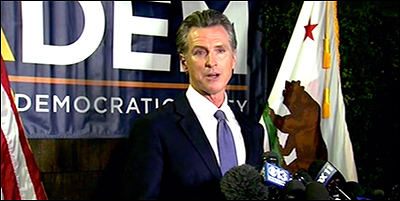
California Gov. Gavin Newsom (D)

Sept. 16, 2021 — California Gov. Gavin Newsom (D) easily avoided being recalled in last night’s statewide election, but the margin will likely close once all of the ballots are received and finally counted. The reported results are largely from mail ballots received well before election day. The posted turnout totals exceed 9 million voters, and this number will continue to grow.

The NO option on the recall ballot, meaning the vote individuals cast in order to keep Gov. Newsom in office, is running just under 64 percent, but under the California system of ballot signature verification it will be several weeks before we see official final totals. California also allows a long post-election period for ballots postmarked on election day to be received. It is clear, however, that Newsom will survive in office by a wide margin, but with an end-result closer margin than we see in early returns.

Though the replacement election became moot with the recall being rejected, conservative commentator Larry Elder was the clear leader, recording a tick under 47 percent of the vote. The next closest candidate was Democrat Kevin Paffrath with 10 percent. Former San Diego Mayor Kevin Faulconer (R) finished third with just under 9 percent. John Cox (R), who was one of the leading recall effort funders and the finalist against Newsom in the 2018 election, fell back to less than 4.5% of the vote. Media star Caitlin Jenner (R), who proved not to be a serious candidate, scored just 1.1% in the replacement election.

All of the replacement candidates were at a disadvantage in terms of financial resources. Though Elder raised a reported $18 million, an impressive amount in a short time frame, Gov. Newsom spent possibly as much as $80 million.

The rules for Newsom, however, were different. Because he was the recall subject, and the people were deciding the question as to whether or not he alone should remain in office, the campaign financial structure for him was that of a referendum. Therefore, he could raise unlimited amounts of money from individuals and entities. The replacement candidates, because they were running in an election campaign, were bound by the state campaign finance laws that feature contribution amount limits.

Continue reading

The New Mexico Ploy

By Jim Ellis

Sept. 15, 2021 — During the last week reports were surfacing that suggested the New Mexico State Democratic leadership was considering ways to turn the current 2D-1R congressional map into a 3D-0R plan. This might be easier said than done, however.

New Mexico is one of the Democrats’ 15 “trifecta states,” meaning the party controls all three legs of the redistricting stool: the state Senate, state House, and governor’s mansion. Republicans have 23 trifectas. Therefore, if the Democrats are to minimize the redistricting damage, or even possibly come out slightly ahead, they must fully use their political leverage in the states they control.

Of the Democrats’ 15 trifectas, however, five of the states handle redistricting through a commission, and in another five the party already controls all the congressional seats. Therefore, if they are to make a national redistricting play they must take maximum advantage in Illinois, Nevada, New Mexico, New York, and Oregon. The lay of the land, however, makes it very difficult to expand their fortunes in Nevada and possibly Oregon, which is why trying to take an extra seat from New Mexico makes some sense from a national Democratic perspective.

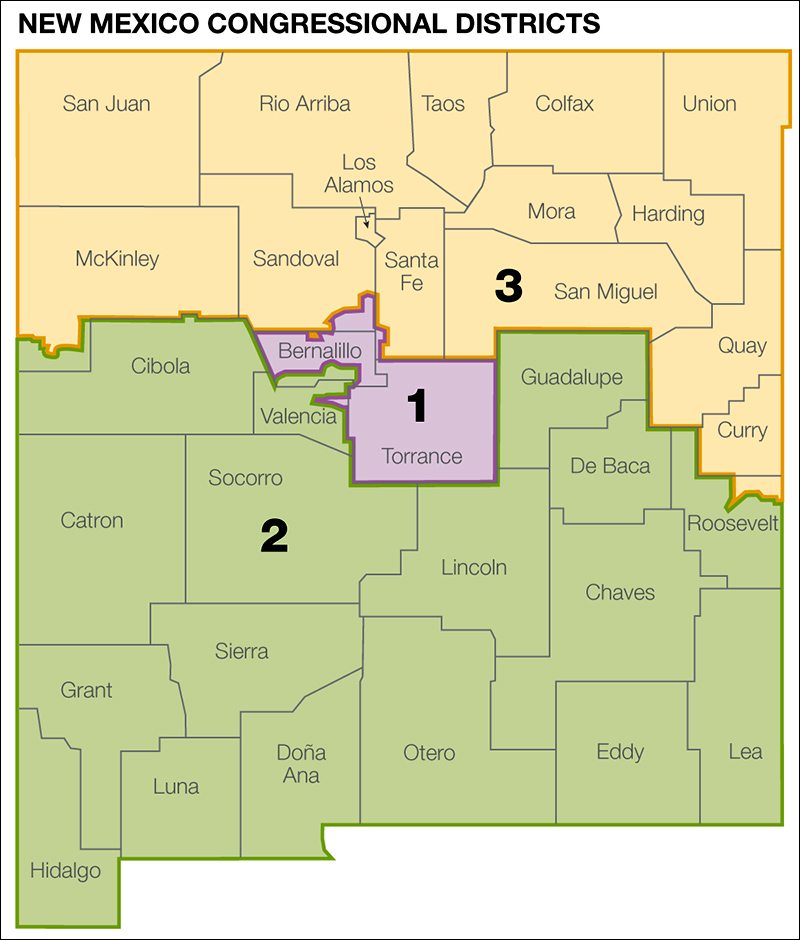
New Mexico has three congressional seats, all of which a freshman represents. The 1st (Rep. Melanie Stansbury; D-Albuquerque) and 3rd Districts (Rep. Teresa Leger Fernandez; D-Santa Fe) in the northern part of the state are safely Democratic.

The southern 2nd District (Rep. Yvette Herrell; R-Alamogordo), which encompasses almost all of the territory south of Albuquerque, has performed as a Republican seat at the congressional level in 19 of the last 21 elections. Democrats picked up the district in their recent wave election years (2006; 2018) with open seat victories, but the voters favored the Republican challenger in both successive elections. This, despite NM-2 being a majority Hispanic district: 53.7 percent of the overall population according to the previous census data.

Additionally, the current seats are not widely out of population balance. The 1st District needs to gain just 11,264 people, while the 2nd must shed 8,181 individuals, and the 3rd must relinquish 3,082 residents. Therefore, a radical re-draw that results in a sweep of the three districts for one party when the population swings are so small would certainly draw a political gerrymandering lawsuit upon adoption of the new map. Whether such a lawsuit would succeed of course is a question that can only be answered when the final map is drawn and enacted.

Likely, the only way to draw a 3D-0R map in New Mexico would be to keep the northern 3rd District Democratic seat virtually intact, and then draw the Republican 2nd into Albuquerque. This would cause the city and Bernalillo County to be split resulting in the 1st and 2nd then appearing as southwestern and southeastern seats that divide Albuquerque, and subsequently stretch all the way to the Mexican border.

Even this draw might make it difficult to create three Democratic seats because the southeastern district would still have the potential of being Republican enough to make the party’s candidate, in this case Rep. Herrell, strong enough to have a chance of winning a general election.

New Mexico is a good example as how a largely internal state exercise can transform itself to help achieve a national partisan goal. It remains to be seen just how bold the New Mexico Democrats will be, as this small and sometimes obscure state steps into the national redistricting limelight.

Trump Chooses Cheney Opponent

By Jim Ellis

Sept. 14, 2021 — Movement is occurring in the Wyoming Republican primary challenge race against at-large Rep. Liz Cheney (R-Wilson). At this point, however, the latest developments may still not be enough to deny her re-nomination in a crowded open GOP primary scheduled for Aug. 16, 2022.

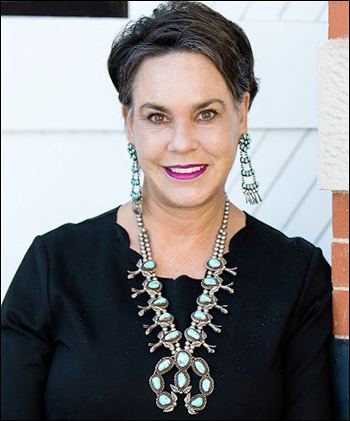
Former Wyoming Republican National Committeewoman Harriet Hageman late last week announced her candidacy as a Republican representative in the state’s lone congressional district to challenge Rep. Liz Cheyney (R-Wilson).

Attorney and former Wyoming Republican National Committeewoman Harriet Hageman late last week announced her candidacy in the Equality State’s lone congressional district. She joined a throng of eight GOP candidates opposing Rep. Cheney in the 2022 primary.

A day after Hageman’s announcement, former President Donald Trump, who is the focal point of Rep. Cheney’s actions relating to the Jan. 6 uprising at the Capitol and her vote to impeach him, is now actively supporting one of the candidates.

Hageman, in a coordinated announcement and endorsement over a two-day period, entered the race knowing she had the support of the former national chief executive. Such backing has often helped other endorsed candidates prevail in similar Republican primaries.

After Trump publicized his Hageman endorsement, the field slimmed to seven as US Air Force veteran Bryan Miller and attorney Darin Smith ended their campaigns, thus answering the former President’s call for the party to unite behind one candidate.

The remaining group of contenders, state Sen. Anthony Bouchard (R-Laramie), state Rep. Chuck Gray (R-Casper), retired Army Colonel Denton Knapp, former Pavillion mayor, Marissa Joy Selvig, and two minor candidates, have not yet followed suit.

Polling suggests that the crowded field, with the anti-Cheney vote split multiple ways, could allow the congresswoman to win re-nomination with a rather small plurality. Another point in her favor is that Wyoming does not register voters by political party affiliation. In this state’s nomination elections, and in many other places, voters simply choose the party primary in which they desire to participate.

This system would allow disaffected Democrats to vote in the Republican primary. They would likely support Cheney, having the goal of thwarting the Trump and conservative forces who are attempting to oust her.

Because Rep. Cheney has gone so far to oppose Mr. Trump’s post-election actions and stances, denying her re-nomination becomes a significant test of the former president’s party leadership. Cheney has even aligned herself with House Speaker Nancy Pelosi (D-CA) in taking her Trump opposition to the ultimate level by serving as a member of the House select committee investigating the Capitol uprising. This was knowingly done so in defiance of House Republican Leader Kevin McCarthy’s (R-CA) directive to the GOP members vis-a-vis committee participation.

Continue reading

The Tennessee Rumor

Tennessee Congressional Districts (click on image to see larger)

By Jim Ellis

Sept. 13, 2021 — Unconfirmed stories from Democratic sources are flying around the Internet suggesting that the Tennessee Republican state legislative leadership is in the process of drawing a new congressional map that would shred Rep. Jim Cooper’s (D-Nashville) seat and convert the current 7R-2D map into 8R-1D.

This may well be happening, but when looking at the population densities in each of the state’s nine congressional districts, drawing such a map may be unavoidable and not entirely partisanship-driven. The problem for Cooper and the Democrats is not the congressman’s Nashville-anchored 5th District. Rather, the Memphis seat of Rep. Steve Cohen (D) is the source of their difficulty. It is this 9th District, with a major population shortage and unfavorable geographic boundaries from a redistricting perspective, that could adversely affect Rep. Cooper.

Despite Tennessee ranking as the 17th fastest growing domain during the previous decade, the Volunteer State did not gain a new congressional seat in reapportionment. Additionally, and the fundamental problem for Rep. Cooper, middle Tennessee is experiencing explosive growth, while the east and the west are inhabitant deficient, at least from a congressional district equivalency perspective. Rep. Cohen’s Memphis anchored seat is the least populated of the nine CDs and must gain 77,122 people to meet the new Tennessee congressional district population requirement of 767,871 individuals.

As you know, Memphis sits in the far southwestern corner of Tennessee. Therefore, the Cohen district is bordered by Arkansas to the west and Mississippi to the south. Thus, the people needed to fill the 9th can only come from the north and east. To further complicate matters, the TN-9 is a Voting Rights majority minority district and must remain with relatively constant minority population numbers.

Additionally, the 8th District of Rep. David Kustoff (R-Georgetown), that stretches from Kentucky to Mississippi and the only place from where the 9th District can annex the people it needs, is also under-populated. To meet its own population requirements, the 8th CD must gain 51,524 inhabitants, hence having to stretch closer to the Nashville area districts, which is how Cooper’s Nashville seat factors into Memphis’ population swing problem. Combined, these issues making drawing western Tennessee difficult.

Continue reading

Ohio Data: Below the Surface

By Jim Ellis

Sept. 10, 2021 — The London-based Redfield & Wilton Strategies international survey research firm tested electorates in several American states at the end of August, and today we look at their Ohio results. With a major open Senate campaign and a Republican governor seeking re-election in 2022, the Buckeye State is once again a national political focal point for the coming political year.

Ohio Rep. Tim Ryan announces his candidacy for the 2020 Presidential Election on the TV talk show, “The View.”

The Redfield & Wilton poll (Aug. 20-24; 1,200 likely Ohio voters) finds the Republican Senate candidates performing adequately opposite US Rep. Tim Ryan (D-Warren/Youngstown), who, at this early stage, has become the Democrats’ consensus statewide Senate contender.

Former state treasurer and 2012 US Senate candidate Josh Mandel (R) holds a 51-47 percent ballot test lead over Rep. Ryan within the sample segment who are self-identified as likely 2022 general election voters. Author J.D. Vance (R) largely falls into a dead heat with Ryan, trailing 37-36 percent, as does former Ohio Republican Party chair Jane Timken who places within two points of the congressman, 38-36 percent.

In the governor’s race, incumbent Republican Mike DeWine, who former Rep. Jim Renacci is challenging in the GOP primary from the ideological right, looks to be in strong shape against potential Democratic opponents. If Dayton Mayor Nan Whaley were the Democratic gubernatorial nominee, Gov. DeWine would post a 46-27 percent advantage. Should Cincinnati Mayor John Cranley become the Democratic nominee, he would trail the governor by a slightly larger 47-25 percent spread.

Generally, the Ohio polling pattern leans Democratic in the early going and then closes in the Republican candidates’ favor, while consistently understating GOP strength.

In the 2020 presidential election, Ohio polls in July of the election year were returning Joe Biden leads of 4-8 percentage points before former President Trump would rebound to score a mean average 1.0 percent polling lead close to election day, and then win the state going away with an eight-point margin, 53-45 percent. In 2016, the pattern was similar. In the July-September period, Hillary Clinton held leads of between 4 and 7 percentage points only to see the average favor Trump by a 2.2 percent spread. He would win the state 51-43 percent.

The same pattern occurred for Sen. Rob Portman (R) in 2016 and was present to a degree against Sen. Sherrod Brown (D) in 2018. In June through September of that year, certain polls found former Gov. Ted Strickland (D) leading incumbent Portman with a 3-6 point edge. As the race closed, Sen. Portman established an average 18-point lead and won 58-37 percent.

Even in a Democratic victory, the polling trend favoring Democrats early and then closing for the GOP toward election day was again present. During June-September of 2018, Sen. Brown held leads between 13-17 points. Going into the election, his polling average had slipped to 11 points, and he only won with a 6.4 percent margin.

Keeping this pattern in mind and then looking at the underlying Biden job approval numbers in the R&W poll suggests that even today, the GOP candidates are poised for a stronger finish than the current results yield. Overall, the Redfield & Wilton figures point to a 40:46 percent favorable to unfavorable presidential approval ratio for Biden, which isn’t particularly bad particularly in a state that the subject did not win. The underlying numbers, however, point to a much greater negative.

Continue reading

Colorado’s Second Map

The Colorado Independent Redistricting Commission’s recently released second iteration of the state’s new eight-seat congressional map.

By Jim Ellis

Sept. 9, 2021 — After a round of public redistricting hearings, the staff for the Colorado Independent Redistricting Commission released the second iteration of the state’s new eight-seat congressional map. The Centennial State gained one seat in national reapportionment.

The second map differs significantly from the first commission draw, but the partisan outcome may be similar. The biggest differences affect Rep. Lauren Boebert’s (R-Silt) 3rd District, which becomes the contiguous southern seat for which many people were calling in the public hearings. Though her home would be placed in Rep. Joe Neguse’s (D-Boulder) 2nd District, all seven current incumbent members would have a place to run.

Rep. Neguse’s 2nd District has already drawn criticism for pairing the college town of Boulder with a rural western slope constituency that would stretch all the way to Utah. The traditional Colorado western slope rural district included all of the state’s western sector and stretched from Wyoming to New Mexico.

Despite the unusual draw, Rep. Neguse would have a safe Democratic seat. Rep. Boebert would have a district that would stretch beyond the Democratic city of Pueblo, which she currently represents, but this new 3rd District iteration would only be slightly more Democratic than her current domain.

According to the accompanying electoral statistical chart that the Commission supplied, all Republican candidates carried the 3rd in the chosen eight benchmark races from 2016, ’18, and ‘20. Curiously, the commission staff did not include the 2020 presidential contest among the considered races though they did include the landslide 2020 US Senate result.

The other member who would have a similar district to that of Rep. Boebert, but from a partisan Democratic perspective, is 7th District Rep. Ed Perlmutter (D-Arvada). Here, Perlmutter would find himself in a relatively competitive seat that in a bad year for his party could flip. The cumulative election result gives the Democrats a 5.2 percent margin, similar to Boebert’s 5.5 percent Republican tilt in her 3rd District. The party registration numbers, however, give the Democrats only a 1.3 percent advantage.

Continue reading

Ohio’s Lost Seat

Ohio’s Congressional Districts

By Jim Ellis

Sept. 8, 2021 — In some of our previous redistricting articles, we’ve alluded to Ohio’s interesting situation. With a 16-member congressional delegation reducing to 15, it seemed unlikely that Republican map drawers would stretch the new map to 12R-3D from its current 12R-4D split. Outside pressures and other factors, however, suggest the first Buckeye State map could have such a partisan division.

Recently, news coming from Illinois suggests that Democratic leaders are looking at ways to reduce the Republican federal contingent in the Land of Lincoln from five House members to just three. If so, states like Ohio, where Republicans are in complete control of the redistricting process, face national pressure to maximize the partisan gain.

Another factor pointing to the Democrats losing the Ohio seat is that only one member to-date, Rep. Tim Ryan (D-Warren/Youngstown), is not running for re-election. The eastern Ohio congressman is an announced US Senate candidate, meaning that his 13th District, which stretches from Akron to the Pennsylvania border, is largely unprotected.

As in Pennsylvania, where Rep. Conor Lamb (D-Pittsburgh) is the lone House member not seeking re-election in his state because he, too, is running for the Senate, it is reasonable that the collapsed seat would be the one with no incumbent. Therefore, in both cases, Republican map drawers would have a defensible opportunity to collapse a Democratic seat. Furthermore, a Democratic power grab in Illinois, should that happen, makes Republican retribution in Ohio and Pennsylvania more likely.

Another transitional Ohio factor is the two new members coming into the House right after the Nov. 2 special election. Since the partisan primaries have already nominated candidates in a pair of vacated congressional districts that have consistently performed for each party, it became clear on primary night that Democrat Rep. Shontel Brown and Republican Rep. Mike Carey would be joining the delegation.

Brown’s 11th District that stretches from Cleveland to Akron is likely to be a key redistricting focal point. The 11th must gain 94,091 people to reach the new 15-District Ohio population quota of 786,630 individuals, which is the second most of any Buckeye State CD. Since this is also a majority minority seat, adding the necessary people from the Akron area would be a reasonable move, and such a population segment would have to come from Rep. Ryan’s 13th District.

Continue reading

A New Jersey Shock Poll

By Jim Ellis

New Jersey Gov. Phil Murphy (D)

Sept. 7, 2021 — The Fabrizio Lee polling firm, surveying for the Club for Growth organization (Aug. 4-29; 600 likely 2021 New Jersey election voters, live interview) finds New Jersey Gov. Phil Murphy (D) potentially falling into a precarious political position.

Since June 1, Gov. Murphy has led in all four publicly released polls, each from a different pollster, with margins ranging from a low of 11 to as high as 28 points over former state Assemblyman Jack Ciattarelli (R). The Fabrizio-Lee data casts a much different light upon the race, finding Gov. Murphy leading by a scant 43-41 percent margin as the contest has apparently become tighter with August ending.

Digging deeper into the polling analysis, it appears that Gov. Murphy is in slightly better position than the Fabrizio lead ballot test suggests, but nowhere close to his previous standing. The question then posed: is there significant movement toward Ciattarelli or is this Fabrizio Lee poll an outlier?

Among the 600 respondents who identify themselves as planning to vote in the Nov. 2 election, segmentation exists between those who have previously voted in an odd-numbered year election and those who have not. Among the “Gov-election” voters, Murphy’s ballot test position improves to 46-40 percent. For those who have not cast a ballot in a previous NJ governor’s election, Ciattarelli pulls ahead of the incumbent by a 41-35 percent margin, but these individuals are significantly less likely to participate.

The poll illuminates several other warning signs for the incumbent, however. While Ciattarelli has an 87:3 percent loyalty factor among Republicans, Gov. Murphy is running slightly less robustly among Democrats (75:11 percent). More concerning for the governor is him trailing among white voters (39-48 percent), and Independents (28-43 percent). Failing to improve within these two latter sectors could result in an upset election loss for the first term state chief executive.

Though the poll responses are weighted to compensate, the sampling universe’s racial composition is different than the state population numbers. The respondent sample is more heavily white than the state as a whole, with Hispanic and black respondents totaling only about half of their standing within the population at large. This would suggest that the Murphy ballot test numbers are slightly deflated.

Continue reading

NH Gov. Sununu Polling Positively

By Jim Ellis

New Hampshire Gov. Chris Sununu (R)

Sept. 3, 2021 — The St. Anselm College’s New Hampshire Institute of Politics poll was released this week (Aug. 24-26; 1,855 registered New Hampshire voters, online weighted responses), and it contains good news for three-term Granite State Gov. Chris Sununu (R). From this data, Sununu records his largest lead of the early 2022 election cycle, 49-41 percent, over first term incumbent Sen. Maggie Hassan (D).

Gov. Sununu has yet to enter the race and says he will make a final decision about his political future well into next year. Since New Hampshire is one of two states that limits its governors to two-year terms, Sununu is in the middle of his third term even though completing just his fifth year in office. He is eligible to run for a fourth term, and beyond.

Because New Hampshire has one of the latest primaries on the election calendar – Sept. 13 in 2022 – it wouldn’t be surprising for the governor to wait even until the end of the next legislative session to declare his political intentions for the midterm cycle. With his win percentage increasing to 65.1 percent in 2020 after victories of 52.8 and 49.0 percent in his first two elections and with a current 64:34 percent positive favorability ratio, the governor has the luxury of waiting along with the ability to clear the GOP field regardless of the office for which he ultimately declares.

With Gov. Sununu as the GOP’s Senate nominee, New Hampshire becomes the Republicans’ best national conversion opportunity, and he is obviously under heavy pressure from party leaders to run.

For her part, Sen. Hassan is prepared for a tough fight. Through the June 30 Federal Election Commission financial disclosure period, she reported raising $11.3 million during her out-of-cycle four years, with a whopping cash-on-hand figure of $6.56 million.

The Democrats appear fortunate that the election is so far away. The poll’s underlying numbers suggest they would fare badly in the New Hampshire general election if voting were in a close time proximity, but the Granite State electorate is wholly unpredictable. Since the turn of the century, no state has swung as wildly as New Hampshire, with the electorate going heavily for both parties in different election years.

Continue reading

Former Mass. Sen. Scott Brown’s Wife Soon to be a House Candidate?

By Jim Ellis

Gail Huff Brown (R)

Sept. 2, 2021 — Television news journalist Gail Huff Brown (R), wife of former Massachusetts senator and ex-US ambassador to New Zealand Scott Brown, is reportedly preparing to run for New Hampshire’s 1st Congressional District in what can arguably be considered the most competitive CD in the United States.

Scott Brown (R) served in the Massachusetts state House and Senate before winning the US Senate seat in a 2010 special election after veteran incumbent Ted Kennedy had passed away. Current Sen. Elizabeth Warren (D) then defeated Brown in the 2012 regular general election. In 2014, Brown, after moving back to his native state of New Hampshire, challenged Sen. Jeanne Shaheen (D) but lost 51-48 percent despite running in a wave Republican election year.

Now, the Browns are looking to embark upon another political campaign, but this time the candidate will apparently be Gail Huff Brown, the former senator and ambassador’s wife of 35 years. A formal announcement is expected soon according to the NH Journal news site, which quotes Scott Brown as saying that “Gail is very close to a yes,” in responding to a question about whether his wife will run. Additionally, the ex-senator believes that former President Trump will endorse Ms. Brown, but such a move could be a long time in coming and may not be a sure bet.

Already in the Republican field hoping to challenge two-term Rep. Chris Pappas (D-Manchester) are at least two other candidates with strong Trump credentials. Matt Mowers is the 2020 GOP nominee who held Rep. Pappas to a 51-46 percent re-election victory. Mowers, along with fellow 1st District congressional candidate Karoline Leavitt, is a former Trump White House staff member. A third announced candidate is freshman state Rep. Tim Baxter (R-Portsmouth).

The 1st District electorate has defeated more incumbents since 2004 than any other. In fact, only twice in those eight succeeding elections did the incumbent win re-election. Republican optimism for 2022 is high, however, because the 2020 elections awarded the GOP both the state House and Senate and, with Gov. Sununu (R) in office, the Republicans have a redistricting trifecta.

The state has two congressional districts. The plan would be to make the marginal 1st District, the eastern seat that contains the state’s small coastline area, into a likely Republican domain while conceding the 2nd CD, or western seat, to five-term incumbent Annie Kuster (D-Hopkinton/Concord). Currently, the 2nd plays relatively marginal – Rep. Kuster has averaged 52.9 percent of the vote over her five elections – but would be made safely Democratic under this discussed redistricting concept.

According to the Census Bureau’s per congressional district population report, the 2nd District needs 8,973 individuals from the 1st to equalize the resident figures. We can, however, expect a much bigger people swap if the defined partisan split plan is to become a political reality.

Rep. Pappas was initially elected in 2018 after then-incumbent Carol Shea-Porter (D) chose to retire. Shea-Porter first won in 2006, lost in 2010, was re-elected in 2012, defeated in 2014, and re-elected once more in 2016. Prior to his election to Congress, Pappas, a restaurant owner, was an elected member of the state’s Executive Council, a five-member board that holds certain checks and balances power over the Governor.

Pappas has said that he wants to survey the New Hampshire political situation before making his own 2022 electoral plans. If he deems the 1st District as becoming too Republican, he has not closed the door on running for governor, particularly if incumbent Sununu opts to run for the Senate. Sununu has been elected governor three times but is only in his fifth year of service because New Hampshire is one of two states, neighboring Vermont is the other, that maintains two-year terms for their state chief executives.

Though New Hampshire is a small state, the redistricting process will be closely watched because the GOP will need to convert the politically seesawing seat to meet their projected national majority numbers. With Gail Huff Brown potentially becoming a candidate, we can also expect increased national political attention coming to this race.

Additionally, it will be quite some time before we see the political patterns develop. New Hampshire still has a late primary, Sept. 13 for 2022, and candidate filing doesn’t close until June 10. Gov. Sununu is also indicating he will decide about the Senate race well into next year. Therefore, this political scenario is a long way from fully unfolding, and Gail Huff Brown’s potential entry into the congressional race brings us yet another new twist.