Tag Archives: Tom Steyer

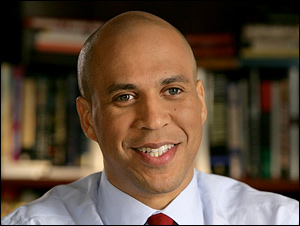
Sen. Cory Booker Ends Run for 2020

By Jim Ellis

Sen. Cory Booker (D)

Jan. 15, 2020 — With less than three weeks from the first votes being cast in the Democratic presidential nomination process, Sen. Cory Booker (D-NJ) announced via Twitter that he is ending his national effort.

The move is not surprising, as Sen. Booker rarely reached or surpassed three percent support in any presidential primary poll. Like Sen. Kamala Harris (D-CA), who left the race just before the California candidate filing deadline in early December, visions of Senate re-election may have at least in part driven the timing of Booker’s move. While Sen. Harris doesn’t face voters in a strong Democratic state until 2022, Sen. Booker is on the New Jersey ballot this year.

Before the presidential race began, New Jersey legislators and Gov. Phil Murphy (D) changed the state election law to allow candidates to run simultaneously for more than one office. The move was obviously made to assist Sen. Booker’s presidential efforts. Now, however, the simultaneous filing option becomes moot.

Leaving the race now provides him an excuse for finishing poorly in the first four voting states: Iowa, New Hampshire, Nevada, and South Carolina, though he filed for each primary and caucus vote and will still be on the ballot in at least New Hampshire and South Carolina.

Though Sen. Booker appears safe for re-election, the New Jersey filing deadline isn’t until March 30. Poor finishes in all primary and caucus states could have left him in a vulnerable state, and while the Garden State is highly unlikely to elect a Republican to the Senate, it’s not out of the realm of possibility that a strong Democrat could have begun to mount a primary challenge. Now we can expect Sen. Booker to invest all of his political capital into cementing his re-election for a second full six-year term.

Continue reading

Sanders, Steyer With Momentum

By Jim Ellis

2020 presidential candidate, Tom Steyer

Jan. 14, 2020 — For the first time in this Democratic primary cycle, Sen. Bernie Sanders (I-VT) has taken the lead in an Iowa Caucus poll, while billionaire Tom Steyer is moving into contention in both Nevada and South Carolina.

Several surveys released on Friday point to these conclusions. In Iowa, Selzer & Company, polling for the Des Moines Register newspaper and Mediacom (Jan. 2-8; 701 likely Iowa Democratic primary voters) finds Sen. Sanders taking a 20-17-16-15 percent slight edge over Sen. Elizabeth Warren (D-MA), South Bend Mayor Pete Buttigieg, and former Vice President Joe Biden. The close results suggest that all four of these contenders are in position to qualify for the all-important delegate apportionment.

Des Moines based Selzer & Company has long been considered the polling industry standard for the Iowa electorate. According to their analysis, Sen. Sanders has the most committed support, and is in the best position to deliver his supporters to the individual caucus meetings on Feb. 3, which will translate into committed delegate votes.

The Selzer poll produces similar results to other pollsters in that the top four contenders are closely bunched, but the rest find a different leader. Instead of Sen. Sanders, most have recently found Mayor Buttigieg holding first position. All, however, suggest the top four finishers will likely qualify to split the 41 first ballot votes that the Democratic National Committee allots to Iowa.

Fox News conducted a series of research studies in Nevada, South Carolina, and Wisconsin over the Jan. 5-8 period and, in the two early states, Steyer has moved into a third place Nevada tie with Sen. Warren and is in sole possession of second place in South Carolina.

The Fox News Nevada poll (Jan. 5-8; 635 likely Nevada Democratic caucus attenders) gives Biden the overall edge in recording 23 percent, Sanders follows at 17 percent, and Steyer and Warren are tied with 12 percent.

Continue reading

Castro Out; Bernie Brings in $34.5M

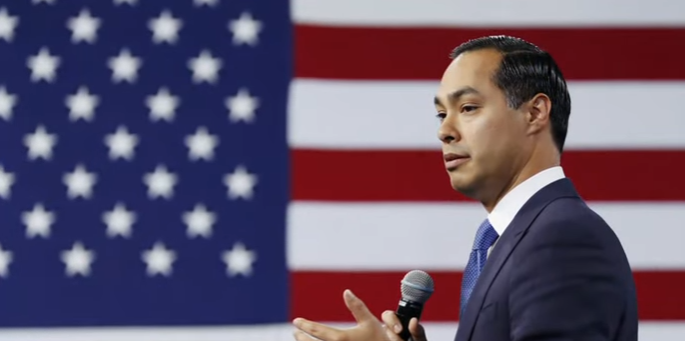
Julian Castro, 2020 Presidential candidate and Former Housing and Urban Development Secretary, bows out of the race.


By Jim Ellis

Jan. 6, 2020 — Saying that it simply “isn’t our time,” former Housing and Urban Development Secretary Julian Castro announced late last week that he is ending his bid for the Democratic presidential nomination now, exactly one month before the campaign’s first votes are cast in the Iowa Caucuses.

Castro, who served the final two-and-a-half years of the Obama Administration in the president’s cabinet after a five-year stint as mayor of San Antonio and previously being elected to one term on the city council, was one of the first candidates to enter the 2020 presidential campaign. Beginning the race as a little-known political figure despite serving in a national office, Castro couldn’t get his campaign untracked. He never came close to attaining high single digit support in any poll, even when including those from his home state of Texas.

On the money front, Castro raised slightly over $10 million for his national effort. Through Sept. 30, he attracted $7.6 million in financial backing with estimates of approximately $3.5 million for his final quarter in the race. Castro qualified for participation in four of the six national candidate forums, taking a major risk in one of them that proved to backfire.

Continue reading

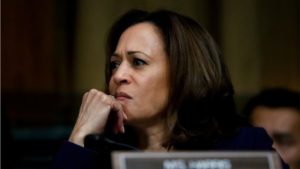
Is Sen. Kamala Harris Protecting
Her California Senate Seat?

By Jim Ellis

Democrat Sen. Kamala Harris of California

Dec. 5, 2019 — Sen. Kamala Harris (D-CA) became the first of what one might consider the top-tier candidates to end her presidential effort, but the announcement timing on Tuesday likely has more to do with her 2022 Senate race than the presidential contest.

The California candidate filing deadline is tomorrow, so Sen. Harris deciding to end her presidential effort means she won’t be on the Golden State presidential primary ballot, and thus avoids an embarrassing loss within her own constituency. Recent polling was forecasting her in the single-digit range even in California.

Obviously, losing any race in one’s home state reveals political weakness, and though she is virtually invulnerable against a Republican in the 2022 general election, the same might not be true if her opponent were a strong Democrat.

Under the California election system that features the jungle primary concept, variations of which are also seen in Washington state and Louisiana, members of the same party can advance into the general election. Florida voters will have the opportunity of adopting that jungle primary concept via ballot initiative next year.

Because California and Washington hold regular primaries before the general election, a pair of candidates always advance irrespective of percentages attained. Conversely, Louisiana holds one election concurrent with the general, meaning a candidate exceeding 50 percent is elected outright; otherwise the top two finishers advance into a December run-off election.

In the California 2022 Senate race, for example, two candidates will move into the general election from their March or June primary (California has continually alternated their primary election dates between the two months, depending upon the political situation at the time the legislature acted) so long as more than one candidate files. Thus, a strong Democrat — and California has many such individuals — could challenge Sen. Harris, draw a relatively meager percentage in the primary while finishing second, and then rally to make a serious general election challenge against her.

Other previous presidential candidates have often found the political going much tougher than expected when returning home to seek re-election after engaging in the national contest, and it remains to be seen if Sen. Harris will find her road to re-election any bumpier.

Continue reading

Is Buttigieg a One-State Wonder?

By Jim Ellis

South Bend Mayor Pete Buttigieg

Oct. 23, 2019 — The new Suffolk University/USA Today poll of Iowa voters (Oct. 16-18; 500 likely Iowa Democratic caucus attenders) was conducted immediately after the most recent Democratic presidential debate and confirms that South Bend Mayor Pete Buttigieg registered a strong performance.

According to the Suffolk results, former Vice President Joe Biden posts only 18 percent support, a drop of six points from their July Iowa poll, while Sen. Elizabeth Warren (D-MA) is in a virtual tie with him at 17 percent. She gained four percentage points since mid-summer. Mayor Buttigieg now moves into a close third place with 13 percent, more than doubling his support from the July poll when he registered only six percent preference. Sen. Bernie Sanders (I-VT) remains constant with nine percent and holds fourth position.

The remainder of the field includes four candidates tied with three percent support: billionaire Tom Steyer who made his first debate appearance in the October forum, Sen. Kamala Harris (D-CA) who dropped a whopping 13 percentage points from the July Suffolk U. survey, Rep. Tulsi Gabbard (D-HI), and Minnesota Sen. Amy Klobuchar who, like Mayor Buttigieg, needs to take advantage of her Midwestern roots and reap a solid support percentage from the Iowa Democratic electorate. So far, however, she has failed to generate significant support.

While Mayor Buttigieg has appreciably increased his Iowa standing, it remains to be seen if this poll is reflective of a short-term bounce from a strong debate performance or whether seeds are being sown for a legitimate push into the top tier. And, even if he proves himself in Iowa, will that momentum carry over into other states? At this point, the available data suggests that Buttigieg could be a one-state wonder.

Qualifying Already Underway
For Upcoming Presidential Debates

By Jim Ellis

Oct. 1, 2019 — The Democratic National Committee had barely announced the new qualification requirements for the November and December presidential debates when three candidates immediately proved they met the polling requirement and several others reached the halfway point.
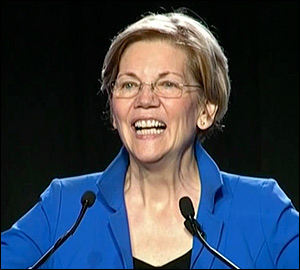
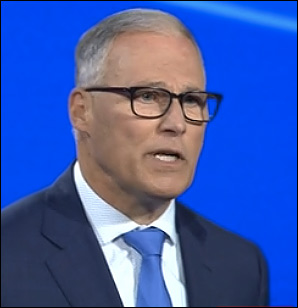
Not that there was any doubt that former Vice President Joe Biden and Sens. Elizabeth Warren (D-MA) and Bernie Sanders (I-VT) would be in the late year forums, but they have already clinched their podiums.

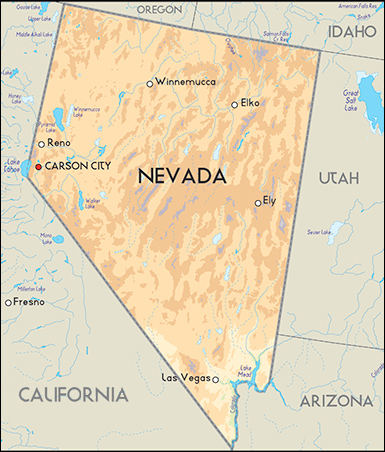
CNN, one of the sanctioned pollsters that the DNC recognizes for determining candidate support, released two studies in states whose electorates will vote in February. The surveys that SSRS, the CNN regular polling firm partner, conducted tested the electorates in both Nevada and South Carolina.

The new party rules require candidates to now earn three percent support, up from two percent, in four sanctioned surveys either nationally or within the first four voting states, those that party rules allow to hold their nominating event in February (Iowa, New Hampshire, Nevada, South Carolina). Another option allows a candidate to meet the polling requirement if he or she receives five percent in two of the first four voting states.

The CNN/SSRS Nevada poll (Sept. 22-26; 324 likely Nevada Democratic caucus attenders) is sanctioned even though the sample size is small. That being the case, the results find that the three top contenders lie in a statistical tie. Biden and Sen. Sanders each post 22 percent support, while Sen. Warren trails only by four points at 18 percent.

Sen. Kamala Harris (D-CA) is next with five percent, a rather poor showing considering that Nevada is adjacent to her home state of California, but one that would alone give her one-half of the polling qualification requirement. She would need to reach five percent in just one other poll in a First Four state to meet the polling requirement in order to earn a debate podium spot in November and December.

Continue reading

Multiple Choice, Multiple Candidates

Sen. Elizabeth Warren (D-MA)

By Jim Ellis

Sept. 16, 2019 — The international polling firm YouGov for The Economist magazine just completed a major 86-question survey of 1,500 US adults (Sept. 8-10; online through an opt-in panel), 1,182 of whom are registered voters and found many interesting results. The most unique, however, might be their question asking the self-identified primary or caucus attending Democrats and Democratic-leaning Independents (632) just how many of their party’s presidential candidates they would consider supporting.

The purpose of the question was to test for multiple responses; therefore, most respondents named several candidates. Possibly the most interesting phase of the response process was that only one candidate exceeded 50 percent under this format, and the person receiving the 55 percent consideration factor might not be who you would name with your first guess.

Of the 20 candidates identified in the questionnaire, 10 broke into double digits. This is not particularly surprising when remembering that respondents were encouraged to give more than one candidate they are considering and, in fact, could name as many individuals as they liked.

But the candidate receiving the 55 percent mention factor was not former Vice President Joe Biden. Rather, it was Massachusetts Sen. Elizabeth Warren, and this type of outcome could be quite significant in determining who people might ultimately support. Biden was second but failed to reach a majority even from a respondent pool who could render multiple choices. He posted a 48 percent score.

In third position was Vermont Sen. Bernie Sanders (40 percent), so here again we see these three candidates, Warren, Biden, and Sanders, capturing the top positions by a wide margin.

Sen. Kamala Harris (D-CA) was fourth with 32 percent followed by South Bend Mayor Pete Buttigieg who was named by 27 percent of the sample. Others in double digits were New Jersey Sen. Cory Booker at 18 percent, ex-Rep. Beto O’Rourke recording 14 percent, and former HUD Secretary Julian Castro posting 13 percent, with Minnesota Sen. Amy Klobuchar and New York City businessman Andrew Yang both registering 11 percent under this format.

Continue reading

Inslee Bows Out of Presidential Race

By Jim Ellis

Washington Gov. Jay Inslee (D)

Aug. 23, 2019 — The Democratic National Committee leaders’ strategy to substantially increase the presidential debate qualification requirements in order to decrease the unwieldy and bloated candidate field is working.

The prerequisites to prove that a campaign has more than 130,000 donors and that each candidate reaches a minimum of two percent support from four of eight designated pollsters paid another dividend Wednesday as Washington Gov. Jay Inslee became the third Democratic candidate to officially exit the race.

Not making the debate stage signifies that a candidate has no chance to become a top-tier candidate. Without national exposure, also-ran candidates have little opportunity to increase name identification and familiarity in order to raise enough money to deliver a message, motivate people to work on their campaign, and attract serious media attention both nationally and in the important local markets within key states.

Inslee follows Rep. Eric Swalwell (D-CA) and former Colorado Gov. John Hickenlooper in making the decision to bow out of the race, and there are likely to be several more following suit once it becomes even more evident that the lower-tier candidates will no longer have the opportunity to climb onto the national debate stage.

Gov. Inslee, in an interview on MSNBC’s “The Rachel Maddow Show” Wednesday, stated ” … it’s become clear that I’m not going to be carrying the ball. I’m not going to be the president, so I’m withdrawing tonight from the race.” He is expected to announce that he will seek a third term as Washington’s governor.

The Inslee withdrawal is not a surprise to anyone, apparently even to the candidate himself. He remained non-committal about ruling out running for a third gubernatorial term, which froze most of the Washington Democratic potential aspirants in place. The rhetoric blocked them from overtly assembling a statewide campaign since most correctly interpreted the political tea leaves as meaning that Inslee would, in fact, be back to seek re-election.

With 10 candidates now qualified for the next debate since former HUD Secretary Julian Castro just joined the top-tier candidates of Joe Biden, Bernie Sanders, Elizabeth Warren, Kamala Harris, and Pete Buttigieg who are also joined by Sens. Cory Booker (D-NJ), Amy Klobuchar (D-MN), ex-Rep. Beto O’Rourke (D-TX), and businessman Andrew Yang, it remains to be seen just how many of those who won’t meet the qualifications will continue.

Continue reading

Nevada Looms Large for Biden, Harris

By Jim Ellis

Aug. 22, 2019 — The Nevada Caucus is third on the presidential nomination schedule and it appears the Silver State nomination event will carry more weight than it has in past elections.

After the Iowa Caucus (Feb. 3) and New Hampshire primary (Feb. 11), the candidates will stream into Nevada for the Feb. 22 caucus event that is traditionally held on a Saturday.

Nevada could be critically important for two of the candidates, former Vice President Joe Biden and California Sen. Kamala Harris, should the first two states evolve as currently predicted.

Kicking the cycle off in Iowa, Biden may find himself in a similar position to that of Hillary Clinton in 2016. Coming into the state as the clear front runner, Clinton stumbled in Iowa as she technically won the caucus vote, but only after a series of coin flips were conducted to break ties … and she won them all.

The rules are different in 2020, and it will be easier for more people to participate, but Iowa voters tend to like the Midwestern candidates, something Biden is not. Additionally, with Sen. Sanders proving he has a base in the state and two Midwestern candidates in the field, Minnesota Sen. Amy Klobuchar and South Bend Mayor Pete Buttigieg, the chances of Biden faltering here are actually quite high.

Then the candidates will move to Sens. Bernie Sanders’ (I-VT) and Elizabeth Warren’s (D-MA) New England backyard in New Hampshire. In 2016, Sen. Sanders upended Clinton with a 60 percent victory, so Biden’s ability to derail both Sanders and Warren in this state will prove to be a difficult task. Therefore, it is entirely possible that Biden could move into Nevada in search of a badly needed win.

Sen. Harris has a major advantage in that her home state of California will award 416 first-ballot delegates, a figure 45 percent larger than even the second-largest state, which is Texas. But, in order to maximize this advantage, Sen. Harris will have to be competitive in the First Four states.

Continue reading

Warren Ahead in Iowa & Wisconsin

By Jim Ellis

Sen. Elizabeth Warren (D-MA)

Aug. 19, 2019 — The Change Research organization, which has previously conducted simultaneous multi-state polling within the same sampling period, just repeated their process. This time, the firm surveyed likely Democratic voters in both Iowa and Wisconsin over the Aug. 9-11 period and found Massachusetts Sen. Elizabeth Warren topping the field in both states.

As we know, the Iowa Caucus, with only 41 first-ballot delegate votes, is an important trend-setting state because of being placed first on the national voting calendar. In 2016, after her campaign was selling Hillary Clinton as the “inevitable nominee,” she barely won the first vote in Iowa, which arguably began a downward spiral for her campaign. Though Clinton obviously won the party nomination, the long fight with Sen. Bernie Sanders (I-VT) politically weakened her for the general election campaign.

According to the Change Iowa data (621 likely Iowa Democratic Caucus participants through online communication), Sen. Warren would lead Sen. Sanders, former Vice President Joe Biden, South Bend Mayor Pete Buttigieg, and Sen. Kamala Harris (D-CA), 28-17-17-13-8 percent, respectively. Minnesota Sen. Amy Klobuchar, who needs to make a major play in her neighboring state, still only shows two percent support, tying her with Rep. Tulsi Gabbard (D-HI), billionaire Tom Steyer, and Montana Gov. Steve Bullock, but behind the three percent score of both Sen. Cory Booker (D-NJ) and ex-Rep. Beto O’Rourke (D-TX).

Biden may have a similar problem to that of Clinton, and it could prove to be a major stumbling block. As the presumptive national front-runner, under-performing in Iowa would show clear vulnerability. Traveling the following week to Sens. Warren and Sanders’ New England backyard for New Hampshire’s first-in-the-nation primary after sustaining an Iowa loss would strengthen the two local candidates and possibly cause Biden to again fall.

This scenario would be quite damaging to the former vice president. Because his momentum would significantly slow, re-starting for the succeeding Nevada Caucus becomes very difficult and he would need a boost here before heading to the South Carolina primary and the southern states-dominated Super Tuesday. Currently, Biden is polling very strongly throughout the south, but faltering early could quickly change that dynamic.

Continue reading