
Tag Archives: Sen. Heidi Heitkamp

Cramer Up Against Heitkamp in
North Dakota Senate Polling

By Jim Ellis

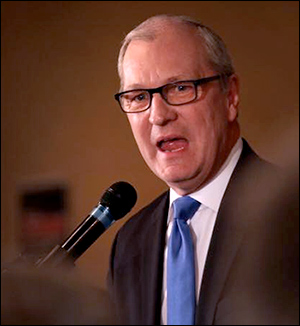
Rep. Kevin Cramer (R-ND) | Facebook

Rep. Kevin Cramer (R-Bismarck) | Facebook

March 5, 2018 — A new Tarrance Group poll (Feb. 18-20; 500 likely North Dakota registered voters) conducted for the National Republican Senatorial Committee finds at-large Rep. Kevin Cramer (R-Bismarck) taking an early lead over first-term Sen. Heidi Heitkamp (D), 49-44 percent, a split just beyond the polling margin of error.

The Tarrance poll comes on the heels of previously released data from Gravis Marketing (Feb. 21-24; 385 North Dakota voters interviewed online) that gives Sen. Heitkamp a 43-40 percent edge, but this survey was conducted wholly online. Though the Tarrance poll was in the field before the Gravis study, the latter data was first to enter the public domain.

North Dakota state law prohibits vendors from placing automated telephone calls, which is Gravis’ usual method of conducting their surveys. Additionally, since the state has no voter registration requirement or system, the likely voter screen is a bit more difficult to define. Both of these elements would affect the reliability factor, and particularly so for the Gravis results.

The Tarrance data also detected a retrogression in Sen. Heitkamp’s favorability rating. Though still strong, her positive ratio is a net 10 points below what was determined in the organization’s October poll. The February data records the senator with a strong 54:38 percent positive to negative index, but that is below the 60:34 percent rating she received in October. Rep. Cramer posted a slightly better 53:29 percent positive ratio. He was not tested in the October poll.

Continue reading

Senate News From
North Dakota & New Jersey

1200px-Seal_of_the_United_States_Senate.svgBy Jim Ellis

Feb. 15, 2018 — The North Dakota US Senate campaign is on the precipice of drastic change. Earlier in the week, at-large US Rep. Kevin Cramer (R-Bismarck) indicated that he was reconsidering his decision to bypass challenging first-term Democratic Sen. Heidi Heitkamp.

According to one of the contenders who just dropped out of the race, and who is a close confidant of Rep. Cramer, the congressman has made the decision to enter the Senate race. Former ND Republican Party chairman Gary Emineth told the media that he is ending his fledgling Senate campaign to make way for Rep. Cramer. He further said that the congressman will shortly announce his new plans.

The Republican Senate race had gotten off to a slow start. Rep. Cramer had been keeping the party leaders hanging for the better part of a year, and then announced he wouldn’t run. State Sen. Tom Campbell (R-Grafton) has been running for months, but it is obvious that national and state party officials don’t think he is a strong enough opponent for Sen. Heitkamp. That was one reason Emineth jumped in, but he quickly made a media gaffe, so his credibility was suffering even from the very beginning of his statewide effort.

Continue reading

New Year Senate Preview – Part II

By Jim Ellis

Jan. 5, 2018 — Continuing our New Year’s preview, today we look at the 2018 Senate races from the Democrats’ perspective.

THE DEMOCRATS

Sen. Claire McKaskill | (Facebook)

Sen. Claire McKaskill | (Facebook)

Because they are now defending 26 of the 34 in-cycle seats, with the addition of the Minnesota special election, the Dems must primarily develop a solid defense before venturing into attack mode. If they are to have any chance of gaining a 51-49 majority, they will realistically have to win all 26 of the incumbent and open seat races they are forced to risk. This includes three contests already considered toss-up campaigns: Missouri Sen. Claire McCaskill likely facing Attorney General Josh Hawley (R), Sen. Joe Donnelly in the Indiana race, and the budding Florida campaign likely between Sen. Bill Nelson and Gov. Rick Scott.

Regardless of whom Sen. Donnelly ultimately faces in the Hoosier State, he will draw a top-tier opponent. Reps. Todd Rokita (R-Brownsburg/Lafayette) and Luke Messer (R-Greensburg/Muncie) battle for the Republican senatorial nomination, and they also face a credible third challenger in former state Rep. Mike Braun (R-Jasper). Braun has the strong ability to finance his own campaign, thus allowing him to adequately compete with the two congressmen. Since he has the promise of becoming his own force, Braun could conceivably strike a chord with the Republican electorate if the two congressmen continue fighting amongst themselves and allow him to slip by both of them.

Republicans will also be competitive in several other Senate races, as they project to have a strong opponent against West Virginia Sen. Joe Manchin (Attorney General Patrick Morrisey and Rep. Evan Jenkins battle for the GOP nomination to be decided in May), while state Treasurer Josh Mandel looks to provide a stronger challenge to Ohio Sen. Sherrod Brown (D) than he did in 2012 when he fell 51-45 percent. The Pennsylvania GOP electorate looks to be coalescing behind Rep. Lou Barletta (R-Hazelton) but upsetting Sen. Bob Casey Jr. is still a highly formidable task, and this developing contest must be considered a long shot as the new year begins.

Continue reading

Two Stunning Polls

By Jim Ellis

Oct. 27, 2017 — A pair of eyebrow-raising polls were released mid-week, one for the 2018 North Dakota Senate race and the other for the impending Virginia gubernatorial campaign.

North Dakota Senate

Poll results show Sen. Heidi Heitkamp (D) trailing for first time.

Poll results show Sen. Heidi Heitkamp (D) trailing for first time.

The 1892 polling firm, which has a record of surveying North Dakota statewide races, went into the field for Republican senatorial candidate Tom Campbell, a state senator and agri-businessman from Grafton, ND.

The survey (Oct. 11-12; 500 registered North Dakota voters; 400 additional Republican primary voters) finds Sen. Campbell leading in a hypothetical GOP primary, and in rather astonishing fashion for this early in the election cycle, actually trending ahead of Sen. Heidi Heitkamp (D), 44-41 percent.

Sen. Campbell has a healthy lead among Republicans, topping former US Rep. Rick Berg, 32-24 percent, among others. Ex-Rep. Berg admits to be considering the race, but has not given tangible indications that he is beginning to construct a campaign. The poll did not test current US Rep. Kevin Cramer (R-Bismarck), however, who says he will decide about running sometime next year.

Continue reading

House Financials as Predictors

By Jim Ellis

April 19, 2017
— As we all know, actions speak louder than words. The US House first quarter campaign finance reports (through March 31, 2017) were publicized Monday and, tracking those members who have publicly indicated at least some interest in declaring a Senate challenge, we now have some tangible information to gauge which individuals might be serious about making a statewide run. A look below at the Senate incumbent and House challenger(s):

Arizona: Sen. Jeff Flake (R)
• Rep. Kyrsten Sinema (D-Phoenix)
   $677,542 raised; $136,496 spent; $2,804,679 cash-on-hand; $0 debt
Rep. Sinema has failed to confirm rumors that she is planning to run for Senate or governor. Considering that incumbent Sen. Flake is appearing in a more vulnerable state than Gov. Doug Ducey (R), it is more reasonable to think that a Sinema Senate challenge is the more likely. The congresswoman’s aggressive early campaign fundraising and already reaching just short of the $3 million mark in cash-on-hand makes her a very serious potential challenger.

Florida: Sen. Bill Nelson (D)
• Rep. Tom Rooney (R-Okeechobee)
   $73,552 raised; $59,359 spent; $84,848 cash-on-hand; $0 debt
Rep. Rooney indicated several times that he has not closed the door on challenging Sen. Nelson. With little fundraising effort in the first quarter and Gov. Rick Scott (R) positioning himself for a Senate challenge, the financial numbers confirm that Rep. Rooney will not enter the statewide race.

Indiana: Sen. Joe Donnelly (D)
• Rep. Luke Messer (R-Greensburg)
   $706,414 raised; $136,418 spent; $1,620,394 cash-on-hand; $0 debt
• Rep. Todd Rokita (R-Brownsburg)
   $321,166 raised; $88,501 spent; $1,548,229 cash-on-hand; $0 debt
Both congressmen Messer and Rokita have impressive campaign accounts and are well positioned financially to launch a challenge against Sen. Donnelly. Messer has been the more aggressive early fundraiser, but it is conceivable that both could enter the Senate race.

Continue reading

The Trump 10

By Jim Ellis

March 2, 2017 — There already has been a great deal of talk about the difficult campaign road ahead that Democrats face in 2018. With having to defend 25 of 34 states in next year’s election, the minority party finds itself being forced to play defense in what should be a very offensive election cycle for them.

Republicans, theoretically, have a chance to gain seats in the midterms because they have offensive opportunities, similar to what the Democrats enjoyed in 2016. In that cycle, Republicans were forced to defend 24 of 34 in-cycle states, but were able to sustain their majority status, nonetheless.

The Trump 10 refers to the number of in-cycle Senate states that President Trump carried, where Democrats must defend. The following is a list of the 10 incumbents seeking re-election who should be in politically precarious positions. The group is listed in order of vulnerability, based upon the Democratic performance in the presidential race, the strength of the incumbent, and presumed challenger capability.

1) Indiana – Sen. Joe Donnelly – President Trump and the Republicans, ostensibly led by Vice President Mike Pence, the former Indiana governor, racked up large percentages in the Hoosier State. The trend, and the quality of potential Republican challengers such as representatives Luke Messer (R-Greensburg/Muncie) and Todd Rokita (R-Brownsburg/Lafayette), arguably makes Sen. Donnelly the most vulnerable of Democrats seeking re-election.

Continue reading

Another Special Looms

By Jim Ellis

Dec. 16, 2015 — Already, calling potentially five special elections may be necessary even before the new 115th Congress convenes. Now, a sixth is on the political horizon now that Rep. Ryan Zinke (R-MT-AL) has been nominated as US Interior Secretary.

As we have detailed in previous Updates, Sen. Jeff Sessions’ Alabama seat could go to a special election after an interim appointment is made, and the North Dakota Senate seat will definitely go before the voters if president-elect Donald Trump chooses Sen. Heidi Heitkamp (D) as Agriculture Secretary.

In the House, three seats will be vacated either before or just after the new Congress begins. Rep. Xavier Becerra (D-CA-34) has already resigned his seat to accept Gov. Jerry Brown’s (D) appointment as attorney general, replacing Sen.-Elect Kamala Harris (D). The KS-4 and GA-6 districts will be opened when Reps. Mike Pompeo (R-Wichita) and Tom Price (R-Roswell) are confirmed as CIA Director and Secretary of Health & Human Services, respectively.

So far, all of the seats, including the North Dakota Democratic Senate seat, should easily go Republican in special elections. The Montana at-large seat, however, may well become competitive.

Continue reading

Special Elections Mounting – Senate

By Jim Ellis

Dec. 14, 2016 — Just as the 2016 election cycle ended with the Louisiana run-off elections last Saturday, a new round of voting is about to begin.

President-Elect Donald Trump’s selection of Rep. Ryan Zinke (R-MT-AL) as Interior Secretary adds yet another future special election to the growing number of House and Senate odd-numbered year electoral contests.

In addition to what could well become a competitive Montana statewide election in approximately 100 days or so, as many as five other campaigns will be calendared within approximately the same time frame depending upon individual state election laws.

With Sen. Jeff Sessions (R-AL) appointed as Trump’s Attorney General-designate, and with speculation being rampant that Sen. Heidi Heitkamp (D-ND) will become Agriculture Secretary, two new senators and a trio of US House members will be chosen.

Continue reading

A Bayou Sweep

By Jim Ellis

Dec. 12, 2016 — Republicans completed the 2016 election cycle with a sweep of Saturday’s Louisiana run-off races. In the US Senate race, state Treasurer John Kennedy (R) easily defeated Public Service Commissioner Foster Campbell (D), 61-39 percent, as expected.

State Rep. Mike Johnson (R-Bossier City) will replace outgoing Rep. John Fleming (R-Minden/Shreveport). He defeated Democratic attorney Marshall Jones, 65-35 percent, in a race that also contained little in the way of suspense.

Finally, in the double Republican 3rd CD, Lafayette retired police captain Clay Higgins out-polled Public Service Commissioner and former gubernatorial candidate Scott Angelle, 56-44 percent. Higgins will replace Rep. Charles Boustany (R-Lafayette) in the new Congress. Both Fleming and Boustany ran unsuccessfully for US Senate.

In the Senate race, Kennedy captured 55 of the state’s 64 parishes. The result here was never in doubt. Kennedy placed first in the Nov. 8 jungle primary, 25-17 percent over Campbell among 24 candidates. The qualifying Democratic candidate, who has run and lost before in statewide and congressional races, could never attract outside funding support, even from the national Democratic Party apparatus.

Continue reading

Picking Democratic Senators;
Rep. Becerra Tapped for A.G.

By Jim Ellis

Dec. 5, 2016 — Donald Trump may be looking to find cabinet members who bring him immediate tangible policy and political benefits. A new prospective appointee, if chosen, would even increase the president-elect’s strength in the United States Senate.

North Dakota Sen. Heidi Heitkamp (D) made her way to New York yesterday to speak with Trump. If the president-elect tabbed her for an administration position, it would allow him to reach out to Democrats while simultaneously paving the way for incoming Gov. Doug Burgum (R) to appoint a Republican to replace her. Assuming John Kennedy (R) wins the Louisiana Senate run-off on Dec. 10, as expected, replacing Heitkamp would boost the Senate Republican Conference to 53 members.

The senator won a close upset victory in 2012, defeating one-term at-large Rep. Rick Berg (R) by a one-point margin. She is now preparing for what is likely to be a highly competitive 2018 re-election bid, but accepting a position in the Trump Administration would obviously require her to resign the Senate seat. With North Dakota voting patterns now going solidly Republican – Trump received 63 percent in the Nov. 8 election compared to 58 percent for Mitt Romney in 2012, and John McCain’s 53 percent eight years ago – Republican conversion prospects in a post-appointment election would be bright should Heitkamp depart.

Continue reading